Friendship psychology studies how people become friends, what keeps them friends, and what friendship actually does for people. Personality shapes all three: agreeable, easygoing people are chosen as friends more often, outgoing people collect more friends, and strong social relationships are tied to measurably better health outcomes than weak ones [1] [2].
What friendship psychology actually studies
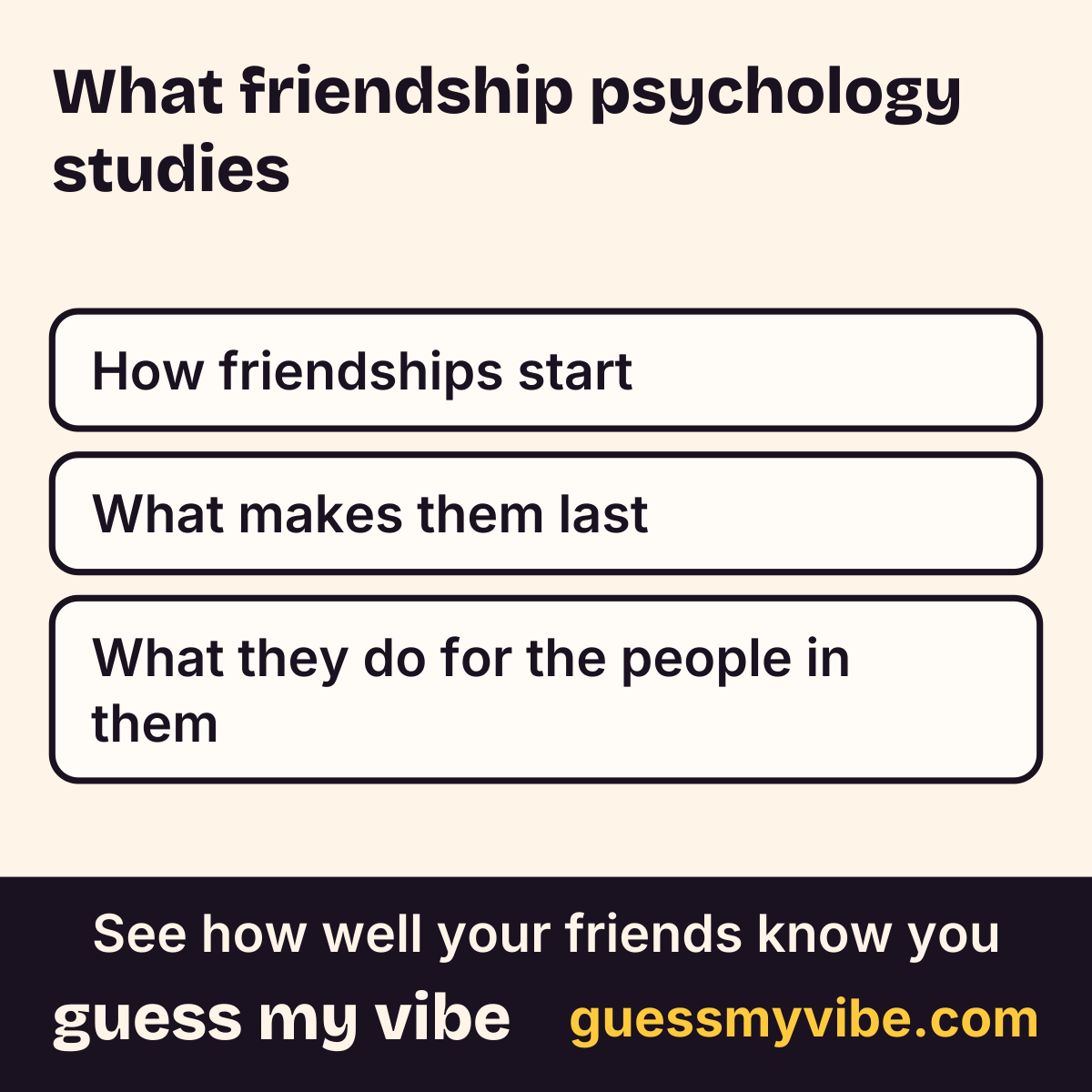
Friendship psychology is the research on how friendships start, what makes them last, and what they actually do for the people in them. It gets a fraction of the research attention that romantic relationships do, even though most people have far more friends than romantic partners over a lifetime [1]. The short version of what decades of this research has found: your personality shapes who becomes your friend and how the friendship goes, real friends end up only modestly alike rather than practically identical, and having strong friendships is tied to outcomes serious enough that researchers compare the size of the effect to other well-established risk factors for mortality.
Cite this figure
Figure: "What friendship psychology studies." Guess My Vibe (guessmyvibe.com). https://guessmyvibe.com/learn/friendship-psychology#figure-three-questions
How friendships actually form
One of the clean ways to study friendship formation is to watch a group of total strangers meet and track who becomes friends with whom. A study of 205 students starting university did exactly that, surveying the same group five times across their first year using social network analysis [3]. Friendship networks got more tightly connected over the first three months, then leveled off. Two personality patterns stood out clearly: students higher in extraversion ended up selecting more friends overall, while students higher in agreeableness were the ones more often chosen as a friend by others. That split is worth sitting with: being outgoing helps you go out and gather friends, but being easy to get along with is what makes other people want to keep you. Students also tended to pick friends who were similar to them in agreeableness, extraversion, and openness, though not identical.
Which personality traits matter most for friendship
A review pulling together the wider research on personality and friendship landed on a clear ranking [1]. Agreeableness has the most consistent effects on friendship development of any of the five traits, showing up reliably across studies on who initiates friendships, who friendships form around, and who avoids being the one a friendship ends with. Neuroticism (how easily someone gets stressed or worried) came in a close second, generally working against friendship stability when it runs high. Extraversion, conscientiousness, and openness to experience all showed real effects too, but less consistent ones: sometimes extraversion went with more friends, sometimes it went with more conflict, depending on the study and the context. The review's authors, drawing partly on the larger body of research on romantic relationships, note that friendship research still lags well behind, with real open questions about what specifically keeps a friendship going once it's past the forming stage.
Do friends actually become similar, or choose each other because they already are?
"Birds of a feather" is one of the oldest ideas about friendship, and the real evidence on it is more interesting than a flat yes or no. A study that followed new college friendships for a year found that actually sharing a similar personality had surprisingly little connection to how close a new friendship became. What mattered far more was believing you were similar to your new friend, whether or not that belief matched reality, and other people's outside sense that the two of you seemed alike [4]. A much larger follow-up, measuring personality through real behavior instead of self-report questionnaires, did find genuine similarity between friends after all, across more than 46,000 friend relationships, with correlations roughly between .12 and .31 depending on the trait [5]. That's a real but modest overlap, not a match. Put the two findings together and the honest picture is: friends are a little alike, probably more than self-report surveys alone can detect, but feeling alike does more for the friendship than actually being alike.
Curious how your friends would answer?
Free. Answer 10 quick questions about you, then send your link. Friends play in their browser, no app needed.
Start freeWhat keeps a friendship going, once it's past the forming stage
Forming a friendship and keeping one healthy turn out to lean on overlapping but not identical skills. The same review that ranked agreeableness as the most consistent trait in friendship formation found it mattered for maintenance too, for an intuitive reason: the qualities that make someone easy to befriend (warmth, cooperation, not escalating small conflicts into big ones) are largely the same qualities that make a friendship pleasant to stay in [1]. Neuroticism worked against maintenance specifically through its link to more conflict and more sensitivity to perceived slights, which can wear on a friendship over years even when no single incident is serious on its own. The review is honest that this is one of the thinner parts of the literature. Researchers know far more about how friendships start than about the specific habits that keep a good one going for decades, which leaves real room for future research to catch up to what people experience firsthand.
Why friendship is good for your health, measurably
The case for taking friendship seriously goes well beyond feeling good; it shows up in hard health numbers too. A meta-analysis combining 148 separate studies and more than 300,000 participants looked at how the strength of someone's social relationships connected to mortality risk over each study's follow-up period [2]. People with stronger social relationships had about 50% higher odds of survival than people with weaker ones, a pattern that held up consistently across age, sex, health status, and cause of death. The effect was strongest for rich, complex measures of social integration and weakest for a simple yes/no of whether someone lived alone, which suggests it's the quality and range of someone's connections that matters, not just having one person technically listed as a friend. The researchers describe this as comparable in size to other well-established risk factors for mortality, which is a serious claim for something as ordinary-sounding as "having friends."
How well do friends actually know each other
A natural question once you know personality shapes friendship this much: how well do friends actually read each other's personalities? A large meta-analysis of 263 samples and more than 44,000 people found agreement between another person's rating and someone's own self-rating differed by trait: it was highest for extraversion and lowest for Agreeableness, the trait closest to warmth [6]. A separate study of daily behavior, tracked with an audio recorder worn for several days, found a single close friend's guess about someone's everyday habits matched reality about as well as the person's own self-guess did, a real but far-from-perfect result [7]. Extraversion sits at the high end of that picture and Agreeableness at the low end, with the other three traits in between.
Put friendship psychology to the test with an actual friend
All five traits research groups under the Big Five, outgoing, agreeable, organized, stress-prone, and curious, show up in how friendships form, who picks whom, and how well friends can actually read each other. Guess My Vibe measures all five the same way the research does: your friend answers real personality questions about you, you answer the same questions about yourself, and you see where your friend's view of you lines up with reality and where the two of you genuinely disagree. It's the same core question friendship psychology has been studying for decades, just made into something you can actually do with the person sitting next to you.
Key takeaways
- Agreeableness has the single most consistent effect on friendship formation and maintenance of any Big Five trait, with neuroticism a close second; extraversion, conscientiousness, and openness all matter too, just less predictably [1].
- Watching new friendships form from scratch, researchers found extraverted people select more friends, agreeable people get selected as friends more often, and people tend to pick friends who resemble them in agreeableness, extraversion, and openness [3].
- Friends end up a little alike in personality, but less than the stereotype suggests, and feeling similar to a new friend tracks closeness even better than actually being similar does [4] [5].
- A meta-analysis of 148 studies and over 300,000 people found people with stronger social relationships had 50% higher odds of survival over the study period than people with weaker ones, a health effect on par with well-known physical risk factors [2].
- This isn't therapy, a diagnosis, or a substitute for professional care.
Questions people ask
What is friendship psychology?
Friendship psychology is the research on how friendships form, what keeps them going, and what they do for people's well-being. It studies the same personality traits (the Big Five) that shape most of social psychology, applied specifically to friends rather than romantic partners or family [1].
Which personality trait matters most for making friends?
Agreeableness has the most consistent effect of any Big Five trait on friendship formation and maintenance. Extraversion matters too, but more for how many friends someone collects than for how close those friendships become [1] [3].
Do friends really have similar personalities?
A little, once it's measured through actual behavior rather than self-report surveys, with correlations roughly .12 to .31 depending on the trait. Feeling similar to a friend tracks closeness even more strongly than measurably being similar does [5] [4].
Does friendship actually affect health?
Yes, measurably. A meta-analysis of 148 studies and over 300,000 people found stronger social relationships were linked to 50% higher odds of survival over each study's follow-up period, an effect the researchers compare to other major, well-established health risk factors [2].
How accurately can a friend guess your personality?
Moderately well, and it depends heavily on the trait. Agreement with a person's own rating was highest for extraversion and lowest for Agreeableness, the trait closest to warmth, according to a meta-analysis of over 44,000 people [6].
See how well your friends know you.
Free. Answer 10 quick questions about you, then send your link. Friends play in their browser, no app needed.
Start freeReferences
- [1] Harris, K., & Vazire, S. (2016). On friendship development and the Big Five personality traits. Social and Personality Psychology Compass, 10(11), 647–667. doi.org/10.1111/spc3.12287 (opens in a new tab)
- [2] Holt-Lunstad, J., Smith, T. B., & Layton, J. B. (2010). Social relationships and mortality risk: A meta-analytic review. PLoS Medicine, 7(7), e1000316. PubMed: 20668659 (opens in a new tab)
- [3] Selfhout, M., Burk, W., Branje, S., Denissen, J., van Aken, M., & Meeus, W. (2010). Emerging late adolescent friendship networks and Big Five personality traits: A social network approach. Journal of Personality, 78(2), 509–538. PubMed: 20433629 (opens in a new tab)
- [4] Selfhout, M., Denissen, J., Branje, S., & Meeus, W. (2009). In the eye of the beholder: Perceived, actual, and peer-rated similarity in personality, communication, and friendship intensity during the acquaintanceship process. Journal of Personality and Social Psychology, 96(6), 1152–1165. PubMed: 19469593 (opens in a new tab)
- [5] Youyou, W., Schwartz, H. A., Stillwell, D., & Kosinski, M. (2017). Birds of a feather do flock together: Behavior-based personality-assessment method reveals personality similarity among couples and friends. Psychological Science, 28(3), 276–284. PubMed: 28059682 (opens in a new tab)
- [6] Connelly, B. S., & Ones, D. S. (2010). An other perspective on personality: Meta-analytic integration of observers' accuracy and predictive validity. Psychological Bulletin, 136(6), 1092–1122. PubMed: 21038940 (opens in a new tab)
- [7] Vazire, S., & Mehl, M. R. (2008). Knowing me, knowing you: The accuracy and unique predictive validity of self-ratings and other-ratings of daily behavior. Journal of Personality and Social Psychology, 95(5), 1202–1216. PubMed: 18954202 (opens in a new tab)
How we find and check these sources: how we write. Spotted an error? Report a correction.
Related
- Introvert vs Extrovert: What the Research Actually Shows
- BFF Test: A Real One to Take With Your Best Friend
- How Well Do You Know Me Questions to Ask Friends
- Self-Perception vs. How Others See You
- Agreeableness: The Trait Closeness Barely Helps Friends Read
- What Makes Relationships Last? The Biggest Study Yet
- Introvert Extrovert Friendship: Why It Works
- Social Connection: Why It Matters for Wellbeing
- Can Men and Women Be Friends? What the Research Says
- Big Five Personality Traits: A Plain-Words Guide
- Male Friendship: What Research Says About Men's Friends
- Attachment Styles in Friendship: What Research Shows
More in The Big Five in social life
- Conscientiousness Meaning: What the Trait Is and Isn't
- Low Conscientiousness: Costs, Upsides and What Helps
- Openness to Experience: Meaning, Facets and Creativity
- Is MBTI Accurate? MBTI vs the Big Five, Fairly
- Are Personality Tests Accurate? What the Evidence Shows
- Can Your Personality Change? What the Evidence Shows
- 16Personalities vs the Big Five: How They Differ
- Omnivert vs Ambivert: What the Research Says
- Neuroticism Meaning: What the Trait Actually Is
- Extraversion: What the Trait Is and What It Isn't
- Big Five Personality Traits: A Plain-Words Guide
- People Pleaser: The Agreeableness Research Behind It
- Low Agreeableness: What It Means (and Doesn't)
- What Makes an Open-Minded Person? Openness in Friendships
- Introvert and Introvert Relationship: What Research Says
- Neuroticism in Relationships: What the Research Shows
- Conscientiousness in Relationships: What the Research Says
- Social Battery: The Science of Why Socializing Drains You
- Flaky Friends: The Personality Science of Canceling Plans
- Agreeableness: The Trait Closeness Barely Helps Friends Read
- Ambivert: What the Science Actually Says
- Why Some People Are Always Late
- Introvert Extrovert Friendship: Why It Works
- Emotional Stability: What It Means and Why It Helps Friends
- Reserved Personality: Why Quiet Isn't the Same as Cold
- Shy vs Introvert: Why They Get Confused
- Outgoing Personality: What It Actually Means
- What Makes Someone a Warm Person?
- How to Make Friends as an Introvert
- Introvert vs Extrovert: What the Research Actually Shows
Cite this article
- Title
- Friendship Psychology: What the Research Actually Says
- Publisher
- Guess My Vibe
- Updated
- URL
- https://guessmyvibe.com/
learn/ friendship-psychology
Copy this citation
Guess My Vibe. (2026, October 3). Friendship Psychology: What the Research Actually Says. Guess My Vibe. https://guessmyvibe.com/
To point at one section, add that section's anchor (the # link on its heading) to the URL.