Neuroticism is a normal personality trait: how strongly and how often someone feels stress, worry and other negative emotions. In relationships, a meta-analysis of 19 samples found that lower neuroticism correlated with higher relationship satisfaction in intimate partners [1]. But in a four-year study of newlyweds, neuroticism was linked to where satisfaction started, not to how fast it changed afterward [2]. It's a tendency, not a verdict.
Neuroticism in relationships: the short version
Neuroticism in relationships is one of the most-studied links between personality and love, and one of the most misread. Neuroticism is one of the Big Five personality traits. It describes how readily a person experiences stress, worry, irritability and low moods, and everybody falls somewhere on the scale. It isn't a diagnosis or a flaw, just a dimension on which people differ, with the opposite end often called emotional stability. The research summary: lower neuroticism goes with somewhat higher relationship satisfaction on average [1], but the trait is only one input, and the studies show it works through everyday reactions, not fate.
This article stays non-clinical. We're talking about the ordinary range of the trait, the same way researchers talk about extraversion or conscientiousness, and nothing here is a way to label yourself or a partner.
Neuroticism and relationship satisfaction
A meta-analysis pooled 19 samples with 3,848 participants to ask how the Big Five relate to relationship satisfaction in intimate heterosexual partners. Four of the five traits correlated significantly with satisfaction: low neuroticism, high agreeableness, high conscientiousness and high extraversion [1]. The abstract doesn't break out effect sizes by trait, so we can't say how large each link is or rank them. And a correlation, even across 19 samples, doesn't show that neuroticism causes less satisfaction. Satisfaction could affect mood, or a third factor could shape both.
You'll sometimes see neuroticism described as the single strongest personality predictor of relationship satisfaction. That ranking isn't in the study we read, so we're not going to repeat it. What the evidence supports is narrower: low neuroticism is one of several traits that go with happier partners on average.
A closer look: neuroticism over four years of marriage
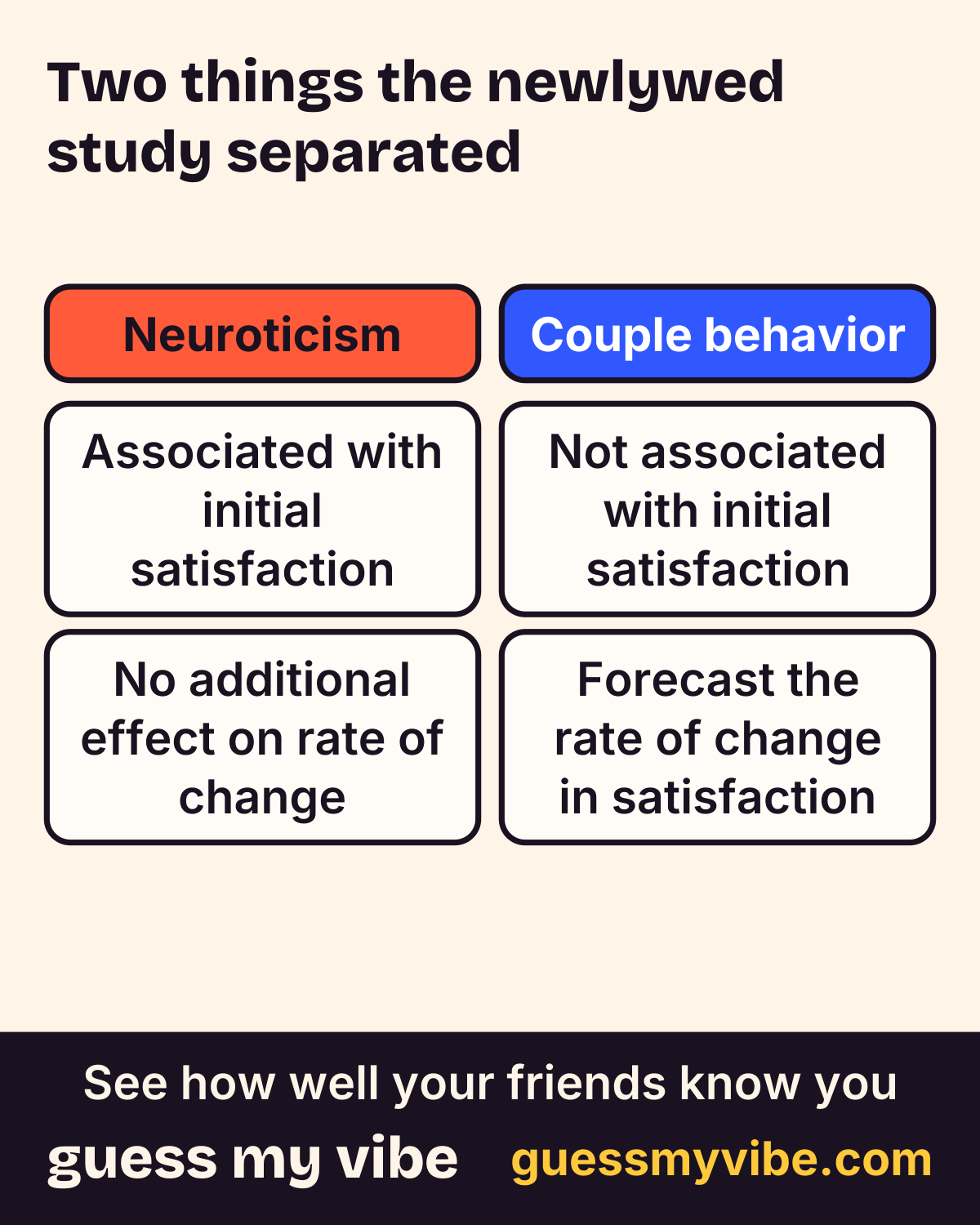
One of the most useful studies for this question followed 60 newlywed couples for four years. They completed measures of neuroticism, were observed during a marital interaction, and reported on their satisfaction every six months. The researchers separated two things: how satisfied people were at the start, and how fast that satisfaction changed. Neuroticism was associated with the initial level of satisfaction but had no additional effect on the rate of change. Behavior during the interaction did the opposite: it forecast the rate of change in satisfaction but was not associated with the initial level [2].
In plain terms, in this sample, a higher-neuroticism partner started off, on average, with a different level of satisfaction, but the trait didn't forecast that satisfaction would slide faster afterward. What did forecast the direction of change was how the couple behaved with each other. That's a small study, with 60 couples, so it is a pointer, not a settled answer. But it's a helpful counterweight to the idea that a trait seals a couple's fate: how partners treat each other still carried information about where the relationship was heading.
Cite this figure
Figure: "Two things the newlywed study separated." Guess My Vibe (guessmyvibe.com). https://guessmyvibe.com/learn/neuroticism-in-relationships#figure-newlywed-study-two-things
Why the trait shows up in daily life
What does higher neuroticism look like day to day? Two lines of daily-life research give a picture, though neither used couples. In one, 339 people reported minor stressful events and their mood every day for six weeks. Exposure and reactivity to those small stressors explained over 40% of the difference in distress between high- and low-neuroticism people, and reactivity accounted for about twice as much of the difference as exposure. The authors read this as meaning that reactions within stressful situations matter more than which situations a person ends up in [3].
A later series of daily-process studies with community residents found something consistent. People who scored higher in neuroticism reported more daily problems, tended to react with more severe emotions, carried more mood over from earlier occasions, and reacted more strongly to problems that kept recurring, a pattern the authors call the "neurotic cascade" [5]. Notice that these were studies of people in general, not partners, so connecting them to relationships is our inference. But it's a reasonable one. Relationships are full of small, recurring stressors (schedules, chores, misunderstandings), and a trait that amplifies reactions to small, recurring problems has plenty to work with there.
Seen this way, neuroticism in a relationship is less about a partner being "dramatic" and more about a stronger and longer-lasting emotional response to the same ordinary events. That's a description of a tendency, not of anyone's intentions.
Curious how your friends would answer?
Free. Answer 10 quick questions about you, then send your link. Friends play in their browser, no app needed.
Start freeCan your partner or friends see your neuroticism?
Neuroticism is mostly an inside job: much of it is felt, not shown. In a study of 165 people rated by four friends and up to four strangers each, the self was the best judge of neuroticism-related traits, friends were the best judges of intellect-related traits, and people of all perspectives were about equally good at judging extraversion-related traits [4]. The authors' model explains it by how observable a trait is, with neuroticism low in observability.
That study didn't include romantic partners, so we can't say how partners fare. But it offers a hint about why neuroticism can be misread from the outside. Someone who feels a lot of worry may look calm, and someone who simply expresses feelings out loud may look more anxious than they are. Because of that, a partner who says "I'm fine" may or may not be, and a partner who says "I'm stressed" may be telling you something nobody else could see. It's one more reason asking works better than guessing.
It also helps to remember that two people can be reacting to the same moment very differently without either being wrong. One partner may be ready to move on in an hour while the other is still carrying the mood from earlier, which fits the mood-carryover pattern researchers describe in daily-life studies [5]. Naming that difference, "this is staying with me longer than I'd like," is usually more useful than reading the slower recovery as a statement about how much someone cares. That's our reading of the research, not a tested technique.
What this doesn't mean
- It doesn't mean high-neuroticism people make worse partners. The links in the meta-analysis are averages across many people, and the abstract doesn't report effect sizes by trait [1].
- It doesn't mean the trait fixes the outcome. In the newlywed study, neuroticism had no additional effect on the rate of change in satisfaction [2].
- It doesn't mean low neuroticism is purely good. Our own caution: calm can also look like not being bothered, and the research above doesn't test that.
- It isn't a diagnosis or a way to evaluate a partner. If either of you finds stress is getting in the way of daily life, that's a conversation for a professional, not a personality article.
Using this in your own relationship
A few practical ideas follow from the research, and they are our suggestions, not tested interventions. If you tend to react strongly, knowing that, in the daily-life study, reactions to stressors accounted for more of the distress difference than how many stressors people met [3] points toward the moment after the trigger, not just the trigger itself. If your partner does, remember that how you behave toward each other, not the trait alone, tracked how satisfaction changed in the newlywed study [2]. And if you're not sure how your partner is really doing, ask, because this is a trait the outside view can miss [4].
Guess My Vibe is a good way to see this gap in a low-stakes setting. Friends guess how you'd answer questions about how you handle stress and change, and you see where their picture of you matches your own and where it doesn't. For a trait like this one, the mismatches are often the most interesting part.
Key takeaways
- A meta-analysis of 19 samples (3,848 people) found that low neuroticism was one of four traits that correlated significantly with relationship satisfaction in intimate partners, alongside high agreeableness, conscientiousness and extraversion [1].
- In 60 newlywed couples followed for four years, neuroticism was associated with initial marital satisfaction but had no additional effect on how satisfaction changed over time; behavior during a couple interaction forecast the change [2].
- In daily-life studies of people in general, higher neuroticism went with more daily problems and stronger emotional reactions to them, with reactivity accounting for about twice as much of the difference as exposure [3].
- The self was the best judge of neuroticism-related traits in one study of friends and strangers, which suggests partners and friends may not see this trait as clearly as the person living it [4].
- This isn't therapy, a diagnosis, or a substitute for professional care.
Questions people ask
Is neuroticism bad for relationships?
On average, lower neuroticism went with higher relationship satisfaction in a meta-analysis of 19 samples [1]. But it's an average link between a normal trait and satisfaction, not a forecast for any one couple, and the abstract doesn't give per-trait effect sizes.
Does neuroticism make marriages fail?
The studies we cite don't show that. In 60 newlywed couples followed for four years, neuroticism was associated with initial satisfaction but had no additional effect on the rate of change [2].
What does high neuroticism look like in daily life?
In daily-life studies of people in general, higher neuroticism went with more daily problems and stronger emotional reactions to them [5], with reactivity explaining about twice as much of the distress difference as exposure [3].
Can people tell how neurotic you are?
Less well than you can. In one study, the self was the best judge of neuroticism-related traits, while friends were best at judging intellect-related traits [4].
Is neuroticism a mental health condition?
No. It's a normal personality dimension that everyone has some amount of. This article isn't therapy, a diagnosis, or a substitute for professional care.
See how well your friends know you.
Free. Answer 10 quick questions about you, then send your link. Friends play in their browser, no app needed.
Start freeReferences
- [1] Malouff, J. M., Thorsteinsson, E. B., Schutte, N. S., Bhullar, N., & Rooke, S. E. (2010). The Five-Factor Model of personality and relationship satisfaction of intimate partners: A meta-analysis. Journal of Research in Personality, 44(1), 124-127. doi.org/10.1016/j.jrp.2009.09.004 (opens in a new tab)
- [2] Karney, B. R., & Bradbury, T. N. (1997). Neuroticism, marital interaction, and the trajectory of marital satisfaction. Journal of Personality and Social Psychology, 72(5), 1075-1092. PubMed: 9150586 (opens in a new tab)
- [3] Bolger, N., & Schilling, E. A. (1991). Personality and the problems of everyday life: The role of neuroticism in exposure and reactivity to daily stressors. Journal of Personality, 59(3), 355–386. PubMed: 1960637 (opens in a new tab)
- [4] Vazire, S. (2010). Who knows what about a person? The self-other knowledge asymmetry (SOKA) model. Journal of Personality and Social Psychology, 98(2), 281–300. PubMed: 20085401 (opens in a new tab)
- [5] Suls, J., & Martin, R. (2005). The daily life of the garden-variety neurotic: Reactivity, stressor exposure, mood spillover, and maladaptive coping. Journal of Personality, 73(6), 1485–1509. PubMed: 16274443 (opens in a new tab)
How we find and check these sources: how we write. Spotted an error? Report a correction.
Related
Cite this article
- Title
- Neuroticism in Relationships: What the Research Shows
- Publisher
- Guess My Vibe
- Updated
- URL
- https://guessmyvibe.com/
learn/ neuroticism-in-relationships
Copy this citation
Guess My Vibe. (2026, October 4). Neuroticism in Relationships: What the Research Shows. Guess My Vibe. https://guessmyvibe.com/
To point at one section, add that section's anchor (the # link on its heading) to the URL.