Emotional stability is the calm end of Neuroticism, one of the Big Five personality traits. It describes how much someone's mood actually moves when daily life gets stressful: more emotionally stable people show a smaller mood swing from the same stressful day than people higher in Neuroticism do [1]. It isn't about not caring or never having a bad day. It's a difference in degree, and in a friend group, it often shows up as the person whose mood doesn't swing as hard when a plan falls apart.
What emotional stability actually means
Emotional stability is the calm end of Neuroticism, one of the five traits researchers use to describe personality (the Big Five). It isn't a separate quality some people have and others lack. It's the low end of the same single scale, the same way "introvert" and "extrovert" are just the two ends of the extraversion scale. Someone described as emotionally stable tends to react less intensely to the small stresses of daily life, missing a bus, a short argument, a work deadline. Someone higher in Neuroticism reacts more intensely to the same kinds of events. Both are measuring the same underlying thing: how much your mood actually moves in response to daily stress.
Why reactivity, not bad luck, drives the difference
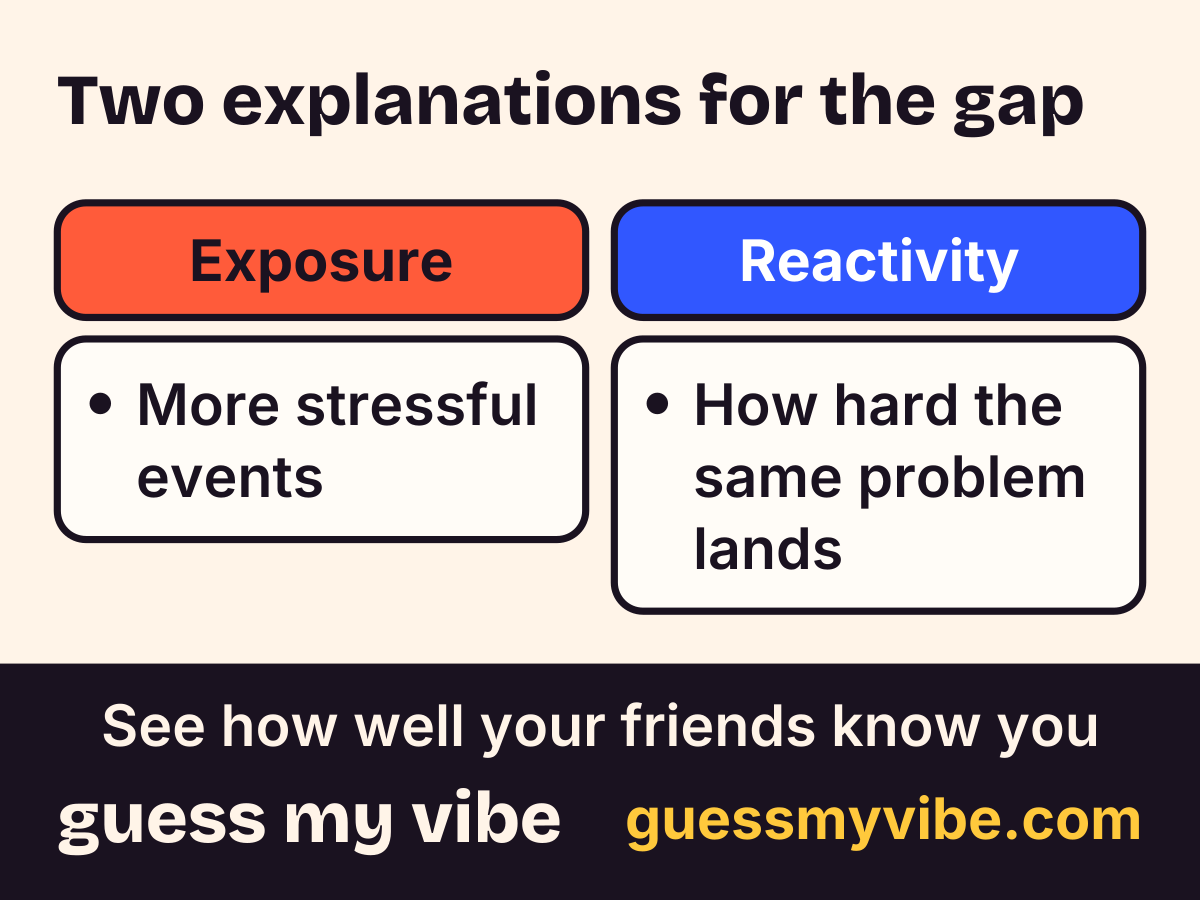
A classic study had 339 people file daily reports of minor stressful events and their mood for six straight weeks, which let researchers tease apart two competing explanations for why some people end up more distressed than others. One possibility: less emotionally stable people simply run into more stressful events. The other: they react more intensely to the same events everyone else deals with. The study found both play a role, together explaining over 40% of the distress gap between high- and low-Neuroticism people, but reactivity carried roughly twice the weight that exposure did [1]. In plain terms, the calm end of the trait isn't mostly about having an easier life with fewer problems. It's mostly about how hard the same ordinary problem actually lands once it happens.
That distinction is worth sitting with, because the two explanations point in very different directions. If emotional stability were mostly about exposure, the advice would be about circumstances: get a calmer job, a calmer living situation, fewer deadlines. The actual finding says the bigger difference is reactivity, which is a much more specific, situational thing: the same canceled plan, the same short-tempered reply, the same delayed train, is simply processed differently once it happens. That's also a big part of why emotional stability shows up so clearly in a social setting rather than only in private. Exposure (how many stressful things happen to you) is often invisible to other people. Reactivity (how big your reaction is once one happens) is the part a friend standing next to you actually watches in real time.
Cite this figure
Figure: "Two explanations for the gap." Guess My Vibe (guessmyvibe.com). https://guessmyvibe.com/learn/emotional-stability#figure-exposure-vs-reactivity
The "neurotic cascade," and the calmer pattern on its other end
A later line of daily-diary research gave this pattern a name: the neurotic cascade. Across several studies tracking community residents' problems and mood multiple times a day, people high in Neuroticism reported more daily problems, reacted to each one with more severe emotion, carried more mood spillover from earlier in the day into later events, and reacted especially strongly to problems that kept recurring [2]. Because Neuroticism and emotional stability are the same scale read from opposite ends, that cascade describes the high-reactivity end of a continuum whose low end is exactly what "emotional stability" refers to: fewer recurring problems snowballing into each other, less carryover from one bad moment into the next, and a more contained reaction to any single stressor. The research measured the high-Neuroticism pattern directly; emotional stability is its low-reactivity mirror image on the same scale, not a separately tested trait with its own cascade of calm.
Curious how your friends would answer?
Free. Answer 10 quick questions about you, then send your link. Friends play in their browser, no app needed.
Start freeIt holds up in a large, nationally sampled study too
This isn't a pattern limited to one small study. An 8-day diary study of 1,012 adults ages 25 to 74, part of the National Study of Daily Events, found the same core result: the link between a stressful day and that day's negative mood was reliably stronger for people high in Neuroticism than for people lower in it [3]. The same stressful event, a deadline, a disagreement, a canceled plan, moved the needle further for less emotionally stable people than for more stable ones. (The same study also found stress reactivity tends to rise with age, a separate finding worth knowing but not the focus here.) Two independently run diary studies, using different samples and different stretches of time, landing on the same basic shape of result is exactly the kind of replication that makes a finding worth trusting.
Why one calm friend can steady a whole group
Put the reactivity finding in a social setting and the practical version becomes obvious. When a group plan falls through, a reservation gets lost, a trip gets rained out, the group's overall mood doesn't just depend on the bad event itself. It depends on how each person in the group reacts to it, and reactions aren't identical. A more emotionally stable friend experiences a smaller mood swing from the same disruption, which in a group setting functions like a stabilizer: less visible frustration radiating outward, less of the mood spillover from one annoyance into the next decision the group has to make together. That's not the same as being unbothered or not caring how the plan went. It's a smaller dip, repeated across enough small stressors that it changes the emotional tone of an entire hangout, not just that one person's night.
What emotional stability isn't: a permanent good mood
It's worth being precise about what the research does and doesn't say. Emotional stability is a difference in degree, not a claim that some people are simply immune to stress. Experience-sampling research on personality more broadly makes this point well: even people who are typically steady show real, substantial swings in their day-to-day behavior. What stays stable over time is a person's average level, not any single day [4]. A generally emotionally stable friend can absolutely have a rough week. The trait describes their typical pattern across many stressful moments, not a guarantee about any one of them. Calling someone "emotionally stable" isn't the same as calling them unflappable, and the research never claims otherwise.
See it play out in your own friend group
You probably already have a rough sense of who in your group tends to react small to a setback and who tends to react big, and whether your own guess about yourself matches how your friends would actually describe you. Guess My Vibe turns that hunch into an actual side-by-side comparison: you answer real personality questions about how you handle everyday stress, a friend separately guesses your answers, and you see where your self-view and their outside read line up, or don't, on exactly this part of your personality.
Key takeaways
- Emotional stability is the low end of Neuroticism, not a separate trait. The same scale that measures how reactive someone is to daily stress also measures how calm they are [1].
- In a 6-week diary study, how strongly someone reacted to a stressful day mattered about twice as much as how often stressful things happened to them in explaining who ended up more distressed [1].
- Researchers call the high-reactivity pattern a "neurotic cascade": more problems reported, more severe reactions, and mood that spills over from one incident to the next. Emotional stability is the calmer, lower-reactivity end of that same continuum [2].
- The link between a stressful day and a bad mood is measurably weaker for more emotionally stable people, a pattern that held in a national diary study of over 1,000 adults [3].
- Nobody is perfectly calm all the time. Even people who are typically steady show real day-to-day swings in behavior; what stays stable is the average, not any single day [4].
- This isn't therapy, a diagnosis, or a substitute for professional care.
Questions people ask
What does emotional stability mean?
It's the calm end of Neuroticism, one of the Big Five personality traits. It describes how intensely someone's mood reacts to everyday stress not whether someone has an easier life with fewer problems [1].
Is emotional stability the same as not caring about things?
No. It's a difference in how big a mood reaction is, not a lack of concern. Even typically calm people have real day-to-day swings in behavior; what's stable is the average pattern over time, not any single day [4].
Why do some people get more stressed by the same event as everyone else?
Research separating reactivity from exposure found that how intensely someone reacts to a stressful event matters roughly twice as much as how often stressful events happen to them in explaining who ends up more distressed over time [1].
What is the "neurotic cascade"?
It's a pattern researchers found in daily-diary studies: people higher in Neuroticism report more problems, react more severely to each one, and carry mood spillover from one incident into the next. Emotional stability describes the calmer, lower-reactivity end of that same scale [2].
Can emotional stability change, or is it fixed?
This article's research is about how the trait shows up day to day, not about whether or how it can change over a lifetime, so it isn't the place to look for that answer. What the daily-diary studies do show is that even people who typically fall on the calm end still have real variation from day to day [4].
See how well your friends know you.
Free. Answer 10 quick questions about you, then send your link. Friends play in their browser, no app needed.
Start freeReferences
- [1] Bolger, N., & Schilling, E. A. (1991). Personality and the problems of everyday life: The role of neuroticism in exposure and reactivity to daily stressors. Journal of Personality, 59(3), 355–386. PubMed: 1960637 (opens in a new tab)
- [2] Suls, J., & Martin, R. (2005). The daily life of the garden-variety neurotic: Reactivity, stressor exposure, mood spillover, and maladaptive coping. Journal of Personality, 73(6), 1485–1509. PubMed: 16274443 (opens in a new tab)
- [3] Mroczek, D. K., & Almeida, D. M. (2004). The effect of daily stress, personality, and age on daily negative affect. Journal of Personality, 72(2), 355–378. PubMed: 15016068 (opens in a new tab)
- [4] Fleeson, W. (2001). Toward a structure- and process-integrated view of personality: Traits as density distributions of states. Journal of Personality and Social Psychology, 80(6), 1011–1027. PubMed: 11414368 (opens in a new tab)
How we find and check these sources: how we write. Spotted an error? Report a correction.
Related
- Introvert vs Extrovert: What the Research Actually Shows
- Agreeableness: The Trait Closeness Barely Helps Friends Read
- Social Battery: The Science of Why Socializing Drains You
- Ambivert: What the Science Actually Says
- Friendship Psychology: What the Research Actually Says
- Neuroticism in Relationships: What the Research Shows
- Neuroticism Meaning: What the Trait Actually Is
- Big Five Personality Traits: A Plain-Words Guide
Cite this article
- Title
- Emotional Stability: What It Means and Why It Helps Friends
- Publisher
- Guess My Vibe
- Updated
- URL
- https://guessmyvibe.com/
learn/ emotional-stability
Copy this citation
Guess My Vibe. (2026, October 3). Emotional Stability: What It Means and Why It Helps Friends. Guess My Vibe. https://guessmyvibe.com/
To point at one section, add that section's anchor (the # link on its heading) to the URL.