"Social battery" is a popular way to describe feeling drained after socializing, not a formal research term. The closest real evidence comes from a study that tracked mood and fatigue five times a day for 12 days: acting more outgoing went with a better mood right away, but with more fatigue about three hours later, and that delayed-fatigue pattern showed up for both introverts and extraverts, not just one [1].
What people mean by a "social battery"
"Social battery" is the phrase a lot of people use, especially online, for the feeling of running low on social energy: fine at the start of a hangout, running on fumes by the end, needing quiet time afterward to feel like yourself again. Some people call the day-after version of this an "introvert hangover." Both are vivid, useful ways to describe something real. Neither is a term from personality research. No study has found an actual battery-like store of social energy that fills up with rest and drains with use the way a phone battery does. What research has actually found is narrower, and more interesting: a specific pattern in exactly when the tiredness from socializing shows up, and who it shows up for.
The real science behind a social battery: happy now, tired later
A 12-day experience-sampling study had 48 people report their mood, stress, and fatigue five times a day, alongside how extraverted and how conscientious their behavior had been in that stretch, for a total of more than 2,300 individual check-ins. Acting more extraverted (and separately, acting more conscientious) than usual tracked with a better mood and lower fatigue at that same moment. But checking back in about three hours later told a different story: that same burst of extraverted or conscientious behavior went with higher fatigue by then. Part of the delayed fatigue after extraverted behavior was explained by something simple: the person had usually encountered more people during that stretch [1]. In plain words, socializing really does seem to work like the metaphor suggests, a cost that shows up later rather than immediately, just not quite as a "battery" and not only for the people the metaphor usually gets blamed on.
Cite this figure
Figure: "Happy now, tired later." Guess My Vibe (guessmyvibe.com). https://guessmyvibe.com/learn/social-battery#figure-happy-now-tired-later
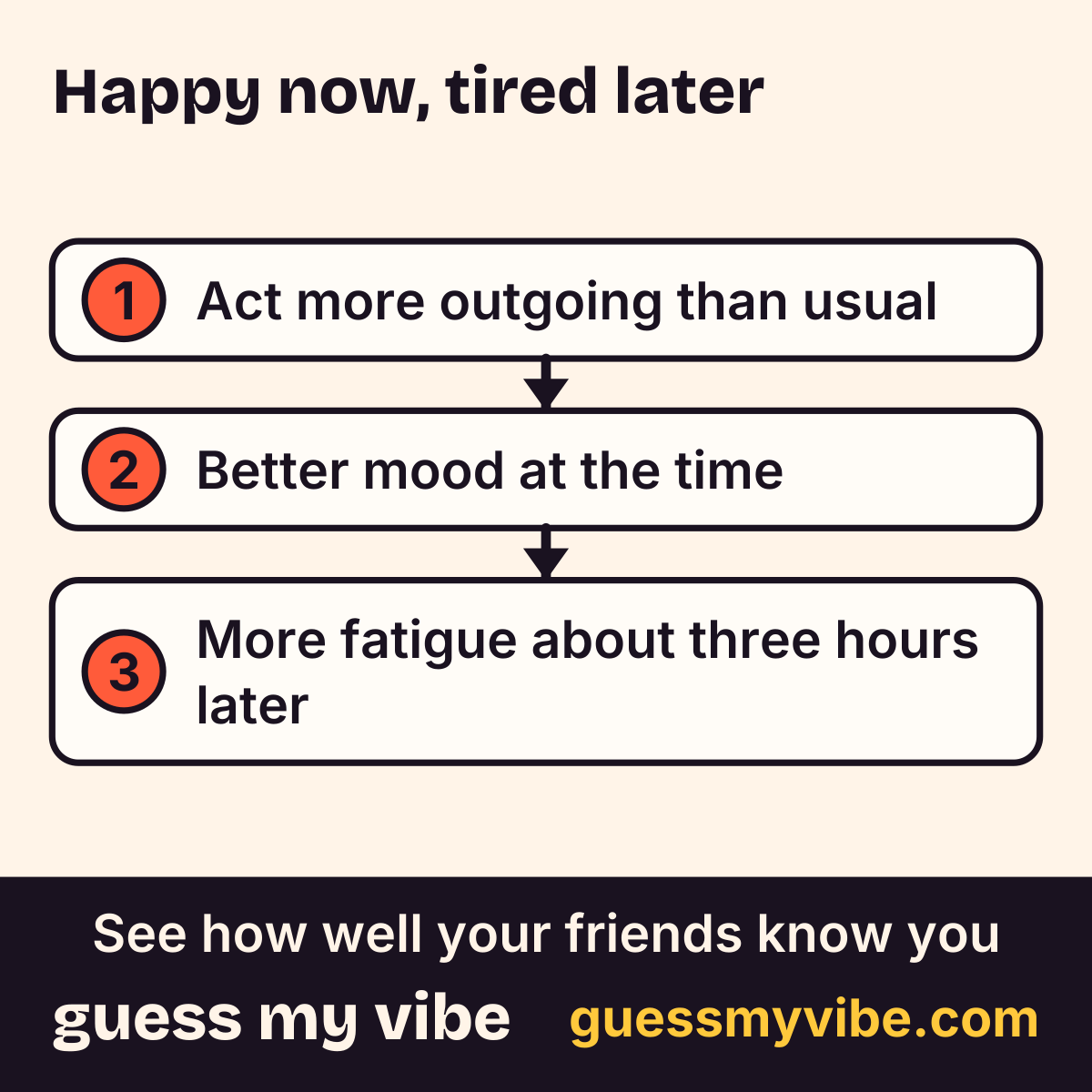
Who actually gets more tired: everyone, about equally
Here's the detail that cuts against the usual way "social battery" gets told, that introverts have a small one and extraverts barely have one at all. In that same 12-day study, the delayed-fatigue pattern wasn't stronger for people who scored lower in extraversion. It showed up at close to the same strength regardless of someone's own usual personality level [1]. What was driving the fatigue wasn't being an introvert. It was being more outgoing than your own personal normal during that particular stretch, a temporary state anyone can be in, not a fixed trait only some people carry. Separate experience-sampling research backs up that framing: the typical person shows nearly every level of outgoing behavior at some point in a given week, from quiet to the life of the party, and it's each person's average over time, not any single moment, that stays stable [4].
Curious how your friends would answer?
Free. Answer 10 quick questions about you, then send your link. Friends play in their browser, no app needed.
Start freeIt isn't only outgoing behavior that works this way
The same 12-day study found the identical happy-now, tired-later pattern for conscientious behavior, not just extraverted behavior: being more organized and on-task than usual also tracked with a better mood at the time, and with more fatigue about three hours afterward. The reason behind the delay was different for each, though. Extraverted behavior's later fatigue was explained in part by simply encountering more people. Conscientious behavior's later fatigue was explained in part by whether the person had been working toward an actual goal in that stretch [1]. That's a useful detail for "social battery" specifically: the drain researchers can actually measure isn't unique to socializing. It's closer to a general cost of effortful, engaged behavior of several kinds, with socializing as one well-studied example rather than the only one.
Acting outgoing helps now, costs more if you push it
A different kind of study complicates that tidy picture. A week-long randomized trial assigned people to deliberately act more outgoing than usual across several days of ordinary life, not just a few hours of naturally occurring behavior. Acting outgoing did raise positive mood and feelings of authenticity overall. But the benefit wasn't spread evenly: the most introverted participants gained less positive mood from it, and also reported more negative mood, more tiredness, and feeling less like themselves [2]. A shorter lab study points the other way for a single session: acting extraverted raised positive mood without raising negative mood for introverts and extraverts alike, and the one cognitive cost it found (worse performance on an attention task) showed up only in extraverts who were asked to act introverted, not in introverts acting outgoing [3]. So the honest, slightly less tidy version is this: a short, naturally occurring burst of being more outgoing seems to cost about the same for everyone a few hours later. Sustained or deliberately forced outgoing behavior, stacked across many days is where a difference between more and less extraverted people starts to show up.
What the "social battery" metaphor gets right, and what it doesn't
The part the metaphor gets right: the cost of socializing really does show up on a delay, not in the moment, and that delay (about three hours, in the one study that measured it this precisely) is a real, specific finding, not just a feeling people made up. The part it probably gets wrong is treating the drain as something only introverts have. The newest, most naturalistic data says a short burst of extra sociability taxes almost everyone about equally a few hours later. Where personality does seem to matter more is when the outgoing behavior isn't a short natural burst but something sustained for days or forced for an extended stretch, which is closer to what a demanding week of back-to-back plans actually feels like.
Guess where a friend's battery actually is
A few of the social-battery questions in our full how well do you know me list ask exactly this: does a friend want quiet after a big group hang, or do they want to keep going? Guess My Vibe turns the same idea into a daily habit instead of a one-time guess, so you find out whether you're reading a friend's actual pattern or just assuming it matches a stereotype about who they are. Over enough rounds, the pattern that shows up is specific to that friend, not a generic rule about introverts or extraverts in general.
Key takeaways
- "Social battery" is a metaphor, not something researchers have directly measured as an actual battery that drains and refills.
- The closest real pattern: acting more outgoing tracks with a better mood and less fatigue in the moment, but with more fatigue about three hours later, in a 12-day study measuring mood five times a day [1].
- That delayed-fatigue pattern wasn't stronger for people who scored lower in extraversion; it showed up about equally regardless of someone's own usual personality, and was partly explained by simply spending time with more people [1].
- A separate week-long trial that had people deliberately act more outgoing found the opposite nuance: more introverted participants did report more tiredness and feeling less like themselves afterward [2], while a shorter lab study found no such cost for introverts acting outgoing [3], so the evidence on who pays the biggest cost is genuinely mixed.
- This isn't therapy, a diagnosis, or a substitute for professional care.
Questions people ask
What does "social battery" actually mean?
It's a popular, non-scientific way to describe feeling drained after socializing and needing quiet time to recover. No study has measured an actual battery-like store of social energy; the closest real research instead tracks mood and fatigue directly over time.
Is social battery a real psychological concept?
Not as a formal term, no. But the pattern behind it is real: a 12-day study found that acting more outgoing lifted mood immediately but was linked to more fatigue about three hours later.
Do introverts really have a smaller social battery than extraverts?
The evidence is mixed, and that's worth saying plainly. A within-day study found the delayed-fatigue pattern showed up about equally regardless of someone's usual personality. A week-long trial that had people deliberately act outgoing for days found more introverted participants paid a bigger cost. Short natural bursts and sustained, forced effort may simply work differently.
How long does it take to feel drained after socializing?
In the one study that measured this directly, the fatigue showed up about three hours after the outgoing behavior, not immediately. That's a specific finding from one 12-day study, not a universal timer that applies to every person or every situation.
What's the best way to recharge a social battery?
No study referenced here directly tested specific recharge methods, so there's no research-backed answer to give. The reasonable inference from the fatigue research is that quiet, lower-stimulation time after a demanding social stretch makes sense, but that's an inference, not a tested result.
See how well your friends know you.
Free. Answer 10 quick questions about you, then send your link. Friends play in their browser, no app needed.
Start freeReferences
- [1] Leikas, S., & Ilmarinen, V. J. (2017). Happy Now, Tired Later? Extraverted and Conscientious Behavior Are Related to Immediate Mood Gains, but to Later Fatigue. Journal of Personality, 85(5), 603–615. PubMed: 27281444 (opens in a new tab)
- [2] Jacques-Hamilton, R., Sun, J., & Smillie, L. D. (2019). Costs and benefits of acting extraverted: A randomized controlled trial. Journal of Experimental Psychology: General, 148(9), 1538–1556. PubMed: 30489119 (opens in a new tab)
- [3] Zelenski, J. M., Santoro, M. S., & Whelan, D. C. (2012). Would introverts be better off if they acted more like extraverts? Exploring emotional and cognitive consequences of counterdispositional behavior. Emotion, 12(2), 290–303. PubMed: 21859197 (opens in a new tab)
- [4] Fleeson, W. (2001). Toward a structure- and process-integrated view of personality: Traits as density distributions of states. Journal of Personality and Social Psychology, 80(6), 1011–1027. PubMed: 11414368 (opens in a new tab)
How we find and check these sources: how we write. Spotted an error? Report a correction.
Related
- Introvert vs Extrovert: What the Research Actually Shows
- Communication Styles and Personality: The Real Research
- This or That Questions for Friends, and What They Say
- Ghosting: Why People Do It, According to Research
- FOMO: What Research Says About Fear of Missing Out
- How to Be More Social: What the Research Actually Shows
- Reserved Personality: Why Quiet Isn't the Same as Cold
- Alone vs Lonely: Why Solitude Isn't the Same Thing
- Omnivert vs Ambivert: What the Research Says
- Extraversion: What the Trait Is and What It Isn't
Cite this article
- Title
- Social Battery: The Science of Why Socializing Drains You
- Publisher
- Guess My Vibe
- Updated
- URL
- https://guessmyvibe.com/
learn/ social-battery
Copy this citation
Guess My Vibe. (2026, October 3). Social Battery: The Science of Why Socializing Drains You. Guess My Vibe. https://guessmyvibe.com/
To point at one section, add that section's anchor (the # link on its heading) to the URL.