An omnivert is the internet's word for someone who swings between a quiet, introvert-like mode and a loud, extrovert-like mode, while an ambivert is usually described as someone who stays near the middle. Neither is a category personality researchers use. What research does show is that everyone swings: in studies where people reported their behavior several times a day, the typical person showed nearly every level of outgoing behavior within a few weeks [1].
What is an omnivert?
An omnivert is the popular word for a person who feels like they swing between introvert mode and extrovert mode. One week they want every party and a full calendar. The next they want the phone off and the door shut. The word borrows from "omnivore," an animal that eats everything, and the idea is that an omnivert takes in the whole range of social energy depending on the day. The short version of this article: that experience is real and very common, but "omnivert" is a nickname, not a personality type that researchers measure.
Definitions online are loose, and they don't all agree. Most describe the omnivert as someone whose social mood changes a lot with the situation or the day. That is the version used here. If a site you read draws the line somewhere else, that's the nature of a word that no research group has defined.
Omnivert vs ambivert: the popular difference
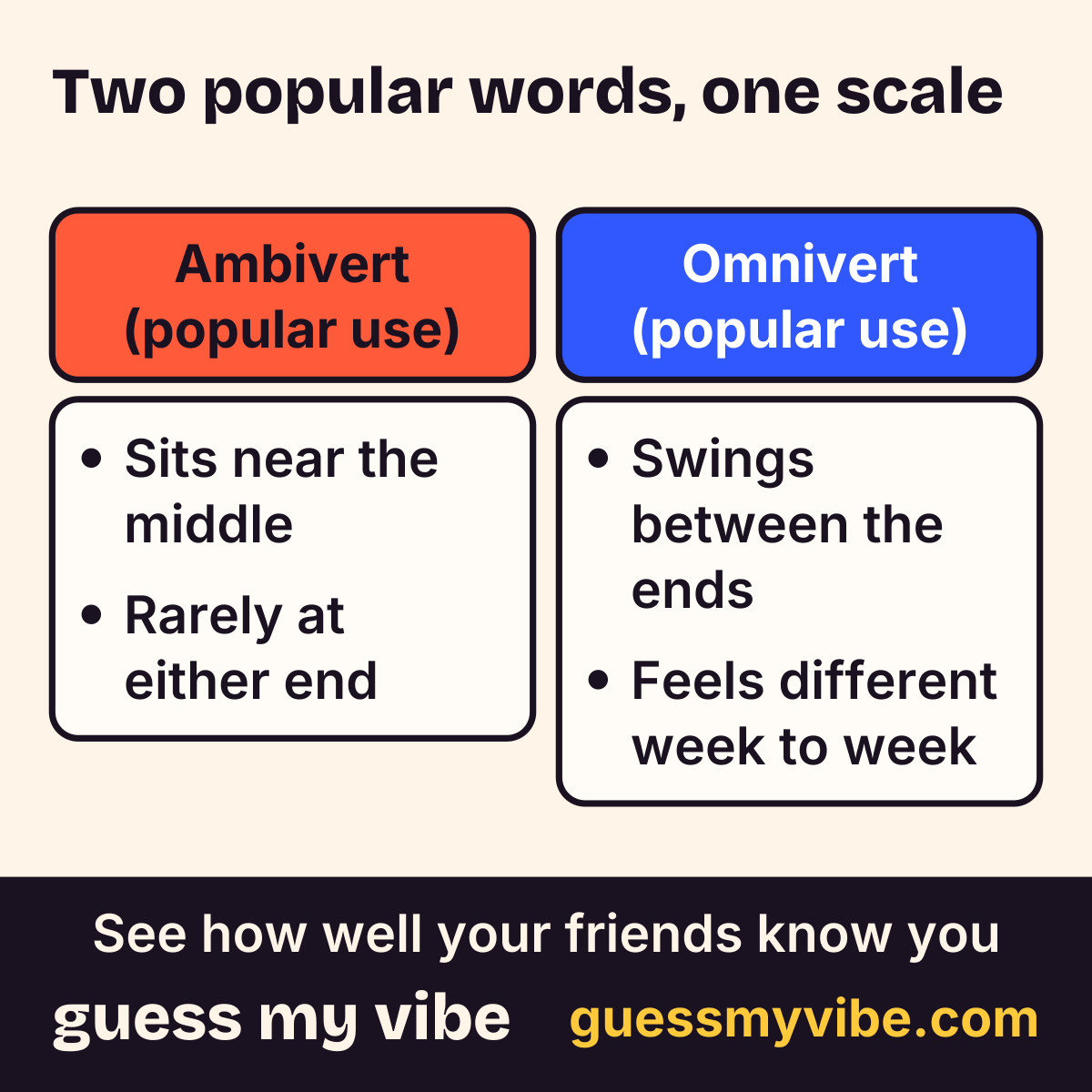
In popular use, the two words split the middle of the scale into two stories. An ambivert is described as someone who sits near the middle most of the time: comfortable at a party, comfortable at home, rarely at either extreme. An omnivert is described as someone who swings, spending real time at both ends and feeling very different from one week to the next. Our separate article on the ambivert covers why that word describes the middle of one continuous scale and what the one well-known sales study found. This page is about the swinging part.
Here is the honest catch. The two stories are hard to tell apart from the outside, and they are hard to tell apart from the inside too. Someone near the middle of the scale can still have a loud Friday and a silent Sunday. Someone who swings can still average out near the middle. The words describe a feeling, and the research below shows why almost everyone has that feeling.
Cite this figure
Figure: "Two popular words, one scale." Guess My Vibe (guessmyvibe.com). https://guessmyvibe.com/learn/omnivert#figure-ambivert-vs-omnivert
Is omnivert a real personality type?
No. It is a pop term, not a research construct. When we searched PubMed for the word on 6 October 2026, it returned no studies. Personality psychology treats extraversion as one continuous scale from low to high, and the Big Five model it belongs to describes people with five sliding scales rather than a set of types. There is no third box labeled omnivert on those scales, and there is no questionnaire that sorts people into it.
That doesn't make the label useless. A nickname can describe a real experience even when it isn't a scientific category. The useful question is what the experience is made of, and on that point the research is surprisingly specific.
What research shows: nearly everyone swings
In experience-sampling studies, people report what they are doing and how they are acting several times a day, as it happens, for a couple of weeks. Three such studies looked at behavior linked to each of the Big Five traits. The main finding runs against the type idea: within-person variability was high, and the typical person regularly and routinely showed nearly all levels of all the traits in everyday behavior [1]. In plain words, the quiet person has loud hours and the loud person has quiet ones.
So the swing an omnivert describes is not an exotic exception. It is the normal shape of human behavior, seen up close. What differs between people is mostly the average and, as the next section shows, how much they move around it.
Curious how your friends would answer?
Free. Answer 10 quick questions about you, then send your link. Friends play in their browser, no app needed.
Start freeYour average is stable, and so is how much you swing
The same studies found two stable things underneath all that movement. First, people's central tendencies, the average level of their behavior over the weeks, were almost perfectly stable. Second, the amount of variability itself, along with the skew and kurtosis of the distribution, was a stable individual difference [1]. A meta-analysis of 15 experience-sampling studies with over 20,000 behavior reports then found that questionnaire trait scores forecast people's average levels of trait-relevant behavior, with correlations between .42 and .56 [2].
Here is the part that bears most on the omnivert idea. Those results suggest that people may differ in how much they swing, as well as in where they average. That is a difference in degree. It does not show that there is a distinct kind of person called an omnivert. The original study also tied the amount of swing in extraversion to how strongly a person reacted to extraversion-relevant cues in the situation [1]. In everyday terms, who is in the room and what is going on matters.
Why "switching on" at a party often feels good
A common omnivert story is that you can flip into outgoing mode when you need to, and that it sometimes feels great. There is research on that. In one set of studies, participants reported their extraversion and positive mood every three hours for two weeks. Each participant was happier when acting extraverted than when acting introverted, and the same pattern showed up in a weekly diary study and in an experiment that changed how people acted within a fixed situation [3].
A follow-up randomly assigned people to act introverted or extraverted. Positive mood rose when people acted extraverted, and negative mood did not, even for people who were introverted by disposition. The one cost found was on a concentration test (the Stroop task), and it showed up only for naturally extraverted people who were told to act introverted, not for introverts told to act extraverted [4]. These are short lab and diary studies, so they say little about months of exhausting social calendars. They do suggest that switching modes is common, and often feels pleasant, for people at all points on the scale.
Does swinging between modes make you better at things?
The best-known study with "ambivert" in its title found that, among 340 outbound call-center sales representatives, revenue was highest in the middle of the extraversion range and lower at both ends [5]. The author proposed an explanation, that people in the middle naturally mix talking and listening. The study itself measured where people scored on extraversion. It did not measure whether anyone swung between modes. So it speaks to the middle of the scale, and says nothing direct about omniverts as the internet defines them.
Be careful with any claim that omniverts, or ambiverts, are better at friendship, work, or dating. The evidence for a middle-of-the-scale advantage is one study of one job. The evidence for a swing advantage is not there at all.
How to use the word without overclaiming
- Treat "omnivert" as a description of your pattern, not of your type: "my energy swings a lot" says the same thing with less baggage.
- Look at your average across a few weeks, not your best or worst day. The average is the stable part.
- Notice what moves you between modes: the people, the place, how much sleep you got. Situations matter.
- Remember that this is a normal pattern, not a flaw and not a superpower.
Can your friends tell which one you are?
In a study of 165 people rated by themselves, four friends and strangers, then checked against behavioral tests, people of all perspectives were about equally good at judging extraversion-related traits [6]. That means friends are a reasonable check on how outgoing you come across, even though they can't read your inner battery.
Ask your friends how you come across
If you wonder whether you are really an omnivert, ask the people who see your Fridays and your Sundays. Guess My Vibe has a friend guess your answers to everyday questions, including how you recharge, then scores how close the guess lands. It isn't a test and it won't give you a label, but it does show whether your friends read your social battery the way you do.
Key takeaways
- "Omnivert" is a popular label. A search of PubMed for the word on 6 October 2026 turned up no studies that use it, and different websites define it a little differently.
- In the popular version, an ambivert sits in the middle of the scale and an omnivert swings between the ends. Research treats extraversion as one continuous scale, not three boxes.
- Swinging is not unusual. In experience-sampling studies, the typical person showed nearly every level of every Big Five trait in everyday behavior [1].
- Even so, a person's average level is a stable thing. Questionnaire scores forecast people's average behavior with correlations between .42 and .56 [2].
- This isn't therapy, a diagnosis, or a substitute for professional care.
Questions people ask
What is an omnivert?
A popular, unofficial word for someone who swings between a quiet, introvert-like mode and an outgoing, extrovert-like mode depending on mood or situation. Websites define it a little differently, and personality researchers don't use it as a category.
What is the difference between an omnivert and an ambivert?
In popular use, an ambivert stays near the middle of the introvert-extrovert scale, while an omnivert swings between the two ends. Research doesn't split people this way: extraversion is one continuous scale, and the typical person shows a wide range of outgoing behavior over a few weeks [1].
Is an omnivert the same as an extroverted introvert?
Not exactly, but the labels overlap. "Extroverted introvert" is another popular name for someone in the middle of the scale. None of these three words is a research category.
Is there an omnivert test?
Online quizzes exist, but there is no research-backed test that sorts people into omniverts. A trait questionnaire gives a position on the extraversion scale, and questionnaire scores do forecast people's average behavior across a few weeks of real life [2].
Do omniverts get drained by socializing?
Some people feel that way, but this article cites no study showing it for omniverts, because the word isn't studied. What is shown is that acting outgoing raised positive mood in two experiments, including for people acting out of character [4].
Can my friends tell if I swing between modes?
They can judge how outgoing you come across: in one study, self, friends and strangers were about equally good at judging extraversion-related traits [6]. Whether you swing a lot is something a friend who sees you in many settings can notice, and you can ask.
See how well your friends know you.
Free. Answer 10 quick questions about you, then send your link. Friends play in their browser, no app needed.
Start freeReferences
- [1] Fleeson, W. (2001). Toward a structure- and process-integrated view of personality: Traits as density distributions of states. Journal of Personality and Social Psychology, 80(6), 1011–1027. PubMed: 11414368 (opens in a new tab)
- [2] Fleeson, W., & Gallagher, P. (2009). The implications of Big Five standing for the distribution of trait manifestation in behavior: Fifteen experience-sampling studies and a meta-analysis. Journal of Personality and Social Psychology, 97(6), 1097–1114. PubMed: 19968421 (opens in a new tab)
- [3] Fleeson, W., Malanos, A. B., & Achille, N. M. (2002). An intraindividual process approach to the relationship between extraversion and positive affect: Is acting extraverted as "good" as being extraverted?. Journal of Personality and Social Psychology, 83(6), 1409–1422. PubMed: 12500821 (opens in a new tab)
- [4] Zelenski, J. M., Santoro, M. S., & Whelan, D. C. (2012). Would introverts be better off if they acted more like extraverts? Exploring emotional and cognitive consequences of counterdispositional behavior. Emotion, 12(2), 290–303. PubMed: 21859197 (opens in a new tab)
- [5] Grant, A. M. (2013). Rethinking the extraverted sales ideal: The ambivert advantage. Psychological Science, 24(6), 1024–1030. PubMed: 23567176 (opens in a new tab)
- [6] Vazire, S. (2010). Who knows what about a person? The self-other knowledge asymmetry (SOKA) model. Journal of Personality and Social Psychology, 98(2), 281–300. PubMed: 20085401 (opens in a new tab)
How we find and check these sources: how we write. Spotted an error? Report a correction.
Related
Cite this article
- Title
- Omnivert vs Ambivert: What the Research Says
- Publisher
- Guess My Vibe
- Updated
- URL
- https://guessmyvibe.com/
learn/ omnivert
Copy this citation
Guess My Vibe. (2026, October 6). Omnivert vs Ambivert: What the Research Says. Guess My Vibe. https://guessmyvibe.com/
To point at one section, add that section's anchor (the # link on its heading) to the URL.