An introvert extrovert friendship isn't the odd match people sometimes assume. New friendships tend to form a bit more by similarity than by contrast, and in a study of new university students, more outgoing people named more friends overall [1]. Extraversion is also one of the more visible traits, and other-ratings get more accurate as informants get closer to someone, which may be part of why this kind of friendship can work better than people expect [2].
Introvert extrovert friendship: how common is the match, really?
An introvert extrovert friendship gets talked about like a classic odd couple, the quiet one and the loud one, somehow making it work. The research on how friend networks actually form complicates that picture a little. A study that tracked incoming university students across their first year, watching entire friendship networks take shape from scratch, found more extraverted students ended up selecting more friends overall, and people generally leaned toward choosing friends who were similar to themselves in extraversion, agreeableness, and openness [1]. That's a real tilt toward "birds of a feather," not toward opposites. But a tilt isn't a rule. The same extraverted people naming lots of friends are, by sheer numbers, likely to have some quieter friends in the mix, and an introvert and an extrovert can still land in each other's corner even if similarity is the more common path to a new friendship overall.
Why this kind of friendship tends to hold up once it exists
Here's the part that favors an introvert-extrovert friendship specifically: extraversion is a highly visible trait, so it tends to be easier to read than inner traits. A meta-analysis spanning 263 samples and more than 44,000 people found that closeness to the person improved the accuracy of other-ratings, especially for traits low in visibility [2]. For a visible trait like extraversion, that suggests friends have plenty to go on. That matters more between two friends who differ than between two who are already alike, because it means neither one has to work hard to correctly clock how much social stimulation the other actually wants. The extroverted friend doesn't have to guess whether their quieter friend secretly wants a bigger party; it tends to be visible. The quieter friend doesn't have to decode whether their outgoing friend is performing energy or genuinely has it; that tends to be visible too. The exact trait that makes the two of them different is also one that tends to be easy to see in each other.
What makes it work: quiet isn't the same as shy
A common assumption trips up a mixed friendship before it gets a chance to form: that the quieter friend must be shy, nervous, or need to be drawn out. A classic set of studies separated shyness from sociability and found the two are only loosely related constructs [3]. Shyness is tension and self-consciousness around other people. Low extraversion, what casually gets called "introversion," is a lower appetite for social stimulation, not fear of it. An introverted friend here isn't necessarily anxious around their more outgoing friend; they may just genuinely prefer a quieter hang to a loud one, with zero discomfort either way. Getting this distinction right changes how the friendship actually plays out day to day: the extroverted friend isn't "helping" a nervous friend come out of their shell, they're just one person who wants more stimulation sharing time with one person who wants less.
Curious how your friends would answer?
Free. Answer 10 quick questions about you, then send your link. Friends play in their browser, no app needed.
Start freeWhat the difference actually does for a friendship day to day
There's a narrow, well-studied precedent for real difference being useful rather than just tolerated. A study of 102 college roommate duos found that after two weeks living together their behavioral styles did not complement each other, but after fifteen weeks they strongly did, in line with the principle that partners drift toward opposite on dominance (one more assertive, the other more yielding) and similar on warmth, while their perceptions of their own personalities were relatively unaffected [4]. Translated to an introvert-extrovert friendship, a version of the same thing plausibly happens on a smaller scale: the more outgoing friend ends up the one who picks the restaurant and starts the group chat, the quieter friend ends up the one who remembers the smaller details and keeps the one-on-one conversations going, and the division of labor works precisely because it isn't identical. It's a narrow finding, about behavioral styles in one living situation, not a blanket rule that opposites always balance each other out. But it's a real mechanism, not just a flattering story people tell about mismatched friends.
What this actually looks like in practice
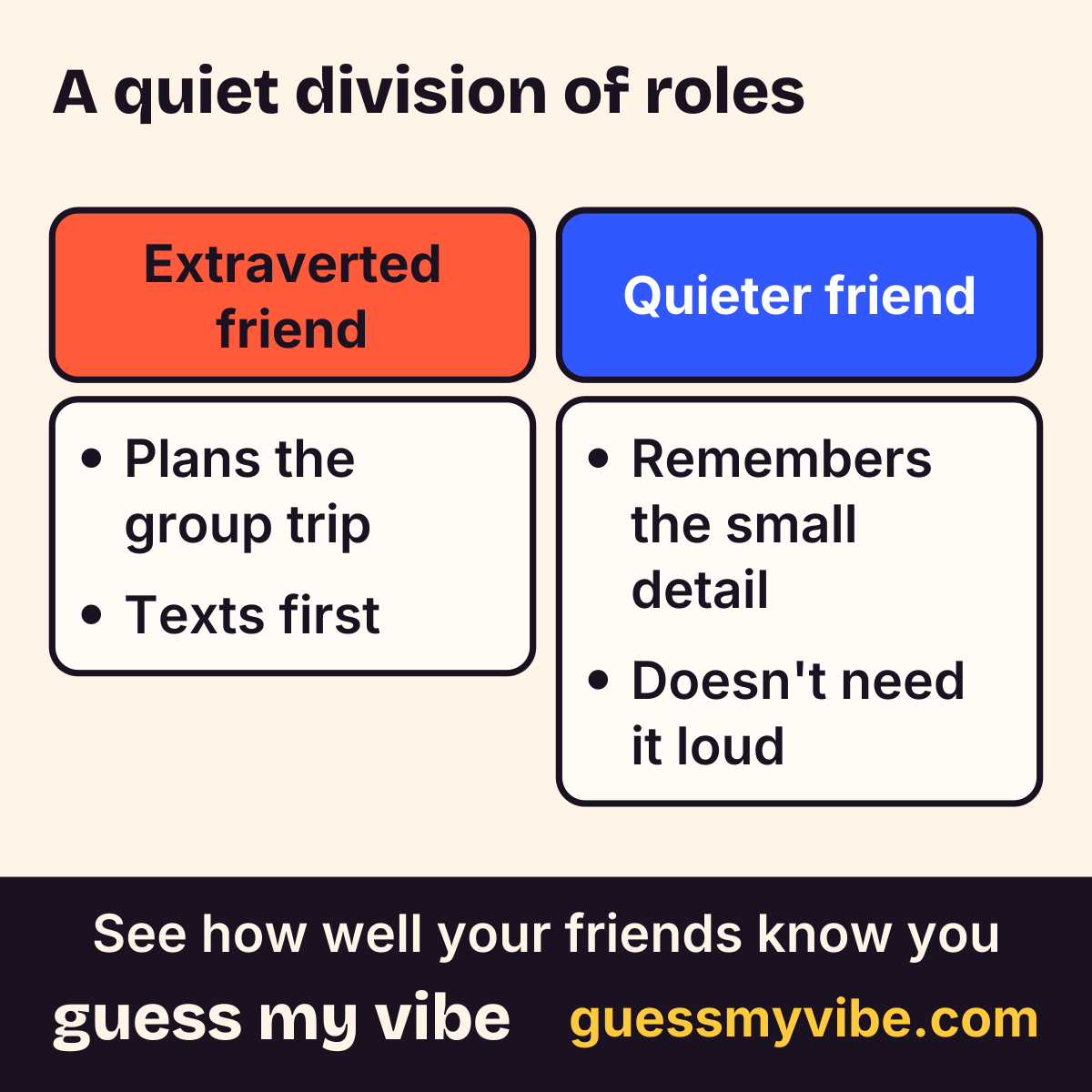
In practice, this usually isn't a dramatic clash so much as a quiet division that works until one side forgets to check in on it. The more extraverted friend plans the group trip, texts first, fills the silences at a party neither of them particularly wanted to go to. The quieter friend is the one who actually remembers the small detail from three weeks ago, who doesn't need the night to be loud to count as a good one, and who sometimes needs the outgoing friend to notice when enough stimulation is enough for the day. The friction, when it shows up, usually isn't about personality itself; it's about one friend assuming the other should want the same amount of socializing they do, rather than reading the cue that's sitting right there, which the research above says is exactly the trait both of them are best equipped to read correctly in each other.
Cite this figure
Figure: "A quiet division of roles." Guess My Vibe (guessmyvibe.com). https://guessmyvibe.com/learn/introvert-extrovert-friendship#figure-quiet-division
So who actually calls whom better?
Given how accurately extraversion gets read by close friends in general, the honest answer for a specific introvert-extrovert friendship is: probably both of them, about equally, on this particular trait. That's the useful and slightly deflating thing about the research above. It's not that one side of a mismatched friendship is secretly the better judge of the other. It's that the trait that makes them an odd match on paper is also one of the easiest traits either of them has to read correctly, which is a big part of why the friendship works better in practice than it looks like it should on paper. The traits that actually tend to cause friction in a mixed friendship are more likely the less visible ones, like how each person handles stress or conflict, where accuracy drops for everyone regardless of how outgoing either friend is.
That also means the stereotype, that the extrovert is dragging a reluctant introvert along to everything, gets less accurate the longer the friendship actually runs. Research tracking personality judgments over time finds that as acquaintance lengthens, people rely less on generic assumptions about what people in general are like and more on things that are specifically, actually true about the person in front of them [5]. In a friendship like this, that shift usually means the extroverted friend gets better, not worse, at reading when their quieter friend has had enough, and the quieter friend gets better at knowing which invitations are actually worth the energy, rather than either side just tolerating the other's default setting indefinitely.
Guess My Vibe is one direct way to find out how a specific introvert-extrovert friendship actually reads each other, not just on extraversion but across the rest of their personality too: a friend guesses your real answers to personality questions, and you see exactly where the guess landed, trait by trait, rather than assuming the mismatch everyone jokes about is the whole story.
Key takeaways
- Friend groups form more by similarity than by contrast on average: in one study of new university students, more extraverted people selected more friends, and people leaned toward picking friends similar to themselves in extraversion [1].
- That doesn't rule out introvert-extrovert friendships. It means they're less the norm than people assume, not that they don't work once they exist.
- Extraversion is one of the more visible Big Five traits, and a meta-analysis of over 44,000 people found other-ratings grow more accurate as informants get closer to someone, which cuts both ways here: friends have good evidence on both the quieter friend and the louder one [2].
- Being quieter isn't the same as being shy. Research separating the two found they're only loosely related, which matters for a mixed friendship: one friend wanting less stimulation doesn't mean they're anxious around the other [3].
- This isn't therapy, a diagnosis, or a substitute for professional care; it's a plain-English summary of what personality research says about introvert-extrovert friendships.
Questions people ask
Can an introvert and an extrovert really be best friends?
Yes. Research on new friendship networks found similarity is the more common path to forming a friendship, but it's a tilt, not a rule, and extraversion is a highly visible trait that friends are in a good position to read in each other, which helps a mixed friendship avoid misreading the exact difference between them [1] [2].
Is the quieter friend in an introvert-extrovert friendship just shy?
Not necessarily. Research separating shyness from sociability found the two are only loosely related: low extraversion is a lower appetite for social stimulation, while shyness is tension and self-consciousness around people, a different trait that can show up at any point on the extraversion scale [3].
Who reads the friendship more accurately, the introvert or the extrovert?
Likely both, about equally, at least on extraversion itself. A meta-analysis of over 44,000 people found other-ratings grow more accurate with closeness, so a visible trait like extraversion is something both friends are well placed to read, including how much stimulation the other one wants [2].
Do introvert-extrovert friendships actually complement each other?
There's narrow, specific evidence for this in a related context: college roommates' behavioral styles became more complementary over fifteen weeks, while their self-perceived personalities were relatively unaffected. It suggests real difference can work on specific dimensions without being a blanket rule [4].
Are most friendships between similar personalities or opposite ones?
More often similar. Tracking real friendship networks forming from scratch, researchers found people tend to pick friends similar to themselves in extraversion, agreeableness, and openness, though more extraverted people also named more friends overall [1].
See how well your friends know you.
Free. Answer 10 quick questions about you, then send your link. Friends play in their browser, no app needed.
Start freeReferences
- [1] Selfhout, M., Burk, W., Branje, S., Denissen, J., van Aken, M., & Meeus, W. (2010). Emerging late adolescent friendship networks and Big Five personality traits: A social network approach. Journal of Personality, 78(2), 509–538. PubMed: 20433629 (opens in a new tab)
- [2] Connelly, B. S., & Ones, D. S. (2010). An other perspective on personality: Meta-analytic integration of observers' accuracy and predictive validity. Psychological Bulletin, 136(6), 1092–1122. PubMed: 21038940 (opens in a new tab)
- [3] Cheek, J. M., & Buss, A. H. (1981). Shyness and sociability. Journal of Personality and Social Psychology, 41(2), 330–339. doi.org/10.1037/0022-3514.41.2.330 (opens in a new tab)
- [4] Markey, P. M., & Kurtz, J. E. (2006). Increasing acquaintanceship and complementarity of behavioral styles and personality traits among college roommates. Personality and Social Psychology Bulletin, 32(7), 907-916. PubMed: 16738024 (opens in a new tab)
- [5] Biesanz, J. C., West, S. G., & Millevoi, A. (2007). What do you learn about someone over time? The relationship between length of acquaintance and consensus and self-other agreement in judgments of personality. Journal of Personality and Social Psychology, 92(1), 119–135. PubMed: 17201547 (opens in a new tab)
How we find and check these sources: how we write. Spotted an error? Report a correction.
Related
- Introvert vs Extrovert: What the Research Actually Shows
- Friendship Psychology: What the Research Actually Says
- Do Opposites Attract? What the Research Actually Says
- Friendship Compatibility: What Actually Makes It Work
- Friends With Different Personalities: When Opposites Work
- Introvert and Introvert Relationship: What Research Says
Cite this article
- Title
- Introvert Extrovert Friendship: Why It Works
- Publisher
- Guess My Vibe
- Updated
- URL
- https://guessmyvibe.com/
learn/ introvert-extrovert-friendship
Copy this citation
Guess My Vibe. (2026, October 3). Introvert Extrovert Friendship: Why It Works. Guess My Vibe. https://guessmyvibe.com/
To point at one section, add that section's anchor (the # link on its heading) to the URL.