An introvert and introvert relationship has no special research verdict, because no study we found tracks two-introvert couples as such. The broader evidence says personality similarity explains very little of how satisfied couples are, under 0.5% of the difference in nationally representative married samples [1], so sharing a quiet style neither guarantees nor threatens a relationship. Two introverts still differ on every other trait.
Introvert and introvert relationship: what the research actually covers
Start with an honest limit. Searches for an introvert and introvert relationship (romantic or friendship) expect a clear answer, and the research doesn't offer one. We found no study that recruits couples or friends where both people are introverted and follows them over time. What exists is research on personality similarity in general, plus a few studies that look at extraversion specifically. This article works from those, and it will say each time a point is an inference rather than a finding.
A second clarification: introversion is the low end of the Big Five trait of extraversion (the app calls it Social battery). It describes how much social energy and stimulation someone seeks, and it isn't the same as shyness, which is more about worry in social situations. Two people can share a low social battery and still be very different in warmth, structure, stress and curiosity. That is the first lesson of this topic: two introverts are not two copies of one person.
Does being alike help a relationship?
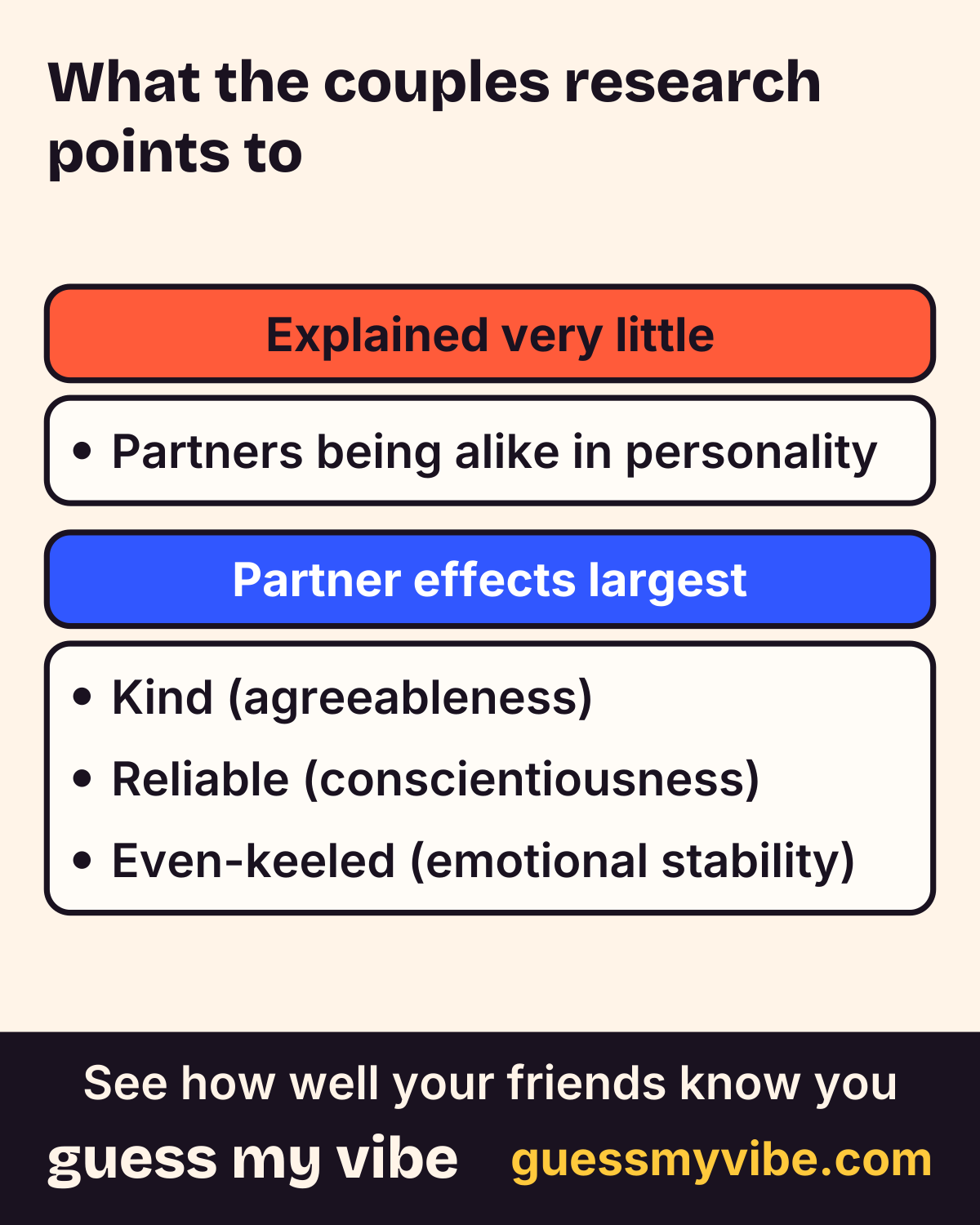
The general question of whether similar partners are happier has been studied at scale. The largest test used nationally representative married-couple samples from Australia (5,278 people), the United Kingdom (6,554) and Germany (11,418). A person's own personality explained about 6% of the variance in their relationship satisfaction, a partner's personality explained between 1% and 3%, and couple similarity explained less than 0.5% after those other effects were accounted for [1]. The abstract reports similarity across personality overall, not trait by trait, so it doesn't isolate extraversion.
A later study of 1,294 female-male romantic couples tried a finer lens, testing whether similarity in personality facets (narrower pieces of each trait) would explain what broad traits did not. It didn't: similarity in traits and facets was not robustly associated with either life or relationship satisfaction [2]. Put plainly, two people being alike in how they're wired does not do much to tell us whether they will be satisfied. That cuts both ways for two introverts. Matching is not a hidden advantage, and it is not a hidden risk.
What happens when two introverts first meet
The closest direct evidence is about first conversations. Cuperman and Ickes studied 87 initial, unstructured interactions between strangers and looked at how each two-person combination of Big Five traits played out. Most of the significant effects involved extraversion or agreeableness. Personality similarity gave relatively good initial interactions for two extraverts or two introverts, compared with extravert-introvert duos, though similarity gave uniquely poor interactions for two low-agreeable people [3].
This is a modest, specific result, and it should not be stretched. It covers one unstructured conversation between strangers, not a friendship or a relationship. It is consistent with the idea that two quieter people can find a comfortable rhythm quickly, though the abstract does not say why, and that is an inference on our part. It doesn't say what happens months later. If you've seen how an introvert-extravert match can work well too, our dating an introvert article covers that side of the research.
Introverts and friendship: similar people tend to find each other
There is also evidence on who ends up befriending whom. In a study that tracked 205 late adolescents through their first year at university, people tended to select friends with similar levels of agreeableness, extraversion and openness, and more extraverted students selected more friends [4]. These were just-acquainted students, so the finding describes how friendship networks form from scratch. It is plausible, though this study did not test it, that quieter people often find each other in small settings.
The same finding contains a quieter point. More extraverted students selected more friends, but nothing in the abstract says introverts end up with worse friendships. Number of friends and depth of friendship are different things. Our how to make friends as an introvert article looks at that distinction in more detail.
Curious how your friends would answer?
Free. Answer 10 quick questions about you, then send your link. Friends play in their browser, no app needed.
Start freeSame battery, different rhythms
Here is where inference starts, so treat it as an idea to test rather than a result. Two people can both be introverted and still recharge differently. One might need a solo evening after every outing, while the other prefers a quiet morning. One might be fine with a small dinner party and the other only with one friend at a time. The Big Five trait is a single number, and it flattens those differences. A relationship between two introverts is still a relationship between two specific people with specific rhythms.
There is one finding that makes rhythm worth paying attention to. In a one-week randomized study in which people were asked to act more extraverted in daily life, positive mood and sense of authenticity rose on average, but more introverted participants had weaker mood gains and reported more negative affect, more tiredness and less authenticity [5]. It tested individuals, not couples, so it says nothing about two introverts together. But it suggests that pushing yourself to be more social may carry costs for more introverted people, which is a good reason for two introverts to be explicit about what each of them can handle in a given week.
What matters more than matching on introversion
If similarity does little, what does the research say matters? In the three-country study, partner effects were largest for agreeableness, conscientiousness and emotional stability [1]. In plain words, having a kind, reliable and even-keeled partner went with more satisfaction than having a partner like yourself. For two introverts, that means the more useful questions are not "are we both quiet" but "are we both kind to each other when stressed" and "do we follow through on what we say."
There are a few untested but sensible ideas to follow from this. Two quiet people might be at risk of drifting into never deciding what to do, because neither pushes. They might also take each other's silence as agreement or as distance when it is neither. None of this is a finding. It is a list of things worth checking in with each other about, and the way to check is to ask, not to guess.
The same logic applies to friendship, not just romance. Two introverted friends may be perfectly content with a low-key routine, such as a walk, a show or a long text thread, and the research gives no reason to think that is a problem. The question worth asking is whether both people actually want that routine or whether one of them is going along with it. That is something personality scores cannot tell you, since two people with identical Social battery scores can want quite different amounts of contact. The only reliable way to find out is to ask and to compare notes.
It also helps to keep the findings in proportion. The couples research is about satisfaction in marriages and long-term partnerships, the first-meeting study is about strangers talking once, and the friendship study is about new students building networks. None of them follows two introverts through years of closeness, so the honest summary is that the evidence is thin but points in one direction: matching on introversion neither helps nor harms much, and the traits that matter more are about how you treat each other.
Cite this figure
Figure: "What the couples research points to." Guess My Vibe (guessmyvibe.com). https://guessmyvibe.com/learn/introvert-and-introvert-relationship#figure-matching-vs-treatment
Do you know your quiet person's real answers?
If similarity matters little, then knowing the specific person matters more. That is something a game can test directly. Guess My Vibe asks friends or partners to guess how you would answer questions about your Social battery, Warmth, Structure, Stress and Curiosity, then shows where the guess matched and where it didn't. For two introverts, who may be less likely to say aloud what they need, seeing the gaps can start a conversation that wouldn't happen on its own.
Key takeaways
- No study we found follows two-introvert couples directly, so anything specific to that combination is inference from broader research on similarity.
- In married couples from three countries, how similar partners' personalities were explained under 0.5% of the difference in relationship satisfaction, and a 1,294-couple study found similarity in traits and facets not robustly linked to satisfaction [1] [2].
- In first meetings between strangers, two introverts had relatively good interactions compared with introvert-extravert duos, but that's a one-conversation result, not a verdict on a relationship [3].
- Extraversion is one of five separate traits, and in a large study the strongest partner effects came from agreeableness, conscientiousness and emotional stability, not extraversion [1].
- This isn't therapy, relationship advice, or a substitute for professional care; it's a plain-English summary of personality research.
Questions people ask
Can two introverts have a good relationship?
Nothing in the research says otherwise. Personality similarity between partners explained under 0.5% of the difference in relationship satisfaction in three large national samples [1], and a later study of 1,294 couples found similarity not robustly linked to satisfaction [2].
Do introverts get along better with other introverts?
In first conversations between strangers, two introverts talking had relatively good interactions compared with introvert-extravert duos [3]. That covers one meeting, not a long-term relationship.
Do introverts pick other introverts as friends?
Among 205 new university students, people tended to select friends with similar extraversion, agreeableness and openness [4]. It describes early friend choices, not what keeps a friendship going.
What's different about two introverts versus an introvert and an extrovert?
The research doesn't compare them over time. The three-country couples study found partner traits like agreeableness, conscientiousness and emotional stability mattered more than matching on traits [1].
Do introverts need time alone in a relationship?
More introverted people reported more tiredness and less authenticity after a week of acting extraverted [5]. That tested individuals, not couples, but it is a reason to talk openly about energy.
See how well your friends know you.
Free. Answer 10 quick questions about you, then send your link. Friends play in their browser, no app needed.
Start freeReferences
- [1] Dyrenforth, P. S., Kashy, D. A., Donnellan, M. B., & Lucas, R. E. (2010). Predicting relationship and life satisfaction from personality in nationally representative samples from three countries: The relative importance of actor, partner, and similarity effects. Journal of Personality and Social Psychology, 99(4), 690-702. PubMed: 20718544 (opens in a new tab)
- [2] Weidmann, R., Purol, M. F., Alabdullah, A., Ryan, S. M., Wright, E. G., Oh, J., & Chopik, W. J. (2023). Trait and facet personality similarity and relationship and life satisfaction in romantic couples. Journal of Research in Personality, 104, 104378. PubMed: 37396145 (opens in a new tab)
- [3] Cuperman, R., & Ickes, W. (2009). Big Five predictors of behavior and perceptions in initial dyadic interactions: personality similarity helps extraverts and introverts, but hurts "disagreeables". Journal of Personality and Social Psychology, 97(4), 667-684. PubMed: 19785485 (opens in a new tab)
- [4] Selfhout, M., Burk, W., Branje, S., Denissen, J., van Aken, M., & Meeus, W. (2010). Emerging late adolescent friendship networks and Big Five personality traits: A social network approach. Journal of Personality, 78(2), 509–538. PubMed: 20433629 (opens in a new tab)
- [5] Jacques-Hamilton, R., Sun, J., & Smillie, L. D. (2019). Costs and benefits of acting extraverted: A randomized controlled trial. Journal of Experimental Psychology: General, 148(9), 1538–1556. PubMed: 30489119 (opens in a new tab)
How we find and check these sources: how we write. Spotted an error? Report a correction.
Related
Cite this article
- Title
- Introvert and Introvert Relationship: What Research Says
- Publisher
- Guess My Vibe
- Updated
- URL
- https://guessmyvibe.com/
learn/ introvert-and-introvert-relationship
Copy this citation
Guess My Vibe. (2026, October 4). Introvert and Introvert Relationship: What Research Says. Guess My Vibe. https://guessmyvibe.com/
To point at one section, add that section's anchor (the # link on its heading) to the URL.