Dating an introvert doesn't need to match your own extraversion level to work. Large studies of married couples find that how similar two partners' personalities are, including extraversion, explains well under 1% of the difference in relationship satisfaction, once each partner's own traits are already accounted for [1]. What matters more is accurately reading your actual partner's social needs, not sharing the same ones.
Dating an introvert: does matching extraversion levels actually matter?
Less than the popular idea of "compatibility" suggests. The strongest evidence on this comes from a study of married couples in three large, nationally representative samples: Australia (5,278 people), the United Kingdom (6,554 people), and Germany (11,418 people). Researchers separated three kinds of personality effects on relationship satisfaction: your own traits (actor effects), your partner's traits (partner effects), and how similar your two sets of traits are (similarity effects). Couple similarity across the Big Five, which includes extraversion, consistently explained under 0.5% of the difference in relationship satisfaction across all three countries, once actor and partner effects were already accounted for [1]. That's not a small effect reported cautiously; that's close to no measurable effect at all. If you're introverted and dating someone extraverted (or the reverse), the mismatch itself is not, on this evidence, a meaningful risk factor for the relationship.
What matters a bit more than matching: the traits themselves
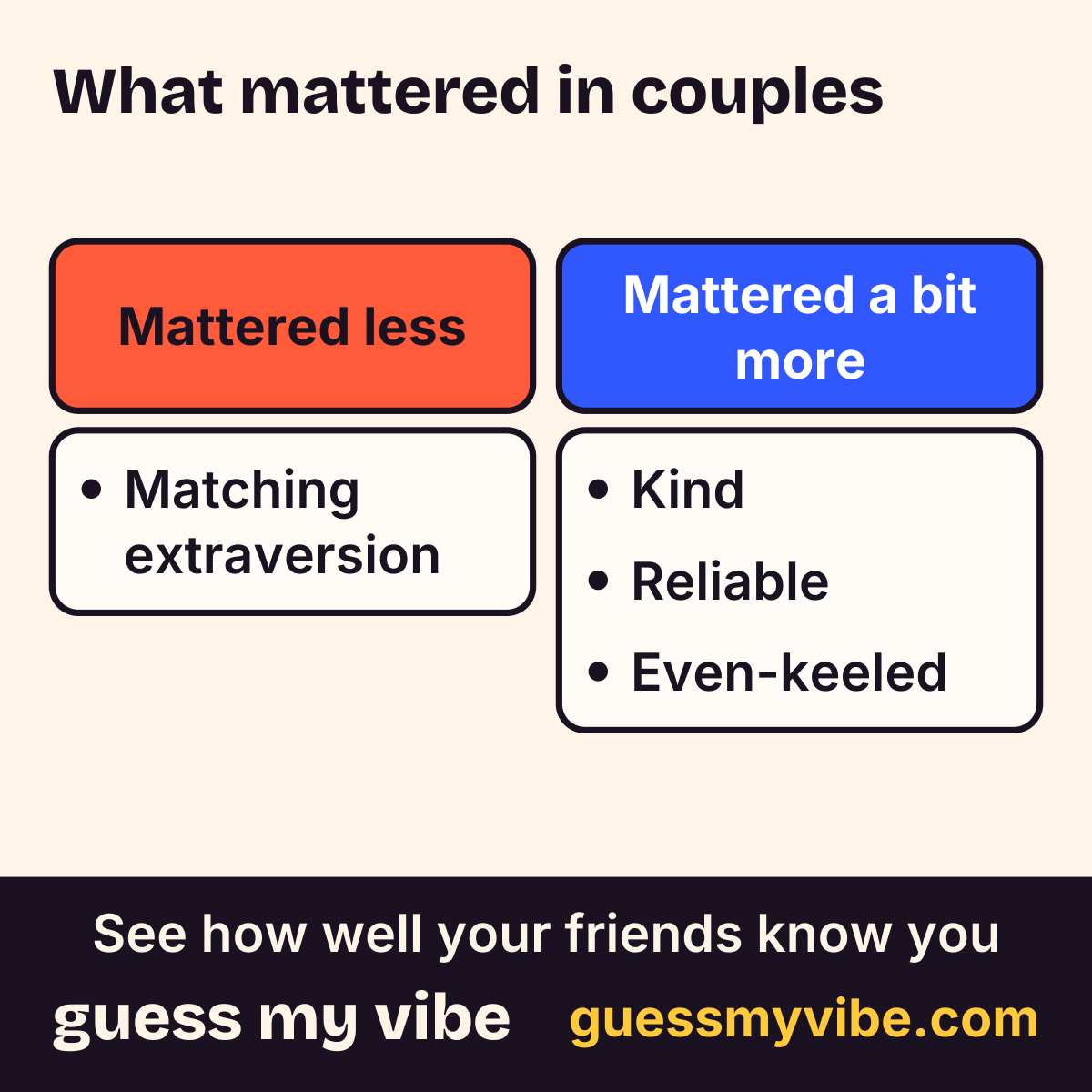
The same three-country study found a partner's own traits mattered modestly more than how well-matched the couple was, accounting for 1-3% of the variance in relationship satisfaction. But here's the detail that matters most for "dating an introvert" specifically: those partner effects were largest for Agreeableness, Conscientiousness, and Emotional Stability (how calm someone stays under stress), not Extraversion [1]. In plain terms, whether your partner is especially introverted or extraverted carries less weight for your own satisfaction than whether they're kind, reliable, and even-keeled. The extraversion-related worry that fuels a lot of "can an introvert and extrovert work" searches isn't where this particular research finds the real signal.
A separate meta-analysis, pooling 19 samples and 3,848 people, did find a specific, modest link worth mentioning: higher extraversion in a partner correlated with more relationship satisfaction reported by that partner, alongside lower neuroticism and higher agreeableness and conscientiousness (openness showed no reliable link) [2]. The abstract doesn't report exact effect sizes trait by trait, only that four of the five traits cleared statistical significance. So there's a small, real average tendency for a more extraverted partner to be more satisfied, but it says nothing about whether the other partner needs to match that extraversion level, and the three-country study above suggests matching barely matters either way [1].
Cite this figure
Figure: "What mattered in couples." Guess My Vibe (guessmyvibe.com). https://guessmyvibe.com/learn/dating-an-introvert#figure-matching-vs-traits
Where the real friction point actually is
If matching extraversion levels isn't the issue the data points to, the practical friction in an introvert-extrovert relationship is more likely to be about pacing and expectations than compatibility itself: how many social plans feel right in a given week, how much warning someone needs before a big gathering, how a quiet night in gets interpreted by the other person (relaxing, versus distant). None of that requires two people to share a trait score. It requires each partner to accurately read what the other one actually wants in a given moment, which is a skill, not a personality match.
There's a genuinely useful piece of research on exactly that skill. A week-long randomized trial had people act more outgoing than usual across several days of ordinary life. It lifted positive mood and feelings of authenticity overall, but the benefit wasn't even: the more introverted participants had weaker mood gains and also reported more negative mood, more tiredness and feeling less like themselves [4]. For a couple, that's a specific, practical thing to know rather than a vague stereotype: saying yes to a bigger social week can be worth it for an introverted partner and still come with a real energy cost afterward, one an extraverted partner may not pay at all. Knowing that in advance beats being surprised by it after the fact.
Curious how your friends would answer?
Free. Answer 10 quick questions about you, then send your link. Friends play in their browser, no app needed.
Start freeThe good news: extraversion is one of the easier traits to read in a partner
Here's a genuine advantage for a couple navigating different extraversion levels: it's one of the more visible Big Five traits. A meta-analysis of 263 samples and more than 44,000 people found extraversion had the highest agreement between self-ratings and a single other person's rating of the five traits (a correlation of about .51 after correcting for measurement error), compared to about .39 for agreeableness, the lowest [3]. In plain terms, a partner's actual social needs and preferences aren't a hidden, hard-to-read mystery the way some personality traits are. If a relationship is paying attention, accurately reading "my partner is close to their limit for this week" is a realistic, learnable thing, not a long shot.
What this means for early dating, before you know someone well
Early on, before a couple has had time to learn each other's rhythms, extraversion differences can look like bigger red flags than the research above suggests they are. A quieter first date isn't necessarily disinterest, and a highly talkative one isn't necessarily a sign of better long-term compatibility; both are just a snapshot of one person's baseline social energy on one night. Since extraversion is comparatively easy to read accurately even from limited exposure [3], it's reasonable to trust an early read on how outgoing someone generally is. It's far less reasonable to treat that read as a verdict on whether the relationship will work, given how small similarity effects turn out to be once a relationship is actually studied [1]. A more useful early question than "are we a match on energy" is simply "do I actually enjoy how this specific person spends their time," though that question is our suggestion, not a research finding; what the research above found mattering more later on were traits like agreeableness, conscientiousness and emotional stability.
The honest takeaway for dating an introvert or an extrovert
Put together, the research doesn't support treating "dating an introvert" (or an extrovert) as a compatibility problem to solve by finding someone just like you. Matching barely moves the needle on satisfaction [1]; the traits that do matter more (agreeableness, conscientiousness, emotional stability) aren't about extraversion at all; and extraversion itself, however different between two partners, is one of the easier things about each other to read accurately [3]. That last point is exactly what Guess My Vibe turns into something playful instead of theoretical: one partner guesses the other's real answers to personality questions, and the score isn't about whether your personalities match, it's about whether you actually know the specific person you're with.
Key takeaways
- Across nationally representative married couples in three countries, how similar two partners' personalities were (including extraversion) explained under 0.5% of the difference in relationship satisfaction [1].
- In that same research, a partner's own traits mattered somewhat more than matching did, but the strongest partner effects came from Agreeableness, Conscientiousness and Emotional Stability, not Extraversion [1].
- A separate meta-analysis of 19 samples found a partner's higher extraversion is modestly linked to more relationship satisfaction, though that analysis didn't test whether partners match [2].
- Extraversion is the trait where other people's ratings agreed most with people's own, which suggests it is relatively easy to read, which makes your partner's social needs easier to pay attention to than you might expect [3].
- This isn't therapy, relationship advice, or a substitute for professional care; it's a plain-English summary of what personality research actually finds.
Questions people ask
Can an introvert and an extrovert really have a happy relationship?
Yes, based on the evidence. Large studies of married couples find that how similar two partners' personalities are, including extraversion, explains under 0.5% of the difference in relationship satisfaction once each partner's own traits are accounted for [1].
Does it matter more if my partner is extraverted, or if we match on extraversion?
A partner's own traits matter a bit more than matching does, but the traits with the strongest link to satisfaction were agreeableness, conscientiousness and emotional stability, not extraversion specifically [1]. A separate meta-analysis found a modest link between a partner's higher extraversion and their own satisfaction, but that analysis didn't test whether the other partner needs to match it [2].
What actually causes friction in introvert-extrovert relationships?
The research points more to pacing and expectations (how much socializing feels right, how plans get interpreted) than to compatibility itself. A week-long study found acting more outgoing costs more introverted people more energy afterward, which is useful to plan around in a relationship rather than being surprised by it [4].
Is it easy to tell what my partner actually needs socially?
Easier than for many personality traits. Extraversion has the highest agreement between self-ratings and other people's ratings of all five Big Five traits, a meta-analysis of over 44,000 people found, so a partner's social needs are relatively visible if you're paying attention [3].
Should I look for a partner with the same personality as me?
Not based on this research. Personality similarity between partners, including on extraversion, explains a very small share of relationship satisfaction. A partner's own traits, especially agreeableness, conscientiousness and emotional stability, mattered more than how alike the two partners' scores were [1].
See how well your friends know you.
Free. Answer 10 quick questions about you, then send your link. Friends play in their browser, no app needed.
Start freeReferences
- [1] Dyrenforth, P. S., Kashy, D. A., Donnellan, M. B., & Lucas, R. E. (2010). Predicting relationship and life satisfaction from personality in nationally representative samples from three countries: The relative importance of actor, partner, and similarity effects. Journal of Personality and Social Psychology, 99(4), 690-702. PubMed: 20718544 (opens in a new tab)
- [2] Malouff, J. M., Thorsteinsson, E. B., Schutte, N. S., Bhullar, N., & Rooke, S. E. (2010). The Five-Factor Model of personality and relationship satisfaction of intimate partners: A meta-analysis. Journal of Research in Personality, 44(1), 124-127. doi.org/10.1016/j.jrp.2009.09.004 (opens in a new tab)
- [3] Connelly, B. S., & Ones, D. S. (2010). An other perspective on personality: Meta-analytic integration of observers' accuracy and predictive validity. Psychological Bulletin, 136(6), 1092–1122. PubMed: 21038940 (opens in a new tab)
- [4] Jacques-Hamilton, R., Sun, J., & Smillie, L. D. (2019). Costs and benefits of acting extraverted: A randomized controlled trial. Journal of Experimental Psychology: General, 148(9), 1538–1556. PubMed: 30489119 (opens in a new tab)
How we find and check these sources: how we write. Spotted an error? Report a correction.
Related
- What Makes Someone a Warm Person?
- How to Make Friends as an Introvert
- Personality and Relationships: What the Research Shows
- Relationship Compatibility: What Research Can Tell You
- Do Opposites Attract? What the Research Actually Says
- Introvert Extrovert Friendship: Why It Works
- Introvert and Introvert Relationship: What Research Says
- Neuroticism in Relationships: What the Research Shows
- First Date Questions: 25 to Ask (and Why Follow-Ups Win)
Cite this article
- Title
- Dating an Introvert: What Research Actually Says
- Publisher
- Guess My Vibe
- Updated
- URL
- https://guessmyvibe.com/
learn/ dating-an-introvert
Copy this citation
Guess My Vibe. (2026, October 3). Dating an Introvert: What Research Actually Says. Guess My Vibe. https://guessmyvibe.com/
To point at one section, add that section's anchor (the # link on its heading) to the URL.