Relationship compatibility isn't mainly about how closely two personality profiles match. A machine-learning study across 43 couples datasets found that how partners actually treat each other day to day explains far more of relationship quality than any individual trait does [1], and separate research found personality similarity between partners explains under 0.5% of the difference in satisfaction [2]. A compatibility test built purely on matching answers is measuring the smallest part of the real picture.
Relationship compatibility: what research can and can't tell you
Most online "compatibility" tests work the same way: answer a set of questions, compare two people's answers, and score how closely they line up. It's an appealing shortcut, and it's measuring close to the least important part of what actually makes two people compatible. The strongest research on this question, a large-scale study using machine learning across dozens of existing datasets, found that matching profiles barely register next to how two specific people actually treat each other [1]. A second line of research, using enormous nationally representative samples, backs this up from a different direction: how similar two partners' personalities are explains well under half a percent of the difference in how satisfied they are [2].
What actually explains relationship quality, according to the biggest study of its kind
In 2020, a large group of relationship researchers pooled 43 separate longitudinal couples datasets from 29 different labs and applied a machine-learning method (random forests) to ask a direct question: out of everything self-report surveys can measure, what actually explains the most variation in relationship quality? The strongest factors were all relationship-specific: how committed a person felt their partner was, how appreciated they felt, sexual satisfaction, how satisfied they believed their partner was, and how conflict got handled between them. Together, these relationship-specific factors explained up to 45% of the difference in relationship quality at the start of a study, and still up to 18% by its end [1].
Individual-difference traits, the kind a personality-matching quiz is built around, explained a respectable 21% on their own, led by life satisfaction, general mood and attachment style, not the Big Five traits most compatibility tests actually measure. But here's the finding that matters most for the word "compatibility" specifically: once a person's own relationship-specific reports were already in the statistical model, their individual-difference traits and even their partner's own ratings added almost nothing further. In plain terms, how you personally experience and describe the relationship carries almost all the useful signal; a separate personality score layered on top of that barely moves the number [1].
Conflict handling deserves a closer look, since it's one of the few relationship-specific factors in that top list that two people can actually work on together, rather than a fixed trait either of them brings in. The same 43-dataset study didn't need to compare personality types to find that how couples navigate disagreement carries real weight for relationship quality; it showed up as one of the strongest relationship-specific factors across 29 different labs' worth of couples, studied in dramatically different ways and contexts [1]. That's a genuinely different kind of compatibility question than "do our personalities match": it's "what actually happens between us when something goes wrong," which a one-time quiz answered separately by each person can't see at all.
Curious how your friends would answer?
Free. Answer 10 quick questions about you, then send your link. Friends play in their browser, no app needed.
Start freeDoes matching personalities actually matter for compatibility?
Only a little, and the data behind that answer is about as solid as personality research gets. Researchers compared married couples from Australia (5,278 people), the United Kingdom (6,554 people) and Germany (11,418 people), looking specifically at how much couple similarity (how alike two partners' personalities are) explains relationship satisfaction, after accounting for each person's own traits and their partner's traits separately. The answer, consistent across all three countries: under 0.5% of the difference in satisfaction comes from similarity itself [2]. That's not a rounding error worth arguing with. Matching on a personality test is close to the least informative thing a compatibility check could measure.
This doesn't mean personality is irrelevant to compatibility altogether. A separate meta-analysis of 19 samples and 3,848 people found that lower Neuroticism, and higher Agreeableness, Conscientiousness and Extraversion, each went with a partner reporting more satisfaction, regardless of whether the two partners were alike on those traits or not [3]. In other words: your traits matter somewhat, your partner's traits matter somewhat, but whether your two sets of traits match each other barely matters at all.
The part a matching quiz can't see: how you actually see each other
If matching real traits isn't where the signal is, something else has to explain why some couples with wildly different personalities feel deeply compatible. One well-known study of 82 married and 98 dating couples offers a clue: people who saw their partner in a more positive light than the partner saw themselves (controlling for the partner's own self-reported traits) reported meaningfully higher satisfaction, and being seen that generously by one's own partner independently went with higher satisfaction too [4]. That's a finding about perception, not about matching, and it tracks with the machine-learning study's own emphasis on felt commitment and appreciation over any objective trait comparison. A companion article on this site, positive illusions, goes deeper into this specific finding.
What a real compatibility check would actually need to measure
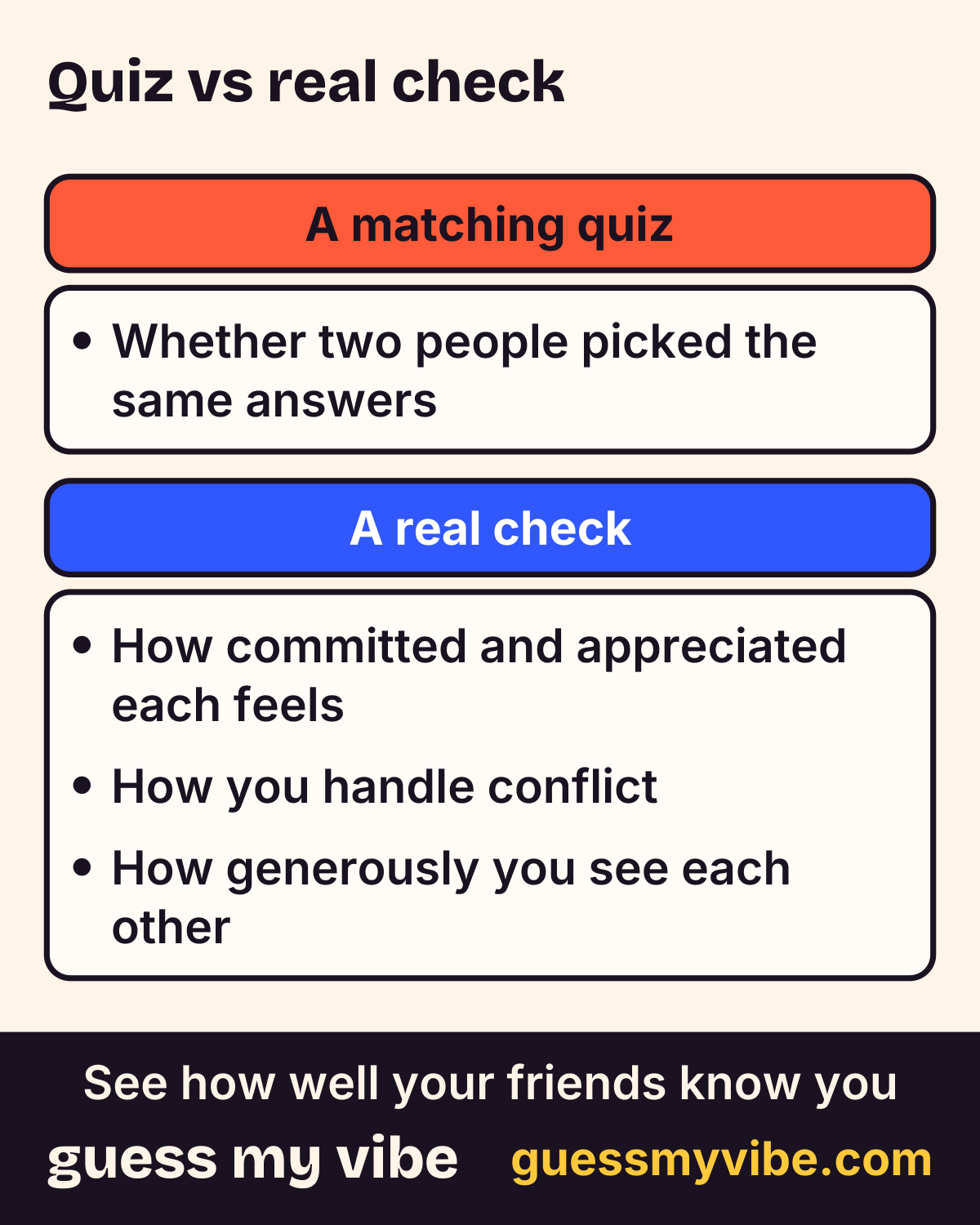
Put the research together and an honest compatibility check looks less like a matching quiz and more like a short list: how committed and appreciated each person actually feels, how the two of you handle conflict when it comes up, and how generously each of you sees the other, next to (not instead of) each person's own general tendencies like stress-reactivity and warmth. None of that shows up on a quiz that only checks whether two people picked the same multiple-choice answer. It shows up in how two specific people actually experience being together, day to day, which is exactly the part a one-time matching score is built to miss.
Cite this figure
Figure: "Quiz vs real check." Guess My Vibe (guessmyvibe.com). https://guessmyvibe.com/learn/relationship-compatibility#figure-quiz-vs-real-check
See where your own answers actually line up
Guess My Vibe isn't a matching quiz either, by design. Instead of scoring how similar two people's answers are, it has one person guess the other's honest answers to real personality questions, then shows exactly where that guess held up and where it didn't, trait by trait. It's a closer match to what this research actually points to: not whether your profiles line up, but whether you really see each other the way you think you do.
Key takeaways
- A machine-learning study across 43 longitudinal couples datasets found relationship-specific habits (felt commitment, appreciation, how conflict gets handled) explained up to 45% of the difference in relationship quality; a partner's own personality or life satisfaction added almost nothing extra [1].
- How similar two partners' personalities are to each other explains under 0.5% of the difference in satisfaction, in nationally representative samples from three different countries [2].
- Some individual traits do go with happier partners on average (lower Neuroticism, higher Agreeableness, Conscientiousness and Extraversion), but the effect is modest next to how two people actually treat each other [3].
- Seeing a partner more generously than the partner sees themselves goes with higher satisfaction, in both dating and married couples, regardless of how closely the two people's traits actually match [4].
- This isn't therapy, a diagnosis, or a substitute for professional care.
Questions people ask
Does matching personality profiles actually mean two people are compatible?
Not much, according to the data. How similar two partners' personalities are explained under 0.5% of the difference in relationship satisfaction across large representative samples from three countries [2], and a separate machine-learning study across 43 datasets found relationship-specific factors (felt commitment, appreciation, conflict) explained far more than any trait comparison [1].
What does research say actually matters for a good relationship, if not matching?
Relationship-specific experiences: how committed and appreciated each partner feels, sexual satisfaction, and how conflict gets handled. Together those explained up to 45% of the difference in relationship quality at the start of a study, far more than any individual personality trait [1].
Are some personality traits still linked to happier relationships?
Yes, modestly. Lower Neuroticism, and higher Agreeableness, Conscientiousness and Extraversion, each went with a partner reporting more satisfaction across a meta-analysis of 19 samples [3]. The effect is real but small next to how two people actually treat each other.
Can a compatibility test actually tell me if I'm compatible with someone?
Only partly, and only if it looks at how you two actually treat and perceive each other rather than just comparing self-reported traits. A test built purely on matching answers measures close to the least informative part of what the research finds matters [1] [2].
Is it a problem if my partner and I have very different personalities?
No, not based on this research. Personality similarity explains under 0.5% of the difference in relationship satisfaction once each person's own traits are accounted for [2]. How you treat and see each other matters far more than how alike you are.
See how well your friends know you.
Free. Answer 10 quick questions about you, then send your link. Friends play in their browser, no app needed.
Start freeReferences
- [1] Joel, S., Eastwick, P. W., Allison, C. J., Arriaga, X. B., Baker, Z. G., et al. (2020). Machine learning uncovers the most robust self-report predictors of relationship quality across 43 longitudinal couples studies. Proceedings of the National Academy of Sciences, 117(32), 19061-19071. PubMed: 32719123 (opens in a new tab)
- [2] Dyrenforth, P. S., Kashy, D. A., Donnellan, M. B., & Lucas, R. E. (2010). Predicting relationship and life satisfaction from personality in nationally representative samples from three countries: The relative importance of actor, partner, and similarity effects. Journal of Personality and Social Psychology, 99(4), 690-702. PubMed: 20718544 (opens in a new tab)
- [3] Malouff, J. M., Thorsteinsson, E. B., Schutte, N. S., Bhullar, N., & Rooke, S. E. (2010). The Five-Factor Model of personality and relationship satisfaction of intimate partners: A meta-analysis. Journal of Research in Personality, 44(1), 124-127. doi.org/10.1016/j.jrp.2009.09.004 (opens in a new tab)
- [4] Murray, S. L., Holmes, J. G., & Griffin, D. W. (1996). The benefits of positive illusions: Idealization and the construction of satisfaction in close relationships. Journal of Personality and Social Psychology, 70(1), 79-98. doi.org/10.1037/0022-3514.70.1.79 (opens in a new tab)
How we find and check these sources: how we write. Spotted an error? Report a correction.
Related
- Personality and Relationships: What the Research Shows
- Positive Illusions: Why Idealizing Your Partner Helps
- Friendship Compatibility: What Actually Makes It Work
- Do Opposites Attract? What the Research Actually Says
- Couple Compatibility Test: What It Can and Can't Tell You
- Love Languages: What the Research Actually Shows
Cite this article
- Title
- Relationship Compatibility: What Research Can Tell You
- Publisher
- Guess My Vibe
- Updated
- URL
- https://guessmyvibe.com/
learn/ relationship-compatibility
Copy this citation
Guess My Vibe. (2026, October 3). Relationship Compatibility: What Research Can Tell You. Guess My Vibe. https://guessmyvibe.com/
To point at one section, add that section's anchor (the # link on its heading) to the URL.