Positive illusions are the tendency to see a romantic partner a little more generously than the partner sees themselves, and research finds this goes with a happier relationship, not a less honest one. A study of married and dating couples found people who idealized their partner this way reported meaningfully higher satisfaction, and being idealized by one's own partner went with higher satisfaction too [1].
What are positive illusions, exactly?
Positive illusions is the name researchers gave to a specific, measurable pattern: people in close relationships tend to see their partner in a more flattering light than the partner's own self-reported traits would justify, and that gap goes with being happier together, not with being less in touch with reality. It sounds like it should be a bad thing. "Illusion" usually means being fooled. But in this specific research, the illusion isn't a blindfold. It's closer to a generous reading of an ordinary, imperfect person, and the research finds that generous reading tends to be good for the relationship, not a warning sign.
Cite this figure
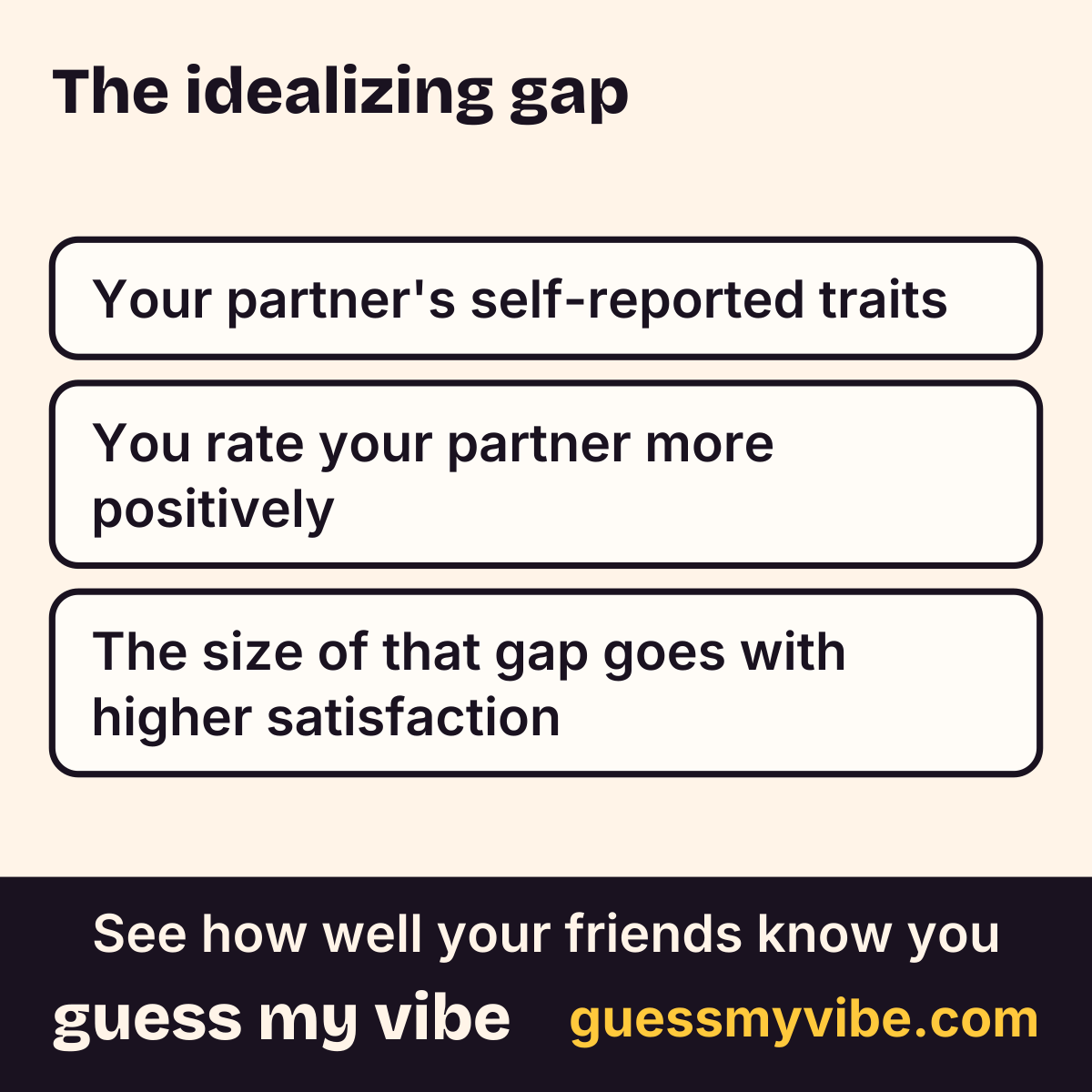
Figure: "The idealizing gap." Guess My Vibe (guessmyvibe.com). https://guessmyvibe.com/learn/positive-illusions#figure-the-idealizing-gap
The study behind the idea
The core research here asked both members of 82 married couples and 98 dating couples to rate themselves, their own partner, their ideal partner, and a "typical" partner, all on the same set of traits (kindness, patience, being critical, and so on). This design let researchers separate how someone's partner actually saw themselves from how that person was seen by their own romantic partner. Overall, people rated their partner's qualities more positively than their partner rated their own qualities, a gap of roughly a quarter point on a 9-point scale for married couples, and a bigger gap for dating couples [1].
The part that actually matters for compatibility: the size of that idealizing gap, specific to each person's own partner rather than to people in general, went with meaningfully higher relationship satisfaction. In statistical terms, the link between idealizing a partner and feeling happier was strong and reliable in both the married sample (a standardized path coefficient around .34) and the dating sample (around .53), both clearing the threshold researchers use for a dependable finding. Being idealized by one's own partner, separately, also went with higher satisfaction in both samples [1]. A partner's own self-rated traits, on their own, barely moved satisfaction once idealization was in the picture.
The same study also checked whether this was really a matter of distortion, not just interpretation: did people actually rate their partner's qualities more positively than the partner rated their own? For married couples, yes: partners were rated an average of 6.51 out of 9 on the measured traits, compared to 6.24 when people rated their own traits, a reliable difference. Dating couples showed the same basic pattern (6.70 versus 6.30), though it was driven mostly by women idealizing their partners; dating men's ratings of their partners barely differed from their partners' self-ratings [1]. Everyone in the study also rated their own actual partner more positively than they rated a "typical" partner in general, which rules out the simplest alternative explanation, that people are just relentlessly positive about everyone. The generosity was specific to the one person they were actually with.
Curious how your friends would answer?
Free. Answer 10 quick questions about you, then send your link. Friends play in their browser, no app needed.
Start freeThis isn't about ignoring who someone actually is
It's worth being precise about what this research is and isn't saying. The couples in this study weren't inventing virtues out of nothing. They were interpreting a real, if imperfect, person in the most generous light a reasonable reading of that person could support, the kind of thing that turns "stubborn" into "has strong convictions" rather than the other way around. That's a very different thing from overlooking behavior that actually causes harm, which this research doesn't address and this article isn't a guide to. Positive illusions describes how people interpret ordinary, everyday flaws and quirks, not a reason to excuse something that genuinely hurts you. If something in a relationship feels unsafe or seriously wrong, that calls for a different kind of attention than a personality study can offer.
Seeing people generously isn't only a romance thing
The same basic self-vs-other gap shows up outside romantic relationships too, under a related name: assumed similarity, the tendency to see other people as more like yourself than they actually are. A meta-analysis of 24 studies on how people judge one another confirmed this is its own measurable pattern, separate from how similar two people's personalities really are [2]. A separate study following new college friendships for a full year found that believing you were similar to a new friend tracked with how close that friendship became better than actually being similar did [4]. The pattern in positive illusions research and the pattern in ordinary friendship-forming look like the same underlying habit: people who matter to us get read through a kinder, more flattering lens than a stranger would use, and that kinder lens tends to help the relationship along rather than hurt it.
Why idealizing fits the data better than matching does
This also helps explain a finding that otherwise looks strange: personality similarity between partners barely matters. Across nationally representative married-couple samples from three countries, how similar two partners' personalities actually were explained under 0.5% of the difference in their relationship satisfaction, once each person's own traits were accounted for [3]. If matching barely matters but happy couples clearly share something, idealization is a much better candidate for what that something is: not two profiles that line up on paper, but two people who've each decided, in their own heads, to see the other as a little better than a strict accounting of the evidence would say. That's not dishonesty. It's a documented, specific way people build satisfaction in a relationship that a simple trait-matching score was never going to capture.
There's one more piece worth knowing, since it cuts against a reasonable worry: that idealizing someone just sets a relationship up to disappoint later, once the gap between the illusion and the real person becomes impossible to ignore. The same study found the opposite tendency in its data. Even unmet, high ideals for a partner went with higher satisfaction for married couples specifically, not lower, once the researchers accounted for how the partner actually saw themselves [1]. Holding a generous, hopeful picture of a partner didn't set couples up for a letdown in this data; it went with feeling more satisfied, not less, even when that picture ran ahead of the partner's own self-view.
See your own gap between self-view and partner-view
Guess My Vibe is built around exactly this kind of comparison, just made visible instead of left as a quiet assumption: one person answers honestly about themselves, the other guesses those answers, and the two views sit side by side. Played with a partner, it's a two-minute look at where your read on each other is generous, accurate, or genuinely off, the same self-vs-other gap this research has been studying for decades.
Key takeaways
- People who saw their partner more positively than the partner saw themselves (controlling for the partner's own self-reported traits) reported higher relationship satisfaction, in both married couples and dating couples [1].
- Being idealized by your own partner independently went with higher satisfaction too, separate from how you saw them [1].
- This self-vs-other gap isn't unique to romance: people generally see other people as more similar to themselves than those people actually are, a well-documented bias called assumed similarity [2].
- Idealizing a partner is a better match for what the research finds than trying to match personality profiles exactly: how similar two partners actually are explains under 0.5% of the difference in satisfaction [3].
- This isn't therapy, a diagnosis, or a substitute for professional care.
Questions people ask
What does "positive illusions" mean in relationship psychology?
It's the tendency to see a romantic partner more positively than the partner's own self-reported traits would justify. Research finds this gap goes with higher relationship satisfaction, not with being out of touch with who the partner really is [1].
Is idealizing your partner actually good for the relationship?
Research on 82 married and 98 dating couples found yes: idealizing a partner went with meaningfully higher satisfaction in both samples, and being idealized by one's own partner independently went with higher satisfaction too [1].
Does idealizing a partner mean ignoring their flaws or real problems?
No. The research describes a generous interpretation of ordinary, everyday traits and quirks, not a reason to excuse behavior that actually causes harm. This isn't therapy or safety guidance, and nothing here should be read as advice to overlook something genuinely wrong in a relationship.
Is this the same thing as having a similar personality to your partner?
No, and that's part of the point. Personality similarity between partners explains under 0.5% of the difference in relationship satisfaction [3]. Idealization is about how generously you interpret your partner, not about how closely your two personalities match.
Do people idealize friends the same way they idealize partners?
A related pattern, assumed similarity, shows people generally see others as more like themselves than those people really are [2], and believing you're similar to a new friend tracked with closeness better than actually being similar did [4]. It's the same broad habit of generous perception showing up outside romance.
See how well your friends know you.
Free. Answer 10 quick questions about you, then send your link. Friends play in their browser, no app needed.
Start freeReferences
- [1] Murray, S. L., Holmes, J. G., & Griffin, D. W. (1996). The benefits of positive illusions: Idealization and the construction of satisfaction in close relationships. Journal of Personality and Social Psychology, 70(1), 79-98. doi.org/10.1037/0022-3514.70.1.79 (opens in a new tab)
- [2] Kenny, D. A., & West, T. V. (2010). Similarity and agreement in self- and other perception: A meta-analysis. Personality and Social Psychology Review, 14(2), 196-213. PubMed: 20142435 (opens in a new tab)
- [3] Dyrenforth, P. S., Kashy, D. A., Donnellan, M. B., & Lucas, R. E. (2010). Predicting relationship and life satisfaction from personality in nationally representative samples from three countries: The relative importance of actor, partner, and similarity effects. Journal of Personality and Social Psychology, 99(4), 690-702. PubMed: 20718544 (opens in a new tab)
- [4] Selfhout, M., Denissen, J., Branje, S., & Meeus, W. (2009). In the eye of the beholder: Perceived, actual, and peer-rated similarity in personality, communication, and friendship intensity during the acquaintanceship process. Journal of Personality and Social Psychology, 96(6), 1152–1165. PubMed: 19469593 (opens in a new tab)
How we find and check these sources: how we write. Spotted an error? Report a correction.
Related
Cite this article
- Title
- Positive Illusions: Why Idealizing Your Partner Helps
- Publisher
- Guess My Vibe
- Updated
- URL
- https://guessmyvibe.com/
learn/ positive-illusions
Copy this citation
Guess My Vibe. (2026, October 3). Positive Illusions: Why Idealizing Your Partner Helps. Guess My Vibe. https://guessmyvibe.com/
To point at one section, add that section's anchor (the # link on its heading) to the URL.