Mostly no: decades of research on similarity and attraction find that people are drawn to others who are like them, not unlike them, and "birds of a feather flock together" is closer to true than "opposites attract." The twist is that feeling similar to someone matters more than actually being similar, especially once you've gotten to know them [1]. There's one narrow, well-studied exception: in how two people actually behave toward each other in the moment, like how assertive each person is, a little bit of opposite does pull people together [2].
Do opposites attract? Mostly not, and here's why the myth sticks around
"Opposites attract" is one of the most repeated ideas about relationships, and it's mostly not what the research finds. Personality and social psychology's actual track record points the other way: people like, befriend, and date people who are similar to them far more reliably than people who are different. The catchier way researchers put it is "birds of a feather flock together," and it has a lot more evidence behind it than its rival. The twist isn't that the saying is simply wrong, it's that the similarity doing most of the work isn't always the similarity that's actually there. It's the similarity you believe is there.
Actual similarity vs. perceived similarity: the real split
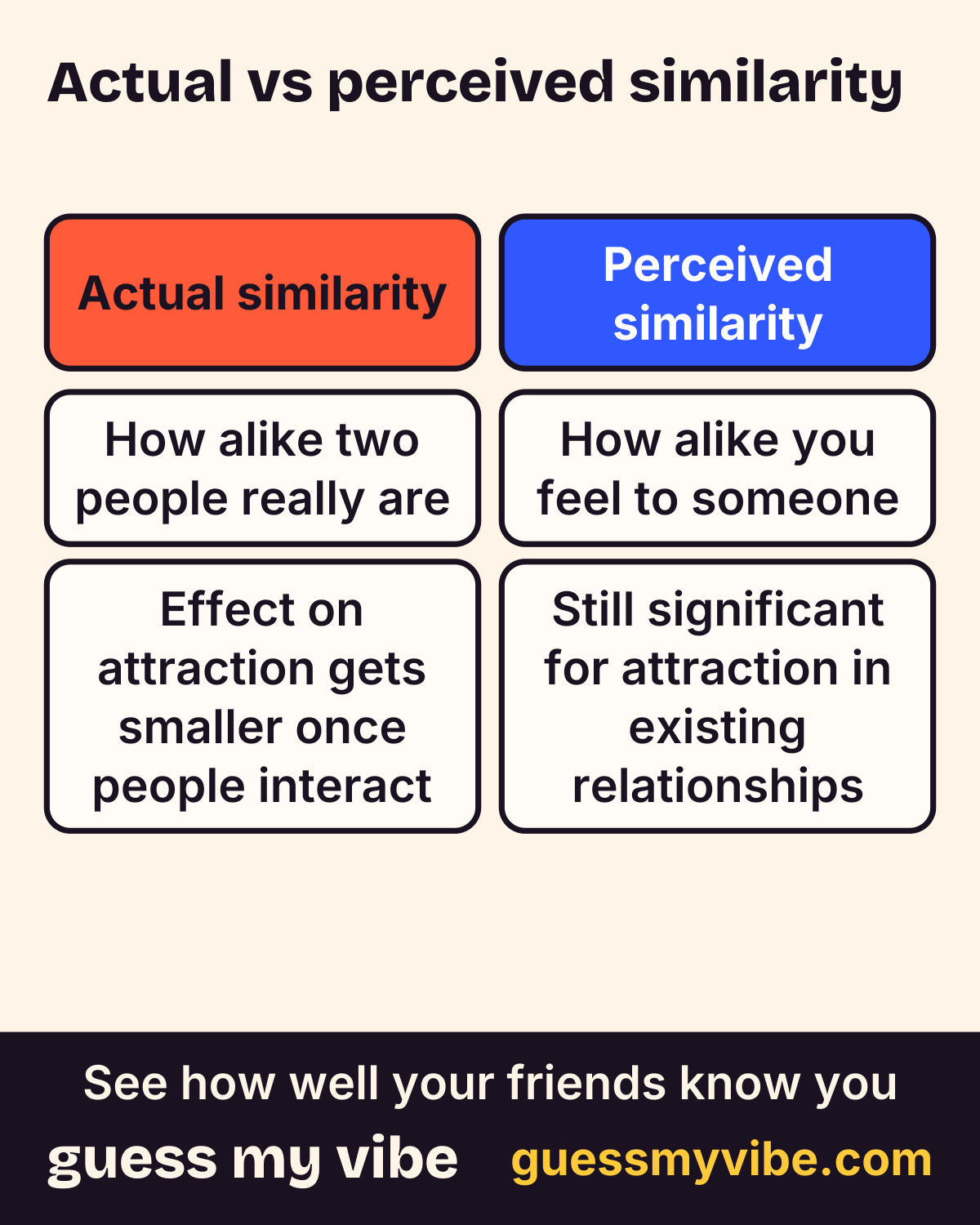
A 2008 meta-analysis pulled together 460 effect sizes from 313 studies to settle exactly this question: does actually being similar to someone drive attraction, or does believing you're similar do the real work [1]. Both mattered, on average. Actual similarity (real overlap in traits, attitudes, or background) correlated with attraction at about .47, and perceived similarity (just feeling like you're alike) correlated at about .39. Both are real, moderate-to-large relationships; neither is a coin flip.
The part worth remembering is what happened once people actually interacted. Actual similarity's effect got noticeably smaller once a study involved real interaction instead of just reading a stranger's profile, and in already-existing relationships, actual similarity's link to attraction wasn't statistically significant at all. Perceived similarity, by contrast, kept going with more attraction across short interactions and existing relationships alike. Once two people actually know each other, in other words, it's not how alike they really are that keeps the attraction going. It's how alike they feel.
That pattern also explains something that can feel confusing about dating profiles and quick first impressions: actual similarity (shared interests listed on a profile, matching answers on an app) really did matter most in the earliest stage, before two people had actually interacted, and in brief, first-encounter studies [1]. It's a real signal worth paying attention to on a first swipe or a first conversation. It just isn't the thing doing the work a few months into an actual friendship or relationship, once perceived similarity has taken over as the stronger force behind how the two people feel about each other.
Cite this figure
Figure: "Actual vs perceived similarity." Guess My Vibe (guessmyvibe.com). https://guessmyvibe.com/learn/do-opposites-attract#figure-actual-vs-perceived
Why "we're so alike" is partly a bias, not a discovery
There's a reason perceived similarity runs ahead of actual similarity: people have a built-in habit of assuming others are more like them than they really are. A 2010 meta-analysis of 24 studies on person perception studied exactly this pattern, under the name assumed similarity, how much someone sees another person as being like themselves, treating it as its own measurable judgment, distinct from simply judging how alike two other people are to each other [3]. That means some of what feels like "we just click because we're so alike" can be a mental shortcut running quietly in the background, projecting your own traits and opinions onto someone you like, rather than a discovery you made by carefully comparing notes.
Curious how your friends would answer?
Free. Answer 10 quick questions about you, then send your link. Friends play in their browser, no app needed.
Start freeThe one real exception: complementarity, but only in a narrow sense
If "opposites attract" has a real foothold anywhere in the research, it's here, and it's much narrower than the folk version of the idea. A study followed 102 college roommate duos at 2 weeks and again at 15 weeks living together, tracking how their actual behavioral styles meshed [2]. By 15 weeks, their behavior had become genuinely complementary, but only on dominance: one roommate tended to take the more assertive role in their day-to-day interactions while the other took the more yielding one. On warmth, the opposite pattern held: similarity, not opposition, is what tracked with a smoother dynamic. And tellingly, each roommate's sense of their own personality barely budged based on who they were living with. Complementarity, where it's real, is about how two specific people behave toward each other moment to moment on one narrow dimension, not a rule that opposite personalities as a whole get along better.
Do friends actually end up with similar personalities?
A separate line of research asked the "birds of a feather" question the hard way: not by asking people to rate their own personality (which is exactly where assumed similarity can creep in) but by measuring personality from real digital behavior. Across more than 46,000 friend duos, this approach found friends really were meaningfully alike in personality, with correlations roughly between .12 and .31 depending on the trait, a real but modest overlap, not a near-match [4]. The researchers' own explanation for why earlier self-report studies had sometimes missed this: people tend to rate themselves relative to whoever they happen to be comparing themselves with, which can hide a real pattern that shows up once you look at what people actually do instead of what they say about themselves.
That figure, spanning more than 46,000 ordinary friendships rather than a handful of exceptional ones, also undercuts a specific, common worry: that finding a friend who's genuinely "like you" takes a rare stroke of luck. A real, modest personality overlap showing up at that scale looks less like a lottery win and more like the normal, unremarkable outcome of spending real time with people you already liked for other reasons.
Why this is more than a trivia answer
None of this says similarity is destiny or that a close friendship with someone very different from you is somehow working against the odds. It says something more useful: the comfortable feeling of "we're basically the same person" is doing a lot of the attraction's heavy lifting, and that feeling can run ahead of the facts. That's a completely normal part of how attraction works, not a problem to fix. It's also exactly the kind of gap a friend's honest guesses can expose, where you actually line up with someone versus where you've just been assuming you do, trait by trait instead of as one vague vibe. Guess My Vibe turns that into a two-minute comparison: you each answer the same personality questions, and you see your real overlap next to each other instead of guessing at it.
Key takeaways
- "Birds of a feather" has far more research behind it than "opposites attract." A meta-analysis of over 300 studies found both actual and perceived similarity go with more attraction, but once people actually know each other, only perceived similarity keeps mattering [1].
- Assumed similarity, quietly expecting other people to be like you, is a well-documented pattern researchers can measure on its own, separate from simply judging how alike two other people seem [3].
- The real exception to "similar people get along" is narrow: new roommates' day-to-day behavior became more complementary on assertiveness specifically over 15 weeks living together, not on warmth, where similarity still won out [2].
- Friends really are somewhat alike in personality, once it's measured from actual behavior instead of a self-report survey, though the overlap is real but modest [4].
- This isn't therapy, a diagnosis, or a substitute for professional care.
Questions people ask
Do opposites really attract?
Mostly no. Research consistently finds similarity, especially perceived similarity, goes with more attraction than being opposite does. The one well-documented exception is narrow: close duos like roommates can develop complementary behavior specifically around assertiveness, not across personality generally [1] [2].
Is 'birds of a feather flock together' more accurate than 'opposites attract'?
Yes, by a wide margin in the research literature. A large meta-analysis found both actual and perceived similarity go with more attraction, with perceived similarity remaining significant even in existing relationships, while actual similarity's effect shrank once people had really interacted [1].
What's the difference between actual similarity and perceived similarity?
Actual similarity is how alike two people really are, measured independently of either person's opinion. Perceived similarity is how alike you feel to someone, partly a real reflection of actual similarity and partly a measurable bias researchers call assumed similarity, projecting your own traits onto other people [3].
Do close friends actually have similar personalities?
A little, measured carefully. A study using real behavior instead of self-report surveys found friends share a real but modest personality overlap, roughly .12 to .31 depending on the trait, across more than 46,000 friend duos [4].
Why does 'opposites attract' feel true even though the research says otherwise?
Partly because the one real, narrow exception (complementary behavior on dominance between close partners) is memorable and gets generalized into a bigger claim than the data supports, and partly because a strong initial spark with someone different from you stands out more than the much more common pattern of being drawn to people who are actually like you.
See how well your friends know you.
Free. Answer 10 quick questions about you, then send your link. Friends play in their browser, no app needed.
Start freeReferences
- [1] Montoya, R. M., Horton, R. S., & Kirchner, J. (2008). Is actual similarity necessary for attraction? A meta-analysis of actual and perceived similarity on attraction. Journal of Social and Personal Relationships, 25(6), 889-922. doi.org/10.1177/0265407508096700 (opens in a new tab)
- [2] Markey, P. M., & Kurtz, J. E. (2006). Increasing acquaintanceship and complementarity of behavioral styles and personality traits among college roommates. Personality and Social Psychology Bulletin, 32(7), 907-916. PubMed: 16738024 (opens in a new tab)
- [3] Kenny, D. A., & West, T. V. (2010). Similarity and agreement in self- and other perception: A meta-analysis. Personality and Social Psychology Review, 14(2), 196-213. PubMed: 20142435 (opens in a new tab)
- [4] Youyou, W., Schwartz, H. A., Stillwell, D., & Kosinski, M. (2017). Birds of a feather do flock together: Behavior-based personality-assessment method reveals personality similarity among couples and friends. Psychological Science, 28(3), 276–284. PubMed: 28059682 (opens in a new tab)
How we find and check these sources: how we write. Spotted an error? Report a correction.
Related
- Friendship Compatibility: What Actually Makes It Work
- BFF Test: A Real One to Take With Your Best Friend
- Self-Perception vs. How Others See You
- Attraction Psychology: 4 Forces That Draw People Together
- Assumed Similarity: Why You Think Friends Are More Like You
- The False Consensus Effect: Why You Assume Others Agree
- Do You Become Like Your Friends? What Research Says
- Friends With Different Personalities: When Opposites Work
- Ideal Partner: Why Your List Doesn't Match Who You Like
- Do Couples Look Alike? A Classic Finding Didn't Replicate
More in Similarity, attraction and compatibility
- Attractive Personality Traits: What Research Says Matters
- Do Couples Look Alike? A Classic Finding Didn't Replicate
- Friendship Compatibility: What Actually Makes It Work
- Attraction Psychology: 4 Forces That Draw People Together
- Assumed Similarity: Why You Think Friends Are More Like You
- The False Consensus Effect: Why You Assume Others Agree
- Do You Become Like Your Friends? What Research Says
- Friends With Different Personalities: When Opposites Work
- Instant Connection: Why You Click With Some People Fast
Cite this article
- Title
- Do Opposites Attract? What the Research Actually Says
- Publisher
- Guess My Vibe
- Updated
- URL
- https://guessmyvibe.com/
learn/ do-opposites-attract
Copy this citation
Guess My Vibe. (2026, October 3). Do Opposites Attract? What the Research Actually Says. Guess My Vibe. https://guessmyvibe.com/
To point at one section, add that section's anchor (the # link on its heading) to the URL.