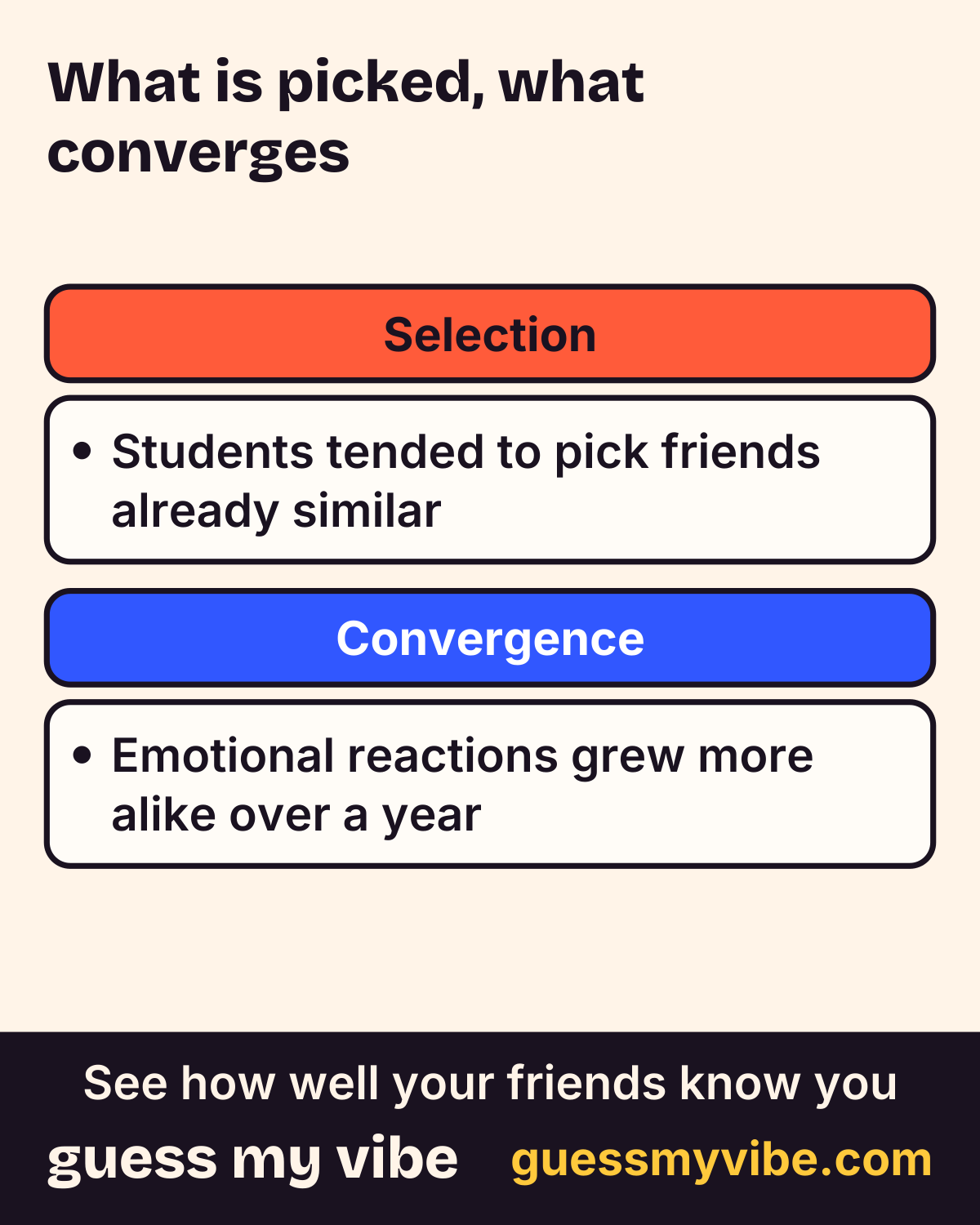
A lot of the match is there from the start: in a study following friendships forming across a first university year, students tended to pick friends already similar in Agreeableness, Extraversion and Openness [1]. That study tracked who picked whom, not whether anyone's personality shifted afterward. What actually does converge over time, measurably, is how you respond emotionally: a year-long study of dating partners and college roommates found their emotional reactions grew more alike the longer they spent together, even though this is a different thing from your personality changing [2].
"You become like the people you spend the most time with" gets repeated so often it sounds like settled science. The real research is more specific, and more interesting, than the saying. Most of what looks like friends "becoming alike" actually happened before the friendship even started: people tend to pick friends who are already a bit like them. What genuinely does shift once a friendship is underway isn't your personality in the broad sense, it's something narrower: how your emotions respond to things, day to day, next to someone you spend a lot of time with.
Do you become like your friends, or did you pick one who was already like you?
A study that followed 205 incoming university students across their entire first year answers this about as directly as a study can. Researchers mapped the whole friendship network forming from scratch, at five points over the year, and watched who became friends with whom [1]. The pattern: more extraverted students ended up with more friends overall, more agreeable students got picked as friends more often, and when it came to extraversion, agreeableness, and openness specifically, students leaned toward choosing friends who were already similar to themselves. That's selection at work, and this study can't say how much, if any, transformation happens afterward. By the time two people call each other friends, a meaningful chunk of their similarity was already there on day one.
This matters because it changes the question people are actually asking when they say "do you become like your friends." The honest version of the question splits into two different things: did a friendship change you, or did you just notice the parts of yourself that were already similar to theirs? Friendship-formation research is at least consistent with the second one. A review pulling together the Big Five research on friendship discusses personality similarity between friends as a "dyadic effect," one of the two-person factors in how friendships develop, alongside who initiates and who ends them [4].
What actually does change: emotional convergence
None of that means close relationships leave you completely unchanged. One specific thing does shift, and it's been measured directly: how you emotionally react to things. A study tracked dating couples and college roommates over roughly a year, using lab tasks that triggered real emotional responses rather than just asking people how they felt in general [2]. By the end of the year, both dating partners and roommates had become more similar to each other in their emotional reactions than they were at the start. That's emotional convergence, a real and specific phenomenon, and it's a different thing from your broader personality (how outgoing, organized, or curious you are) shifting to match a friend's.
Two more details from that study are worth knowing. First, convergence wasn't symmetrical: whichever partner had less power in the relationship did more of the emotional adjusting. Second, convergence wasn't neutral or incidental. The couples and roommates who grew more similar emotionally over the year reported more cohesion and were less likely to break up or stop being roommates by the study's end. The researchers' own read on why this happens: shared emotional responses help two people coordinate, understand each other faster, and feel more like a unit, which is a genuinely useful thing for a relationship to have, whether it's romantic or a friendship.
Curious how your friends would answer?
Free. Answer 10 quick questions about you, then send your link. Friends play in their browser, no app needed.
Start freeSo how similar are close friends, really?
Put selection and convergence together and ask the bottom-line question: are close friends actually alike in personality? A study that measured personality from real digital behavior instead of self-report surveys, across more than 46,000 friend duos, found yes, modestly [3]. The overlap ran roughly from .12 to .31 depending on which trait was measured, a real pattern but a long way from a personality match. That number is the combined result of everything above: some of it is people picking friends who were already a little like them, and some of it may be the kind of emotional convergence described above nudging things slightly further, though the friend study itself didn't separate out how much of the overlap came from which source.
The honest takeaway sits between two overclaims people make in either direction. "You'll turn into whoever you hang out with" overstates it: your core traits are considerably more stable than that, and most of the similarity you already share with a close friend was there before the friendship, not caused by it. "Friends have zero effect on you" overstates it the other way: something measurable does converge the longer you spend real time with someone, it's just narrower and more specific (emotional responses, not your whole personality) than the folk version of the idea suggests.
Cite this figure
Figure: "What is picked, what converges." Guess My Vibe (guessmyvibe.com). https://guessmyvibe.com/learn/do-you-become-like-your-friends#figure-selection-vs-convergence
Why peer influence feels like more than the research shows
"Peer influence" gets searched a lot more than the specific research term "emotional convergence," and the gap between the two phrases says something. People notice the moments that feel like influence (picking up a friend's slang, adopting a hobby, reacting to news the way your group chat does) and build a bigger story out of them than the underlying trait data supports. Agreeableness has the most consistent documented effects on how friendships form and last, followed by neuroticism, while extraversion, conscientiousness, and openness matter but less consistently across different studies [4]. None of that is the same claim as "your friends reshape who you fundamentally are." It's closer to: certain traits make someone easier to befriend and keep as a friend, and those traits are things people bring to a friendship.
Seeing where this actually shows up in your own friendships
If you want to see the selection-vs-convergence split play out somewhere concrete, personality is the easiest place to look. Guess My Vibe has you and a friend each answer the same personality questions, then shows exactly where your real answers line up and where they don't, trait by trait, instead of leaving it as a vague "we're basically the same person" feeling. Where you already matched going in is selection; it was there before the friendship. If a future round shows you drifting slightly closer on a specific trait over months of answering together, that's closer to the narrower kind of change the research above actually documents, not a personality transplant.
Key takeaways
- Do you become like your friends? Partly the similarity is there from the start. New friendships form partly through selection (students tended to pick friends already similar in Agreeableness, Extraversion and Openness) [1]; that study didn't test whether friends reshape each other's traits.
- What does change with a close friend or partner is emotional convergence: a year-long study found dating partners and college roommates grew more alike in how they emotionally reacted to things; the study measured emotional responses, not broader personality [2].
- In that same study, the person with less power in the relationship did more of the emotional adjusting, and the dating partners and roommates who converged more emotionally were more cohesive and less likely to break up [2].
- Close friends really do end up with somewhat similar personalities, measured from actual behavior instead of self-report: a real but modest overlap (roughly .12 to .31 depending on the trait) across more than 46,000 friend duos [3].
- This isn't therapy, a diagnosis, or a substitute for professional care.
Questions people ask
Do you actually become like your friends over time?
Some of it is there from the start. Research following a whole friendship network forming from scratch found students tended to pick friends who were already similar to them in several traits, which that study tracked rather than any later change [1]. What does measurably converge is emotional response, not personality overall [2].
What is emotional convergence?
It's when two people in an ongoing relationship (studied in both dating partners and college roommates) grow more similar in how they emotionally react to things over time, measured with real lab tasks rather than self-report. It's a narrower, more specific effect than "your personality changes to match your friend's" [2].
Does peer influence change your personality?
The research here shows personality traits shaping how friendships form and last, not broad personality change from peers. Agreeableness and neuroticism show the most consistent effects on how friendships form and last; the picture for other traits is less consistent [4].
Are close friends really similar in personality?
A little, measured carefully. Using behavior instead of self-report, one study found friends share a real but modest personality overlap (roughly .12 to .31 depending on the trait) across more than 46,000 friend duos [3].
Who changes more in a friendship, you or your friend?
In the one study that measured this directly (dating partners and roommates over a year), the person with less power in the relationship did more of the emotional converging. It wasn't an even split [2].
See how well your friends know you.
Free. Answer 10 quick questions about you, then send your link. Friends play in their browser, no app needed.
Start freeReferences
- [1] Selfhout, M., Burk, W., Branje, S., Denissen, J., van Aken, M., & Meeus, W. (2010). Emerging late adolescent friendship networks and Big Five personality traits: A social network approach. Journal of Personality, 78(2), 509–538. PubMed: 20433629 (opens in a new tab)
- [2] Anderson, C., Keltner, D., & John, O. P. (2003). Emotional convergence between people over time. Journal of Personality and Social Psychology, 84(5), 1054–1068. PubMed: 12757148 (opens in a new tab)
- [3] Youyou, W., Schwartz, H. A., Stillwell, D., & Kosinski, M. (2017). Birds of a feather do flock together: Behavior-based personality-assessment method reveals personality similarity among couples and friends. Psychological Science, 28(3), 276–284. PubMed: 28059682 (opens in a new tab)
- [4] Harris, K., & Vazire, S. (2016). On friendship development and the Big Five personality traits. Social and Personality Psychology Compass, 10(11), 647–667. doi.org/10.1111/spc3.12287 (opens in a new tab)
How we find and check these sources: how we write. Spotted an error? Report a correction.
Related
Cite this article
- Title
- Do You Become Like Your Friends? What Research Says
- Publisher
- Guess My Vibe
- Updated
- URL
- https://guessmyvibe.com/
learn/ do-you-become-like-your-friends
Copy this citation
Guess My Vibe. (2026, October 3). Do You Become Like Your Friends? What Research Says. Guess My Vibe. https://guessmyvibe.com/
To point at one section, add that section's anchor (the # link on its heading) to the URL.