Friends with different personalities aren't working against the grain of how friendships usually form, even though similarity is the more common pattern [1]. The one place real difference helps, in the research covered here, is dominance: in both nonverbal lab interactions and a study of long-term couples, one more assertive person matched with one more easygoing person led to a smoother dynamic than two assertive or two easygoing people together [2] [3]. On most other traits, including warmth, similarity still won out.
Friends with different personalities get treated like an exception that needs explaining: the loud one and the quiet one, the planner and the person who shows up whenever. The research doesn't say this kind of friendship is rare or fragile. It says something more specific: real personality difference helps a friendship on one particular dimension, dominance, consistently and repeatedly, across several different kinds of studies, and doesn't especially help on most other traits, where similarity keeps winning. Knowing which is which is more useful than a blanket "opposites work" or "opposites clash."
Friends with different personalities: how common is this, really?
Start with the base rate. A study that mapped an entire friendship network forming from scratch over a university's first year found people leaned toward picking friends similar to themselves in extraversion, agreeableness, and openness [1]. That's a real tilt toward similarity, not a hard rule. A tilt still leaves plenty of room for friends who land pretty differently on these traits, especially once you count the friends of a very extraverted, high-reach person, who by sheer numbers will include some quieter, lower-key people. Different-personality friendships aren't an outlier result fighting the data. They're the less common half of a pattern that still leaves a lot of real variation.
The one place difference helps: dominance
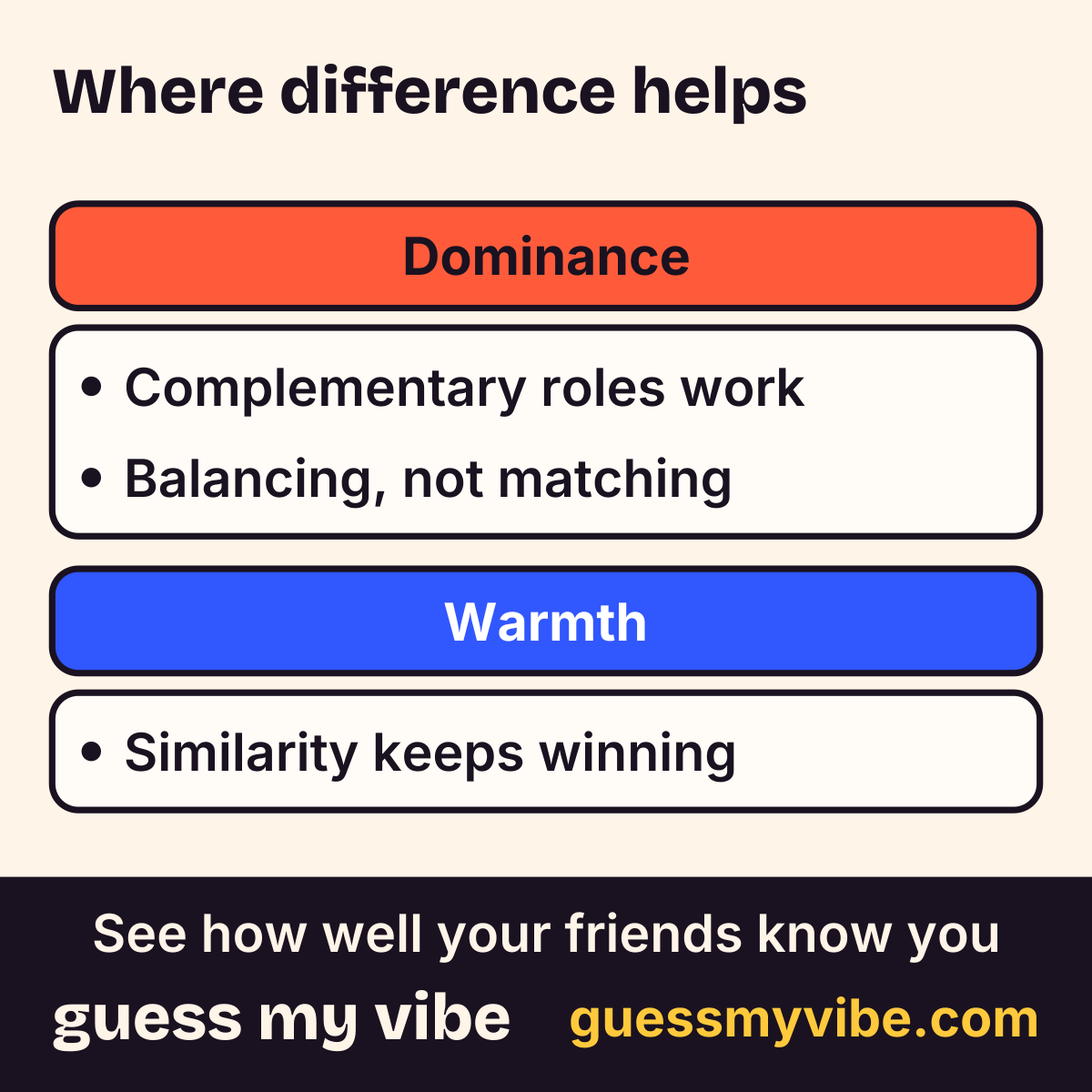
The clearest evidence for "different personalities can work well together" comes from research on dominance specifically, not personality broadly. Two lab studies had participants interact with someone who displayed either a dominant style (expansive posture, assertive behavior) or a submissive one (constrained posture, yielding behavior) [2]. People responded to a dominant partner by becoming more submissive themselves, and to a submissive partner by becoming more dominant: complementary, not matching. In the second study, the researchers directly manipulated whether a partner's response complemented or mimicked the other person's style, and complementary responses produced more liking and more comfort than mimicking ones did. On this one dimension, matching your friend's energy isn't actually the smoother move. Balancing it is.
That pattern isn't a one-off finding from a single lab. A separate study followed 102 college roommate duos at 2 weeks and again at 15 weeks living together, tracking how their actual day-to-day behavior toward each other changed [4]. By 15 weeks, their behavior had become measurably more complementary specifically on dominance, one roommate settling into the more assertive role and the other into the more yielding one. On warmth, the opposite held: similarity, not contrast, tracked with a smoother dynamic. And longer-term couples show the same split. In a study of 106 couples together at least a year, the ones reporting the highest relationship quality were similar to each other in warmth but opposite in dominance, not alike across the board [3]. That study was about romantic couples, not friends, but the pattern it found, difference on dominance specifically paying off while similarity on warmth still mattered, lines up with the roommate and lab findings closely enough to be worth knowing about.
Curious how your friends would answer?
Free. Answer 10 quick questions about you, then send your link. Friends play in their browser, no app needed.
Start freeWhy warmth doesn't work the same way
It's worth being precise about why dominance and warmth split apart like this, since it's the part that keeps "opposites attract" from being a bigger finding than the data actually supports. Dominance is inherently relative: in any interaction, if one person takes up more space, there's room for the other to take up less, and that division of roles can genuinely work for both people. Warmth doesn't have that same structure. Two warm people being warm to each other doesn't create friction the way two dominant people vying for the same role can; there's no equivalent "one has to be the cold one" dynamic that makes contrast useful. That's a big part of why similarity keeps winning on warmth and most other traits, while dominance is the one place a real difference regularly pays off instead of just being tolerated.
Cite this figure
Figure: "Where difference helps." Guess My Vibe (guessmyvibe.com). https://guessmyvibe.com/learn/friends-with-different-personalities#figure-dominance-vs-warmth
What this actually looks like between two different friends
Translated into an actual friendship, this usually shows up as a quiet division rather than a dramatic contrast: one friend tends to pick the restaurant, start the group chat, and make the call when plans stall; the other tends to go along with it, fill in the details the planner missed, and occasionally veto a plan that's clearly a bad idea. That's the dominance axis doing exactly what the research says it does, two people settling into complementary roles rather than competing for the same one. It's a narrow mechanism, about this one dimension, not a general rule that very different personalities automatically balance each other out across the board. A friendship where one person is organized and the other is spontaneous, or one is more anxious and the other more even-keeled, isn't covered by this same evidence; those differences might be genuinely useful, genuinely difficult, or mostly beside the point, and the research above doesn't speak to them directly.
It also helps to say plainly what this research doesn't claim, since "opposites work" is an easy idea to overextend. It isn't a finding that any two very different people will naturally click once they find the right dominance balance, and it isn't permission to read every friction point in a friendship as secretly complementary and therefore fine. The studies above measured one specific behavioral axis, who takes the more assertive role moment to moment, in controlled lab interactions, randomly assigned roommates, and established couples. A friendship where the differences run deeper, in values, humor, or how each person handles conflict, isn't automatically covered by the same mechanism just because dominance happens to divide neatly in that friendship too. The honest, narrower claim still holds up well: real difference on this one trait tends to be workable, often genuinely useful, rather than something a friendship has to overcome.
Seeing your own differences, trait by trait
None of the research above means a specific duo of very different friends needs fixing, or that two very similar friends are missing out. Guess My Vibe doesn't sort friends into a "type" of match before you play; it works the same way for any two people and shows where their real personality answers line up and where they land differently, across all five traits, not just the one (dominance) the research above zeroes in on. For a friendship where the two of you really are different, that's a more useful read than a vague sense of being "opposites": you get to see exactly which differences are there, instead of assuming either that they're a problem or that they're automatically the secret to why the friendship works.
Key takeaways
- In one study of new friendships, people tended to pick friends similar to themselves in agreeableness, extraversion and openness, which makes friends with genuinely different personalities the less common pattern on those traits, not a broken one [1].
- Dominance is the one trait in this research where real difference, not similarity, works better: people respond to a dominant partner by becoming more yielding, and to a yielding partner by becoming more assertive, and that complementary pattern gets rated as more comfortable than matching it [2].
- In long-term couples, the highest relationship quality went with being similar in warmth but different in dominance, not with being alike across the board [3].
- Difference on dominance specifically showed up again in college roommates, who grew more complementary on that one trait over 15 weeks while staying similarity-driven on warmth [4].
- This isn't therapy, a diagnosis, or a substitute for professional care.
Questions people ask
Can friends with very different personalities actually work well together?
Yes, and the research narrows down exactly where the difference helps: dominance specifically, where a more assertive and a more yielding style complement each other, rather than personality differences generally [2] [4].
Is 'opposites attract' true for friendships?
Mostly not as a general rule. In one study people tended to pick friends similar to themselves on agreeableness, extraversion and openness, and the clearest exception in this research is narrow: difference specifically on dominance, not personality broadly [1] [2].
Does being different in personality cause more friction between friends?
The research doesn't support a blanket answer either way. Difference specifically on dominance tends to reduce friction, since it lets two people settle into complementary roles instead of competing for the same one; the evidence doesn't cover whether other kinds of difference, like organization style or stress levels, help or hurt [2].
Why does dominance work differently from other traits like warmth?
Dominance is relative between two people in an interaction, so one person taking a more assertive role leaves room for the other to take a more yielding one. Warmth doesn't have that same structure, two warm people don't compete for a role the way two dominant people can, which is likely why similarity keeps winning on warmth while difference pays off on dominance specifically [4].
Do long-term couples and friends show the same complementarity pattern?
A study of long-term couples found the same split as the friendship and roommate research: the highest relationship quality went with similarity in warmth but difference in dominance, not similarity across every trait. That study covered romantic couples specifically, not friends, but the pattern lines up with what shows up in friendships and among roommates too [3].
See how well your friends know you.
Free. Answer 10 quick questions about you, then send your link. Friends play in their browser, no app needed.
Start freeReferences
- [1] Selfhout, M., Burk, W., Branje, S., Denissen, J., van Aken, M., & Meeus, W. (2010). Emerging late adolescent friendship networks and Big Five personality traits: A social network approach. Journal of Personality, 78(2), 509–538. PubMed: 20433629 (opens in a new tab)
- [2] Tiedens, L. Z., & Fragale, A. R. (2003). Power moves: Complementarity in dominant and submissive nonverbal behavior. Journal of Personality and Social Psychology, 84(3), 558–568. PubMed: 12635916 (opens in a new tab)
- [3] Markey, P. M., & Markey, C. N. (2007). Romantic ideals, romantic obtainment, and relationship experiences. Journal of Social and Personal Relationships, 24(4), 517–533. doi.org/10.1177/0265407507079241 (opens in a new tab)
- [4] Markey, P. M., & Kurtz, J. E. (2006). Increasing acquaintanceship and complementarity of behavioral styles and personality traits among college roommates. Personality and Social Psychology Bulletin, 32(7), 907-916. PubMed: 16738024 (opens in a new tab)
How we find and check these sources: how we write. Spotted an error? Report a correction.
Related
- Do Opposites Attract? What the Research Actually Says
- Do You Become Like Your Friends? What Research Says
- Introvert Extrovert Friendship: Why It Works
- Friendship Compatibility: What Actually Makes It Work
- What Makes an Open-Minded Person? Openness in Friendships
- Openness to Experience: Meaning, Facets and Creativity
Cite this article
- Title
- Friends With Different Personalities: When Opposites Work
- Publisher
- Guess My Vibe
- Updated
- URL
- https://guessmyvibe.com/
learn/ friends-with-different-personalities
Copy this citation
Guess My Vibe. (2026, October 3). Friends With Different Personalities: When Opposites Work. Guess My Vibe. https://guessmyvibe.com/
To point at one section, add that section's anchor (the # link on its heading) to the URL.