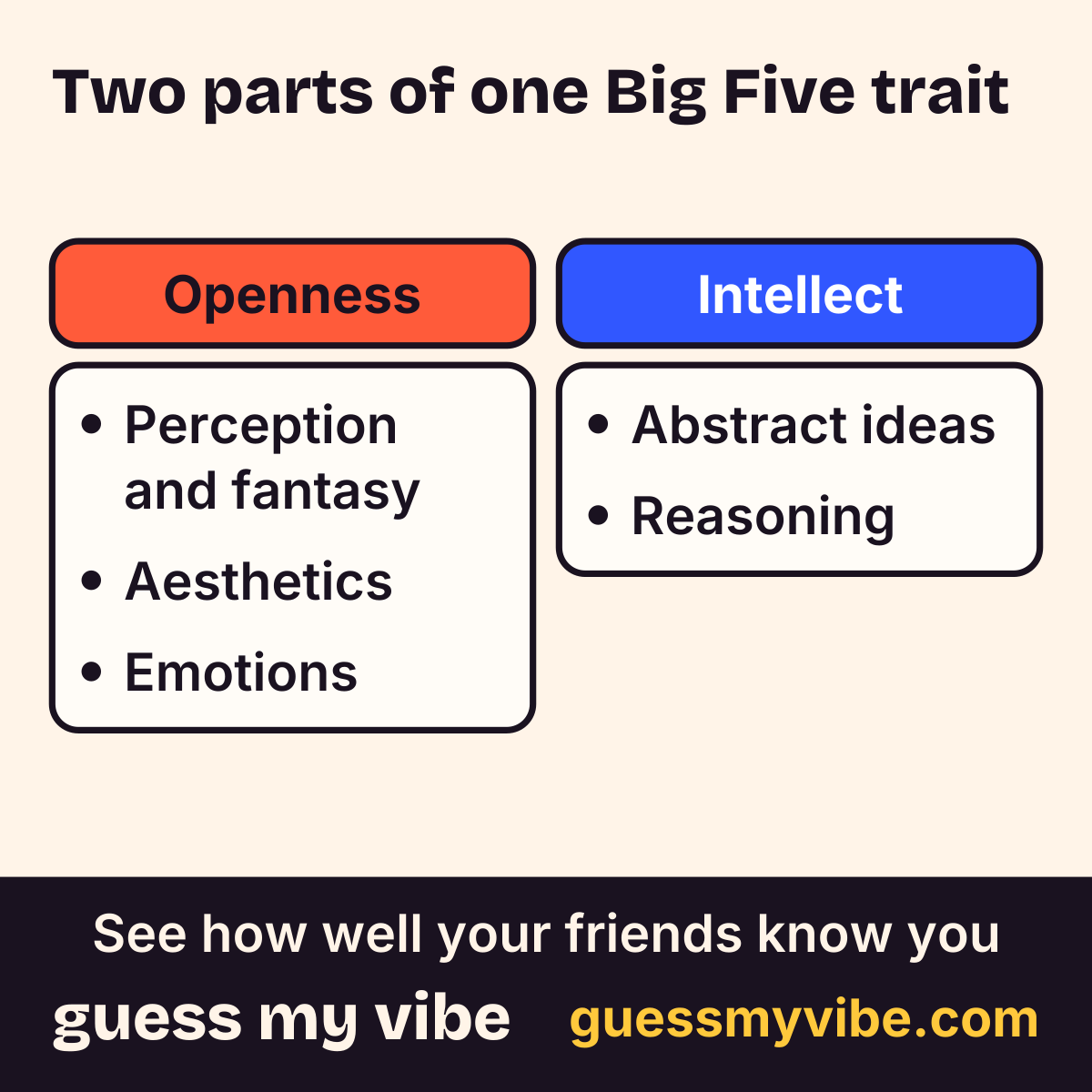
Openness to experience is the Big Five trait of curiosity, imagination and appetite for new ideas, art and feelings. It is one sliding scale, and researchers split it into two parts: Openness (perception, fantasy, aesthetics, emotions) and Intellect (abstract thinking and reasoning). The two went with creative achievement in different fields: Openness with the arts, Intellect with the sciences [1].
Want to take it for real? Make a friendship quiz and see how friends rate your Curiosity
What is openness to experience?
Openness to experience is the Big Five personality trait that describes how curious, imaginative and receptive to new ideas, art, feelings and experiences a person tends to be. It is measured on one continuous scale. One end prefers the familiar, the practical and the proven. The other end is drawn to novelty, abstract ideas and unusual perspectives. Most people land somewhere in between, and where you sit describes a tendency across many situations, not a rule about every choice. Guess My Vibe calls it Curiosity, and the app's science name for it is Openness / Intellect.
A quick note on the word "open". It is easy to hear it as "friendly" or "open-hearted". In research it means open to experience: willing to explore ideas and sensations. Friendliness and kindness belong to a separate trait, agreeableness. Our article on open-minded people covers how this trait plays out socially. This page is about the trait itself.
Openness versus Intellect: two parts of one trait
Openness to experience has a naming problem that tells you something about it. Some researchers call the trait "Openness", others "Intellect", and many write "Openness/Intellect". The reason is that it seems to have two sides. A factor analysis of 75 facet scales in a community sample of 481 people found that every Big Five domain splits into two distinct but correlated aspects, which sit between the broad trait and its narrower facets [5]. For this domain, the two aspects are usually called Openness and Intellect.
A team of researchers defined them like this. Openness reflects cognitive engagement with perception, fantasy, aesthetics and emotions. Intellect reflects cognitive engagement with abstract and semantic information, mainly through reasoning [1]. In plain words, Openness is the part that gets lost in music, daydreams and paintings, and Intellect is the part that enjoys puzzles, theories and arguments. People can be high on one and not the other, which is why "open-minded" can describe very different personalities.
Cite this figure
Figure: "Two parts of one Big Five trait." Guess My Vibe (guessmyvibe.com). https://guessmyvibe.com/learn/openness-to-experience#figure-two-parts-of-openness
What sits underneath the trait
One well-known model characterizes the trait as motivated cognitive flexibility, or cognitive exploration: wanting to take in and play with new information. To test part of this idea, researchers gave 175 people standard cognitive ability measures plus a set of tasks tied to the functioning of the brain's dorsolateral prefrontal cortex. Performance on those tasks, and both fluid and crystallized cognitive ability, was positively related to Openness/Intellect but to no other personality trait [2]. Facet-level analyses supported seeing the trait as primarily cognitive.
Read that carefully. It is one study and one model. It does not mean open people are smarter, and the study does not say that the brain region causes the trait. It does fit the everyday picture: the trait is less about being nice or sociable and more about how a mind handles new material.
Openness and creativity: arts and sciences
Creativity is the best-known correlate. A 1998 meta-analysis of personality and creative achievement compared scientists with nonscientists, more with less creative scientists, and artists with nonartists. In general, creative people were more open to new experiences, among other traits, and the largest effect sizes included openness [6].
A later study split the trait in two. In four demographically diverse samples totaling 1,035 participants, Openness went with creative achievement in the arts, while Intellect went with creative achievement in the sciences. The authors suggest the Intellect link to scientific creativity may be due at least in part to cognitive ability and divergent thinking, and they found extraversion also went with arts achievement independently of Openness [1]. These are correlations measured at one point in time, so they cannot say whether the trait leads to creative work or whether creative work shapes the trait.
Curious how your friends would answer?
Free. Answer 10 quick questions about you, then send your link. Friends play in their browser, no app needed.
Start freeWhat openness does and does not go with in life
Here the honest answer is: less than people assume. A 24-year study followed 497 UC Berkeley students from the start of college into midlife and looked at 51 love and work outcomes. Stable levels of Openness went with few of them. People whose Openness changed more over time showed delayed romantic commitment and some career outcomes. The facets differed. Intellectual interests went strongly with educational outcomes, while aesthetic interests and unconventionality went with nontraditional career motivations [3]. That is one sample of students from one university, so it may not hold for everyone.
A meta-analysis of studies of academic performance found that performance correlated significantly with agreeableness, conscientiousness and openness [7]. The abstract does not give the size for openness, so we will not guess at it. The takeaway is a modest one: openness matters most in the things it is about, such as learning and interests, and much less as a general predictor of how your life will go. Our article on open-minded people covers its smaller-than-expected links to relationships.
Does openness change with age?
On average, yes, in an arc. A meta-analysis of 92 longitudinal samples found that people increase on openness, along with social vitality, in adolescence and then decrease on both in old age [4]. That is an average across groups. Any one person can follow a different path, and the meta-analysis says nothing about the exact ages where your own curiosity peaks. If you feel less curious than you did at 18, or more, that is within the normal range of variation.
Who is the best judge of your openness?
A study of 165 people compared self-ratings, ratings from four friends and ratings from strangers against behavioral tests. Friends were the best judges of intellect-related traits, the self was the best judge of neuroticism-related traits, and everyone was about equally good on extraversion-related traits [8]. The model behind the study says others tend to be more accurate than the self for traits that are highly evaluative, meaning clearly good or bad to have, and it uses intellect as its example. So for the Intellect side of this trait, a friend's view may be a useful check on your own.
Another study adds that curiosity is visible from outside. In a multi-informant design, self, friend and parent reports of curiosity converged, and observers saw a curious personality in behavior such as initiating humor and tolerating uncertainty [9]. Curiosity is not the whole trait, but it is the part you can see from outside.
How to use this
If you are high on openness, expect to be bored by routine and to value time for exploring, and notice that not everyone around you wants novelty as much as you do. If you are lower, you are not closed-minded by default: you may simply prefer proven ways and practical outcomes, which is a strength in many settings. With a friend who sits at the other end, the useful question is not who is right but what kind of new each of you enjoys. One person's "new" is a novel ingredient, another's is a novel idea.
See your Curiosity through a friend's eyes
Since friends can be good judges of the intellect side of this trait, a friend's guess is a fair comparison point. Guess My Vibe has a friend guess your answers on Curiosity and the other traits, then shows you where they were right and where they missed. It is a fun comparison, not a test of the trait.
Key takeaways
- Openness to experience is a scale from preferring the familiar and practical to loving novelty and ideas. In Guess My Vibe the same trait is called Curiosity.
- Researchers describe two parts. In four samples totaling 1,035 people, Openness went with creative achievement in the arts and Intellect with creative achievement in the sciences [1].
- One model describes the trait as motivated cognitive flexibility, or cognitive exploration. In 175 people, ability measures went with it but with no other Big Five trait [2].
- Over a 24-year study of 497 students, stable levels of Openness went with few love or work outcomes, though change in Openness and specific interests did go with some [3].
- On average, openness rises in adolescence and falls in old age [4].
- This isn't therapy, a diagnosis, or a substitute for professional care.
Questions people ask
What does openness to experience mean?
It is the Big Five trait describing how curious, imaginative and receptive to new ideas, art, feelings and experiences a person tends to be. It sits on one continuous scale from preferring the familiar to loving novelty.
What is the difference between Openness and Intellect?
They are two aspects of the same domain. Openness reflects engagement with perception, fantasy, aesthetics and emotions, and Intellect reflects engagement with abstract information and reasoning [1].
Are people high in openness more creative?
On average, creative people were more open to new experiences in a meta-analysis [6]. In four samples, Openness went with achievement in the arts and Intellect with achievement in the sciences [1]. These are correlations.
Does openness make you smarter?
Not exactly. In 175 people, fluid and crystallized cognitive ability were positively related to Openness/Intellect but to no other Big Five trait [2]. That describes a relationship in one study, not a cause.
Does openness change with age?
On average it rises in adolescence and falls in old age [4]. Individual paths vary.
See how well your friends know you.
Free. Answer 10 quick questions about you, then send your link. Friends play in their browser, no app needed.
Start freeReferences
- [1] Kaufman, S. B., Quilty, L. C., Grazioplene, R. G., Hirsh, J. B., Gray, J. R., Peterson, J. B., & DeYoung, C. G. (2016). Openness to Experience and Intellect Differentially Predict Creative Achievement in the Arts and Sciences. Journal of Personality, 84(2), 248–258. PubMed: 25487993 (opens in a new tab)
- [2] DeYoung, C. G., Peterson, J. B., & Higgins, D. M. (2005). Sources of openness/intellect: Cognitive and neuropsychological correlates of the fifth factor of personality. Journal of Personality, 73(4), 825–858. PubMed: 15958136 (opens in a new tab)
- [3] Schwaba, T., Robins, R. W., Grijalva, E., & Bleidorn, W. (2019). Does Openness to Experience matter in love and work? Domain, facet, and developmental evidence from a 24-year longitudinal study. Journal of Personality, 87(5), 1074–1092. PubMed: 30693507 (opens in a new tab)
- [4] Roberts, B. W., Walton, K. E., & Viechtbauer, W. (2006). Patterns of mean-level change in personality traits across the life course: A meta-analysis of longitudinal studies. Psychological Bulletin, 132(1), 1–25. PubMed: 16435954 (opens in a new tab)
- [5] DeYoung, C. G., Quilty, L. C., & Peterson, J. B. (2007). Between facets and domains: 10 aspects of the Big Five. Journal of Personality and Social Psychology, 93(5), 880–896. PubMed: 17983306 (opens in a new tab)
- [6] Feist, G. J. (1998). A meta-analysis of personality in scientific and artistic creativity. Personality and Social Psychology Review, 2(4), 290–309. PubMed: 15647135 (opens in a new tab)
- [7] Poropat, A. E. (2009). A meta-analysis of the five-factor model of personality and academic performance. Psychological Bulletin, 135(2), 322–338. PubMed: 19254083 (opens in a new tab)
- [8] Vazire, S. (2010). Who knows what about a person? The self-other knowledge asymmetry (SOKA) model. Journal of Personality and Social Psychology, 98(2), 281–300. PubMed: 20085401 (opens in a new tab)
- [9] Kashdan, T. B., Sherman, R. A., Yarbro, J., & Funder, D. C. (2013). How are curious people viewed and how do they behave in social situations? From the perspectives of self, friends, parents, and unacquainted observers. Journal of Personality, 81(2), 142-154. PubMed: 22583101 (opens in a new tab)
How we find and check these sources: how we write. Spotted an error? Report a correction.
Related
- What Makes an Open-Minded Person? Openness in Friendships
- Big Five Personality Traits: A Plain-Words Guide
- Personality and Relationships: What the Research Shows
- Can Your Personality Change? What the Evidence Shows
- Friends With Different Personalities: When Opposites Work
- Self-Awareness: What the Research Says It Actually Takes
Cite this article
- Title
- Openness to Experience: Meaning, Facets and Creativity
- Publisher
- Guess My Vibe
- Updated
- URL
- https://guessmyvibe.com/
learn/ openness-to-experience
Copy this citation
Guess My Vibe. (2026, October 7). Openness to Experience: Meaning, Facets and Creativity. Guess My Vibe. https://guessmyvibe.com/
To point at one section, add that section's anchor (the # link on its heading) to the URL.