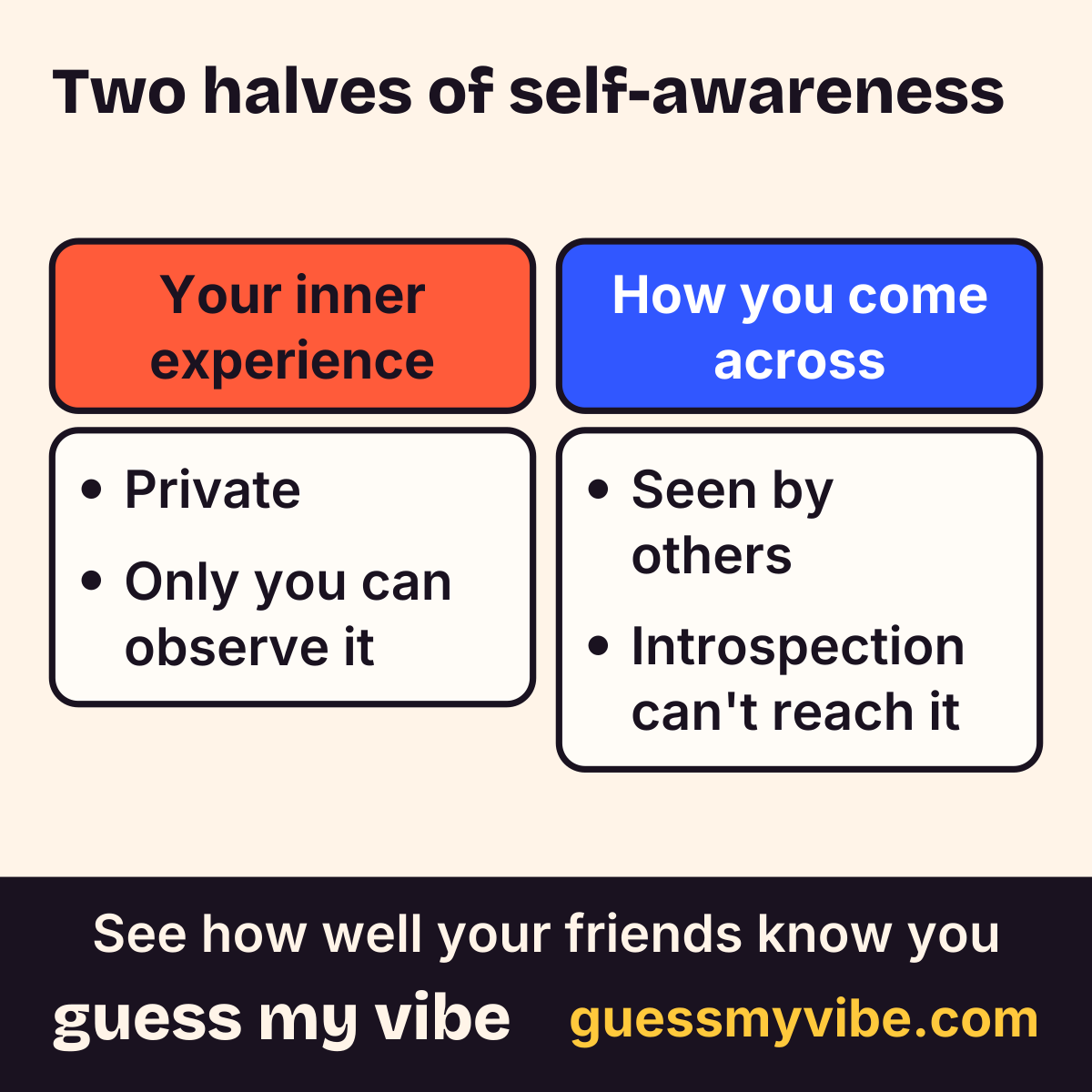
Self-awareness isn't just a matter of thinking about yourself harder. Research finds introspection has real limits, since much of what drives your behavior isn't accessible to conscious thought in the first place [1]. Looking at yourself through other people's eyes is one of the few things that actually adds information introspection can't reach on its own [2], which is why comparing your own self-view with an honest friend's view can get you further than introspecting alone.
Self-awareness: more than just thinking about yourself
Self-awareness gets treated like a muscle you build by reflecting more: journal about it, sit with your thoughts, think it through. Introspection genuinely helps, but personality research has a less comfortable finding sitting underneath that advice: introspection has a real ceiling, not because you're bad at it, but because a lot of what actually drives your behavior was never available to conscious thought to begin with. Getting a fuller picture of yourself takes more than looking inward. It takes comparing what you see with what other people, who are watching a different part of you than you can see yourself, actually see.
Cite this figure
Figure: "Two halves of self-awareness." Guess My Vibe (guessmyvibe.com). https://guessmyvibe.com/learn/self-awareness#figure-inside-and-outside
Why introspection alone has real limits
A widely cited review on self-knowledge laid out exactly why looking inward can only take you so far [1]. Much of the mind, including processes behind perception, motor learning, personality, and attitudes, simply isn't accessible to conscious introspection. You can sit and think about why you reacted a certain way, but a real chunk of what actually produced that reaction happened somewhere introspection can't see. People also sometimes try to consciously push away unwanted thoughts and feelings, and whether that actually works, versus just pushing the thought somewhere less visible, is genuinely unsettled in the research. The review's more useful finding is about what does help: looking at yourself through other people's eyes, and actually watching your own behavior instead of just your intentions, are two paths that can potentially add self-knowledge, though the review notes major obstacles. Thinking harder, on its own, is not reliably one of them.
The real shape of your blind spots
It's tempting to assume you're always the tiebreaker on who you are, that your own view wins by default whenever it disagrees with someone else's. A review of this research pushes back on that directly: self-perceptions are largely accurate, but they have real blind spots, from two different sources [3]. One is informational: you genuinely can't observe yourself from across the room the way someone else can. The other is motivational: people have real, usually unconscious, reasons to see themselves a little more generously than an outside observer would, especially on traits that are very desirable or undesirable. Being a mostly-accurate narrator of your own personality doesn't make you a complete one.
A separate, influential model gives this a clean structure [2]. For low-observability traits, things that happen mostly inside your own head, like how easily your mood gets thrown off by stress, you're the best judge of yourself, hands down. For high-evaluativeness traits, things tied to how smart or capable you come across, friends are often the better judge. For sociable, outward traits, everyone, you included, is about equally accurate. The honest version of self-awareness isn't "trust yourself completely" or "trust other people's view more." It's knowing which kind of information you're missing, and going looking for it in the right place.
Curious how your friends would answer?
Free. Answer 10 quick questions about you, then send your link. Friends play in their browser, no app needed.
Start freeDoes mindfulness actually improve self-awareness?
If introspection alone has limits, is there anything you can actually do, short of recruiting other people, that genuinely helps? One review makes the case for mindfulness, defined in the research sense as paying nonjudgmental attention to your current experience, as a plausible path forward [4]. The reasoning is specific: self-knowledge runs into two kinds of barriers, not having enough information about yourself, and being motivated to distort the information you do have. Mindfulness, in principle, addresses both, since it's about noticing what's actually happening (more raw information) without immediately judging or spinning it (less motivated distortion). It's worth being precise about what this is: a plausible, evidence-consistent hypothesis under active study, not a settled finding with a guaranteed outcome. If you want to try it, the honest framing is "this might help, and here's the mechanism researchers think is behind it," not a promise.
What a self-awareness quiz usually gets wrong
A typical "how self-aware are you" quiz asks you to rate your own self-awareness, which runs into an obvious problem: it's asking your self-perception to grade your self-perception. If your blind spots are real, as the research above says they are, they're exactly the parts a self-report quiz structurally can't see, by definition. A quiz like that can still capture something real, how much you believe you reflect, how open you feel to feedback, but it can't check whether that belief matches your actual blind spots, since nothing outside your own head is involved in scoring it.
The honest workaround isn't a cleverer self-report question. It's bringing in a second source of information that didn't come from inside your own head in the first place. A friend who's actually spent time around you has observed real things about your behavior that you structurally can't observe about yourself, the same way you have access to your own private motives and feelings that they don't. Comparing the two views, not replacing one with the other, is what turns a self-report guess into something closer to an actual check [5].
The practical version: compare, don't just reflect
Put together, the research points to a specific, non-mystical way to get more self-aware: don't rely only on reflection, and don't rely only on other people's opinions either. Use both, on purpose, and expect them to disagree sometimes in informative ways. You hold real information nobody else has access to, your actual inner experience. A friend holds real information you structurally can't get on your own, your actual outward behavior, seen from outside. Neither view is the whole picture; the gap between them is often the most useful part. That's the specific gap Guess My Vibe is built to show: you answer real personality questions about yourself, a friend guesses your answers separately, and you see exactly where your self-view and their outside view agree, and where they split.
None of this makes introspection pointless. It just puts it in its proper place: a real, necessary source of information about yourself that happens to be incomplete on its own, the same way a friend's outside view is real and useful but incomplete on its own. Self-awareness, in the research sense, looks less like a single accurate score and more like an ongoing comparison between two honest, partial views.
Key takeaways
- Introspection has a real ceiling: a lot of what shapes perception, personality, and behavior isn't accessible to conscious thought no matter how hard you reflect on it [1].
- Self-perception is largely accurate, but it has genuine blind spots, some from missing information and some from a motivated, mild self-flattery most people do without noticing [3].
- What you're the best judge of and what others are the best judge of depends on the trait: you have the edge on private, hard-to-observe things like stress; others have the edge on how capable you come across, and everyone is about equally accurate on sociability [2].
- Paying nonjudgmental attention to your own current experience (mindfulness, in the research sense) is a promising, still-developing path to better self-knowledge, not a finished one [4].
- This isn't therapy, a diagnosis, or a substitute for professional care.
Questions people ask
What does it actually mean to be self-aware?
Research treats self-awareness as more than reflecting on yourself: it's having an accurate sense of both your private inner experience, which only you can observe directly, and how you actually come across to others, which introspection alone can't reach [1] [2].
Can you become more self-aware just by thinking about yourself more?
Only partly. Research finds much of what drives behavior isn't accessible to conscious introspection in the first place, so reflecting harder has a real ceiling. Looking at yourself through other people's eyes and watching your own actual behavior are two routes that can potentially add information introspection can't [1].
Does mindfulness actually improve self-knowledge?
It's a promising, evidence-consistent hypothesis, not a settled fact. One review argues mindfulness could address both main barriers to self-knowledge (missing information and motivated self-flattery), while noting the direct empirical link is still being established [4].
Am I the best judge of my own personality?
It depends on the trait. You're the best judge of private, low-observability traits like how easily you get stressed; other people are often better judges of traits tied to how capable you come across; and everyone is about equally accurate on outward, sociable traits [2].
Is a self-awareness quiz accurate?
A self-report quiz you take alone can only reflect your own self-view, which research shows has real blind spots from both missing information and mild, usually unconscious self-flattery [3]. Comparing your answers with an honest friend's separate guesses adds the outside view a solo quiz can't.
See how well your friends know you.
Free. Answer 10 quick questions about you, then send your link. Friends play in their browser, no app needed.
Start freeReferences
- [1] Wilson, T. D., & Dunn, E. W. (2004). Self-Knowledge: Its Limits, Value, and Potential for Improvement. Annual Review of Psychology, 55, 493-518. doi.org/10.1146/annurev.psych.55.090902.141954 (opens in a new tab)
- [2] Vazire, S. (2010). Who knows what about a person? The self-other knowledge asymmetry (SOKA) model. Journal of Personality and Social Psychology, 98(2), 281–300. PubMed: 20085401 (opens in a new tab)
- [3] Vazire, S., & Carlson, E. N. (2011). Others sometimes know us better than we know ourselves. Current Directions in Psychological Science, 20(2), 104–108. doi.org/10.1177/0963721411402478 (opens in a new tab)
- [4] Carlson, E. N. (2013). Overcoming the Barriers to Self-Knowledge: Mindfulness as a Path to Seeing Yourself as You Really Are. Perspectives on Psychological Science, 8(2), 173-186. PubMed: 26172498 (opens in a new tab)
- [5] Connelly, B. S., & Ones, D. S. (2010). An other perspective on personality: Meta-analytic integration of observers' accuracy and predictive validity. Psychological Bulletin, 136(6), 1092–1122. PubMed: 21038940 (opens in a new tab)
How we find and check these sources: how we write. Spotted an error? Report a correction.
Related
- Self-Perception vs. How Others See You
- What Do People Think of Me? What Research Can Tell You
- BFF Test: A Real One to Take With Your Best Friend
- Questions to Ask Your Partner That Build Real Closeness
- Personality Blind Spots: What You Can't See About Yourself
- Self-Knowledge: Why You Know Some Traits Better Than Others
- The Spotlight Effect: You're Noticed Less Than You Think
- Is MBTI Accurate? MBTI vs the Big Five, Fairly
- Are Personality Tests Accurate? What the Evidence Shows
- Can Your Personality Change? What the Evidence Shows
Want to try it with your own friends? Take the best friend test and see how your friends see you
Cite this article
- Title
- Self-Awareness: What the Research Says It Actually Takes
- Publisher
- Guess My Vibe
- Updated
- URL
- https://guessmyvibe.com/
learn/ self-awareness
Copy this citation
Guess My Vibe. (2026, October 3). Self-Awareness: What the Research Says It Actually Takes. Guess My Vibe. https://guessmyvibe.com/
To point at one section, add that section's anchor (the # link on its heading) to the URL.