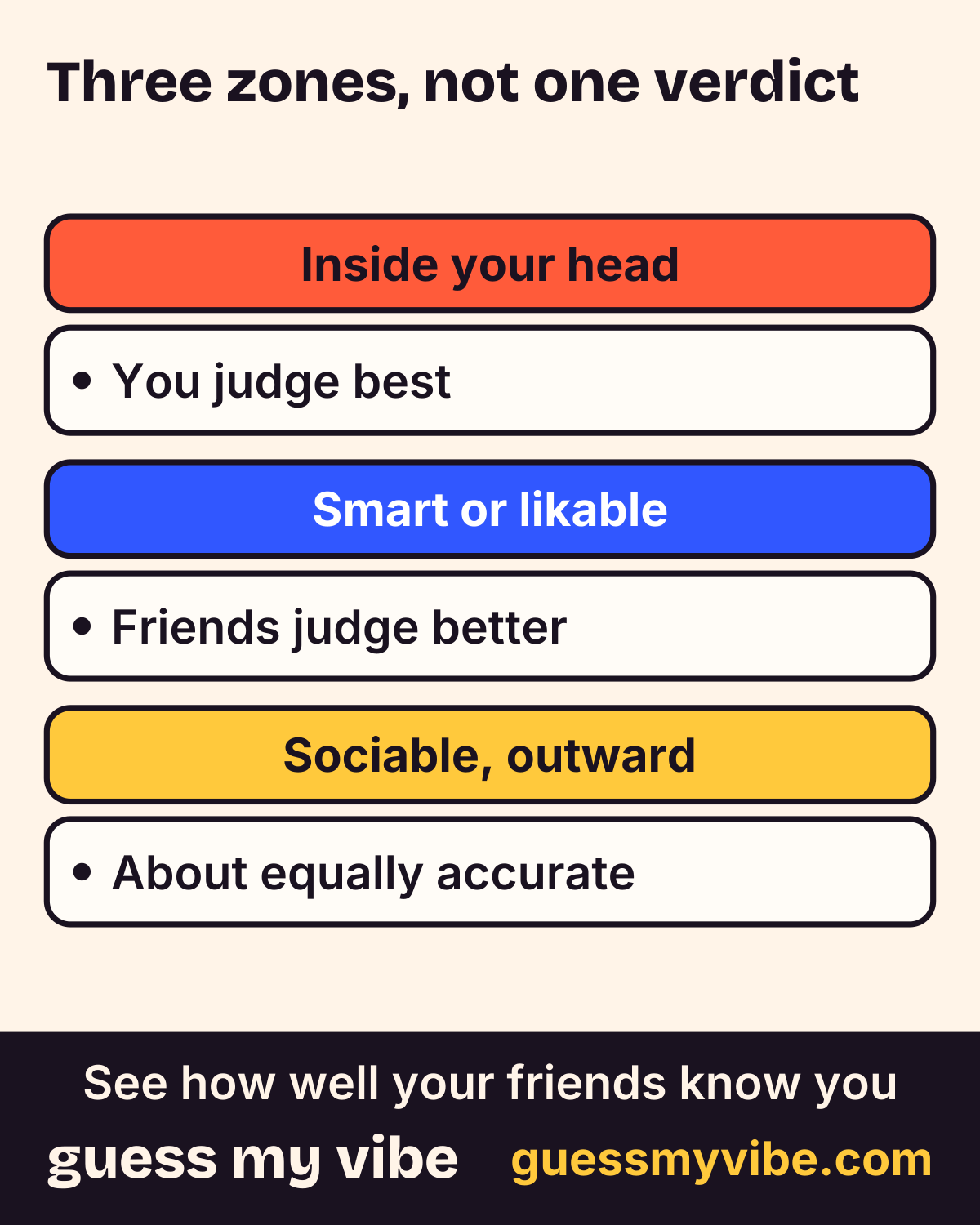
Self-knowledge isn't one single skill you either have or don't. Research finds it's domain-specific: you're genuinely the best judge of your own private, hard-to-observe traits, like how easily your mood is thrown off, while friends were the better judge of traits tied to intellect, how capable you come across, and on sociable, outgoing traits everyone judged about equally well [1]. The honest answer to "how well do you know yourself" depends entirely on which part of yourself you're asking about.
Self-knowledge isn't one skill, it's several
"How well do you know yourself?" is usually asked like self-knowledge is a single number, something you either have a lot of or not much of. Personality research treats it very differently. A study of 165 people, each rated by close friends and by strangers and then checked against real recorded behavior, found that self-knowledge is domain-specific: how accurate you are depends heavily on which trait is being asked about, not on some general self-knowledge ability that applies evenly everywhere [1]. That reframes the whole question. The useful version of "do you know yourself" isn't yes or no. It's: on this specific trait, are you actually the best source, or is someone else?
The three zones: where you win, where friends win, where it's a tie
That same study found a clean, repeatable pattern, often called the self-other knowledge asymmetry model. For low-observability traits, things that happen mostly inside your own head and rarely show up as visible behavior, like how easily your mood gets thrown off by stress, you were consistently the most accurate judge, better than any friend or stranger. For high-evaluativeness traits, things tied closely to how smart, competent or likable a person seems, friends actually out-judged the person's own self-rating. And for sociable, outward traits, things like how much you're energized by being around other people, everyone was about equally accurate, including you [1]. Three zones, not one verdict. You're genuinely the expert on the first. You're not the expert on the second, however much it might feel like you should be. And on the third, your own guess is exactly as good as anyone else's, no more and no less.
Cite this figure
Figure: "Three zones, not one verdict." Guess My Vibe (guessmyvibe.com). https://guessmyvibe.com/learn/self-knowledge#figure-three-zones
Why introspection can't just cover the gap on its own
A natural reaction to the evaluativeness zone is: fine, I'll just think about it harder and figure out how capable I actually seem. A widely cited review on self-knowledge explains why that doesn't fully work [2]. A real portion of what drives human behavior, including processes behind perception, motor skill, personality and attitudes, simply isn't accessible to conscious introspection, no matter how carefully you sit and think about it. You can replay a conversation in your head and genuinely try to assess how competent you came across, but a meaningful part of what actually produced your tone, your word choice, your body language in that moment happened somewhere introspection doesn't reach. That's a structural limit, not a lack of effort. It's also exactly why the evaluativeness zone belongs to other people: they're watching the actual behavior your introspection can't fully explain to you.
Closeness matters most exactly where your own self-knowledge is weakest
A meta-analysis of 263 samples and more than 44,000 people adds a useful detail about who makes a good outside judge: how close someone is to you changes their accuracy, and that closeness effect is strongest precisely for the traits that are hardest to observe from the outside [3]. A close friend who's seen you stressed, tired, disappointed and relieved has real data a stranger simply doesn't have access to. That's a small but important correction to the self-knowledge story: it's not that friends are generally better at reading low-observability traits than you are, it's specifically close, well-acquainted friends. A stranger's guess about how easily you get rattled is close to useless; a years-long friend's guess is a real, informed estimate, even if, on the hardest-to-observe traits, it still isn't as accurate as your own [1].
Curious how your friends would answer?
Free. Answer 10 quick questions about you, then send your link. Friends play in their browser, no app needed.
Start freeThis gets sharper the longer someone has known you
A study that tracked personality judgments as people got to know each other found that as length of acquaintance increased, self-other agreement went up and reliance on a generic stereotype of "people in general" went down [4]. A brand-new acquaintance's guess about you leans heavily on assumptions about what most people are probably like. A long-time friend's guess has mostly swapped that out for things that are specifically, actually true of you. That's a second reason a friend's answer about your evaluative or ambiguous traits is worth taking seriously, and a reason a stranger's first impression of the same trait is worth taking with a much bigger grain of salt.
A concrete example: two questions, two different experts
Picture two questions about the same person. First: "How much did that offhand comment at dinner actually bother you?" Second: "Is this person actually a good listener?" The research above says these two questions have different experts. The first is a low-observability question. The bother happened entirely inside one person's head, and even a close friend sitting right across the table only saw a neutral expression, not the reaction underneath it. Self-report wins here, clearly and by a wide margin. The second is a high-evaluativeness question. "Good listener" is a judgment about a pattern of behavior across many conversations, interrupting, following up, remembering what mattered to someone, and a person's own sense of their listening skills is exactly the kind of self-flattering territory where introspection runs into trouble. A friend who's been on the other end of a hundred conversations has actual data a self-rating doesn't: not what the person meant to do, but what they actually did. Neither question has a universally "more honest" answer. Each one has a specific, correct expert to ask, and it isn't always the person the question is about.
Why this shows up clearly in a friend-guessing game
This three-zone structure is exactly what shows up when a friend actually sits down and guesses your answers to real personality questions instead of just getting asked in the abstract whether they know you well. On questions touching low-observability traits, like how something you didn't show on your face actually affected your mood, you'll usually out-guess your friend's guess about you, because that information genuinely isn't visible from outside. On questions touching evaluative or ambiguous traits, like how organized or how easygoing you actually come across, don't be surprised when your friend's guess lands closer to how other people would describe you than your own self-rating does. Neither result means the test is broken. It means self-knowledge is doing exactly what the research says it does: winning on some traits, losing on others, and depending heavily on who's actually been watching.
Guess My Vibe turns that into something you can actually see rather than just read about. You answer real personality questions about yourself; a friend separately guesses your answers; the app shows both side by side instead of only trusting your own self-report, the way most online personality quizzes do. Where you and your friend agree, that's probably a trait you genuinely have solid self-knowledge about. Where you don't, you've just found one of your own specific zones, not a flaw, just information about which kind of knower you are on that particular trait.
Key takeaways
- Self-knowledge splits into three zones depending on the trait: things you know better than anyone, things friends know better than you, and things everyone reads about equally well [1].
- You keep the advantage on low-observability traits, the ones that happen mostly inside your head, like how easily you get stressed or how much something is actually bothering you [1].
- Friends often have the edge on high-evaluativeness traits, the ones tied to how smart, capable or likable someone comes across, partly because introspection alone can't fully explain your own behavior to you [2].
- How close someone is to you matters most exactly where your own self-knowledge is weakest: hard-to-observe traits, not the easy-to-see ones [3].
- The longer a friend has actually known you, the more their outside view sharpens into something specific to you, rather than a generic guess about people in general [4].
- This isn't therapy, a diagnosis, or a substitute for professional care.
Questions people ask
What does self-knowledge actually mean in psychology?
It's how accurately a person's view of their own personality matches reality, usually checked against outside ratings from friends, strangers, or real recorded behavior. Research treats it as domain-specific rather than a single overall skill: you're more accurate about some traits than others [1].
Am I the best judge of my own personality?
On some traits, yes, specifically the ones that happen mostly inside your own head and are hard for anyone else to observe, like how easily your mood is thrown off by stress. On more evaluative traits, tied to how capable or likable you come across, friends are often the better judge [1].
Why can't I just think harder to understand myself better?
Because a real part of what drives your behavior isn't accessible to conscious introspection in the first place, according to a widely cited review of self-knowledge research. Thinking harder has a real ceiling; it can't recover information that was never available to conscious thought to begin with [2].
Do close friends really know me better than new acquaintances?
Research backs this up two ways: closeness matters most for the hardest-to-observe traits, where a close friend has real data a stranger lacks, and self-other agreement rises the longer someone has actually known you, as generic assumptions get replaced by things specifically true of you [3] [4].
Can a self-knowledge quiz actually tell me how well I know myself?
Only partly, since a quiz you take alone only reflects your self-view back at you. The traits where you're weakest, the evaluative ones, are exactly where that self-view is least reliable. Comparing your answers with a friend's separate guesses adds the outside information a solo quiz structurally can't.
See how well your friends know you.
Free. Answer 10 quick questions about you, then send your link. Friends play in their browser, no app needed.
Start freeReferences
- [1] Vazire, S. (2010). Who knows what about a person? The self-other knowledge asymmetry (SOKA) model. Journal of Personality and Social Psychology, 98(2), 281–300. PubMed: 20085401 (opens in a new tab)
- [2] Wilson, T. D., & Dunn, E. W. (2004). Self-Knowledge: Its Limits, Value, and Potential for Improvement. Annual Review of Psychology, 55, 493-518. doi.org/10.1146/annurev.psych.55.090902.141954 (opens in a new tab)
- [3] Connelly, B. S., & Ones, D. S. (2010). An other perspective on personality: Meta-analytic integration of observers' accuracy and predictive validity. Psychological Bulletin, 136(6), 1092–1122. PubMed: 21038940 (opens in a new tab)
- [4] Biesanz, J. C., West, S. G., & Millevoi, A. (2007). What do you learn about someone over time? The relationship between length of acquaintance and consensus and self-other agreement in judgments of personality. Journal of Personality and Social Psychology, 92(1), 119–135. PubMed: 17201547 (opens in a new tab)
How we find and check these sources: how we write. Spotted an error? Report a correction.
Related
Want to try it with your own friends? Take the best friend test and see how your friends see you
Cite this article
- Title
- Self-Knowledge: Why You Know Some Traits Better Than Others
- Publisher
- Guess My Vibe
- Updated
- URL
- https://guessmyvibe.com/
learn/ self-knowledge
Copy this citation
Guess My Vibe. (2026, October 3). Self-Knowledge: Why You Know Some Traits Better Than Others. Guess My Vibe. https://guessmyvibe.com/
To point at one section, add that section's anchor (the # link on its heading) to the URL.