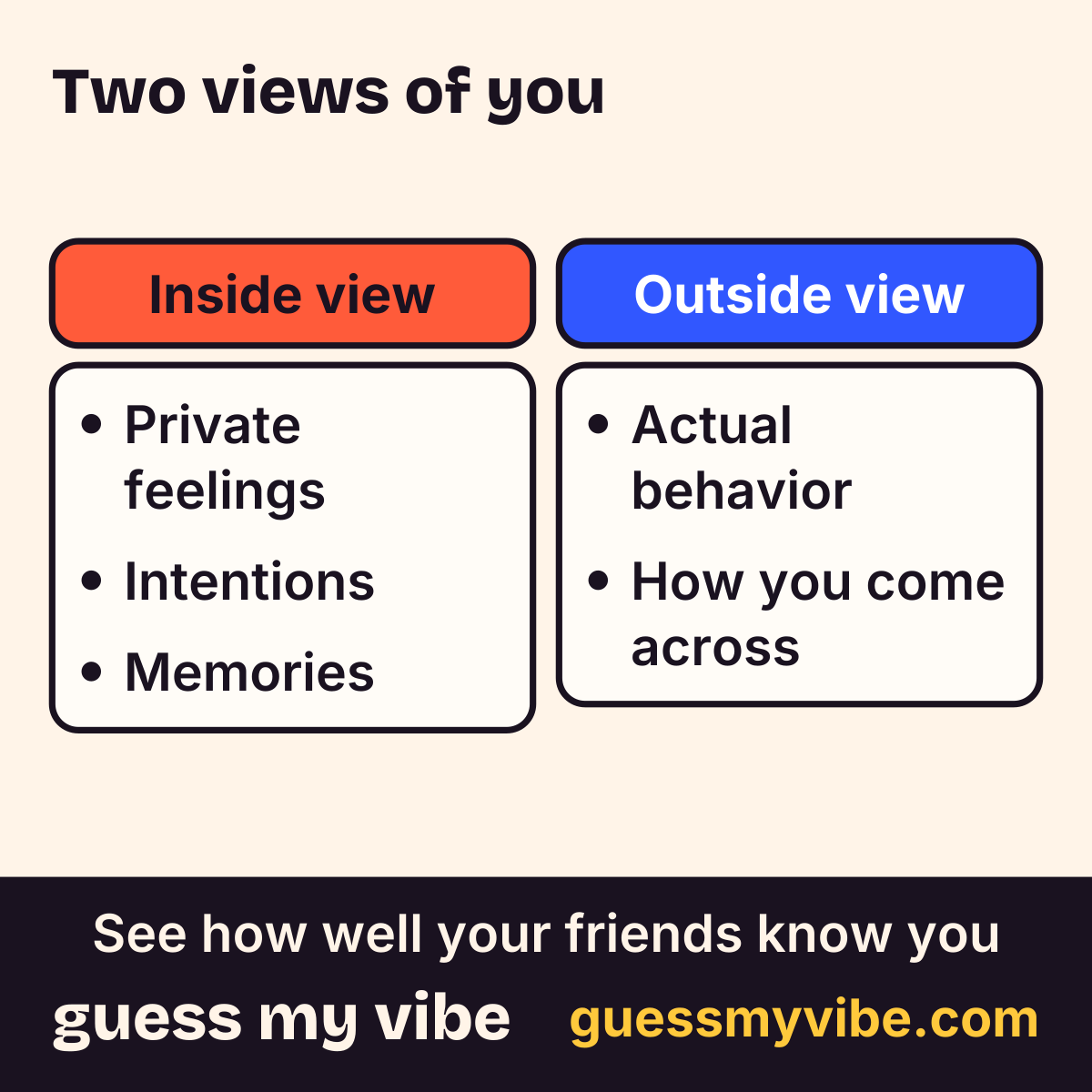
You and your friends each have real, honest information about your personality, just not the same information: you have the inside view on your own feelings and motives, they have the outside view on how you actually come across. Research on self-other agreement finds that neither view is complete on its own, and most people are only moderately good at guessing how others actually see them. The most reliable way to find out how you come across is to ask more than one friend, since several honest observers beat one.
Want to take it for real? Make a friendship quiz and see how your friends see you
Self-perception vs. how others see you: why the two views differ
"How do people see me?" and "How do I see myself?" aren't the same question, and personality research says they shouldn't have the same answer. You and the people around you each have real, honest access to different parts of your personality. You know what you were actually feeling during an awkward silence; a friend only saw the silence. A friend watched how you acted at a party with forty strangers; you were too busy feeling nervous to notice how you came across. Self-perception is built from the inside, out of memories, intentions and private feelings nobody else can see. How others see you is built from the outside, out of your actual behavior, the only thing anyone else ever gets to observe.
A study of 165 people rated by their own friends and by strangers put a name to this split: the self-other knowledge asymmetry (SOKA) model [1]. It found a clean pattern. For low-observability traits, things that happen mostly inside your head, like how easily your mood is thrown off by stress, you were the best judge of yourself. For high-evaluativeness traits, things tied to how smart or capable you come across, friends were better judges than you were. For sociable, outward traits, like how much you're energized by other people, everyone (you included) was about equally accurate. Neither "you know yourself best" nor "others know you best" is the honest answer. It depends which part of you is being asked about.
Cite this figure
Figure: "Two views of you." Guess My Vibe (guessmyvibe.com). https://guessmyvibe.com/learn/how-others-see-you#figure-two-views
Do you actually know how you come across? Meta-perception, in plain terms
There's a second question hiding inside "how do others see me," and it's a harder one: do you even know how others see you? Researchers call this meta-perception (sometimes meta-accuracy), and a classic review of eight studies on it found something a little humbling [2]. People are fairly good at guessing their general reputation, the broad impression they make on people overall, but much worse at guessing how one specific person sees them. The review's explanation is the part worth sitting with: people mostly build their sense of "how others see me" out of their own self-image, not out of real feedback they've actually received. You're often guessing your reputation by consulting yourself, which is exactly the blind spot a self-report quiz can't fix.
Why some traits are easier for friends to read than others
A meta-analysis covering more than 44,000 people across 263 independent samples looked at how well other-ratings (from family, friends, even strangers) line up with self-ratings, and when they don't [4]. Two findings matter here. First, how close someone is to you changes how accurate they are, and that closeness matters most for traits that are hard to observe from the outside, like how easily you get stressed. A close friend has a real edge there that a stranger doesn't. Second, other-ratings weren't just a weaker copy of self-ratings. They had their own predictive validity, meaning friends' ratings of someone's personality connected to real outcomes, like job performance and achievement, independently of what that person said about themselves. Other people aren't just seeing a blurrier version of you. Sometimes they're seeing something true that your own self-report misses.
Curious how your friends would answer?
Free. Answer 10 quick questions about you, then send your link. Friends play in their browser, no app needed.
Start freeThe Johari window: a useful framework, not a research finding
You'll often see this whole topic illustrated with the Johari window, a 1950s diagram that sorts what's known about you into four panes: an open area (known to you and others), a blind spot (others see it, you don't), a hidden area (you know it, others don't), and an unknown area (neither does). It's a genuinely useful way to picture the shape of this problem, especially the "blind spot" idea. But it's worth being clear about what it is: a teaching framework for organizing a conversation, not an empirically tested model like the studies above. Nobody ran an experiment and found four quadrants. Use it as a mental picture, not as evidence.
It gets more accurate the longer they've known you
Acquaintance matters too, not just intimacy. A study tracking how personality judgments change as people get to know each other found that as length of acquaintance increased, self-other agreement and the kind of accuracy that distinguishes one person's traits from another's both increased, while "stereotype accuracy" (judging someone based on what people in general are like) decreased [3]. In plain words: a brand-new friend's first impression of you leans on generic assumptions about people in general. A friend who's known you for years has swapped most of that out for things that are actually, specifically true about you. That's one real reason a long-time friend's guess about you tends to land closer than a new acquaintance's.
Sometimes other people know you better than you know yourself
It's tempting to assume self-perception has home-field advantage by default, that you're always the tiebreaker on who you are. A review of this research pushes back on that directly: self-perceptions are largely accurate, but they have real blind spots, partly from missing information (you genuinely can't watch yourself from across the room) and partly from motivated distortion (you have reasons to see yourself a little kindly, or a little harshly) [5]. The traits where others have the edge tend to be the most desirable or the most undesirable ones, exactly where a person has the most motivation to see themselves generously. Being a trustworthy narrator of your own personality doesn't make you a complete one.
How to actually find out how others see you
None of this research points to a quiz you can take alone. Every study above measured real other-people's real judgments, not a self-report scored against a formula. So the honest, non-clinical way to answer "how do people see me" is the low-tech one: ask people who actually know you, and ask more than one. A single friend's view carries noise. One person might be reading a bad day, an old impression, or a mood that isn't really you. That's exactly why the SOKA study averaged across four friends rather than trusting any one of them alone [1], and why the meta-analysis above found that interrater reliability, how much independent observers agree with each other, is itself a key piece of whether an outside view can be trusted [4]. Several honest observers cancel out each other's noise in a way one observer never can.
A few practical ways to actually do this: ask two or three friends the same specific question ("Would you call me more of a planner or more spontaneous?") and compare their answers instead of asking one friend to sum up your whole personality. Ask people from different parts of your life, a childhood friend and a coworker, since they may be seeing genuinely different behavior, not just disagreeing about the same you. And weigh a long-time friend's answer a little more than a new one's, since the acquaintance research above says that view has had more time to sharpen. Guess My Vibe is built around exactly this structure: a friend answers the same questions about you that you answer about yourself, and you see both side by side, which is several honest outside views instead of one guess made alone in your own head.
Key takeaways
- Self-perception and how others see you are both partly right: you're the expert on your private feelings, friends are often better judges of your outward, sociable behavior [1].
- People are only moderately accurate at guessing how others see them. A lot of what feels like "knowing my reputation" is really just a reflection of how you already see yourself [2].
- How much friends agree with your self-view depends on the trait: they read visible things like sociability well, but you keep the edge on inner stress and worry [1].
- Agreement between you and a friend tends to grow the longer you've known each other [3].
- This isn't therapy, a diagnosis, or a substitute for professional care; it's a plain-English summary of what personality research says about self-perception.
Questions people ask
Is how others see me more accurate than how I see myself?
Neither is flatly more accurate. Research on the self-other knowledge asymmetry model finds you're the better judge of private, hard-to-observe traits like your own stress levels, while friends are often the better judge of traits tied to how capable or sociable you come across [1].
What is meta-perception?
Meta-perception (or meta-accuracy) is how well you know how others actually see you, as opposed to how you see yourself. A classic review found people are decent at guessing their general reputation but much weaker at guessing how one specific person sees them, mostly because they guess from their own self-image rather than real feedback [2].
Is the Johari window based on research?
It's a framework, not a research finding. The four-pane diagram (open, blind spot, hidden, unknown) is a useful way to organize a conversation about self-perception, but it wasn't derived from an experiment the way the studies in this article were.
How many people should I ask to find out how I come across?
More than one. A single person's view is noisy; averaging across a few friends gets you closer to a stable picture, which is part of why personality researchers study groups of friends rather than one at a time [4].
Can an online quiz tell me how others see me?
Only if real people who know you actually answer questions about you. A quiz you take alone can only reflect your self-perception back at you; the research above is specifically about what happens when other people's actual judgments get involved.
See how well your friends know you.
Free. Answer 10 quick questions about you, then send your link. Friends play in their browser, no app needed.
Start freeReferences
- [1] Vazire, S. (2010). Who knows what about a person? The self-other knowledge asymmetry (SOKA) model. Journal of Personality and Social Psychology, 98(2), 281–300. PubMed: 20085401 (opens in a new tab)
- [2] Kenny, D. A., & DePaulo, B. M. (1993). Do people know how others view them? An empirical and theoretical account. Psychological Bulletin, 114(1), 145–161. PubMed: 8346325 (opens in a new tab)
- [3] Biesanz, J. C., West, S. G., & Millevoi, A. (2007). What do you learn about someone over time? The relationship between length of acquaintance and consensus and self-other agreement in judgments of personality. Journal of Personality and Social Psychology, 92(1), 119–135. PubMed: 17201547 (opens in a new tab)
- [4] Connelly, B. S., & Ones, D. S. (2010). An other perspective on personality: Meta-analytic integration of observers' accuracy and predictive validity. Psychological Bulletin, 136(6), 1092–1122. PubMed: 21038940 (opens in a new tab)
- [5] Vazire, S., & Carlson, E. N. (2011). Others sometimes know us better than we know ourselves. Current Directions in Psychological Science, 20(2), 104–108. doi.org/10.1177/0963721411402478 (opens in a new tab)
How we find and check these sources: how we write. Spotted an error? Report a correction.
Related
- How Well Do You Know Me Questions to Ask Friends
- BFF Test: A Real One to Take With Your Best Friend
- Introvert vs Extrovert: What the Research Actually Shows
- What Do People Think of Me? What Research Can Tell You
- Self-Awareness: What the Research Says It Actually Takes
- Social Media Personality: Does It Show the Real You?
- Who Knows You Best: Comparing the Different Judges
- The Johari Window, and What's Actually Real About It
- Judging Personality: Why People Get It Right (or Wrong)
- Likability: What Actually Makes People Like You
- Personality Blind Spots: What You Can't See About Yourself
- Self-Knowledge: Why You Know Some Traits Better Than Others
- Are Personality Tests Accurate? What the Evidence Shows
More in How others see you
- The Spotlight Effect: You're Noticed Less Than You Think
- The Illusion of Transparency: Why People Can't Read You
- What Do People Think of Me? What Research Can Tell You
- Self-Awareness: What the Research Says It Actually Takes
- How to Get Honest Feedback From Friends
- The Beautiful Mess Effect: Vulnerability Reads as Brave
- The Johari Window, and What's Actually Real About It
- Personality Blind Spots: What You Can't See About Yourself
- Self-Knowledge: Why You Know Some Traits Better Than Others
- The Better-Than-Average Effect: Why Friends Check You
Want to try it with your own friends? Take the best friend test and see how your friends see you
Cite this article
- Title
- Self-Perception vs. How Others See You
- Publisher
- Guess My Vibe
- Updated
- URL
- https://guessmyvibe.com/
learn/ how-others-see-you
Copy this citation
Guess My Vibe. (2026, October 2). Self-Perception vs. How Others See You. Guess My Vibe. https://guessmyvibe.com/
To point at one section, add that section's anchor (the # link on its heading) to the URL.