The illusion of transparency is the tendency to overestimate how well other people can tell what you are feeling or thinking inside. In the original studies, liars overestimated how detectable their lies were, and people believed their feelings of disgust were more apparent than they actually were [1]. The researchers attribute it to anchoring on your own experience and not adjusting enough when you try to take another person's perspective.
The illusion of transparency is the feeling that what is going on inside you is written on your face, when it usually isn't. If you have ever sat through a presentation convinced that everyone could see how nervous you were, or kept a straight face about a bad day while feeling sure your friends could tell, you have met it. Put simply, people tend to overestimate how well others can read their internal states. This article explains where the idea comes from, what the original studies found, how it differs from the spotlight effect, and what it means for how well friends can actually know you. We'll also be clear about what the research doesn't show.
What the illusion of transparency is
The term comes from a set of studies that tested what people believe about how readable they are. The authors described it as a tendency for people to overestimate the extent to which others can discern their internal states, a belief that those states "leak out" more than they really do [1]. The key word is "overestimate." The claim is not that nobody can ever tell how you feel. People do sometimes show their feelings. It's that your own sense of how visible you are tends to run higher than the reality.
A quick way to think about it: you have a front-row seat to your own feelings, and nobody else does. A racing heart, a knot in your stomach and a flush of embarrassment are loud from the inside. From the outside, they may show as very little. The illusion of transparency is what happens when you forget that gap.
What the original studies found
The research came in three sets of studies. The first tested liars: people who told lies overestimated how detectable those lies were. The second looked at disgust: people believed their feelings of disgust were more apparent to observers than they actually were. The third explored what the illusion might mean for people's reluctance to intervene in emergencies [1]. The summary of the paper reports the direction of the effects but not the sizes, so we can't tell you how big the overestimate was. What it does say is that all three sets were consistent with the same explanation.
That explanation is anchoring and adjustment. When we try to take another person's perspective, we start from our own experience and then adjust, but not enough [1]. The same authors later summarized this as people anchoring on their own experience when judging how they are seen, so that their assessments are often egocentrically biased [2]. In plain words, your own feelings are the starting point, and the adjustment toward "but they can't feel what I feel" falls short.
Illusion of transparency vs. the spotlight effect
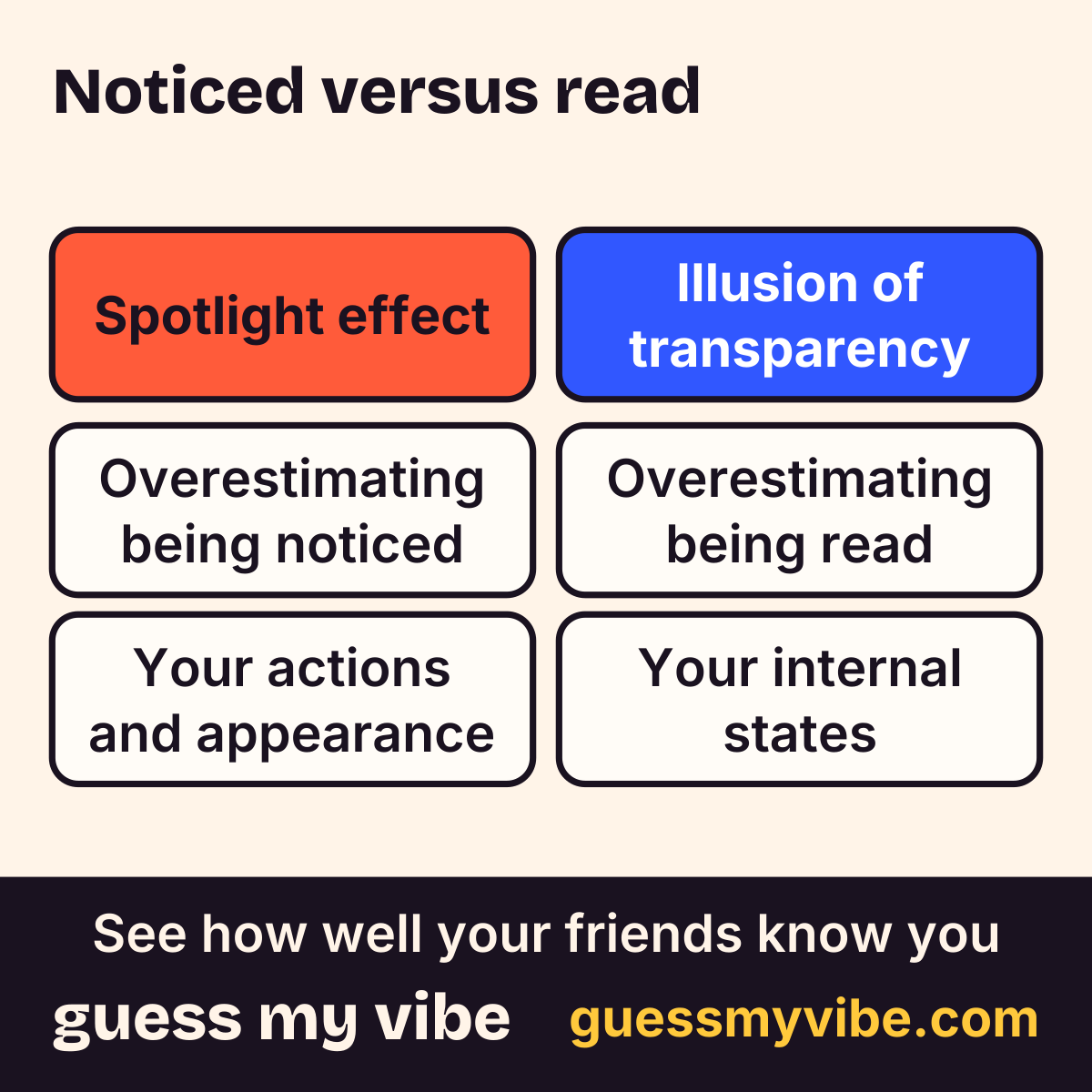
People often mix these two up, and they are cousins, so that's understandable. The spotlight effect is the tendency to overestimate how much other people notice your actions and appearance. In the original T-shirt studies, people overestimated how many observers would remember what was on their shirt [4]. The illusion of transparency is about something different: not what people notice, but what they can tell about your insides. The authors' own short review puts the two side by side, defining the spotlight effect as overestimating how much your behavior and appearance are noticed and evaluated, and the illusion of transparency as overestimating how much your internal states leak out [2].
Here is a handy test. If you are worried about a stain on your shirt, that's the spotlight. If you are worried that everyone can tell you are anxious about the stain, that's transparency. Both come from the same habit of treating your own point of view as the one everyone shares. Our article on the spotlight effect covers the first in detail, and this one stays with the second.
Cite this figure
Figure: "Noticed versus read." Guess My Vibe (guessmyvibe.com). https://guessmyvibe.com/learn/illusion-of-transparency#figure-spotlight-vs-transparency
Curious how your friends would answer?
Free. Answer 10 quick questions about you, then send your link. Friends play in their browser, no app needed.
Start freeWhy friends miss what's going on inside
The illusion connects to something personality researchers have found about which parts of us other people can know. In one study, 165 participants rated themselves and were rated by four friends and up to four strangers, and then completed behavioral tests that served as accuracy measures. The self was the best judge of neuroticism-related traits, friends were the best judges of intellect-related traits, and people of all perspectives were about equally good at judging extraversion-related traits [3]. The author's model explains this by observability: traits that are low in observability, like neuroticism, are known better by the self, while traits high in evaluativeness, like intellect, are judged better by others than by the self.
Put the two lines of research side by side and a picture emerges, although this is our connection, not something either paper tested. Feelings that stay inside, like worry or nerves, are the things others can see least, and they are also the things the illusion of transparency leads us to think are most visible. So a friend can know a lot about you and still have no idea you were anxious all evening. That isn't a failure of the friendship. It's information that wasn't available to them.
Faces are not open books
Part of why the illusion persists may be a common belief that emotions show clearly on the face. A review of the scientific evidence took that assumption on directly. It found that people do sometimes smile when happy, frown when sad and scowl when angry, more often than chance alone would produce, but that how people express emotions varies substantially across cultures, situations and even people within a single situation. A given configuration of facial movements, such as a scowl, often communicates something other than an emotional state [5]. That doesn't mean faces say nothing. It means reading a person from their face alone is far less certain than most of us assume, which is one more reason your feelings may be less legible than they seem to you.
What this means for you
A few practical, low-stakes takeaways, offered as our own interpretation. If you are nervous, it may be worth remembering that the research suggests you probably look less nervous than you feel, though it doesn't say by how much. If you are holding something in, it also works the other way: a friend may genuinely not know you are struggling, so telling them can be fair to both of you. And when you can't tell how a friend is feeling, the same gap applies to them. Asking directly is often better than guessing from their face.
A caution on the limits: the original studies used particular tasks (lying, disgust, an emergency scenario), and the summary we read gives no numbers. The abstracts we read describe lab-style tasks rather than everyday friendships. Nothing here suggests you can hide anything from people who know you well in every situation, and nothing here is advice about anxiety or any other personal difficulty. This isn't therapy, a diagnosis, or a substitute for professional care.
See the gap for yourself
The illusion of transparency is about the distance between how you feel and what others can see. Guess My Vibe lets you measure a small version of that distance: friends guess how you would answer real questions, and you see where they got it right and where they didn't. It won't read your emotions, and it isn't a test of the illusion itself, but it can show you how much of you your friends already know, and how much they have never been told.
Key takeaways
- People tend to believe their inner states "leak out" more than they really do, which researchers call the illusion of transparency [1].
- In the original studies, liars overestimated how detectable their lies were and people thought their feelings of disgust were more apparent than they were [1].
- The proposed reason is anchoring and adjustment: your own experience is the starting point, and people adjust insufficiently from it [1].
- The spotlight effect is about being noticed (actions and appearance), while the illusion of transparency is about being read (internal states) [2].
- Friends are good judges of some traits but not others: in one study the self was the best judge of neuroticism-related traits, which are low in observability [3].
- This isn't therapy, a diagnosis, or a substitute for professional care.
Questions people ask
What is the illusion of transparency?
It is the tendency to overestimate how well others can tell what you are feeling or thinking. People often mistakenly believe their internal states "leak out" more than they really do [1].
What is an example of the illusion of transparency?
In the original studies, liars overestimated how detectable their lies were, and people believed their feelings of disgust were more apparent than they actually were [1]. A common everyday version is feeling sure everyone can see how nervous you are when you speak up.
What is the difference between the illusion of transparency and the spotlight effect?
The spotlight effect is overestimating how much people notice your behavior and appearance, and the illusion of transparency is overestimating how much your internal states can be detected [2]. Both come from anchoring on your own point of view.
Why does the illusion of transparency happen?
The researchers attribute it to anchoring and adjustment: you start from your own vivid experience and don't adjust enough to take the other person's view [1].
Can friends tell when I'm nervous or upset?
Sometimes, but less than you may think. In one study, the self was the best judge of neuroticism-related traits, which are low in observability, while friends were the best judges of intellect-related traits and everyone was about equally good at extraversion-related traits [3].
See how well your friends know you.
Free. Answer 10 quick questions about you, then send your link. Friends play in their browser, no app needed.
Start freeReferences
- [1] Gilovich, T., Savitsky, K., & Medvec, V. H. (1998). The illusion of transparency: Biased assessments of others' ability to read one's emotional states. Journal of Personality and Social Psychology, 75(2), 332-346. PubMed: 9731312 (opens in a new tab)
- [2] Gilovich, T., & Savitsky, K. (1999). The spotlight effect and the illusion of transparency: Egocentric assessments of how we are seen by others. Current Directions in Psychological Science, 8(6), 165-168. doi.org/10.1111/1467-8721.00039 (opens in a new tab)
- [3] Vazire, S. (2010). Who knows what about a person? The self-other knowledge asymmetry (SOKA) model. Journal of Personality and Social Psychology, 98(2), 281–300. PubMed: 20085401 (opens in a new tab)
- [4] Gilovich, T., Medvec, V. H., & Savitsky, K. (2000). The spotlight effect in social judgment: An egocentric bias in estimates of the salience of one's own actions and appearance. Journal of Personality and Social Psychology, 78(2), 211-222. PubMed: 10707330 (opens in a new tab)
- [5] Barrett, L. F., Adolphs, R., Marsella, S., Martinez, A. M., & Pollak, S. D. (2019). Emotional expressions reconsidered: Challenges to inferring emotion from human facial movements. Psychological Science in the Public Interest, 20(1), 1-68. PubMed: 31313636 (opens in a new tab)
How we find and check these sources: how we write. Spotted an error? Report a correction.
Related
- The Spotlight Effect: You're Noticed Less Than You Think
- Self-Perception vs. How Others See You
- What Do People Think of Me? What Research Can Tell You
- Personality Blind Spots: What You Can't See About Yourself
- Self-Awareness: What the Research Says It Actually Takes
- The Johari Window, and What's Actually Real About It
Want to try it with your own friends? Take the best friend test and see how your friends see you
Cite this article
- Title
- The Illusion of Transparency: Why People Can't Read You
- Publisher
- Guess My Vibe
- Updated
- URL
- https://guessmyvibe.com/
learn/ illusion-of-transparency
Copy this citation
Guess My Vibe. (2026, October 4). The Illusion of Transparency: Why People Can't Read You. Guess My Vibe. https://guessmyvibe.com/
To point at one section, add that section's anchor (the # link on its heading) to the URL.