You probably have a rough, fairly accurate sense of your general reputation, the broad impression you make on people overall [1], but you're likely overestimating how closely any one person is noticing and judging you moment to moment. A classic set of studies found people consistently overestimate how much others notice their actions and appearance, a pattern called the spotlight effect [2]. The only way to know what one specific person actually thinks of you is to ask them, since guessing mostly just reflects your own self-image back at you [3].
"What do people think of me?" Two different questions hiding in one
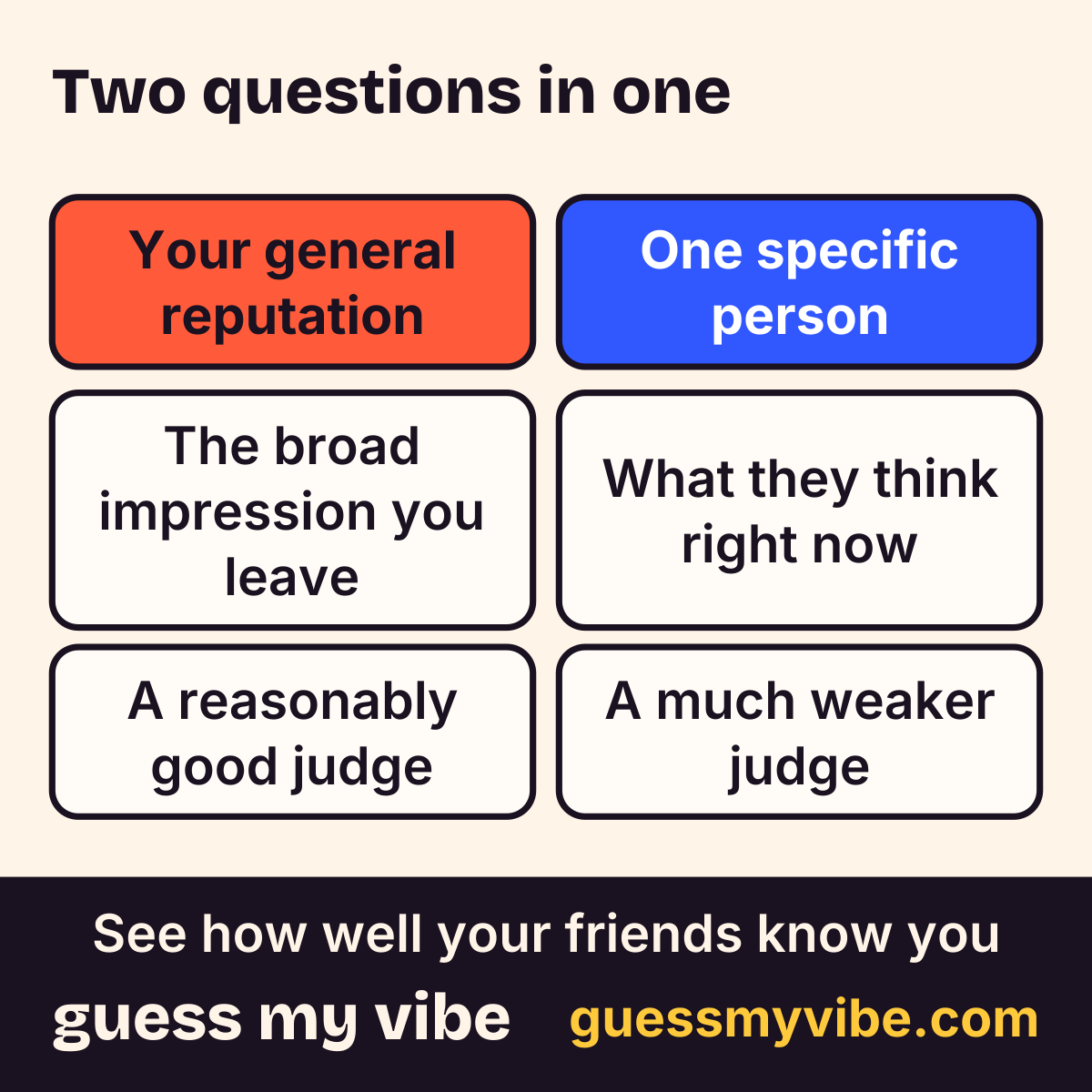
"What do people think of me" usually gets asked as one question, but it's really two. One is about your general reputation: the broad impression you leave on people overall, over time. The other is sharper and more anxious: what is this specific person thinking about me, right now, in this conversation. Research on these two questions gives two different answers. You're a decent, if imperfect, judge of the first one. You're probably overestimating the second one, and there's a specific, well-studied reason why.
Meta-perception: do you actually know your reputation?
Researchers call the question "how well do you know how others see you" meta-perception, or meta-accuracy. A classic review of eight studies on it found a pattern worth knowing before you spiral over a text that took too long to get a reply [3]. People are fairly accurate about their general reputation, the overall impression they make across people. They're much worse at guessing how one specific person sees them. The review's explanation is the useful part: people mostly build their sense of "how others see me" out of their own self-image, not out of real feedback they've actually gotten. That means a lot of what feels like "reading" someone's opinion of you is really your own self-view, reflected back, dressed up as insight into someone else's mind.
That doesn't mean meta-perception is hopeless. A later set of three studies specifically tested whether people can tell the difference between how they see themselves and how others actually see them, rather than just assuming the two always match [1]. Across first impressions and established friendships, people showed real "meta-insight": their guesses about their reputation genuinely tracked other people's actual views, not just their own self-image. So the honest picture isn't "you have no idea what people think of you." It's "you have a real but imperfect sense of your reputation overall, and a much shakier one about any single person's private opinion."
Put the two findings together and a clearer picture forms. Your sense of your reputation is built from a real signal, not pure projection, but it's a blurry, averaged signal: good for the big picture, bad for any single data point. "What does my reputation look like" is a question your own guess can partly, honestly answer. "What does this one specific person think of me after that one conversation" mostly isn't, no matter how confident the guess feels in the moment.
Cite this figure
Figure: "Two questions in one." Guess My Vibe (guessmyvibe.com). https://guessmyvibe.com/learn/what-do-people-think-of-me#figure-two-questions
Curious how your friends would answer?
Free. Answer 10 quick questions about you, then send your link. Friends play in their browser, no app needed.
Start freeThe spotlight effect: you're probably overestimating how closely you're watched
A separate line of research explains why "what does everyone think of me right now" so often feels urgent and overwhelming: people reliably overestimate how much others notice them in the first place. In a set of now-classic studies, participants wore a T-shirt with a flattering or mildly embarrassing image on it, walked into a room of strangers, and then guessed how many people would remember what was on the shirt [2]. They consistently guessed far higher than the number who actually remembered. The same overestimate showed up when people tracked how prominent they thought their comments were in a group discussion. The researchers' explanation: people anchor on their own vivid, close-up experience of the moment and then don't adjust enough for the fact that everyone else is mostly wrapped up in their own experience, not watching yours.
This matters for "what do people think of me" because it changes the size of the actual question. If the spotlight effect is real (and it's been replicated well beyond the original T-shirt studies), then a meaningful share of whatever you're worried people noticed about you, a stumble over a word, an outfit, an awkward pause, was noticed a lot less than it felt like in the moment. People are mostly busy starring in their own version of the spotlight effect to be running a detailed audit of yours.
What a friend's honest answer can tell you, and what it can't
Since guessing mostly reflects your own self-image back at you, the direct fix is also the simple one: ask someone who actually knows you, instead of running the question in your own head. But it helps to know what you're likely to get back. A meta-analysis covering more than 44,000 people found that how accurate other people's ratings are depends heavily on how close they are to you, especially for traits that live mostly inside someone's head, like how easily they get stressed [4]. So a close friend's read is worth more than an acquaintance's, especially on the inner stuff, though even a close friend only knows the feelings you've actually let them see. The same meta-analysis found that other people's ratings are not just opinions, either: when the outcome was school grades or job performance, ratings from people who knew someone tracked it more closely than that person's own self-ratings did, and added to them [4].
That also points to the most reliable version of "finding out what people think of me": ask more than one person, and ask about something specific rather than your whole personality at once ("would you call me more of a planner or more spontaneous" beats "what do you think of me"). A single friend's view is useful but noisy. Several honest views, compared side by side, get you a lot closer than one guess made alone, and a lot closer than the anxious version of this question ever gets on its own. That side-by-side comparison, a friend's actual guesses about you next to your own answers, is the whole premise behind Guess My Vibe.
A specific question also sidesteps a trap the meta-perception research points to directly. A vague prompt like "what do you think of me" invites a vague, hard-to-verify answer, which is exactly the kind of answer easiest to confuse with your own self-image reflected back at you. A narrow, concrete question, about one trait, one situation, one specific habit, is harder to fake, harder to guess at from the outside, and closer to the kind of real, usable feedback most people are genuinely missing.
Key takeaways
- People can genuinely tell the difference between how they see themselves and how others see them; it isn't just a trick of assuming others agree with your own self-view [1].
- You're probably overestimating how much any one person actually notices or remembers about you. The "spotlight effect" is a well-documented overestimate, not just social anxiety talking [2].
- People are fairly good at guessing their general reputation but much worse at guessing how one specific person sees them, mostly because that guess is built from their own self-image rather than real feedback [3].
- Close friends are decent judges of your outward behavior, but hidden things like worry or stress take real closeness to read well [4].
- This isn't therapy, a diagnosis, or a substitute for professional care.
Questions people ask
Do I actually know what people think of me?
Partly. You're a reasonably good judge of your general reputation, the broad impression you leave on people overall, but a much weaker judge of how any one specific person sees you, since that guess tends to be built from your own self-image rather than real feedback [3] [1].
What is the spotlight effect?
The spotlight effect is the well-documented tendency to overestimate how much other people notice and remember your actions and appearance. Classic studies found people consistently overestimated how many onlookers would recall a potentially embarrassing image on their shirt [2].
Why do I feel like everyone is judging me?
Part of that feeling is the spotlight effect: people anchor on their own vivid, close-up experience of a moment and don't adjust enough for how much less attention everyone else is actually paying [2]. That's a documented perceptual bias, not evidence that people are actually scrutinizing you as closely as it feels.
How can I actually find out what someone thinks of me?
Ask them a specific question rather than guessing. Research finds people's guesses about others' opinions mostly reflect their own self-image, not real feedback, so the only way to close that gap is to get an honest answer from someone who actually knows you [3].
Can an online quiz tell me what people think of me?
Only if real people who know you actually answer questions about you. A quiz you take alone reflects your own self-perception, which research shows is an incomplete stand-in for other people's actual opinions, especially about any one specific person's view [3].
See how well your friends know you.
Free. Answer 10 quick questions about you, then send your link. Friends play in their browser, no app needed.
Start freeReferences
- [1] Carlson, E. N., Vazire, S., & Furr, R. M. (2011). Meta-insight: Do people really know how others see them?. Journal of Personality and Social Psychology, 101(4), 831-846. PubMed: 21688920 (opens in a new tab)
- [2] Gilovich, T., Medvec, V. H., & Savitsky, K. (2000). The spotlight effect in social judgment: An egocentric bias in estimates of the salience of one's own actions and appearance. Journal of Personality and Social Psychology, 78(2), 211-222. PubMed: 10707330 (opens in a new tab)
- [3] Kenny, D. A., & DePaulo, B. M. (1993). Do people know how others view them? An empirical and theoretical account. Psychological Bulletin, 114(1), 145–161. PubMed: 8346325 (opens in a new tab)
- [4] Connelly, B. S., & Ones, D. S. (2010). An other perspective on personality: Meta-analytic integration of observers' accuracy and predictive validity. Psychological Bulletin, 136(6), 1092–1122. PubMed: 21038940 (opens in a new tab)
How we find and check these sources: how we write. Spotted an error? Report a correction.
Related
Want to try it with your own friends? Take the best friend test and see how your friends see you
Cite this article
- Title
- What Do People Think of Me? What Research Can Tell You
- Publisher
- Guess My Vibe
- Updated
- URL
- https://guessmyvibe.com/
learn/ what-do-people-think-of-me
Copy this citation
Guess My Vibe. (2026, October 3). What Do People Think of Me? What Research Can Tell You. Guess My Vibe. https://guessmyvibe.com/
To point at one section, add that section's anchor (the # link on its heading) to the URL.