The spotlight effect is the tendency to overestimate how much other people notice your actions and appearance. In the original studies, people wearing a T-shirt with a flattering or embarrassing image overestimated how many observers would remember it [1]. Follow-up work found the same kind of overestimate for embarrassing mishaps: people expected to be judged more harshly than they actually were [2].
What the spotlight effect is, in one sentence
The spotlight effect is the habit of believing other people are watching and remembering you far more than they actually are. The name comes from a 2000 paper that gave the tendency its label: people overestimate how much their actions and appearance are noticed by others [1]. The feeling is familiar. You walk into class with a stain on your shirt, or say something clumsy in a group chat, and it feels like a flashing sign over your head. The research says the sign is mostly visible to you.
This article goes into the experiments themselves, how they were run, what the researchers think is going on, and where the effect weakens. If you want the broader question of how people see you overall, we cover that in a separate piece on what people think of you. Here the question is narrower: how big is the spotlight, and why does it feel so bright from the inside?
The original spotlight effect studies
The 2000 paper reported five studies [1]. In Studies 1 and 2, participants put on a T-shirt showing either a flattering image or a potentially embarrassing one. They then guessed how many of the observers in the room would be able to recall what was pictured. They guessed too high. More people thought they were remembered than actually remembered them, and that held for both the flattering and the embarrassing shirt.
Study 3 moved from clothing to conversation. Participants in a group discussion overestimated how prominent their own positive and negative comments were to the other people in the group [1]. That matters because it shows the effect isn't only about looks. You also overestimate how much your own words stand out, both the clever remarks you hope were noticed and the awkward ones you hope were not.
A caution about reading these studies. They are lab experiments, so they show a reliable tendency, not an exact percentage that applies to every classroom or party. Real rooms have more going on, and some people really are watching. The finding is about the direction of the error: when people guess how much they are noticed, they tend to guess high.
Why the spotlight feels so bright: anchoring and adjustment
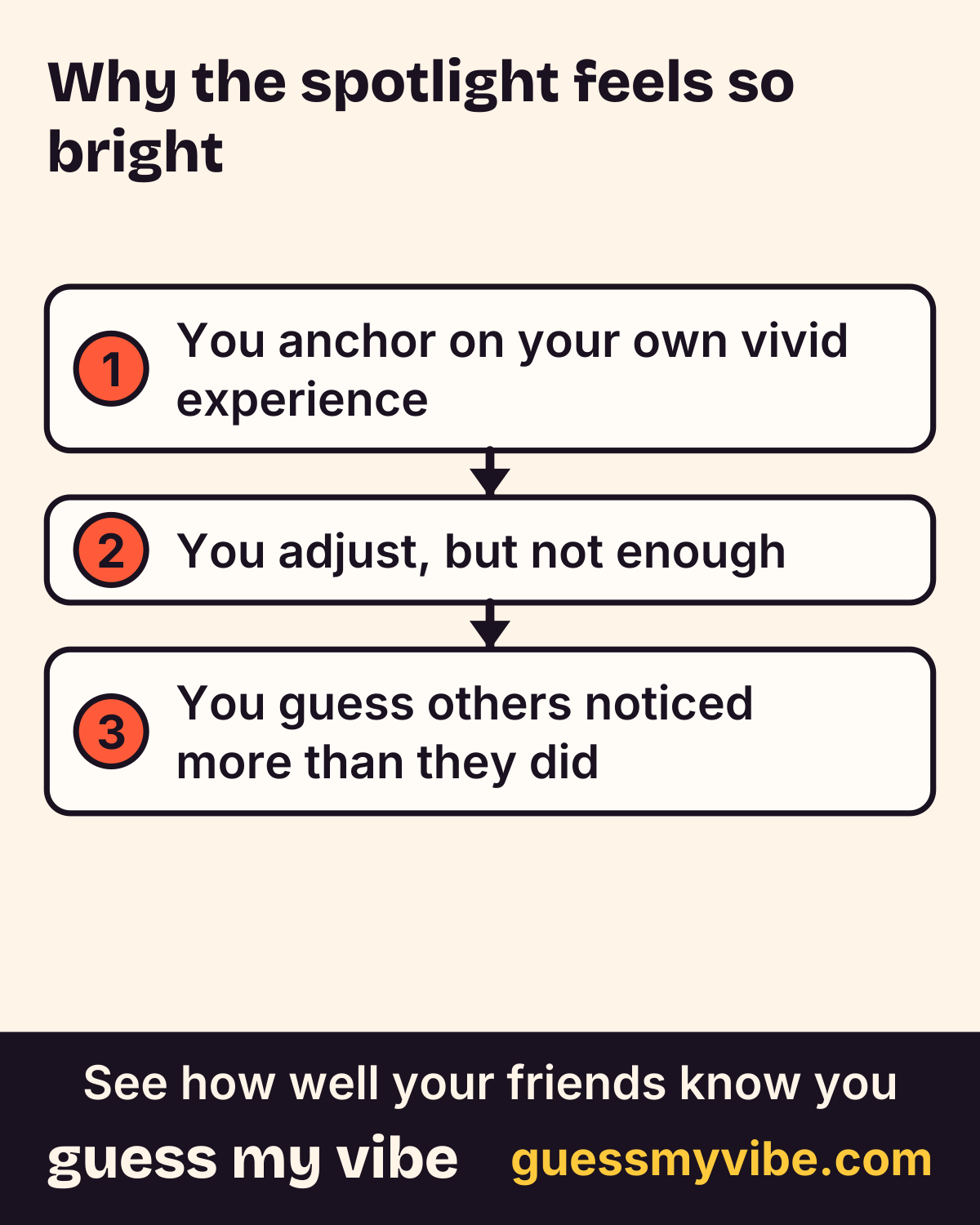
The last two studies in the paper tested why the effect happens. The authors found support for an anchoring-and-adjustment explanation: people anchor on their own rich, first-hand experience of the moment, and then adjust, but not enough, to account for what an onlooker actually perceives [1].
Here is what that looks like in practice. You know exactly how embarrassed you feel, exactly how the shirt looks, and exactly what you meant to say. That experience is huge and vivid. Someone across the room has none of it. They see a person in a shirt for a few seconds while thinking about their own day. You can try to imagine their view, but your own view is the starting point, and the correction stops short.
This is a useful reframe for anyone who replays small moments at night. The size of the memory in your head is not a measure of the size of the memory in anyone else's head. It reflects how close you were standing to the experience.
Cite this figure
Figure: "Why the spotlight feels so bright." Guess My Vibe (guessmyvibe.com). https://guessmyvibe.com/learn/spotlight-effect#figure-anchor-and-adjust
Curious how your friends would answer?
Free. Answer 10 quick questions about you, then send your link. Friends play in their browser, no app needed.
Start freeBlunders, mishaps and harsher judgments
A follow-up set of four studies asked what happens after something actually goes wrong. People imagined committing a social blunder, experienced a public intellectual failure, or were described in an embarrassing way. In each case they expected to be judged more harshly than they were [2]. The authors link this partly to people being inordinately focused on their own misfortune, and so failing to consider the wider set of situational factors that soften how onlookers see them [2].
A later paper adds a wrinkle that keeps the spotlight effect from becoming an excuse. Research on a different bias, the correspondence bias, finds that observers do tend to draw conclusions about someone's character from their behavior. So people are not simply ignoring each other. The authors reconcile the two findings this way: people who blunder neglect that observers moderate their conclusions when they can easily imagine themselves in the same situation [3]. In plain words, people do form a view of you, but it is usually kinder than the one you imagine, because they can picture it happening to them.
When the spotlight feels brightest
The spotlight effect is not a fixed amount. In one study, participants did a memory task in either a low or a high social-evaluation condition. People in the high-evaluation condition reported a stronger spotlight effect and judged their own performance more negatively [4]. The authors suggest the spotlight effect may be tied to social-evaluative concerns, which is a careful way of saying it gets stronger when you feel watched and graded.
That fits everyday experience, though the study itself used a memory task, not real parties. The feeling that everyone noticed is plausibly strongest when the stakes feel high: a presentation, a first day, a party where you don't know anyone. The same study also looked at a related idea, the illusion of transparency, the belief that others can read your inner feelings. It did not change between the low and high evaluation conditions [4]. So these are two separate effects, not two names for the same thing.
None of this is a statement about anyone's mental health, and a study of a memory task can't tell you how to handle a hard week. It simply shows that the feeling of being watched scales with the feeling of being judged.
Spotlight effect or something else? Three quick distinctions
People often lump several ideas together under this one label, so it helps to separate them. The research above supports specific claims, and each one is narrower than the pop version.
- Noticing versus judging. The T-shirt and group-discussion studies are about how much others notice and remember what you did [1]. The blunder studies are about how harshly others judge it [2]. You can overestimate one without the other.
- Noticing versus mind reading. Thinking others can tell how nervous you feel is the illusion of transparency, which the memory-task study measured separately [4]. Thinking others are staring at your outfit is the spotlight effect.
- Overestimating versus zero. The finding is that people guess too high, not that the true number is nothing [1]. Some people do notice, and some do form a view of you [3].
Keeping those apart makes the idea more useful. If the worry is that someone noticed your shirt, the research says probably fewer people than you think. If the worry is that someone now thinks badly of you, it says the judgment is probably milder than you fear. And if the worry is that someone can tell you were nervous, that is a different effect and a different question.
What to do with the spotlight effect
Use it as a calibration tool, not a verdict. When you catch yourself certain that everyone saw the thing, you can adjust the estimate the way the studies suggest people fail to: assume fewer people noticed, and that those who did remember it less sharply than you do.
The cleanest way to check your calibration is to ask. If you want to know what actually registered, a friend who was there can tell you what they noticed and what they didn't, which is almost always less than you feared. Guess My Vibe does this for personality: your friends guess how you would answer, then you see where your picture of yourself and theirs differ. It is not a spotlight-effect test, and it doesn't measure how much people notice you. It does give you real outside views to set against the one in your head.
Key takeaways
- The spotlight effect is a measured bias, not just nerves: in the first three of five studies, people overestimated how much others would notice and remember their appearance and comments [1].
- The proposed reason is anchoring and adjustment: you start from your own vivid, close-up experience of the moment and don't adjust enough for what an onlooker actually perceives [1].
- It also applies to failures: in four studies, people who imagined a blunder, failed in public, or were described unflatteringly expected harsher judgments than others actually gave [2].
- Observers do form impressions of people, just less harsh ones than you fear, partly because they can imagine themselves in your shoes [3].
- In a memory-task study, people in a high social-evaluation setting reported a stronger spotlight effect than people in a low one, so the feeling grows when you feel judged [4].
- This isn't therapy, a diagnosis, or a substitute for professional care.
Questions people ask
What is the spotlight effect in psychology?
It is the tendency to overestimate how much other people notice your actions and appearance. The term comes from a 2000 paper whose participants overestimated how many observers could recall the image on a T-shirt they wore [1].
What causes the spotlight effect?
The researchers propose anchoring and adjustment: you anchor on your own vivid experience of the moment and adjust too little for what someone else actually perceives [1].
Do people really judge you as harshly as you think?
In four studies of blunders and failures, people expected harsher judgment than they received [2]. Observers do form impressions, but the studies suggest they are usually milder than the ones you imagine [3].
Is the spotlight effect the same as the illusion of transparency?
No. The spotlight effect is about overestimating how much others notice you. The illusion of transparency is about overestimating how well others can read your feelings. In one study the first rose in a high social-evaluation setting while the second did not [4].
See how well your friends know you.
Free. Answer 10 quick questions about you, then send your link. Friends play in their browser, no app needed.
Start freeReferences
- [1] Gilovich, T., Medvec, V. H., & Savitsky, K. (2000). The spotlight effect in social judgment: An egocentric bias in estimates of the salience of one's own actions and appearance. Journal of Personality and Social Psychology, 78(2), 211-222. PubMed: 10707330 (opens in a new tab)
- [2] Savitsky, K., Epley, N., & Gilovich, T. (2001). Do others judge us as harshly as we think? Overestimating the impact of our failures, shortcomings, and mishaps. Journal of Personality and Social Psychology, 81(1), 44–56. PubMed: 11474724 (opens in a new tab)
- [3] Epley, N., Savitsky, K., & Gilovich, T. (2002). Empathy neglect: Reconciling the spotlight effect and the correspondence bias. Journal of Personality and Social Psychology, 83(2), 300–312. PubMed: 12150229 (opens in a new tab)
- [4] Brown, M. A., & Stopa, L. (2007). The spotlight effect and the illusion of transparency in social anxiety. Journal of Anxiety Disorders, 21(6), 804–819. PubMed: 17166695 (opens in a new tab)
How we find and check these sources: how we write. Spotted an error? Report a correction.
Related
- What Do People Think of Me? What Research Can Tell You
- Self-Perception vs. How Others See You
- The Liking Gap: Why People Like You More Than You Think
- Self-Awareness: What the Research Says It Actually Takes
- Overthinking Texts: Why You Reread Every Message
- The Illusion of Transparency: Why People Can't Read You
Want to try it with your own friends? Take the best friend test and see how your friends see you
Cite this article
- Title
- The Spotlight Effect: You're Noticed Less Than You Think
- Publisher
- Guess My Vibe
- Updated
- URL
- https://guessmyvibe.com/
learn/ spotlight-effect
Copy this citation
Guess My Vibe. (2026, October 4). The Spotlight Effect: You're Noticed Less Than You Think. Guess My Vibe. https://guessmyvibe.com/
To point at one section, add that section's anchor (the # link on its heading) to the URL.