The liking gap is a well-documented pattern where, after a conversation, people consistently underestimate how much their conversation partner liked them and enjoyed talking with them. It shows up between total strangers, between new roommates, and inside work teams, and it can take months to close. It isn't a personal flaw or a sign something went badly; it's a normal, measurable gap between how a conversation felt from the inside and how it actually landed with the other person.
What the liking gap actually is
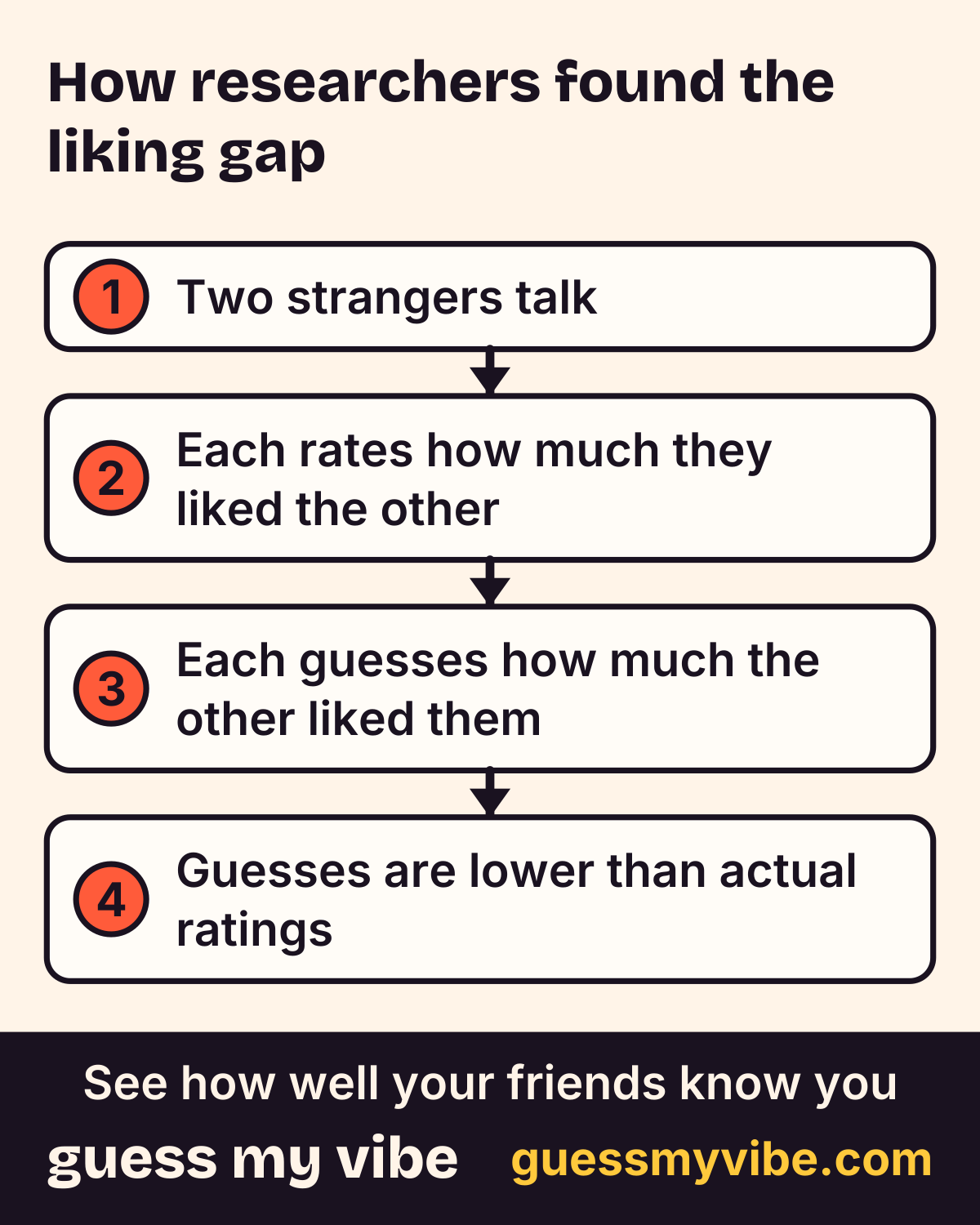
You leave a conversation replaying the one awkward pause, the thing you said a beat too loud, the question you maybe should have asked. Meanwhile, the person you were talking to is doing almost none of that about you. This mismatch has a name: the liking gap. Researchers studying it had two strangers talk for a set amount of time, then had each one rate how much they liked the other and, separately, guess how much the other liked them [1]. Across several different settings, laboratory conversations between strangers, first-year college students getting to know their new roommates, and adults meeting at a workshop, the same pattern showed up every time: people guessed their partner liked them less than their partner actually said they did. Not occasionally. Consistently, and across people who had just met as well as people who had been talking for a while.
Cite this figure
Figure: "How researchers found the liking gap." Guess My Vibe (guessmyvibe.com). https://guessmyvibe.com/learn/liking-gap#figure-how-the-gap-shows-up
Does the liking gap fade once people get to know each other?
It's reasonable to assume this is just first-meeting nerves that clear up once two people actually know each other. The research says otherwise. In the same set of studies, the liking gap held up across conversations of different lengths, and among the new college roommates, it was still measurable several months later, long after "we just met" stopped being a fair excuse [1]. A separate line of work extended the same question past one-on-one chats, into small group conversations and real engineering teams working together on a shared project [2]. The underestimate showed up there too: people reliably guessed their group liked them less than the group actually did, the gap was largest in peer relationships, and it was tied to a specific habit, fixating on the one part of the conversation that felt like it went badly instead of the rest of it that didn't.
Why people underestimate how much they're liked
Part of the explanation sits one step earlier than the liking gap itself: people are often wrong, in the same pessimistic direction, about how much a total stranger even wants to talk to them. In one set of studies, commuters were randomly told to strike up a conversation with a stranger nearby, stay quiet as usual, or ride as they normally would [3]. The people who actually talked to a stranger reported a more positive commute than the ones who stayed quiet, with no drop in how productive they felt. But a separate group of people, asked to guess in advance, expected exactly the opposite: they thought solitude would feel better than connecting would. Part of that mistaken guess came from underestimating how interested the stranger would actually be in talking back. If you walk into a conversation already assuming the other person would rather not be there, it's easy to see why you'd walk out assuming they didn't enjoy it much either, even when, measured honestly, they did.
Curious how your friends would answer?
Free. Answer 10 quick questions about you, then send your link. Friends play in their browser, no app needed.
Start freeDoes the liking gap mean you're bad at reading people?
Not necessarily, and that's part of what makes the liking gap worth knowing about rather than just discouraging. By definition, it isn't a general skill problem; it's a narrow, specific blind spot about your own impact on one particular person, not a broader inability to read people. The group-conversation research above points to one likely piece of the mechanism: people who showed the gap tended to fixate on the one part of the exchange that felt awkward or off, a stumbled sentence, an unanswered question, rather than weighing it against everything else that went fine [2]. That's a selective-memory problem, replaying your own worst moment on a loop, more than a people-reading problem. It's also exactly the kind of error that's hard to correct from the inside, since the stumble you keep replaying is real; what's missing is the rest of the conversation to weigh it against.
Why closing this gap is worth the effort
The liking gap isn't just an interesting quirk; it has a real, practical cost, since it quietly discourages exactly the interactions that tend to pay off. A study found that students felt happier and more connected on days when they interacted with more classmates than usual, and follow-up studies found that everyday interactions with weaker ties, not just close friends and family, were related to well-being too [4]. If you walk away from those lower-stakes conversations assuming they landed worse than they actually did, the natural response is to have fewer of them, the exact opposite of what the well-being research suggests is worth doing more of. The liking gap and the well-being benefit of casual social contact point in opposite directions: one makes you want to pull back after a conversation that actually went fine, the other quietly rewards you for not pulling back in the first place.
What to actually do with this
None of this research says to ignore how a conversation actually went. It says to distrust the automatic, pessimistic read of it. If a conversation felt fine or good while it was happening, the honest best guess, backed by a real body of research, is that the other person liked it about as much as you did, maybe more. The only way to actually check, rather than keep guessing in the direction the liking gap pulls you, is to ask, or to see someone's honest answer in writing instead of trying to infer it from memory. Asking directly feels awkward precisely because the liking gap makes it feel unnecessary, like you already know the answer and it's a bad one. That's the part worth pushing past, since the studies above found that unprompted guess is usually wrong in the same, pessimistic direction. That's the whole premise behind Guess My Vibe's honest-take card: instead of guessing at how a friend sees you from a replayed conversation in your head, a friend rates you directly, so you get their actual answer instead of your own pessimistic guess about it.
Key takeaways
- The liking gap is real and well-replicated: across strangers meeting in a lab, college roommates, and adults at a workshop, people reliably rated how much their partner liked them lower than their partner's own, actual rating [1].
- It isn't limited to one-on-one chats. The same underestimate shows up in small group conversations and in real engineering teams working together, and it's largest between peers [2].
- It doesn't close quickly. In the roommate study, the gap was still measurable after several months of actually living together [1].
- Part of the cause is a more general pattern: people tend to underestimate how interested a stranger is in connecting with them at all, which makes them more hesitant to start a conversation in the first place [3].
- This isn't therapy, a diagnosis, or a substitute for professional care; it's a plain-English summary of what personality and social psychology research says about the liking gap.
Questions people ask
What is the liking gap?
The liking gap is the finding that after a conversation, people consistently rate how much their partner liked them lower than their partner's own, actual rating of how much they liked the conversation [1].
Does the liking gap go away once you know someone better?
Not quickly. Among college roommates, the gap was still measurable several months into actually living together, long after a first-meeting explanation stops applying [1].
Does the liking gap happen in groups, not just one-on-one?
Yes. The same underestimate shows up in small group conversations and real work teams, and it's largest in peer relationships [2].
Why do people assume others like them less than they actually do?
Part of it traces back even further: people tend to underestimate how interested a stranger is in connecting at all, which research on commuters avoiding conversation with strangers found leads people to expect a worse interaction than they actually get [3].
Is it worth pushing past the liking gap and talking to people anyway?
Research on everyday social contact found that casual interactions with people who aren't close friends, like classmates and other acquaintances, are linked to real gains in daily happiness and sense of belonging, which the liking gap's pessimism tends to talk people out of [4].
See how well your friends know you.
Free. Answer 10 quick questions about you, then send your link. Friends play in their browser, no app needed.
Start freeReferences
- [1] Boothby, E. J., Cooney, G., Sandstrom, G. M., & Clark, M. S. (2018). The Liking Gap in Conversations: Do People Like Us More Than We Think?. Psychological Science, 29(11), 1742–1756. PubMed: 30183512 (opens in a new tab)
- [2] Mastroianni, A. M., Cooney, G., Boothby, E. J., & Reece, A. G. (2021). The liking gap in groups and teams. Organizational Behavior and Human Decision Processes, 162, 109–122. doi.org/10.1016/j.obhdp.2020.10.013 (opens in a new tab)
- [3] Epley, N., & Schroeder, J. (2014). Mistakenly seeking solitude. Journal of Experimental Psychology: General, 143(5), 1980–1999. PubMed: 25019381 (opens in a new tab)
- [4] Sandstrom, G. M., & Dunn, E. W. (2014). Social Interactions and Well-Being: The Surprising Power of Weak Ties. Personality and Social Psychology Bulletin, 40(7), 910–922. PubMed: 24769739 (opens in a new tab)
How we find and check these sources: how we write. Spotted an error? Report a correction.
Related
- First Impressions: How Fast and How Accurate They Are
- How to Make a Good First Impression, According to Research
- Self-Perception vs. How Others See You
- Likability: What Actually Makes People Like You
- How to Make Small Talk, According to Research
- Signs Someone Wants to Be Your Friend, and What's Known
- Reciprocity Psychology: Why We Like People Who Like Us
- How to Ask Someone to Hang Out: Less Risky Than It Feels
- Friend Who Only Talks About Themselves: What Research Says
Cite this article
- Title
- The Liking Gap: Why People Like You More Than You Think
- Publisher
- Guess My Vibe
- Updated
- URL
- https://guessmyvibe.com/
learn/ liking-gap
Copy this citation
Guess My Vibe. (2026, October 3). The Liking Gap: Why People Like You More Than You Think. Guess My Vibe. https://guessmyvibe.com/
To point at one section, add that section's anchor (the # link on its heading) to the URL.