The research-backed way to make a good first impression isn't to perform a different personality. It's to let your actual expressions, posture, and warmth show instead of holding them back. Studies find that people who present themselves naturally and a little more positively, more animated, more engaged, aren't just liked more; they're also read more accurately, not less. The traits you can't change much in a single meeting (how outgoing you are by nature) matter less here than the traits you can (how open and expressive you let yourself be in the moment).
How to make a good first impression, the research-backed version
Most advice on how to make a good first impression is either generic ("be confident!") or asks you to fake a different personality for an evening. The research points somewhere more specific and more doable: let more of your actual self show, rather than less. A study using full-body photographs tested this directly, comparing strangers' accuracy when the people in the photos held a controlled, standardized pose and expression against their accuracy when people photographed themselves naturally, choosing their own pose and expression [1]. In the controlled condition, strangers were only accurate about a few traits: how outgoing someone was, their self-esteem, and their religiosity. In the natural, self-expressed condition, strangers were accurate about almost every trait the study measured. Holding still and controlling your expression didn't make people read you better. It made them read less of you.
Trying to make a good impression doesn't hide who you are
There's a common worry that trying to come across well is a kind of performance, and that it must come at the cost of being seen accurately. A study designed specifically to test that worry found the opposite [2]. People were randomly told to either put their best face forward when meeting someone new, or to interact with low pressure to make any particular impression at all. The people trying to make a good impression weren't just liked more, which is the unsurprising part. Their new acquaintance also formed a more accurate read of their actual, self-reported personality and even their IQ. The explanation the researchers landed on: people trying to make a good impression were simply more engaging to talk to, which gave their conversation partner more real material to work with, not a glossier cover over less of it.
What you can actually change vs. what observers just pick up
It's worth being honest about which part of this is in your control. How outgoing you are by temperament isn't something you flip on for one meeting, and the research above isn't suggesting you should try. What's actually adjustable, meeting to meeting, is how much of your natural expression you let show: whether you let your face move, whether you let yourself react, whether you hold back out of nerves or let the moment play out. That's the piece both studies above point to: expressiveness and warmth, not a louder personality, are what made people both better liked and more accurately read. If you're naturally quieter, the lesson isn't to act extroverted; it's that a quieter, genuinely engaged version of you reads better than a guarded, flattened version of you.
Curious how your friends would answer?
Free. Answer 10 quick questions about you, then send your link. Friends play in their browser, no app needed.
Start freeSimple moves the research points toward
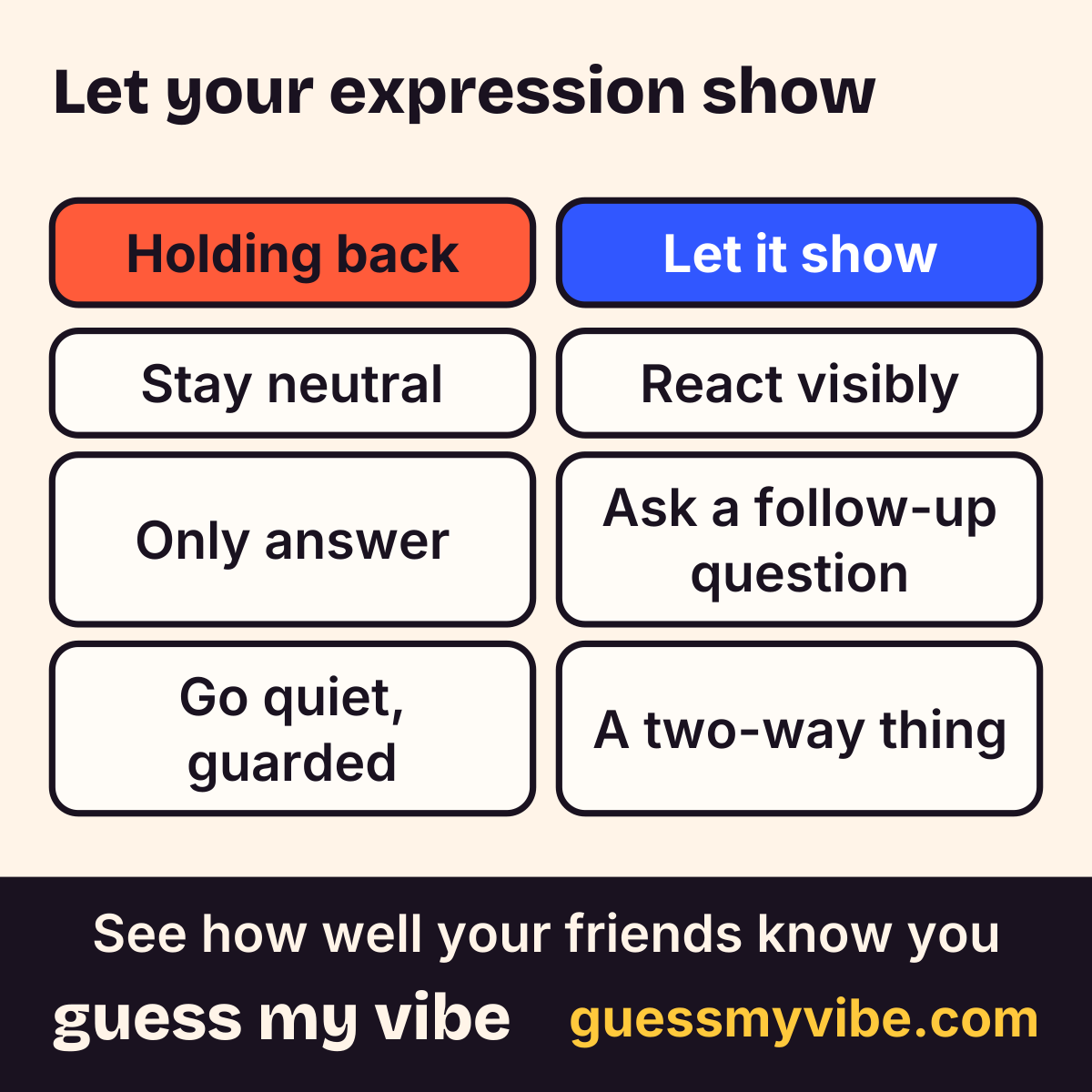
Neither study above hands out a script, and this isn't a top-ten-tips list dressed up as science. But the thread connecting them points toward a few low-cost, honest moves rather than a performance: react visibly instead of staying neutral (a flat expression gives an observer nothing to read, accurately or otherwise); ask a genuine follow-up question instead of only answering the ones you're asked, since that's a plain, doable way to be more engaging, the same quality that made self-presenters both better liked and better understood [2]; and let a first conversation stay a two-way thing instead of either over-preparing a version of yourself to perform or going quiet and guarded. None of this is about adding charisma you don't have. It's about not subtracting the expressiveness you already do.
Cite this figure
Figure: "Let your expression show." Guess My Vibe (guessmyvibe.com). https://guessmyvibe.com/learn/how-to-make-a-good-first-impression#figure-show-dont-subtract
Even a good first impression has a ceiling
A strong first impression is a real head start, not the finish line. Research tracking how people's judgments change over time found that agreement between a new acquaintance's view and a person's own self-view keeps climbing well past the first meeting, as specific, accurate information replaces the generic assumptions a stranger starts with [3]. And some of what a new acquaintance misses isn't something you can present your way around in a single meeting: everyone, including you, carries real blind spots about their own personality, especially around their most desirable and least desirable traits, the ones you have the most motivation to see generously [4]. Other people, simply by not sharing that motivation, can sometimes see those traits more clearly than you do. A good first impression gets someone started in the right direction. It doesn't finish the job, and it isn't supposed to; expecting one good meeting to do all the work is its own kind of overclaim, just one people make about themselves instead of a product.
A simple way to check how you're actually coming across
Since presenting yourself naturally and warmly is the part of a first impression you can actually act on, it's worth finding out whether it's landing the way you think it is. The honest way to check isn't to analyze your own face in a mirror; it's to ask someone who's actually met you. A friend who's known you for a while, comparing notes with someone meeting you for the first time, can tell you whether the expressive, engaged version of you that research says works is actually the version coming through, or whether nerves are flattening it more than you realize. That comparison is also the only way to catch the gap between how a first impression felt from the inside and how it actually landed, since the two are measured from completely different vantage points and there's no reliable way to infer one from the other without asking. Guess My Vibe is built for exactly that kind of comparison: you answer questions about your own personality, and a friend answers the same questions about you, so you can see where your intended first impression and someone else's actual read line up, and where they don't.
Key takeaways
- Looking natural and expressive, rather than stiff or guarded, makes you easier to read accurately, not harder. Strangers judging people who posed and expressed themselves naturally in photos were accurate on almost every trait studied; strangers judging more controlled, constrained photos were only accurate on a few [1].
- Putting your best self forward doesn't hide who you are; one study found it does the opposite. People asked to present themselves positively when meeting someone new were liked more AND judged with greater accuracy than people given no such instruction [2].
- A good first impression is a real head start, not the whole story: accuracy keeps climbing as someone spends more time with you, well past the first meeting [3].
- Even a great first impression has a ceiling, since everyone, including you, has real blind spots about their own personality, especially around the traits they're most motivated to see generously [4].
- This isn't therapy, a diagnosis, or a substitute for professional care; it's a plain-English summary of what personality research says about first impressions.
Questions people ask
What's the single best way to make a good first impression?
Let your natural expression and reactions show instead of holding them back. Strangers judging naturally posed, expressive photos were accurate about almost every personality trait studied, far more than strangers judging controlled, stiff photos [1].
Does trying to make a good impression make people see a fake version of me?
Research found the opposite: people told to put their best face forward were both liked more and judged more accurately than people given no such instruction, likely because trying harder made them more engaging to actually talk to [2].
Should I act more extroverted to make a better first impression?
The research points to expressiveness and warmth, not volume or extroversion specifically. A genuinely engaged, quieter presentation reads better than a guarded, flattened one, regardless of how outgoing you are by nature.
How long does it take for someone to really know me after a good first impression?
Longer than one meeting. Agreement between a new acquaintance's view and your own self-view keeps increasing well past the first impression, as specific, accurate information gradually replaces generic assumptions [3].
Can a first impression ever capture my whole personality?
No single first impression can, and that's expected: even you have blind spots about your own personality, especially around your most and least flattering traits, the ones you're most motivated to see generously; other people aren't working under that same motivation [4].
See how well your friends know you.
Free. Answer 10 quick questions about you, then send your link. Friends play in their browser, no app needed.
Start freeReferences
- [1] Naumann, L. P., Vazire, S., Rentfrow, P. J., & Gosling, S. D. (2009). Personality judgments based on physical appearance. Personality and Social Psychology Bulletin, 35(12), 1661–1671. PubMed: 19762717 (opens in a new tab)
- [2] Human, L. J., Biesanz, J. C., Parisotto, K. L., & Dunn, E. W. (2012). Your Best Self Helps Reveal Your True Self. Social Psychological and Personality Science, 3(1), 23–30. doi.org/10.1177/1948550611407689 (opens in a new tab)
- [3] Biesanz, J. C., West, S. G., & Millevoi, A. (2007). What do you learn about someone over time? The relationship between length of acquaintance and consensus and self-other agreement in judgments of personality. Journal of Personality and Social Psychology, 92(1), 119–135. PubMed: 17201547 (opens in a new tab)
- [4] Vazire, S., & Carlson, E. N. (2011). Others sometimes know us better than we know ourselves. Current Directions in Psychological Science, 20(2), 104–108. doi.org/10.1177/0963721411402478 (opens in a new tab)
How we find and check these sources: how we write. Spotted an error? Report a correction.
Related
Cite this article
- Title
- How to Make a Good First Impression, According to Research
- Publisher
- Guess My Vibe
- Updated
- URL
- https://guessmyvibe.com/
learn/ how-to-make-a-good-first-impression
Copy this citation
Guess My Vibe. (2026, October 3). How to Make a Good First Impression, According to Research. Guess My Vibe. https://guessmyvibe.com/
To point at one section, add that section's anchor (the # link on its heading) to the URL.