A first impression forms in seconds, from almost nothing: a few minutes of talking, a photo, a short video clip. Research on "thin slices" of behavior finds that these snap judgments are not random. Strangers do noticeably better than chance at reading outgoing, confident traits from a brief first impression, though far from perfectly, and they're more accurate for some traits than others. A friend who has known you for months or years reads you even better than a stranger does, because real acquaintance adds information a few seconds never can.
How fast a first impression actually forms
A first impression doesn't build up slowly. It forms almost immediately, from a strikingly small amount of behavior: a few minutes of conversation, a short video clip, even a single photograph. Researchers call this a "thin slice": a brief sample of someone's behavior, often well under a minute long, that a stranger uses to form a judgment about who that person is. A large meta-analysis pulling together 38 separate findings tested how well these thin-slice judgments actually connect to real, independently measured outcomes, things like how a teacher was later rated by students, or how a negotiation actually turned out [1]. The average effect size was a moderate .39, a real, usable signal, not noise, and not a coin flip either. Oddly, watching longer didn't reliably help: judgments made from clips under 30 seconds were about as accurate as judgments from a full five minutes. Whatever a first impression is built from, a lot of it is already there within the first half-minute.
How accurate is a first impression, really?
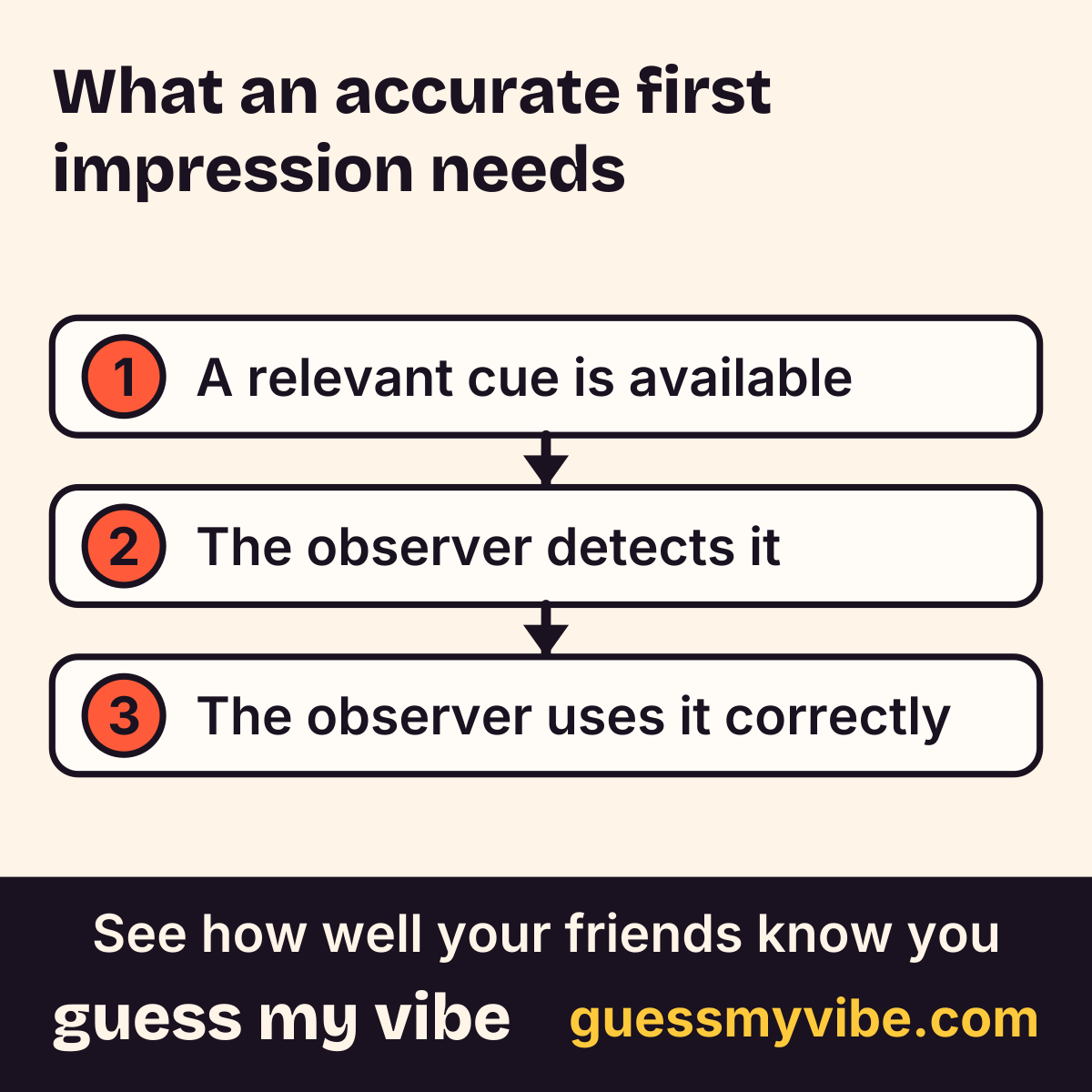
"Accurate" is doing a lot of work in that last paragraph, so it's worth being precise about what the research actually supports. The Realistic Accuracy Model, a framework for studying personality judgment, lays out exactly what has to go right for any outside judgment, including a fast first impression, to land close to the truth [3]. A relevant behavioral cue has to actually be available (you have to do something that shows the trait). The observer has to detect that cue (notice it happened). And the observer has to use it correctly (not misread a nervous laugh as rudeness). Miss any one of those three steps and the judgment drifts off target. That's the real reason a first impression is sometimes sharp and sometimes badly wrong: it's not that strangers are generally good or bad judges, it's that the three-step chain holds up better for some traits, people, and situations than others.
Cite this figure
Figure: "What an accurate first impression needs." Guess My Vibe (guessmyvibe.com). https://guessmyvibe.com/learn/first-impressions#figure-three-steps-to-accuracy
Strangers vs. friends: who reads a first impression better
A classic study put this to a direct test. About 150 undergraduates described their own personalities, and were also described by two close acquaintances and, separately, by two total strangers who had only seen them in one brief, videotaped conversation, exactly a first impression with no history behind it [2]. The acquaintance effect was large: close acquaintances agreed with each other, and with the person's own self-view, far more than the strangers did. But the strangers weren't guessing randomly either. Their snap judgments, formed from a single short clip, still agreed with each other and with the person's self-view beyond chance. And tellingly, the same traits that were easy for acquaintances to read (outgoing, talkative behavior) were also the easiest for strangers to read from a first impression alone. A first impression isn't a different kind of judgment from a long-term friend's view. It's a rougher, faster version of the same thing, limited by how little information it has to work with.
Curious how your friends would answer?
Free. Answer 10 quick questions about you, then send your link. Friends play in their browser, no app needed.
Start freeOne first impression vs. a few, combined
If a single first impression is a rough estimate, does averaging a few of them clean it up? A related study tested a close cousin of that question, using acquaintances rather than strangers, comparing a person's own self-view against a single knowledgeable acquaintance's view and against two acquaintances' combined view, both measured against real videotaped behavior [5]. A single acquaintance's outside view slightly out-performed the person's own self-view at matching their actual behavior. Two acquaintances combined beat self-view by a clear, statistically real margin. The lesson isn't "don't trust your own self-view"; it's that no single vantage point, including your own, sees the whole picture, and a few honest outside views together see more of it than any one view alone, your own included.
A first impression keeps improving the longer someone knows you
A first impression isn't a verdict that locks in on day one and never moves. A study that tracked personality judgments as people actually got to know each other found that as the length of acquaintance grew, agreement between a person's self-view and their acquaintance's view grew too, and so did the kind of accuracy that captures what's distinctively true about one specific person rather than people in general [4]. Meanwhile, reliance on a generic stereotype of "what people like this are usually like" faded. In plain terms: a brand-new acquaintance's first impression leans more on assumptions about people in general; a friend of several years has swapped most of that out for things that are actually, specifically true about you. The first impression was a reasonable starting guess. The years since then did the rest of the work.
What this means in practice
Put together, the research says something more useful than either "first impressions are everything" or "first impressions don't matter." A first impression is a real, moderately accurate read, strongest for outgoing, visible behavior and weakest for quiet, private traits, built almost entirely in the first few seconds, and it only gets more accurate from there as someone actually gets to know you. Neither extreme view survives contact with the actual studies: a first impression is too consistent across strangers to be meaningless, and too limited by how little evidence it has to work with to be the final word. If you want to know how you come across, the honest, research-backed move isn't to obsess over the first few seconds of a new meeting. It's to ask people who've actually spent time with you, and to ask more than one, since the studies above found that a few honest views beat any single one. That's the same idea behind Guess My Vibe: a friend answers the same questions about you that you answer about yourself, so you get more than a single first impression to compare against your own.
Key takeaways
- A first impression is a real, measurable judgment, not just a vibe: a meta-analysis across dozens of studies found that snap judgments from behavior lasting under five minutes connect to real outcomes at a moderate, meaningful level, not by chance [1].
- Strangers are decent, not great, judges of a first impression. Two strangers who separately watched the same brief video of someone agreed with each other and with that person's own self-view beyond chance, but nowhere close to how well two close acquaintances agreed [2].
- Accuracy isn't one fixed number. It depends on the trait (outgoing, confident behavior reads easily; quieter inner traits don't), on how much information is available, and on whether the perceiver actually uses the cues in front of them [3].
- A first impression keeps improving the more time someone spends with you: agreement with a new acquaintance's view of you grows as the friendship goes on, while reliance on generic assumptions about "people in general" fades [4].
- This isn't therapy, a diagnosis, or a substitute for professional care; it's a plain-English summary of what personality research says about first impressions.
Questions people ask
How long does it take to form a first impression?
Extremely fast, often under a minute. A meta-analysis found that judgments from behavior clips lasting well under 30 seconds were about as accurate as judgments from clips lasting a full five minutes [1].
Are first impressions from strangers actually accurate?
Partly. Strangers who saw only one brief, videotaped interaction agreed with each other and with the person's own self-view more than chance would allow, but far less than two close acquaintances agreed with each other [2].
Is it true that first impressions last?
A first impression leaves a mark, but it isn't fixed. Agreement between an acquaintance's view and a person's own self-view grows the longer they know each other, as generic assumptions give way to specific, accurate ones [4].
Why are some traits easier to judge from a first impression than others?
The Realistic Accuracy Model explains it: an accurate judgment needs a visible cue, a perceiver who notices it, and a perceiver who reads it correctly. Outgoing, expressive traits give off more usable cues than quiet, internal ones like how easily someone gets stressed [3].
Whose first impression of me is more reliable, one friend's or several?
Several. A single acquaintance's judgment of someone's personality slightly out-performed that person's own self-judgment, and two acquaintances' combined judgment beat it by a clear margin [5].
See how well your friends know you.
Free. Answer 10 quick questions about you, then send your link. Friends play in their browser, no app needed.
Start freeReferences
- [1] Ambady, N., & Rosenthal, R. (1992). Thin slices of expressive behavior as predictors of interpersonal consequences: A meta-analysis. Psychological Bulletin, 111(2), 256–274. doi.org/10.1037/0033-2909.111.2.256 (opens in a new tab)
- [2] Funder, D. C., & Colvin, C. R. (1988). Friends and strangers: Acquaintanceship, agreement, and the accuracy of personality judgment. Journal of Personality and Social Psychology, 55(1), 149–158. PubMed: 3418488 (opens in a new tab)
- [3] Funder, D. C. (1995). On the accuracy of personality judgment: A realistic approach. Psychological Review, 102(4), 652–670. doi.org/10.1037/0033-295X.102.4.652 (opens in a new tab)
- [4] Biesanz, J. C., West, S. G., & Millevoi, A. (2007). What do you learn about someone over time? The relationship between length of acquaintance and consensus and self-other agreement in judgments of personality. Journal of Personality and Social Psychology, 92(1), 119–135. PubMed: 17201547 (opens in a new tab)
- [5] Kolar, D. W., Funder, D. C., & Colvin, C. R. (1996). Comparing the accuracy of personality judgements by the self and knowledgeable others. Journal of Personality, 64(2), 311–337. PubMed: 8656321 (opens in a new tab)
How we find and check these sources: how we write. Spotted an error? Report a correction.
Related
- The Liking Gap: Why People Like You More Than You Think
- Thin Slicing: What a Few Seconds Reveal About You
- How to Make a Good First Impression, According to Research
- Self-Perception vs. How Others See You
- Are You a Good Judge of Character? What Research Finds
- Judging Personality: Why People Get It Right (or Wrong)
- How to Read People: The Cues That Actually Work
- Snap Judgments: How Accurate Are They, Really?
- How Long Does It Take to Form a First Impression?
- The Halo Effect: Why One Good Trait Colors Everything
More in First impressions and judging people
- Charisma: What It Is and What Research Says Makes It
- Personality From Photos: How Accurate Are First Guesses?
- Reading Body Language: What It Can and Can't Tell You
- How to Be Approachable, According to Research
- Warmth and Competence: The Two Things People Judge First
- Attractiveness Halo Effect: Is What's Beautiful Good?
- The Liking Gap: Why People Like You More Than You Think
- Thin Slicing: What a Few Seconds Reveal About You
- How to Make a Good First Impression, According to Research
- Are You a Good Judge of Character? What Research Finds
- Judging Personality: Why People Get It Right (or Wrong)
- How to Read People: The Cues That Actually Work
- Likability: What Actually Makes People Like You
- Snap Judgments: How Accurate Are They, Really?
- The Halo Effect: Why One Good Trait Colors Everything
- How Long Does It Take to Form a First Impression?
Cite this article
- Title
- First Impressions: How Fast and How Accurate They Are
- Publisher
- Guess My Vibe
- Updated
- URL
- https://guessmyvibe.com/
learn/ first-impressions
Copy this citation
Guess My Vibe. (2026, October 3). First Impressions: How Fast and How Accurate They Are. Guess My Vibe. https://guessmyvibe.com/
To point at one section, add that section's anchor (the # link on its heading) to the URL.