Thin slicing is forming a judgment about someone's personality from a very brief sample of their behavior, sometimes just seconds of video, with no conversation or history involved. Research finds it works better than chance, and sometimes surprisingly well, but not evenly across traits. Outgoing, expressive behavior comes through clearly in a short clip; quieter, inward traits like how easily someone gets stressed mostly don't. That's the same pattern that shows up when friends judge each other over months and years, just compressed into a few seconds.
What thin slicing actually means
Thin slicing is the research term for judging someone's personality or behavior from a very short, isolated sample, a video clip, a photo, a few seconds of speech, with no ongoing relationship and often no conversation at all. The idea got its name, and its research base, from a meta-analysis that pulled together 38 separate findings testing how well these snap judgments held up against real, independently measured outcomes [1]. Across all of them, judgments made from behavior samples under five minutes long connected to those outcomes at an average effect size of about .39, a real, moderate signal. The surprising part: clips under 30 seconds performed about as well as clips running a full five minutes. Whatever information a thin slice carries, more time watching doesn't reliably add much more of it.
What a thin slice gets right
One especially detailed study put 600 people on videotape across 15 brief, separate episodes each, then had strangers rate their personalities from those clips alone [2]. The strangers' thin-slice judgments lined up with what the person's own close, knowledgeable contacts actually said about them, and the more episodes a judge saw, the closer the match, up to a point: the gains in accuracy mostly leveled off beyond about 6 short clips. Intelligence was readable too, and strongly so, from the clips, and one surprisingly specific cue stood out: how someone read a short sentence out loud carried more information about their measured intelligence than almost anything else in the footage. A thin slice is a small sample, but it isn't an empty one.
Why some traits are easier to read in seconds than others
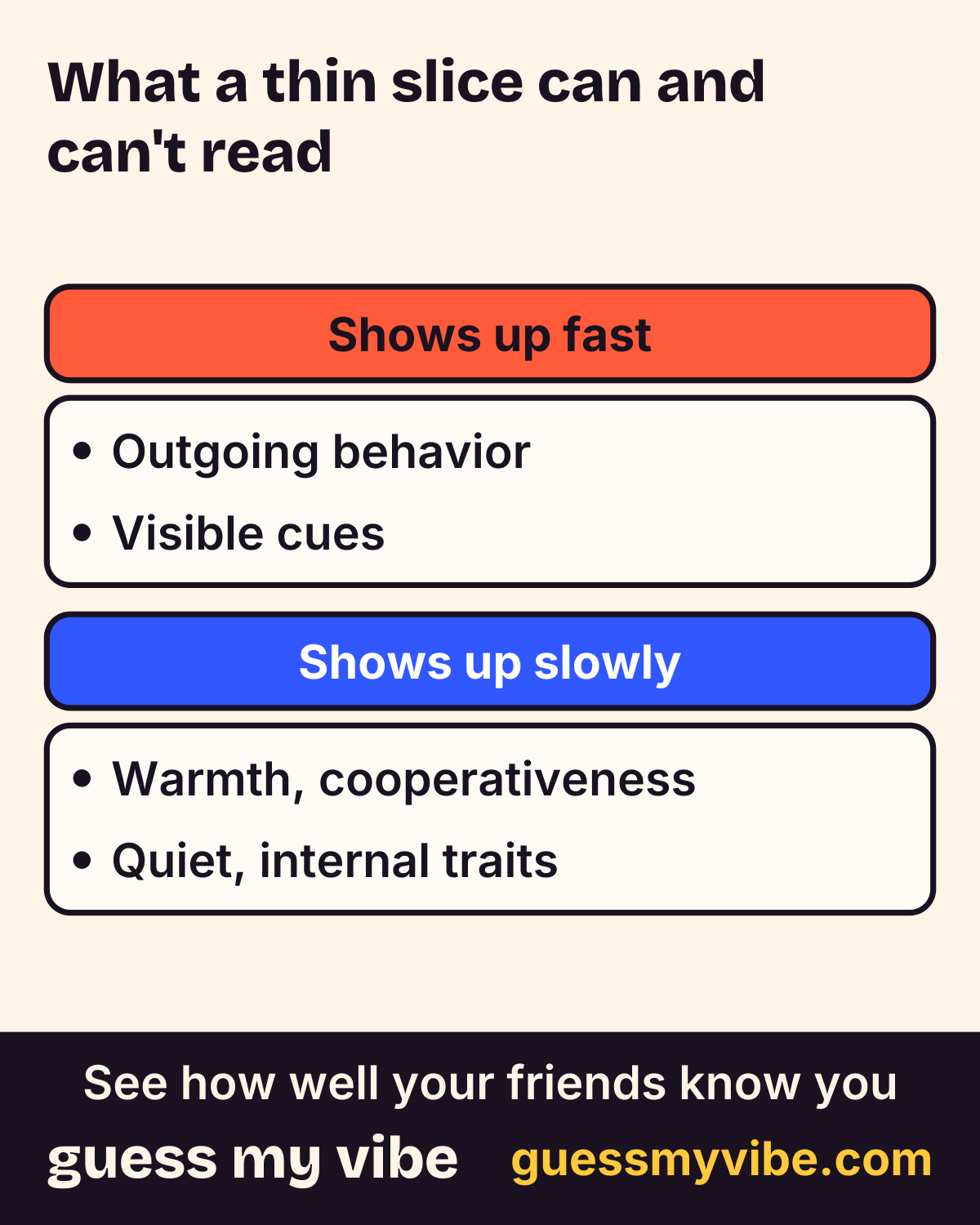
Thin slicing doesn't work equally well on every trait, and the pattern it follows is the same one that shows up when researchers compare how well friends judge each other over months and years. A meta-analysis spanning 263 samples and more than 44,000 people found that agreement between a person's self-view and other people's view of them depended on closeness: being close to someone helped most for traits that are hard to see from outside, like emotional stability, and only minimally for highly evaluative traits like agreeableness (warmth and cooperativeness) [3]. The reason traces back to the same three-step chain that governs any outside judgment, fast or slow: a trait has to show up as a visible cue, someone has to notice it, and they have to read it correctly [4]. Outgoing behavior produces loud, visible cues almost immediately, talking a lot, taking up space in a conversation, a big smile. Warmth is quieter and more easily faked or misread in a short window; genuine cooperativeness often only shows up when something's actually at stake, which a thin slice rarely captures. A few seconds of footage and a few years of friendship are reading the same evidence; a friend just has far more of it to work with.
Cite this figure
Figure: "What a thin slice can and can't read." Guess My Vibe (guessmyvibe.com). https://guessmyvibe.com/learn/thin-slicing#figure-fast-and-slow-traits
Curious how your friends would answer?
Free. Answer 10 quick questions about you, then send your link. Friends play in their browser, no app needed.
Start freeWhere thin slicing shows up every day
You run into thin slicing far more often than the phrase comes up. A dating profile photo, the first 20 seconds of a video call before anyone's really said anything, a brief introduction at a party, these are all, structurally, the same kind of sample researchers study in a lab: a short, isolated piece of behavior that someone else has to read with no history to lean on. None of that makes the read less real. The meta-analysis above pulled its 38 findings from a mix of settings, including clinical and social-psychology outcomes and spotting deception, not just lab personality ratings, and found the same moderate accuracy pattern held across them [1]. What changes from one everyday example to the next isn't whether thin slicing applies; it's which traits that particular slice happens to put on display. A video call's first 20 seconds shows your expressiveness and energy clearly. It shows almost nothing about how reliable you are under a deadline.
Thin slices vs. actually knowing someone
None of this makes thin slicing a shortcut to actually knowing someone; it's closer to a compressed, lower-resolution version of the same process. A first impression from a few seconds of footage and a close friend's read built over years are pulling from the same kind of evidence, visible behavior, just in wildly different quantities. The traits a thin slice nails are the ones that don't need much evidence to show up clearly. The traits it misses are the ones that only reveal themselves slowly, under real conditions a short clip can't manufacture, like how someone actually handles a disagreement, or whether they follow through on a promise made weeks earlier. That's exactly why the studies above treat acquaintance length as its own variable worth measuring, not a detail to average away: the amount of evidence someone has access to changes what they can know, not just how confident they feel about knowing it.
What this means for you
If you've ever wondered how a stranger could form an opinion of you from a few seconds of a video call, a dating profile clip, or a brief introduction, the research says that opinion is probably picking up something real about how outgoing or expressive you come across, and probably missing almost everything about your quieter, inner traits. That gap is exactly why a thin slice of you and a real friend's read of you can land so differently, and why it's worth checking the slower, fuller read against someone who's actually spent time with you. Neither read is wrong, exactly; they're just built from very different amounts of evidence, and it helps to know which one you're getting at any given moment. Guess My Vibe is built around the fuller read: a friend answers the same questions about your personality that you answer about yourself, built from actually knowing you, not from a few seconds of footage.
Key takeaways
- Thin slicing is a real research method, not a guess: a meta-analysis of 38 findings found that judgments from behavior samples under 5 minutes, many far shorter, connected to real outcomes at a moderate, repeatable effect size [1].
- A single short video clip can carry more information than it seems. One study found that strangers' personality impressions from 15 brief videotaped episodes lined up with what the person's own close contacts said about them, though gains leveled off after about 6 clips [2].
- Accuracy isn't even across traits. Outgoing, visible behavior is read well from a thin slice or from a close friend; quiet, internal traits like stress-proneness are read far better by people who actually know you [3].
- The Realistic Accuracy Model explains why: a trait has to show up as a visible cue, get noticed, and get read correctly, and the first two steps are much easier for expressive traits than hidden ones [4].
- This isn't therapy, a diagnosis, or a substitute for professional care; it's a plain-English summary of what personality research says about thin slicing.
Questions people ask
What does thin slicing mean in psychology?
Thin slicing is forming a judgment about someone's personality or behavior from a very brief, isolated sample, often under a minute, with no ongoing relationship involved [1].
Is thin slicing actually accurate?
Better than chance, and sometimes surprisingly good, but uneven across traits. A meta-analysis found a moderate average accuracy across 38 studies, and a separate study found thin-slice judgments lined up with close contacts' reports, especially for a handful of clips [1][2].
Does watching someone longer make a thin slice more accurate?
Only up to a point. Clips under 30 seconds performed about as well as 5-minute clips in one meta-analysis, and accuracy gains from watching more short episodes leveled off after about 6 of them in another study [1][2].
Why can strangers guess how outgoing someone is better than how warm they are?
Outgoing behavior produces clear, visible cues almost immediately, while warmth and cooperativeness are quieter and often only show up under real conditions a short clip can't capture, and in the friendship research, closeness helps most for traits that are hard to see from outside [3][4].
Can a thin slice replace actually knowing someone?
No. It's a compressed, lower-resolution version of the same kind of evidence a close friend has far more of, which is why thin slices are decent at reading visible traits and weak at reading quiet, internal ones.
See how well your friends know you.
Free. Answer 10 quick questions about you, then send your link. Friends play in their browser, no app needed.
Start freeReferences
- [1] Ambady, N., & Rosenthal, R. (1992). Thin slices of expressive behavior as predictors of interpersonal consequences: A meta-analysis. Psychological Bulletin, 111(2), 256–274. doi.org/10.1037/0033-2909.111.2.256 (opens in a new tab)
- [2] Borkenau, P., Mauer, N., Riemann, R., Spinath, F. M., & Angleitner, A. (2004). Thin slices of behavior as cues of personality and intelligence. Journal of Personality and Social Psychology, 86(4), 599–614. PubMed: 15053708 (opens in a new tab)
- [3] Connelly, B. S., & Ones, D. S. (2010). An other perspective on personality: Meta-analytic integration of observers' accuracy and predictive validity. Psychological Bulletin, 136(6), 1092–1122. PubMed: 21038940 (opens in a new tab)
- [4] Funder, D. C. (1995). On the accuracy of personality judgment: A realistic approach. Psychological Review, 102(4), 652–670. doi.org/10.1037/0033-295X.102.4.652 (opens in a new tab)
How we find and check these sources: how we write. Spotted an error? Report a correction.
Related
- First Impressions: How Fast and How Accurate They Are
- How to Make a Good First Impression, According to Research
- Introvert vs Extrovert: What the Research Actually Shows
- Are You a Good Judge of Character? What Research Finds
- Snap Judgments: How Accurate Are They, Really?
- How Long Does It Take to Form a First Impression?
Cite this article
- Title
- Thin Slicing: What a Few Seconds Reveal About You
- Publisher
- Guess My Vibe
- Updated
- URL
- https://guessmyvibe.com/
learn/ thin-slicing
Copy this citation
Guess My Vibe. (2026, October 3). Thin Slicing: What a Few Seconds Reveal About You. Guess My Vibe. https://guessmyvibe.com/
To point at one section, add that section's anchor (the # link on its heading) to the URL.