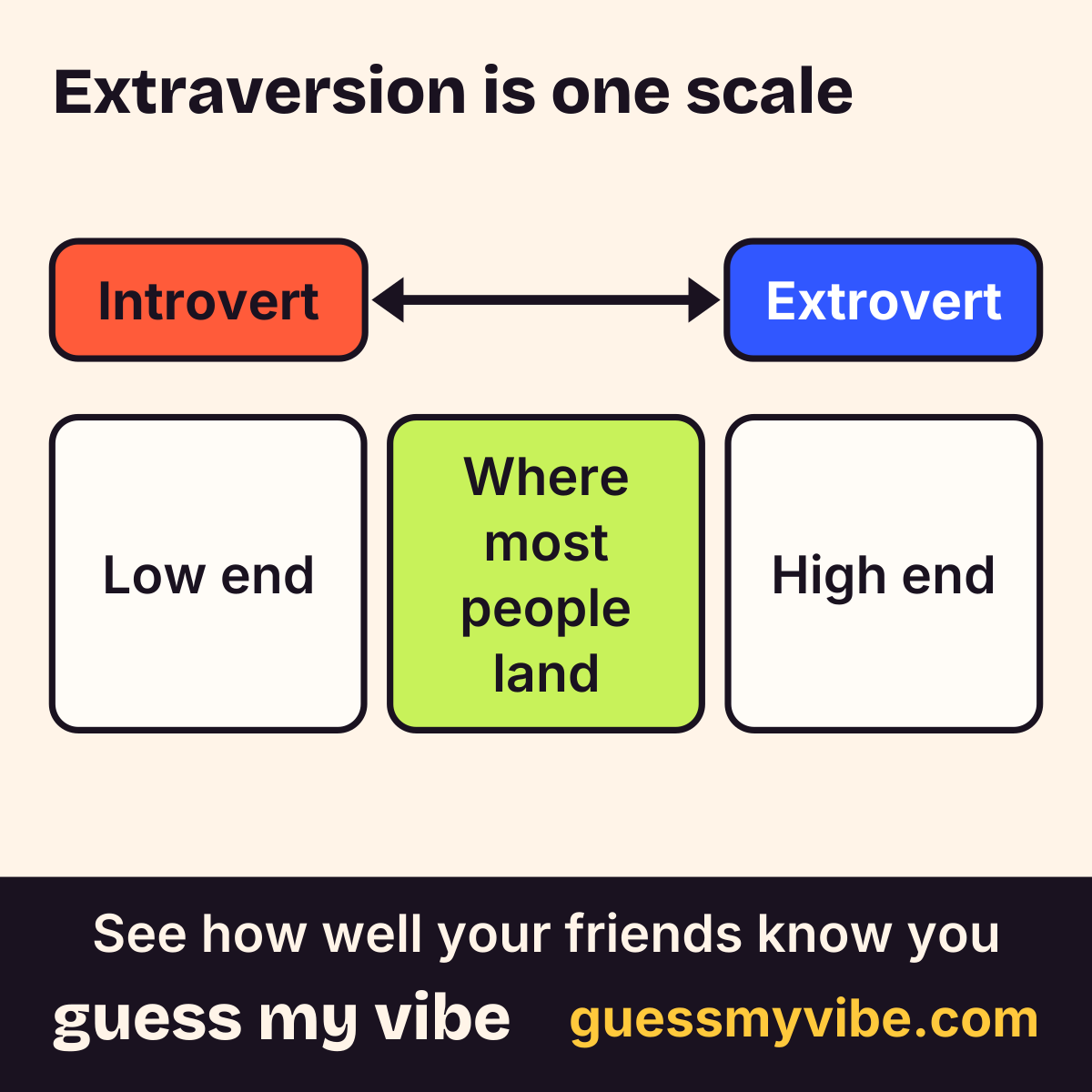
Introvert vs extrovert isn't really two groups. It's one trait, extraversion, measured on a single scale from low to high, and most people land somewhere in the middle rather than at either end. The honest answer to "which am I" is where you sit on that scale, not which label you pick, and your friends can usually tell [1].
Introvert vs extrovert: one scale, not two teams
Introvert vs extrovert is the everyday way of talking about extraversion, one of the five traits researchers use to describe personality (the Big Five). Psychologists don't sort people into an introvert box and an extrovert box. They score everyone on one continuous scale running from low to high, and most people land somewhere between the two ends rather than at either extreme. Researchers spell the trait "extraversion" (with an a); "extrovert" (with an o) is just the everyday spelling of the same idea.
"Ambivert" is the casual word some people use for the middle of that scale, but it isn't a separate category in the research itself, it's just where most people happen to sit. And nobody acts the same way every hour of every day: experience-sampling studies that had people report their behavior every few hours for weeks found that the typical person shows nearly every level of extraverted behavior at some point in a given week, from quiet to the life of the party. What stays stable is each person's average over time, not any single moment [2].
Cite this figure
Figure: "Extraversion is one scale." Guess My Vibe (guessmyvibe.com). https://guessmyvibe.com/learn/introvert-vs-extrovert#figure-one-scale
The six faces of extraversion
Extraversion itself isn't one simple behavior. The IPIP-NEO-120, a public-domain personality inventory built from a development sample of more than 21,000 people, breaks it into six smaller facets: Friendliness, Gregariousness, Assertiveness, Activity Level, Excitement-Seeking, and Cheerfulness [7]. That's why two people can both call themselves extroverts and look different: one might be high in Gregariousness (loves a full room) but low in Assertiveness (hates running the meeting), while the other is the opposite. "Quiet" isn't a facet at all, which is the first clue that quiet and introverted aren't quite the same thing.
What an online introvert or extrovert test is actually measuring
Most quick "am I an introvert or extrovert" quizzes ask a version of the same questions researchers do: do you prefer a full room or a quiet one, group plans or one-on-one time, talking a problem through out loud or thinking it over alone. The quiz adds up your answers into one score on the same extraversion scale, then puts a label like "introvert" on one half of the range. That's a reasonable shortcut, but it's still one number from one source, namely you, rating yourself, on one day. The extraversion meaning behind the label doesn't change from test to test; what changes is how many questions it asks and how it draws the cutoff line.
Two things are worth knowing before you trust a single quiz result. First, your behavior varies a lot hour to hour, so a one-time quiz is really sampling a single moment, not the stable average that actually defines the trait [2]. Second, your own rating isn't the only accurate one available. A friend who knows you well can read your extraversion about as accurately as you can read it in yourself, which most other personality traits can't say [1].
Curious how your friends would answer?
Free. Answer 10 quick questions about you, then send your link. Friends play in their browser, no app needed.
Start freeDoes acting more outgoing make you happier?
Extraversion is one of the traits most consistently linked to pleasant mood. Across several studies and a meta-analysis, people who score higher in extraversion report more pleasant mood overall, though the link is weaker when people log their mood moment to moment in a diary than when they answer a single broad "how happy are you generally" question [8].
A set of classic studies pushed this further by actually manipulating behavior. Across a two-week diary study, a week of journal entries, and a lab experiment, people reported feeling happier in the hours when they were acting more outgoing than usual, whether or not they called themselves introverts [4]. A later study replicated that finding and added a twist: positive mood went up for people acting outgoing regardless of their usual disposition, with no matching rise in negative mood [9].
The most realistic test of this is also the most honest about its limits. In a week-long randomized trial, people in everyday life were assigned to act more outgoing or to a sham routine. Acting outgoing raised positive mood and feelings of authenticity overall. But the benefit wasn't even: more introverted participants gained less positive mood, and also reported more negative mood, more tiredness, and feeling less like themselves [5]. So the honest version is: acting more outgoing helps on average, but it costs the most introverted people more to do it.
Myth: introverts are just shy
A classic set of studies separated shyness from sociability and found they're two different things, only loosely related. Shyness is tension and self-consciousness around other people; sociability is how much you want to be around people in the first place [3]. That split explains people who don't fit the stereotype: someone can be shy and still crave company (nervous at the party, but wishing they'd been invited), or unshy and still prefer a quiet night in (perfectly comfortable around people, just not drawn to a crowd). Low extraversion is about appetite for stimulation, not fear of it. Shyness is closer to a separate, anxiety-flavored trait that can show up at any point on the extraversion scale.
Myth: introverts "recharge" alone and extroverts "recharge" around people
This is a popular way to describe the difference, but it's a metaphor, not something researchers have directly measured as a battery draining and refilling. What the studies above actually found cuts the other way in the short term: acting more outgoing tends to lift mood right away, including for people who call themselves introverted, not drain it on the spot [4] [9]. The real cost showed up differently and later: in the week-long trial, it was the most introverted participants who ended up more tired and feeling less like themselves after sustaining outgoing behavior over time [5]. That's probably closer to where the "recharge" idea comes from, a real cost that builds up over a week, not a simple rule about any single hangout.
The trait your friends can read best
Of all five traits in the Big Five, extraversion is the one where other people's ratings line up best with a person's own. A meta-analysis covering 263 samples and more than 44,000 people found a corrected agreement between self-ratings and one other person's rating of about .51 for extraversion, the highest of the five traits (agreeableness was the lowest, at about .39) [1]. A correlation around .5 is a real, moderate match: not an exact copy of your own self-rating, and not a coin flip either. Friends get the big picture right more often than not, even if they miss the finer detail.
A separate study of 165 people rated by friends and strangers against real behavior in the lab found something similar: self-ratings, friends' ratings, and even strangers' ratings of extraversion-related behavior were all about equally accurate. That's different from traits like stress-proneness, where the person themselves has a real edge over anyone watching from outside [6]. Extraversion, in other words, is written on the outside. That's the exact question Guess My Vibe turns into a game: you answer for yourself, a friend guesses your answer, and you find out how close they actually get.
Key takeaways
- "Introvert" and "extrovert" are casual names for the low and high ends of one Big Five trait, extraversion. Day to day, everyone's behavior swings widely, but each person's average level over time stays remarkably stable [2].
- Introversion isn't shyness. Shyness is tension and worry around other people; extraversion is about how much social stimulation feels good. The two traits are separate and only loosely related [3].
- Acting more outgoing lifts mood on average, even for people who call themselves introverts, but a week-long trial found the most introverted participants also felt more tired and less like themselves [4] [5].
- Of the five traits researchers study, other people's ratings of extraversion agreed most with people's own ratings [1], and in a separate study others judged it about as well as people judge it in themselves [6].
- This isn't therapy, a diagnosis, or a substitute for professional care.
Questions people ask
What's the actual difference between an introvert and an extrovert?
There isn't a hard line between them. Extraversion is scored on one continuous scale, and "introvert" and "extrovert" are just casual names for the low and high ends of it. Most people are somewhere in the middle, sometimes called an "ambivert," though that's a popular label rather than a separate category researchers use.
Am I an introvert or an extrovert?
The honest answer is a matter of degree, not a category. Notice your usual level across things like wanting a full room versus a small group, speaking up versus hanging back, and seeking excitement versus calm, since those are the separate facets that make up extraversion. Your own sense of this is a decent guide, but friends are just as accurate at reading extraversion as you are at reading it in yourself.
Is being an introvert the same as being shy?
No. Shyness is tension and self-consciousness around other people; introversion is a lower appetite for social stimulation. Research separating the two found they're only loosely related, so you can be shy and still want company, or unshy and still prefer a quiet night in.
Do introverts really need alone time to "recharge"?
That's a popular way to describe it, but it hasn't been measured the way the metaphor implies. In the short term, acting more outgoing tends to lift mood for introverts too, not drain it. The real cost shows up over a longer stretch: in a week-long trial, more introverted people felt more tired and less like themselves after sustaining outgoing behavior for days.
Can an introvert become more extroverted?
In the moment, yes. Acting more outgoing is something almost anyone can do, and it tends to lift mood while it's happening. Your average level over months and years is much more stable, since research shows that stability, not any single day, is what a trait score is really describing.
See how well your friends know you.
Free. Answer 10 quick questions about you, then send your link. Friends play in their browser, no app needed.
Start freeReferences
- [1] Connelly, B. S., & Ones, D. S. (2010). An other perspective on personality: Meta-analytic integration of observers' accuracy and predictive validity. Psychological Bulletin, 136(6), 1092–1122. PubMed: 21038940 (opens in a new tab)
- [2] Fleeson, W. (2001). Toward a structure- and process-integrated view of personality: Traits as density distributions of states. Journal of Personality and Social Psychology, 80(6), 1011–1027. PubMed: 11414368 (opens in a new tab)
- [3] Cheek, J. M., & Buss, A. H. (1981). Shyness and sociability. Journal of Personality and Social Psychology, 41(2), 330–339. doi.org/10.1037/0022-3514.41.2.330 (opens in a new tab)
- [4] Fleeson, W., Malanos, A. B., & Achille, N. M. (2002). An intraindividual process approach to the relationship between extraversion and positive affect: Is acting extraverted as "good" as being extraverted?. Journal of Personality and Social Psychology, 83(6), 1409–1422. PubMed: 12500821 (opens in a new tab)
- [5] Jacques-Hamilton, R., Sun, J., & Smillie, L. D. (2019). Costs and benefits of acting extraverted: A randomized controlled trial. Journal of Experimental Psychology: General, 148(9), 1538–1556. PubMed: 30489119 (opens in a new tab)
- [6] Vazire, S. (2010). Who knows what about a person? The self-other knowledge asymmetry (SOKA) model. Journal of Personality and Social Psychology, 98(2), 281–300. PubMed: 20085401 (opens in a new tab)
- [7] Johnson, J. A. (2014). Measuring thirty facets of the Five Factor Model with a 120-item public domain inventory: Development of the IPIP-NEO-120. Journal of Research in Personality, 51, 78–89. doi.org/10.1016/j.jrp.2014.05.003 (opens in a new tab)
- [8] Lucas, R. E., & Fujita, F. (2000). Factors influencing the relation between extraversion and pleasant affect. Journal of Personality and Social Psychology, 79(6), 1039–1056. PubMed: 11138753 (opens in a new tab)
- [9] Zelenski, J. M., Santoro, M. S., & Whelan, D. C. (2012). Would introverts be better off if they acted more like extraverts? Exploring emotional and cognitive consequences of counterdispositional behavior. Emotion, 12(2), 290–303. PubMed: 21859197 (opens in a new tab)
How we find and check these sources: how we write. Spotted an error? Report a correction.
Related
- How Well Do You Know Me Questions to Ask Friends
- BFF Test: A Real One to Take With Your Best Friend
- Self-Perception vs. How Others See You
- Social Media Personality: Does It Show the Real You?
- Friendship Psychology: What the Research Actually Says
- Loneliness: What It Is and Who Feels It Most
- Ambivert: What the Science Actually Says
- Introvert Extrovert Friendship: Why It Works
- Reserved Personality: Why Quiet Isn't the Same as Cold
- Emotional Stability: What It Means and Why It Helps Friends
- How to Be More Social: What the Research Actually Shows
- Omnivert vs Ambivert: What the Research Says
- Extraversion: What the Trait Is and What It Isn't
- Is MBTI Accurate? MBTI vs the Big Five, Fairly
Cite this article
- Title
- Introvert vs Extrovert: What the Research Actually Shows
- Publisher
- Guess My Vibe
- Updated
- URL
- https://guessmyvibe.com/
learn/ introvert-vs-extrovert
Copy this citation
Guess My Vibe. (2026, October 2). Introvert vs Extrovert: What the Research Actually Shows. Guess My Vibe. https://guessmyvibe.com/
To point at one section, add that section's anchor (the # link on its heading) to the URL.