Research on social media personality finds that profiles mostly reflect who someone actually is, not an idealized fake version. More outgoing people really do post more and friend more people online, the same as they would at a party [1]. Social platforms still only capture part of you, and only the outward part at that. A friend who actually knows you in person reads traits a profile can't show at all.
Do people fake their personality on social media?
The common worry about social media personality is that everyone's curating a fake, flattering version of themselves, and whoever shows up on your feed is performing a character, not being a person. It's an understandable worry: profiles are edited, filtered, and posted on purpose, in a way an in-person conversation never is. Actual research on how personality connects to online behavior tells a less cynical story than the worry suggests. Two studies of self-reported Facebook behavior and observable profile information found that more extraverted people didn't invent a louder online persona; they extended the same outgoing behavior they already had offline into the new space [1]. More extraverted participants used the platform more and showed more traces of social engagement, more friends, more activity, which is exactly what you'd expect from someone outgoing at an actual party. The researchers' own conclusion was direct: rather than escaping from or compensating for their offline personality, people seem to extend it into social media.
What a profile actually reveals, according to the data
It's one thing to say online behavior tracks offline personality in general; it's another to ask how precisely a profile can be read. One widely cited analysis took this further than almost any other: using a simple statistical model built on over 58,000 people's Facebook Likes (not posts, not photos, just which pages someone had liked), researchers worked out a long list of personal attributes, including Big Five personality traits [3]. For the trait openness specifically, the model's accuracy came close to the test-retest reliability of a standard personality questionnaire, meaning the Likes-based guess was nearly as consistent as giving the same person the same test twice. That's a striking result for something as casual as which pages someone clicks "like" on. It's also the kind of finding that raises real privacy questions, since the same approach that spots a personality trait can spot other sensitive attributes a person never chose to share, which is worth knowing before you assume "it's just my profile, it's harmless."
A broader meta-analysis backs this up at scale. Pulling together the research on reading personality, psychological well-being, and intelligence from automatically collected social media data, digital footprints turned out to forecast these characteristics with what the researchers called remarkable accuracy, and collecting more kinds of digital traces, or adding basic demographic information, sharpened the forecast further [2]. A stranger scrolling your profile for thirty seconds still doesn't have you fully figured out. But the signal buried in ordinary social media activity, the posts, the Likes, the friend network, is a real, measurable reflection of personality, not just surface noise.
Which traits show up best in a social media profile
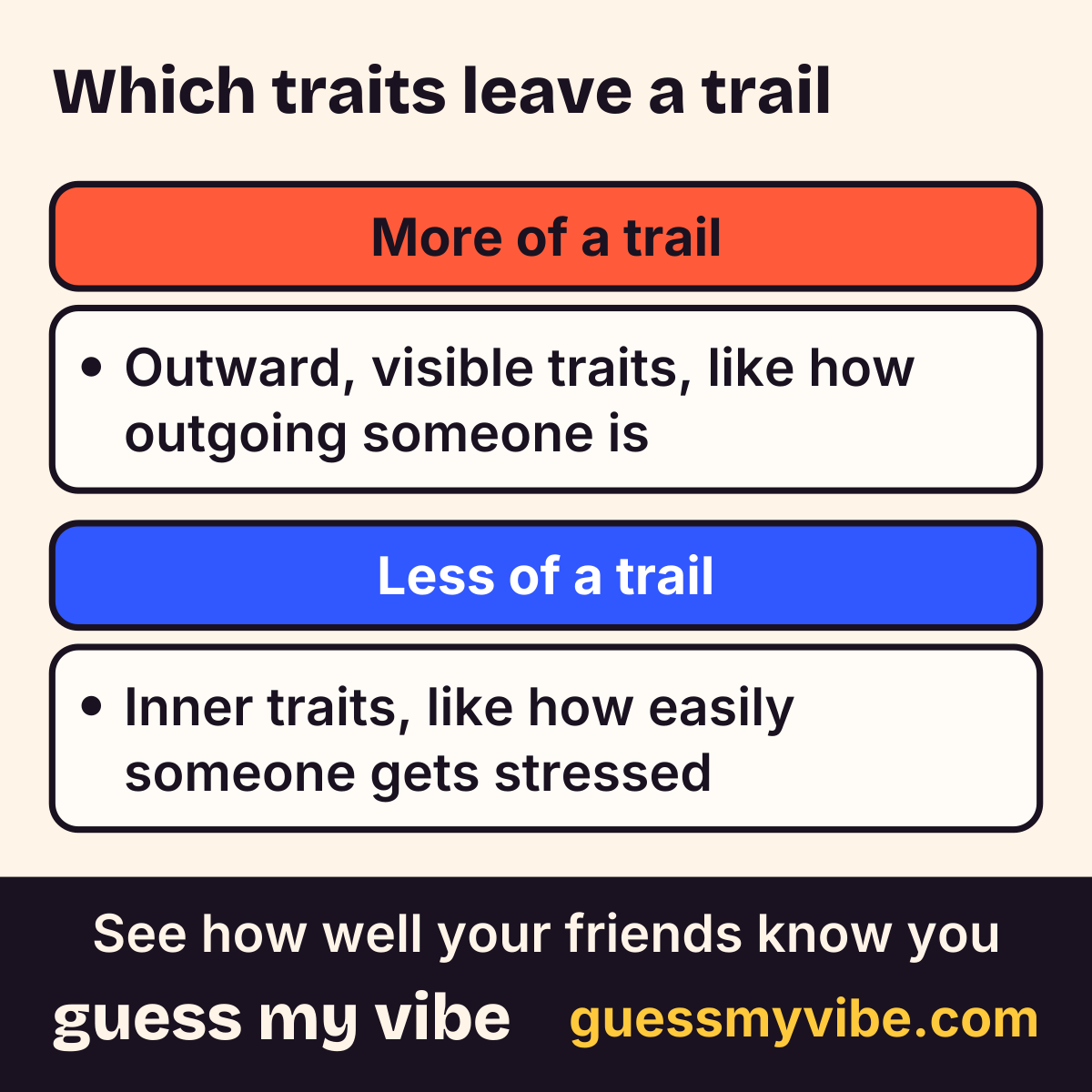
Not every trait comes through online equally well, and that's consistent with how personality judgment works everywhere, not just on the internet. Traits that are outward and visible, like how outgoing or sociable someone is, leave an obvious trail: more posts, more tagged photos, more public interaction. Traits that live mostly on the inside, like how easily someone gets stressed or how much they worry, don't photograph well and rarely make it into a caption. A large meta-analysis of how well other people (not just friends, but raters in general) judge personality found that getting close to someone helped most for traits that are hard to see from outside, like emotional stability, which fits the idea that a profile shows the visible part but not the inner part [5]. A social media profile is, in that sense, just an extreme version of a first impression online: lots of outward behavior on display, almost none of the inner experience that only comes through in a real conversation.
Cite this figure
Figure: "Which traits leave a trail." Guess My Vibe (guessmyvibe.com). https://guessmyvibe.com/learn/social-media-personality#figure-visible-vs-quiet-traits
Curious how your friends would answer?
Free. Answer 10 quick questions about you, then send your link. Friends play in their browser, no app needed.
Start freeFirst impressions online vs. in person
A first impression formed from a profile works a lot like a first impression formed from a few minutes of conversation: it leans on whatever's visible, and it skips everything that isn't. Someone scrolling a new profile picks up tone from captions, energy from photos, interests from what gets posted about, and forms a read in seconds, much like judging a stranger across a room. The difference is that a profile is curated on a longer timescale than a face-to-face first meeting, so it's showing a selected highlight reel rather than a single unscripted moment. That selection bias matters less than people assume for the broad strokes (an outgoing person's account tends to look outgoing, a curious person's account tends to look curious), but it matters more for anything specific. A single photo or caption taken as a first impression online can be read in a completely different way than the person intended, with nobody there to add tone of voice or context the way an actual conversation would.
What a profile still can't tell you
None of this research means a social media profile is a complete read on anyone. The accuracy numbers above describe group-level patterns across thousands of people, not a guarantee about any one profile you happen to be looking at, and a single curated post can absolutely be unrepresentative even if the overall account isn't. More importantly, a profile has no access at all to context: the mood someone was in, what was happening in their life that week, the inside jokes that make a weird caption make sense. A friend who knows you in person has all of that, plus years of watching how you actually act when nobody's taking a photo. That's a real, separate kind of knowledge a profile, no matter how much data it contains, structurally cannot have.
There's also a privacy side worth naming plainly. The same statistical approach that spots a genuine personality trait from ordinary activity doesn't stop at personality; the Facebook Likes study above used the same basic method to flag a range of other attributes a person never explicitly chose to share. That's not a reason to panic about having an account, but it is a reason to think about a profile as a two-way thing: it tells friends something real about you, and it can tell automated systems more than most people assume, which is worth knowing before treating "it's just my profile" as a throwaway line.
So, does social media personality reflect the real you?
Put together, the honest answer sits between the two extremes people usually argue. Social media is neither a mask hiding your real personality behind a performance, nor a perfect window into who you are. The evidence points to a genuine, partial signal: outgoing people really do act outgoing online, Likes and posts really can forecast real traits with meaningful accuracy, and the traits that are easiest to see in person are also the easiest to see on a screen. For a fuller picture than any profile can give, the better move is asking someone who actually knows you to guess, not scrolling your own feed looking for clues. That's the whole idea behind Guess My Vibe: a friend answers real personality questions about you, based on knowing you, not based on your profile, and you see exactly where their read matches yours and where it doesn't.
Key takeaways
- People who are more outgoing in daily life show more activity on social media (more friends added, more posting), the same pattern as their offline behavior, not a different online persona [1].
- A meta-analysis of studies forecasting personality, well-being, and intelligence from social media activity found digital traces can track these traits with real, meaningful accuracy, not just noise [2].
- In one large analysis, a simple model using Facebook Likes alone came within reach of a person's actual score on the trait openness, nearly as consistent as retaking the same personality test a second time [3].
- Some traits still come through far more clearly online than others. Outgoing, visible behavior is easy to spot in posts and photos [1]; quieter traits like how easily someone gets stressed are ones you tend to know better than others do, so they stay hard to read from a profile alone [4].
- This isn't therapy, a diagnosis, or a substitute for professional care, and none of the research here should be read as advice about what to post or not post.
Questions people ask
Is your personality on social media the real you?
Mostly, yes. Research on self-reported Facebook behavior and observable profile information found that more extraverted people showed more social media activity, the same pattern as their offline behavior, rather than inventing a different online persona [1].
Can social media activity actually reveal your personality?
Surprisingly well, in large studies. One analysis found Facebook Likes alone came close to a person's actual score on the trait openness, almost as reliably as retaking the same personality test, and a broader meta-analysis found digital traces track personality with real, meaningful accuracy [3] [2].
Why do some personality traits show up more online than others?
Because visible, outward traits leave more of a trail than quiet, internal ones do. Research on personality judgment finds that people of all perspectives are about equally good at judging outgoing behavior, while the self is the best judge of stress-related traits that stay hard to spot from the outside, online or off [4].
Do people present a fake version of themselves on social media?
Less than the stereotype suggests. The research above found online behavior extends offline personality rather than replacing it with a different, idealized character, though any single post can still be unrepresentative of someone's whole personality.
Does a friend know me better than my social media profile shows?
Usually, yes, especially for inward traits. A profile has no access to context, mood, or the years of in-person observation a real friend has, which is exactly the kind of knowledge a friend brings to guessing your personality that a feed never can.
See how well your friends know you.
Free. Answer 10 quick questions about you, then send your link. Friends play in their browser, no app needed.
Start freeReferences
- [1] Gosling, S. D., Augustine, A. A., Vazire, S., Holtzman, N., & Gaddis, S. (2011). Manifestations of Personality in Online Social Networks: Self-Reported Facebook-Related Behaviors and Observable Profile Information. Cyberpsychology, Behavior, and Social Networking, 14(9), 483–488. PubMed: 21254929 (opens in a new tab)
- [2] Settanni, M., Azucar, D., & Marengo, D. (2018). Predicting Individual Characteristics from Digital Traces on Social Media: A Meta-Analysis. Cyberpsychology, Behavior, and Social Networking, 21(4), 217–228. PubMed: 29624439 (opens in a new tab)
- [3] Kosinski, M., Stillwell, D., & Graepel, T. (2013). Private traits and attributes are predictable from digital records of human behavior. Proceedings of the National Academy of Sciences, 110(15), 5802–5805. PubMed: 23479631 (opens in a new tab)
- [4] Vazire, S. (2010). Who knows what about a person? The self-other knowledge asymmetry (SOKA) model. Journal of Personality and Social Psychology, 98(2), 281–300. PubMed: 20085401 (opens in a new tab)
- [5] Connelly, B. S., & Ones, D. S. (2010). An other perspective on personality: Meta-analytic integration of observers' accuracy and predictive validity. Psychological Bulletin, 136(6), 1092–1122. PubMed: 21038940 (opens in a new tab)
How we find and check these sources: how we write. Spotted an error? Report a correction.
Related
- Introvert vs Extrovert: What the Research Actually Shows
- Self-Perception vs. How Others See You
- BFF Test: A Real One to Take With Your Best Friend
- Self-Monitoring: Are You the Same Person Everywhere?
- How to Read People: The Cues That Actually Work
- What Your Instagram Says About You
- Instagram vs Reality: How Fake Are Curated Profiles?
- What Your Posts Say About You: Language and Personality
- Selfies and Personality: What Your Selfie Says About You
- Why People Post on Social Media: Motives and Personality
More in Social media self-presentation
- Impression Management: What It Is and Why We All Do It
- Selfies and Personality: What Your Selfie Says About You
- Authentic Self on Social Media: Linked to Well-Being
- What Your Posts Say About You: Language and Personality
- Why People Post on Social Media: Motives and Personality
- Self-Monitoring: Are You the Same Person Everywhere?
- Social Media Comparison: What Research Actually Says
- Finsta vs Rinsta: What Research Says About Two Accounts
- What Your Phone Says About Your Personality
- What Your Instagram Says About You
- Instagram vs Reality: How Fake Are Curated Profiles?
Cite this article
- Title
- Social Media Personality: Does It Show the Real You?
- Publisher
- Guess My Vibe
- Updated
- URL
- https://guessmyvibe.com/
learn/ social-media-personality
Copy this citation
Guess My Vibe. (2026, October 3). Social Media Personality: Does It Show the Real You?. Guess My Vibe. https://guessmyvibe.com/
To point at one section, add that section's anchor (the # link on its heading) to the URL.