Social media comparison is real: people who use platforms like Facebook or Instagram more often are exposed to more upward comparisons (seeing people who seem to be doing better), and that's linked to lower self-esteem in some studies [1]. But the honest, full picture is more modest than headlines suggest. A large specification-curve analysis across 355,358 people found digital technology use explains, at most, about 0.4% of the variation in adolescent well-being [2], and a meta-analysis of 61 studies found the overall link between time on social networking sites and well-being is small, r=-.07 [3]. Comparison on social media is a real, small piece of a much bigger picture, not the whole story.
Is social media comparison real? Yes, but the size matters
Social media comparison, feeling worse about your own life after scrolling past someone else's highlight reel, is a real, documented pattern, not an urban legend. It's also smaller and more mixed than a lot of headlines suggest. The honest version of this topic holds both things at once: comparison on social media does measurably affect how people feel, and the overall effect of social media use on well-being, once you zoom out to the full research picture, is modest. Neither "social media is destroying self-esteem" nor "social media comparison isn't real" survives contact with the actual data.
Upward comparison and self-esteem: what one well-designed study found
The clearest direct test of social media comparison comes from a two-part study. In the first part, 145 undergraduates reported their Facebook use, their self-esteem, and how often they compared themselves upward (to people who seem to be doing better) versus downward (to people who seem to be doing worse) on the platform. More frequent Facebook use was linked to lower trait self-esteem, and this relationship was explained specifically by greater exposure to upward comparisons, not by Facebook use on its own [1]. In other words, scrolling itself wasn't the mechanism; what people saw while scrolling, and how it stacked up against their own life, was doing the work.
The second part of the same study tested this with an actual experiment rather than just a correlation. 128 undergraduates were shown a fabricated profile built to contain either upward comparison information (an active social network, described healthy habits) or downward comparison information (a quiet social network, described unhealthy habits). People who saw the upward-comparison profile reported lower immediate self-esteem than people who saw the downward-comparison version, though the effect was small and sat right at the edge of statistical significance [1]. That's a genuinely useful design: it moves past "people who use social media more also have lower self-esteem" (which could be explained a dozen other ways) and shows that exposure to upward comparison content, by itself, nudges self-esteem down in the moment.
Zooming out: how small is the real effect?
The study above is well-designed, but it's one study, and the broader research literature is where the moral-panic version of this topic falls apart. A team of researchers ran what's called a specification-curve analysis, a method built specifically to address a real problem in this field: with huge survey datasets, researchers can usually find a statistically significant link between almost any two variables if they test enough different ways of slicing the data, which makes individual striking findings easy to overstate. Instead of picking one analysis, the researchers ran thousands of equally reasonable analytic choices across three large datasets totaling 355,358 people, and looked at the whole range of results together [2]. The association between digital technology use and adolescent well-being across that whole range was negative, but small, explaining at most 0.4% of the variation in well-being. For comparison, the same datasets showed similarly sized effects for things like eating potatoes or wearing glasses, not the kind of effect size that would justify sweeping claims about social media rewiring a generation.
A separate meta-analysis pooling 61 studies and 19,652 people specifically on time spent on social networking sites found the same modest pattern from a different angle: the average correlation between time spent and psychological well-being was weak, r=-.07 [3]. Breaking that down further, the correlation with positive well-being measures like self-esteem and life satisfaction was close to zero; the correlation with negative measures like loneliness and depression was weak but present. Most of the underlying studies used student samples, which is worth flagging as a real limit on how far these numbers generalize, but the direction and size of the pattern held up across a large pool of independent research, not just one dataset.
Curious how your friends would answer?
Free. Answer 10 quick questions about you, then send your link. Friends play in their browser, no app needed.
Start freeHow a real effect and a small effect fit together
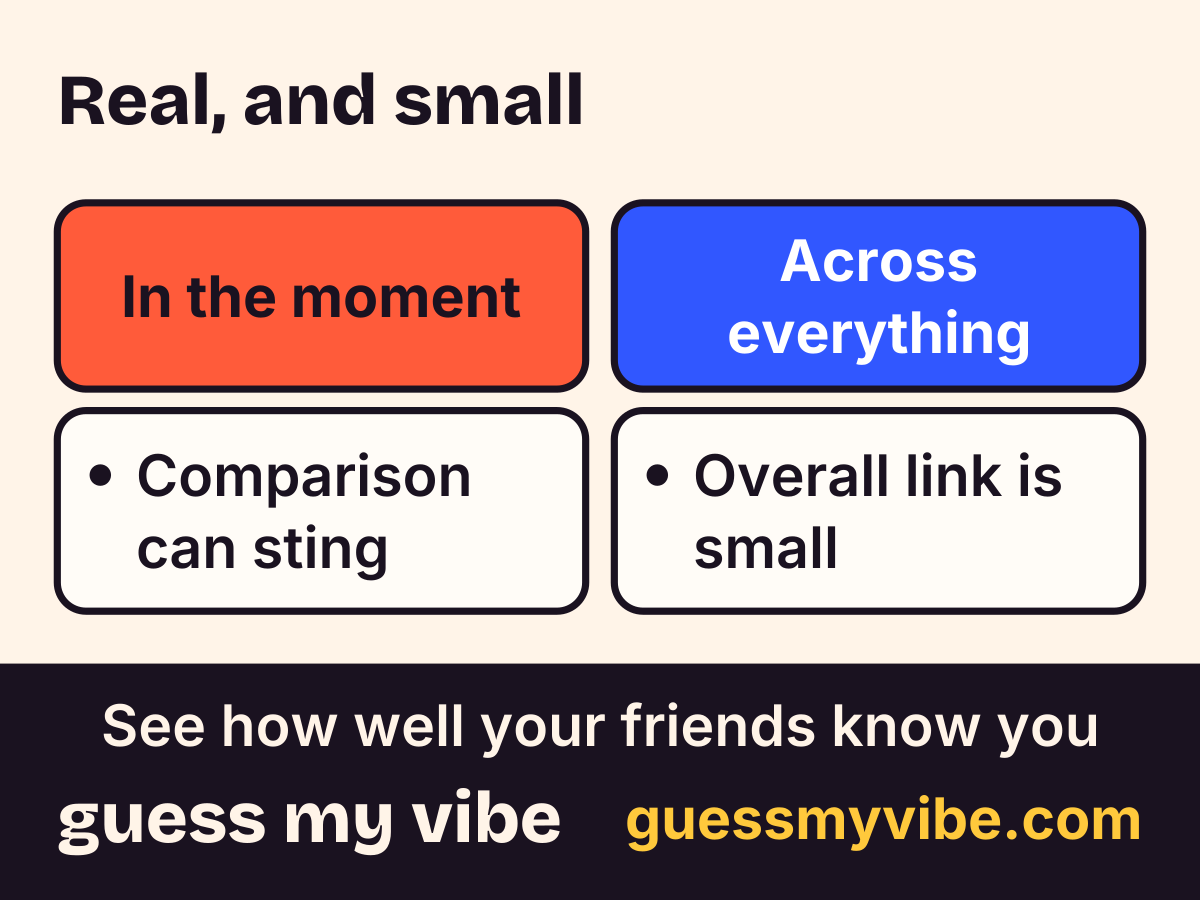
These aren't contradictory findings, they're the same finding at two different zoom levels. Vogel and colleagues' work shows that upward social comparison on social media is a real, specific mechanism that can nudge self-esteem down, and that effect is detectable in a careful lab setting [1]. Orben and Przybylski's and Huang's work show that once you average this kind of effect across the huge range of what people actually do on social media, most of the time, the overall impact on well-being is small [2] [3]. Both can be true: comparing yourself to a curated highlight reel really can sting in the moment, and the average overall effect of using these platforms, across everything someone actually does on them, isn't the dramatic story a lot of commentary assumes.
There's also a related psychological ingredient worth naming honestly: how much a person already worries about being left out shapes how much a given scroll session actually lands. Lower satisfaction of basic psychological needs (feeling competent, autonomous, and connected to others) has been linked to higher fear of missing out, which in turn goes with spending more time on social media [4]. That's a reminder that the comparison effect isn't uniform across everyone; it likely depends in part on what someone's looking for when they open the app in the first place, not just on what shows up in the feed.
Cite this figure
Figure: "Real, and small." Guess My Vibe (guessmyvibe.com). https://guessmyvibe.com/learn/social-media-comparison#figure-real-and-small
What this actually means, practically
The honest, research-backed takeaway isn't "quit social media" or "don't worry about it, the effect is basically nothing." It's closer to: noticing when you're in an upward-comparison loop (scrolling specifically toward accounts that make your own life look worse by contrast) is a reasonable, specific thing to pay attention to, since that's the actual mechanism the research identifies, not social media use in general. The overall, averaged effect of social media on well-being is small enough that it shouldn't be the main story anyone tells about their mood. But the comparison mechanism inside that average is real enough to be worth noticing in your own specific habits, especially since it's the one part of this research that points to something you can actually act on.
Compare notes with a friend instead of a stranger's feed
Guess My Vibe offers a different kind of comparison than a feed does: you answer honest questions about your own personality and habits, a friend guesses your answers, and you see where their read matches yours. It's a comparison built on someone who actually knows you, not a curated highlight reel from someone you've never met.
Key takeaways
- In a study of 145 undergraduates, more frequent Facebook use was linked to lower self-esteem, and this was explained by more exposure to upward (not downward) social comparisons on the platform, not frequency of use by itself [1].
- In a follow-up experiment with 128 undergraduates, briefly viewing a profile built to show upward comparison information (an active social life, healthy habits) lowered people's immediate self-esteem compared to viewing a downward-comparison profile, though the effect was small and borderline [1].
- A rigorous analysis across three large datasets (355,358 people total) found the overall association between digital technology use and adolescent well-being is small and negative, explaining at most 0.4% of the variation, roughly the same size as effects like eating potatoes or wearing glasses in the same data [2].
- A meta-analysis of 61 studies (19,652 people) found the average correlation between time spent on social networking sites and psychological well-being was weak, r=-.07, with correlations near zero for self-esteem and life satisfaction specifically [3].
- This isn't therapy, a diagnosis, or a substitute for professional care; it's a plain-English summary of research on social comparison and well-being, not a verdict on anyone's social media use.
Questions people ask
Does comparing yourself to people on social media really lower self-esteem?
In controlled studies, yes, specifically for upward comparisons. More Facebook use was linked to lower self-esteem through more exposure to upward comparisons, and an experiment found viewing an upward-comparison profile lowered immediate self-esteem more than viewing a downward-comparison one [1].
How big is the overall effect of social media on well-being?
Small. A rigorous analysis of 355,358 people found digital technology use explains at most about 0.4% of the variation in adolescent well-being [2], and a meta-analysis of 61 studies found the average correlation between time on social networking sites and well-being was weak, r=-.07 [3].
Is social media comparison worse than other kinds of comparison?
The research here doesn't directly compare social media to offline comparison. What it shows is that upward comparison on social media specifically is linked to lower self-esteem, and social media offers a lot of opportunities for it [1].
Should I quit social media because of comparison effects?
The research doesn't support that conclusion. The overall effect of social media use on well-being is small [2] [3]; the more specific, actionable finding is that noticing upward-comparison scrolling in your own habits is worth attention.
Does fear of missing out make social media comparison worse?
It may play a role. Lower satisfaction of basic psychological needs has been linked to higher fear of missing out, which in turn goes with more social media engagement [4], suggesting comparison's sting may depend partly on what someone's looking for when they open the app.
See how well your friends know you.
Free. Answer 10 quick questions about you, then send your link. Friends play in their browser, no app needed.
Start freeReferences
- [1] Vogel, E. A., Rose, J. P., Roberts, L. R., & Eckles, K. (2014). Social comparison, social media, and self-esteem. Psychology of Popular Media Culture, 3(4), 206–222. doi.org/10.1037/ppm0000047 (opens in a new tab)
- [2] Orben, A., & Przybylski, A. K. (2019). The association between adolescent well-being and digital technology use. Nature Human Behaviour, 3(2), 173–182. PubMed: 30944443 (opens in a new tab)
- [3] Huang, C. (2017). Time spent on social network sites and psychological well-being: A meta-analysis. Cyberpsychology, Behavior, and Social Networking, 20(6), 346–354. PubMed: 28622031 (opens in a new tab)
- [4] Przybylski, A. K., Murayama, K., DeHaan, C. R., & Gladwell, V. (2013). Motivational, emotional, and behavioral correlates of fear of missing out. Computers in Human Behavior, 29(4), 1841-1848. doi.org/10.1016/j.chb.2013.02.014 (opens in a new tab)
How we find and check these sources: how we write. Spotted an error? Report a correction.
Related
Cite this article
- Title
- Social Media Comparison: What Research Actually Says
- Publisher
- Guess My Vibe
- Updated
- URL
- https://guessmyvibe.com/
learn/ social-media-comparison
Copy this citation
Guess My Vibe. (2026, October 3). Social Media Comparison: What Research Actually Says. Guess My Vibe. https://guessmyvibe.com/
To point at one section, add that section's anchor (the # link on its heading) to the URL.