Social comparison is judging yourself by how you stack up against other people. Festinger's 1954 theory said people have a drive to evaluate their abilities and opinions, and that where performance can be clearly ordered, they do it by comparing their performance with other people's [1]. A meta-analysis of 60+ years of research found people strongly prefer comparing upward when nothing threatens them, and that the usual reaction is contrast, meaning the comparison shapes how you rate yourself in the opposite direction from the target [2]. Researchers have built a scale to measure how much individual people do it [3].
What is social comparison?
Social comparison is judging yourself by how you stack up against other people. You do it when you wonder if you are as funny as your friend, as organized as your roommate or as far along as someone from your class. Festinger's 1954 social comparison theory is the classic starting point. His first hypothesis was that people have a drive to evaluate their opinions and abilities [1]. His own example was running: a person who wants to know how good a runner they are compares their time with the times other people have taken. For abilities with no clear ordering, like writing poetry, he said the evaluation depends largely on what other people think of it [1].
That is the short answer, and the rest of this article is about what 70 years of research have added to it. We will cover who we pick to compare with, how it makes us feel, how much people differ, and why a friend is a special case. If you came here for the social media version, that has its own article: [social media comparison](/learn/social-media-comparison). This one is about comparison in general.
Who do we compare ourselves with?
A big meta-analysis of 60+ years of social comparison research looked at two questions: who people choose to compare with (the authors call this selection) and what comparison does to them (reaction) [2]. On selection, studies that offered two options, up or down, showed a strong preference for upward choices when there was no threat, and the authors found no evidence of publication bias in that result [2]. Put simply, when people are free to pick and nothing is threatening, they tend to look at someone doing better. When a lateral option, someone about the same, was added, selections became less clear-cut [2].
What about downward comparison, looking at someone worse off to feel better? A popular idea holds that people do this when they feel threatened. The meta-analysis found no evidence that downward comparison was the dominant choice, even when people were threatened [2]. That does not mean nobody ever does it. It means that across the studies, it was not the typical pick.
How comparison changes how we see ourselves
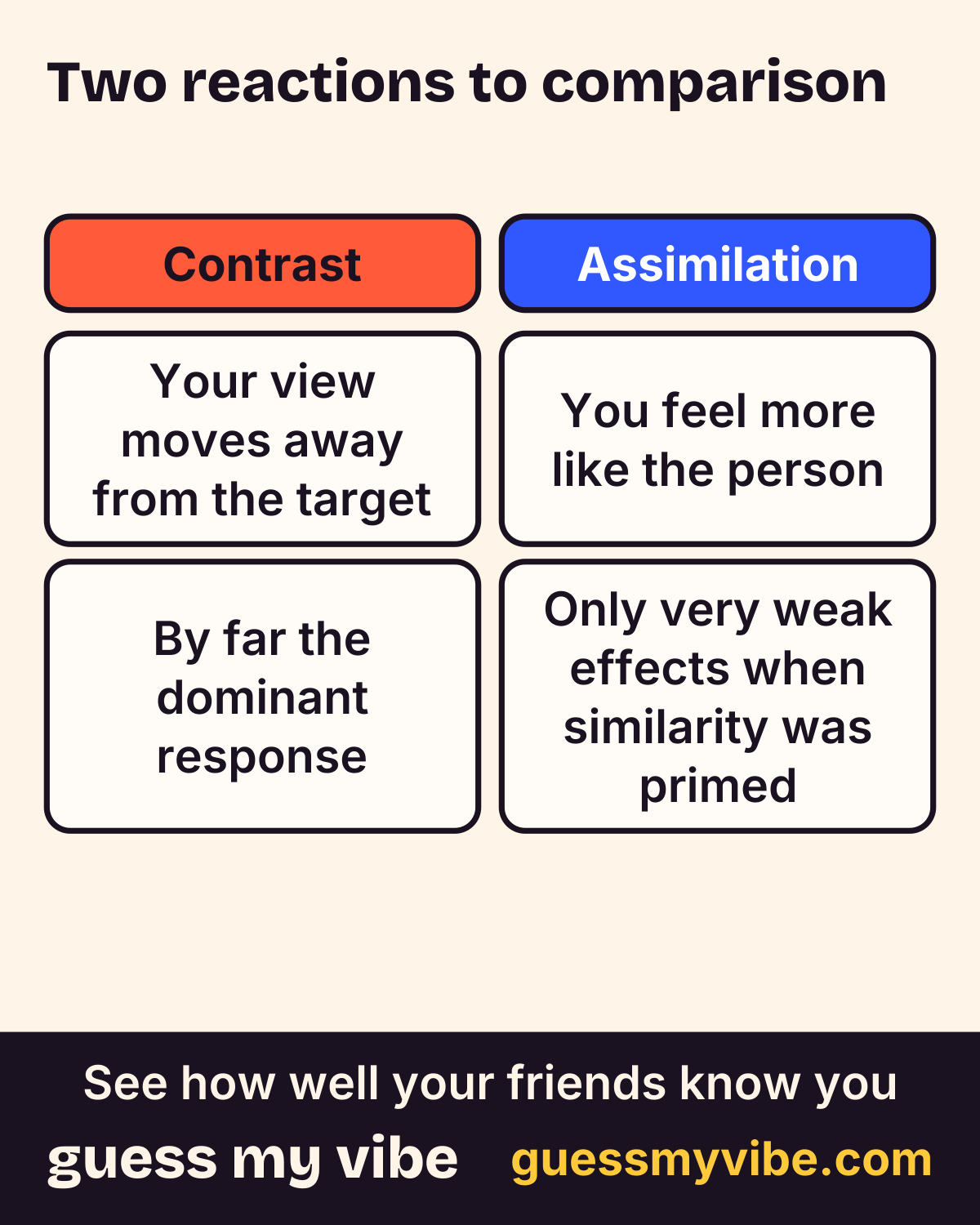
The second half of the meta-analysis is about reactions, and it is where the findings are most surprising. Contrast, by far, was the dominant response to social comparison, and ability estimates were most strongly affected [2]. Contrast means your view of yourself moves away from the comparison target: after a comparison with someone who looks better at something, you tend to rate yourself lower, and after one with someone who looks worse, higher. The opposite pattern, assimilation, where you feel more like the person you are comparing yourself with, showed up only as very weak effects when similarity was primed [2].
There is a second twist. In studies that included control groups, with no comparison at all, effects in response to upward and downward targets were comparable in size and both were contrastive [2]. In other words, the meta-analysis does not support a simple story where looking up always hurts and looking down always helps. The authors are open about the limitations. They note that few studies included no-comparison controls, that some issues are unresolved, and they discuss why people choose to compare upward when the most likely result is a self-deflating contrast [2]. That last puzzle is real. We are drawn to a comparison that, on average, tends to make us rate ourselves lower.
Some caution about the result. These are studies of how people respond to a comparison, often in lab settings with specific tasks. They tell you about averages, not about how any one person will feel about a friend's good news. And contrast is not the same as pain: a person can rate themselves lower on an ability without it bothering them much. Feeling bad is a separate question, and the studies we looked at do not settle it.
Cite this figure
Figure: "Two reactions to comparison." Guess My Vibe (guessmyvibe.com). https://guessmyvibe.com/learn/social-comparison#figure-contrast-vs-assimilation
Curious how your friends would answer?
Free. Answer 10 quick questions about you, then send your link. Friends play in their browser, no app needed.
Start freeSome people compare more than others
Everyone compares, but not equally. In 1999, researchers built a scale to measure individual differences in how much people compare, called the Iowa-Netherlands Comparison Orientation Measure. They assumed the tendency toward social comparison is universal, built the scale to work in two cultures, American and Dutch, and gave it to several thousand people in each country. The scale had good psychometric properties, and a lab study and several field studies showed it could anticipate comparison behavior [3].
A more recent set of five studies, using student and non-student samples, looked at the scale's structure in more detail. It found comparison orientation splits into three parts: non-directional, upward and downward [4]. People endorsed non-directional comparison most, then upward, then downward. Comparison orientation was lower among older individuals and among members of racial and ethnic minority groups [4]. And upward comparison orientation had strong and consistent associations with well-being and affect, appearance beliefs such as body satisfaction, and social emotions such as envy, while the associations for the other two kinds were smaller and less consistent [4]. The abstract reports the strength of those associations, not their direction, so we will not guess at it.
Two honest caveats. First, these are correlations. A person who is feeling low may compare upward more, or comparing upward may make a person feel lower, or something else may drive both. The abstract does not say which. Second, we did not find a Big Five study of comparison orientation that we could open and verify, so we will not tell you that any particular personality trait goes with how much you compare. What the research supports is that comparison orientation is a multi-faceted individual difference, one that can be measured, and that people differ on it [4].
Why comparing yourself to friends is different
Comparing yourself to a stranger is one thing. Comparing yourself to a friend is another, and one classic set of experiments explains why. Tesser and colleagues proposed that when another person outperforms you on something that matters to your self-image, the closer that person is, the greater the threat to how you see yourself. When they outperform you on something that does not matter to you, the closer they are, the more you can enjoy their success [5].
Their three studies gave people feedback about their own performance and that of a friend or a stranger. In the first study, being outperformed by a close other resulted in greater arousal than being outperformed by a distant other. When the task had low relevance to the participant, more positive affect went with a friend outperforming the participant than with either a friend performing equally or a stranger outperforming them [5]. The three studies were small, with about 30 people each, so we would treat this as a clear idea backed by modest evidence, not a settled number. It does fit everyday experience: a friend's win in your own field can sting more than a stranger's, and a friend's win in something you do not care about can just feel good.
What to do with all this
Nothing here says comparing yourself is bad or that you should stop. Festinger's point was that comparison is a way people work out where they stand [1], and the meta-analysis found that, when nothing was threatening, people strongly preferred to compare upward [2]. A few practical thoughts follow from the research, with the reminder that these are our interpretations and not findings.
- Notice which domain is stinging. The friend-comparison research suggests the sting is strongest where the skill matters to your sense of self [5].
- Remember contrast works both ways. In the meta-analysis, upward and downward targets produced similarly sized contrastive effects when compared with a no-comparison control [2].
- Treat the number of upward comparisons as information. An upward tendency was strongly associated with well-being, mood and envy in one set of studies, though the direction of cause is unknown [4].
A different way to think about a friend is as a person to know, not a person to rank. Knowing someone, what they care about, how they would answer a question, how they see the world, is not a competition. That is the idea behind guessing your friends' answers instead of scoring them.
Know your friends instead of ranking them
Guess My Vibe is built around knowing, not ranking. You answer honest questions about yourself, a friend guesses how you answered, and the result shows where their picture of you matches yours. Nobody wins or loses at being a better person. It is simply a quick, fun way to find out how well your friends know you, and how well you know them.
Key takeaways
- Festinger's original idea was that people have a drive to evaluate their opinions and abilities, and where performance can be clearly ordered, they evaluate it by comparing their performance with that of other people [1].
- A meta-analysis of 60+ years of studies found a strong preference for upward comparison choices when there was no threat, and no evidence that downward comparison dominates, even when people are threatened [2].
- The same meta-analysis found that contrast was by far the dominant reaction to comparison, with ability estimates most strongly affected, and that similarity priming produced only very weak assimilation effects (feeling more like the target) [2].
- People differ in how much they compare. A scale tested on several thousand people in the US and the Netherlands treats comparison as universal but variable, and it was able to anticipate comparison behavior [3].
- In a set of five studies, a tendency to compare upward had strong, consistent associations with well-being, mood, body satisfaction and envy; these are correlations, not proof that comparing causes the feelings [4].
- This isn't therapy, a diagnosis, or a substitute for professional care. Comparing yourself to others is ordinary human behavior, not a disorder.
Questions people ask
What is social comparison theory?
It is Festinger's 1954 theory that people have a drive to evaluate their opinions and abilities, and do so by comparison with other people [1].
What is upward social comparison?
Comparing yourself with someone who seems better off or better at something. A meta-analysis found people strongly prefer upward choices when there is no threat [2].
Does comparing yourself to others make you feel worse?
Not automatically. The dominant reaction in a large meta-analysis was contrast, meaning self-ratings shift away from the target, and effects of upward and downward targets were comparable in size [2]. An upward comparison tendency has strong associations with well-being and envy, but that is correlational [4].
Is comparing yourself to friends normal?
Yes. The scale built to measure comparison orientation assumed the tendency toward social comparison is universal [3]. Friends can sting more when the skill matters to your self-image [5].
Do some people compare more than others?
Yes. Researchers measure it as comparison orientation, and it varied across people and was lower among older individuals in one set of studies [4].
See how well your friends know you.
Free. Answer 10 quick questions about you, then send your link. Friends play in their browser, no app needed.
Start freeReferences
- [1] Festinger, L. (1954). A Theory of Social Comparison Processes. Human Relations, 7(2), 117–140. doi.org/10.1177/001872675400700202 (opens in a new tab)
- [2] Gerber, J. P., Wheeler, L., & Suls, J. (2018). A social comparison theory meta-analysis 60+ years on. Psychological Bulletin, 144(2), 177–197. PubMed: 29144145 (opens in a new tab)
- [3] Gibbons, F. X., & Buunk, B. P. (1999). Individual differences in social comparison: development of a scale of social comparison orientation. Journal of Personality and Social Psychology, 76(1), 129–142. PubMed: 9972558 (opens in a new tab)
- [4] Rose, J. P., Edmonds, K. A., Gallinari, E., Herzog, N. K., & Kumar, M. (2024). Tendencies for Comparing Up and Down: An Examination of the Directional Subscales of the Iowa-Netherlands Comparison Orientation Measure. Journal of Personality Assessment, 106(1), 127–143. PubMed: 36942897 (opens in a new tab)
- [5] Tesser, A., Millar, M., & Moore, J. (1988). Some affective consequences of social comparison and reflection processes: The pain and pleasure of being close. Journal of Personality and Social Psychology, 54(1), 49–61. PubMed: 3346807 (opens in a new tab)
How we find and check these sources: how we write. Spotted an error? Report a correction.
Related
- Social Media Comparison: What Research Actually Says
- Envy vs Jealousy: The Real Difference, With Friend Examples
- Competitive Friend: The Psychology Behind the Sting
- FOMO: What Research Says About Fear of Missing Out
- Self-Awareness: What the Research Says It Actually Takes
- How to Respond to a Friend's Good News (Research-Backed)
Cite this article
- Title
- Social Comparison: Why We Measure Ourselves Against Others
- Publisher
- Guess My Vibe
- Updated
- URL
- https://guessmyvibe.com/
learn/ social-comparison
Copy this citation
Guess My Vibe. (2026, October 4). Social Comparison: Why We Measure Ourselves Against Others. Guess My Vibe. https://guessmyvibe.com/
To point at one section, add that section's anchor (the # link on its heading) to the URL.