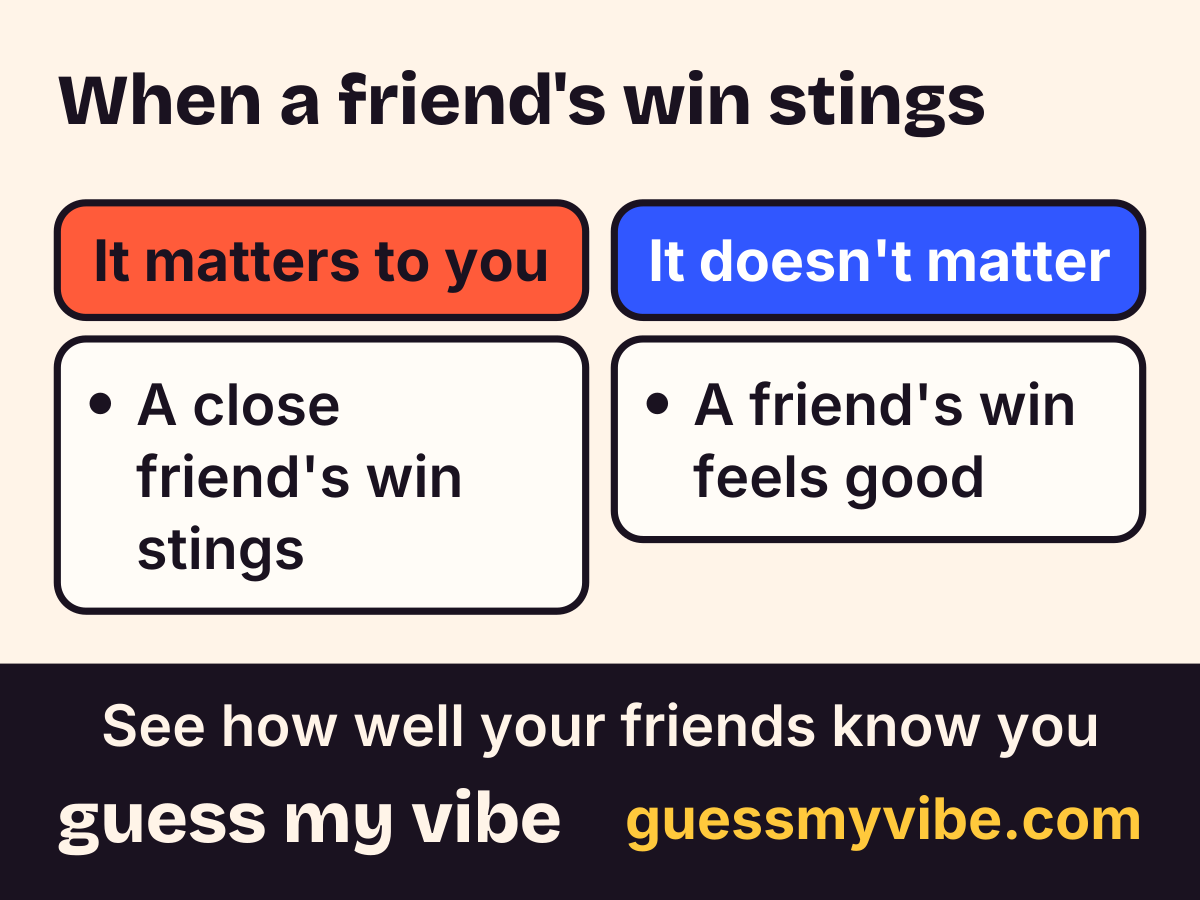
A close friend outperforming you stings specifically when the area matters to your own sense of self, and feels good when it doesn't, a documented pattern psychologists call self-evaluation maintenance: the closer the person and the more the skill matters to you, the more their win threatens you, while their win in an area you don't care about lets you feel proud by association instead [1]. This is why the same friendship can have a genuinely competitive zone in one area and a completely supportive one in another.
A friend crushing their marathon time can feel like genuine, uncomplicated pride, right up until it's the one thing you've also been training for, at which point the exact same accomplishment can feel like a quiet gut-punch. That's not a contradiction or a character flaw. It's a well-documented, specific pattern researchers call the self-evaluation maintenance model, and it explains exactly when a friend's success will feel good to watch and when it won't, based on two simple variables: how close the friend is, and how much the area matters to your own sense of yourself.
The self-evaluation maintenance model, tested directly on friends
Three studies tested this model directly using real friends and strangers as comparison points. Participants got feedback about their own performance and a comparison person's performance, sometimes a close friend, sometimes a stranger, on tasks that were either made to feel important to their self-image or deliberately unimportant [1]. When the task mattered (high self-relevance), being outperformed by the close friend produced measurably more arousal than being outperformed by the stranger, as measured through actual task performance on a second activity. In a third study, facial expressions were monitored during the feedback, and how pleasant they were depended on the task's relevance, who did better, and how close the comparison person was. The closer the comparison person, the more a loss on something that matters stings.
The flip side is the more surprising half of the finding. On a task that was deliberately made to feel unimportant to someone's self-image, a friend outperforming them produced more positive feelings than the friend merely matching their performance, and more than a stranger beating them [1]. In other words, when nothing about your own identity is riding on it, a friend's win doesn't threaten you. It reflects well on you by association, almost like their accomplishment becomes a small win for the friendship itself. The same basic social-comparison process produces opposite emotions depending on just one variable: does this touch how you see yourself.
Cite this figure
Figure: "When a friend's win stings." Guess My Vibe (guessmyvibe.com). https://guessmyvibe.com/learn/competitive-friend#figure-when-it-matters
The pattern holds even with more than one friend in the mix
Real friend groups rarely involve just one comparison person, so a follow-up study extended the model to two close friends at once. When people were outperformed by both friends on the same activity, they rated that activity as less relevant to their self-image than when they outperformed both of them, a self-protective adjustment [2]. Interestingly, when the outcome was split, ahead of one friend, behind the other, or genuinely unclear, people's ratings of how much the activity mattered to them landed in the middle, as if hedging. The self-evaluation system isn't just reacting to one comparison at a time; it's tracking the whole social picture and adjusting what you claim to care about accordingly.
Curious how your friends would answer?
Free. Answer 10 quick questions about you, then send your link. Friends play in their browser, no app needed.
Start freeDoes the same thing happen with romantic partners?
A separate line of research asked whether this self-protective pattern is specific to friendship or shows up anywhere two people are closely tied, testing it on romantic partners instead. Across four studies, both the self-protective reaction (feeling threatened by a partner's success on something self-relevant) and a second, more generous reaction, empathic pride (feeling good because the partner feels good) showed up, and comparisons with a partner produced a different emotional pattern than comparisons with a stranger, confirming the core mechanism isn't unique to platonic friendship [3]. One complication specific to romantic partners: the empathic, genuinely-happy-for-them reaction was weaker or absent when the comparison area mattered a lot to the person doing the comparing, suggesting that when the stakes feel high, the self-protective instinct can crowd out the generous one.
Self-relevance isn't a fixed trait of the activity itself
A detail that gets lost in a short summary of this research: self-relevance isn't a property of the activity, it's a property of the person doing the comparing, and it can shift over time or even get adjusted on the fly as a defense mechanism. The split-outcome finding from the two-friend study is the clearest evidence of this: when people weren't sure who had actually performed better, or when the two friends disagreed about it, people's own ratings of how much the activity mattered to them landed in a protective middle ground, neither fully relevant nor fully dismissed [2]. That's not people lying about what they care about. It's the same self-protective system from the core model adjusting its own inputs in real time, in a situation ambiguous enough to allow it. Something that felt like a core part of your identity last year, a sport, a subject, a creative hobby, can quietly stop being self-relevant once you've drifted away from it, which is part of why an old rivalry with a friend sometimes fades on its own even without either person ever addressing it directly.
When the sting tips into something worse than a sting
The self-evaluation maintenance pattern above is normal and, on its own, not a problem: feeling a flicker of threat when a close friend beats you at something you care about is an ordinary human reaction, not a sign anything is wrong with the friendship. Research on envy specifically draws a useful further distinction for when that flicker goes somewhere less healthy. Envy splits into two separate experiences: benign envy, which motivates you to work toward matching the friend's success, and malicious envy, which motivates wanting to see them brought back down instead, and the two are measurably different responses, not two words for the same feeling [4]. The self-evaluation research above explains why the sting happens at all; which of these two directions it goes in afterward is a separate, and arguably more important, question.
Mapping where your own friendship actually competes
Most friendships have an unspoken map of which areas are competitive and which ones aren't, built up from years of exactly the small reactions this research describes. The useful move isn't trying to eliminate the competitive zones, the research suggests that's not really possible when something genuinely matters to your identity, but getting honest about where they actually are instead of assuming they match what your friend would guess. That's a smaller version of what Guess My Vibe is built to surface: a friend guessing your honest answers instead of assuming they already know them, which tends to expose exactly these kinds of quiet mismatches before they turn into a bigger one.
Key takeaways
- Being outperformed by a close friend on something self-relevant produces more arousal (measured through performance on a follow-up task) and a different affective pattern than being outperformed by a stranger on the same thing [1].
- On a task that doesn't matter to your self-image, a friend doing better than you actually produces more positive feelings than the friend merely tying or a stranger beating you [1].
- This pattern holds up with more than one friend in the picture: being beaten by two close friends at once makes people downgrade how much that activity matters to them, a self-protective move [2].
- The same self-protective reaction and the opposite, genuinely feeling happy for someone, both show up in romantic partners too, not just friends, though the romantic version adds its own complications [3].
- This isn't therapy, a diagnosis, or a substitute for professional care.
Questions people ask
Why does it bother me when my friend is better at something I care about?
Research on the self-evaluation maintenance model found being outperformed by a close friend on something self-relevant produces more arousal than being outperformed by a stranger on the same thing, specifically because the comparison is close to home [1].
Why does my friend's success feel good in some areas and bad in others?
It comes down to self-relevance. The same research found a friend outperforming you on something that doesn't matter to your self-image produces more positive feelings than them merely tying you, while outperforming you on something that does matter produces the opposite [1].
Is it normal to feel competitive with a close friend?
Yes, in specific areas. This is a well-documented, non-pathological pattern that shows up with friends, with more than one friend at a time, and even with romantic partners, all tied to the same underlying mechanism [1] [2] [3].
Is being envious of a friend the same as the self-evaluation threat described here?
They're related but distinct. The self-evaluation research explains why a friend's success in your area can sting at all; separate envy research shows that sting can go one of two ways afterward, benign (motivating you to improve) or malicious (wanting to see them brought down) [4].
Does this pattern only apply to friends, or partners too?
Research extending the model to romantic partners found the same basic self-protective and empathic reactions, though the empathic, happy-for-them reaction was weaker when the comparison area mattered a lot to the person doing the comparing [3].
See how well your friends know you.
Free. Answer 10 quick questions about you, then send your link. Friends play in their browser, no app needed.
Start freeReferences
- [1] Tesser, A., Millar, M., & Moore, J. (1988). Some affective consequences of social comparison and reflection processes: The pain and pleasure of being close. Journal of Personality and Social Psychology, 54(1), 49–61. PubMed: 3346807 (opens in a new tab)
- [2] Pilkington, C. J., & Smith, K. A. (2000). Self-evaluation maintenance in a larger social context. British Journal of Social Psychology, 39(2), 213–227. PubMed: 10907096 (opens in a new tab)
- [3] Beach, S. R. H., Tesser, A., Fincham, F. D., Jones, D. J., Johnson, D., & Whitaker, D. J. (1998). Pleasure and pain in doing well, together: An investigation of performance-related affect in close relationships. Journal of Personality and Social Psychology, 74(4), 923–938. PubMed: 9569652 (opens in a new tab)
- [4] van de Ven, N., Zeelenberg, M., & Pieters, R. (2009). Leveling up and down: The experiences of benign and malicious envy. Emotion, 9(3), 419–429. PubMed: 19485619 (opens in a new tab)
How we find and check these sources: how we write. Spotted an error? Report a correction.
Related
- Envy vs Jealousy: The Real Difference, With Friend Examples
- Friendship Compatibility: What Actually Makes It Work
- Conflict Styles: How Personality Shapes How You Fight
- Why Do I Get Jealous? The Personality Side of Jealousy
- How to Build Trust in a Friendship, According to Research
- How to Respond to a Friend's Good News (Research-Backed)
- Frenemy: What Mixed Feelings About a Friend Do to You
Cite this article
- Title
- Competitive Friend: The Psychology Behind the Sting
- Publisher
- Guess My Vibe
- Updated
- URL
- https://guessmyvibe.com/
learn/ competitive-friend
Copy this citation
Guess My Vibe. (2026, October 3). Competitive Friend: The Psychology Behind the Sting. Guess My Vibe. https://guessmyvibe.com/
To point at one section, add that section's anchor (the # link on its heading) to the URL.