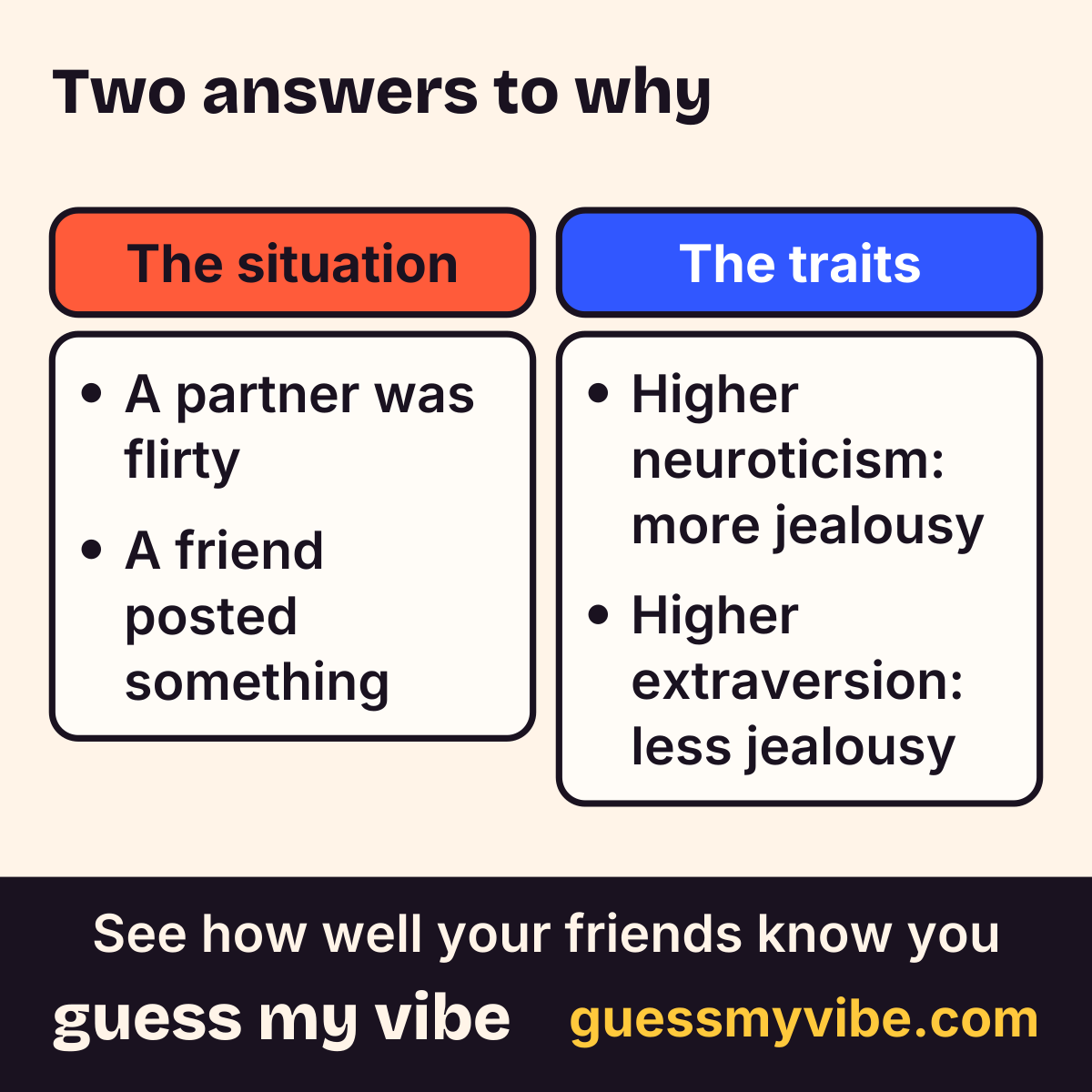
How jealous you get isn't just about what's actually happening, it's also about a stable part of your personality: research finds higher neuroticism consistently goes with more jealousy, while higher extraversion goes with less, in couples studied for jealousy as a trait rather than a one-time reaction [1]. The same underlying pattern, more emotional reactivity to stress in general, shows up away from jealousy entirely, in how men in one diary study responded to ordinary daily problems [2], which is part of why the same event (a partner texting an ex, a friend getting close to someone new) can barely register for one person and consume another.
"Why do I get jealous?" usually gets answered with a situation: a partner was flirty, a friend posted something, someone got too close to someone they shouldn't have. The situation matters, but research on jealousy as a personality trait, something that varies from person to person independent of what's actually happening, finds a real, measurable second answer underneath the situational one. Some people are simply more prone to jealousy across a wide range of situations, and that tendency tracks closely with two specific, well-studied personality traits.
Neuroticism and extraversion: the two traits that keep showing up
A study of two large community samples of heterosexual couples, 459 couples in one sample and 230 in the other, tested how self-reported personality related to three types of jealousy. The pattern was consistent across both samples: higher self-reported neuroticism went with more jealousy, and higher self-reported extraversion went with less [1]. The same study also looked at whether a partner's personality mattered, not just your own, and found that couples who resembled each other in personality reported lower jealousy overall, though the specific expectation that a partner's own extraversion would reduce jealousy wasn't supported by the data. The honest reading here: your own baseline emotional reactivity (the core of neuroticism) is clearly linked to how jealous you tend to get, alongside whatever is going on with the specific partner or friend you're worried about.
Cite this figure
Figure: "Two answers to why." Guess My Vibe (guessmyvibe.com). https://guessmyvibe.com/learn/why-do-i-get-jealous#figure-situation-vs-trait
Jealousy looks closer to anxious than controlling
A separate study of 100 Dutch men and 100 Dutch women measured three jealousy types, reactive (a response to an actual event), preventive (trying to head off a threat before it happens), and anxious (ongoing, undirected worry about betrayal), against a wider set of personality measures. None of the three jealousy types were meaningfully related to egoism or dominance, traits you'd expect if jealousy were mainly about control or possessiveness. All three were significantly related instead to neuroticism, social anxiety, rigidity and hostility [3]. That's a meaningfully different picture than the common assumption that jealous people are controlling. The research points toward jealousy going with anxiety and emotional reactivity more than with a desire to control another person, with low self-esteem adding to the picture specifically for women in this sample. The same study also found attachment style mattered: people with an anxious-ambivalent attachment style reported the most jealousy across all three types, and people with a secure attachment style reported the least.
Jealousy isn't one thing, and that matters for how you read your own reaction
A study of 76 gay men, 79 lesbians, 70 heterosexual women and 70 heterosexual men found that different jealousy subtypes don't just vary in intensity, they can point in opposite directions. Anxious jealousy, the free-floating, hard-to-pin-down worry, was linked to lower relationship quality among heterosexuals and especially gay men, but not among lesbians. Reactive jealousy, a response to something that actually happened, was linked to higher relationship quality among heterosexuals specifically [4]. In plain terms: feeling a jolt of jealousy when something real happens isn't automatically a bad sign about you or the relationship, the research found it's associated with healthier relationships in some groups. A constant, untethered background hum of jealousy with no clear trigger is the pattern worth paying more attention to.
Curious how your friends would answer?
Free. Answer 10 quick questions about you, then send your link. Friends play in their browser, no app needed.
Start freeWhy this is really a stress-reactivity story, not just a jealousy story
Neuroticism's role in jealousy isn't a special, jealousy-specific effect, it's a smaller piece of a much broader pattern in how the trait works. An 8-day diary study tracking real daily stressors and conflicts found that men higher in neuroticism showed small but consistent emotional reactivity to both conflict and non-conflict everyday problems, not just romantic or jealousy-related ones [2]. That same study also found agreeable men in particular felt more distress specifically on days with more interpersonal conflict. Put together with the jealousy-specific research above, the honest picture is less "jealousy is its own separate thing" and more "a general stress-reactivity trait shows up in jealousy the same way it shows up everywhere else in your emotional life," which is part of why someone who gets more rattled by jealousy often also runs a little hotter on unrelated daily stress too.
The difference between a jealous moment and a jealous disposition
It's worth being precise about what this research is and isn't claiming. All four studies above measured jealousy as a disposition, a general tendency, usually via questionnaires asking how someone typically reacts across situations, not jealousy as a one-off reaction to a specific event. Almost everyone feels a jealous flash in some specific situation at some point; that single moment doesn't say much about personality on its own. What the trait research describes is the person who feels that flash often, across many different situations and relationships, independent of how legitimate any one trigger actually was. The practical distinction matters: a single jealous reaction to something that actually happened is closer to the "reactive" jealousy this research found linked to healthier relationships, while a pattern that shows up constantly, regardless of the specific partner or friend involved, is the piece more clearly tied to the personality traits above. These are also mostly European community and student samples (Dutch and general Western samples across the studies), which is worth keeping in mind before assuming the exact pattern holds identically everywhere.
What this actually means for you
None of this research says jealousy is irrational or something to suppress, reactive jealousy in particular was linked to better, not worse, relationships in the data above. What it does offer is a more accurate starting point than "the situation made me jealous": if jealousy shows up often, with no specific trigger, and you also notice yourself reacting strongly to other, unrelated daily stress, that's a trait-level pattern worth recognizing as yours rather than something only this one relationship or friendship is causing. A useful gut check, borrowed from the broader idea behind Guess My Vibe, is asking a friend you trust how your reaction actually compares to theirs in a similar situation, since a friend's honest outside read is often a faster way to tell trait from trigger than sitting with it alone.
Key takeaways
- Self-reported neuroticism is positively related to jealousy and self-reported extraversion is negatively related to it, a pattern found in two large community samples of couples (459 and 230 couples) [1].
- Jealousy correlates with neuroticism, social anxiety, rigidity and hostility, but not with egoism or dominance, in a study of 200 adults, suggesting it's closer to an anxious, reactive trait pattern than a selfish or controlling one [3].
- Jealousy isn't one thing with one effect: different subtypes (reactive, anxious, possessive) relate to relationship quality differently, and sometimes in opposite directions [4].
- In an 8-day diary study of men, higher neuroticism went with small but consistent emotional reactivity to both conflict and non-conflict daily problems, not just jealousy-triggering ones, which helps explain why the same trait shows up across very different kinds of situations [2].
- This isn't therapy, a diagnosis, or a substitute for professional care.
Questions people ask
Why do I get jealous more easily than my friends seem to?
Research finds jealousy correlates with higher neuroticism and lower extraversion as stable personality traits, not just with what's happening in a given relationship, so some people are more prone to it across many different situations [1].
Does getting jealous mean I'm controlling?
Not according to the research. A study of 200 adults found jealousy was unrelated to egoism or dominance, but significantly related to neuroticism, social anxiety, rigidity and hostility, a pattern closer to anxious than controlling [3].
Is all jealousy a bad sign in a relationship or friendship?
No. Research distinguishing jealousy subtypes found reactive jealousy (a response to something that actually happened) was linked to higher relationship quality among heterosexuals, while anxious, untethered jealousy was linked to lower relationship quality [4].
Why does the same situation make me jealous but not my friend?
Partly because of baseline emotional reactivity. In a diary study of men, higher neuroticism went with small but consistent reactivity to many kinds of daily problems, not just jealousy-triggering situations, which helps explain why identical situations land differently for different people [2].
Can a partner's personality affect how jealous I get?
Some evidence points that way: couples who were more similar to each other in personality reported lower jealousy overall, though the specific expectation that a partner's own extraversion would reduce a person's jealousy wasn't supported in that study [1].
See how well your friends know you.
Free. Answer 10 quick questions about you, then send your link. Friends play in their browser, no app needed.
Start freeReferences
- [1] Dijkstra, P., & Barelds, D. P. H. (2008). Self and partner personality and responses to relationship threats. Journal of Research in Personality, 42(6), 1500–1511. doi.org/10.1016/j.jrp.2008.06.008 (opens in a new tab)
- [2] Suls, J., Martin, R., & David, J. P. (1998). Person-environment fit and its limits: Agreeableness, neuroticism, and emotional reactivity to interpersonal conflict. Personality and Social Psychology Bulletin, 24(1), 88–98. doi.org/10.1177/0146167298241007 (opens in a new tab)
- [3] Buunk, B. P. (1997). Personality, birth order and attachment styles as related to various types of jealousy. Personality and Individual Differences, 23(6), 997–1006. doi.org/10.1016/S0191-8869(97)00136-0 (opens in a new tab)
- [4] Barelds, D. P., & Dijkstra, P. (2006). Reactive, anxious and possessive forms of jealousy and their relation to relationship quality among heterosexuals and homosexuals. Journal of Homosexuality, 51(3), 183–198. PubMed: 17135120 (opens in a new tab)
How we find and check these sources: how we write. Spotted an error? Report a correction.
Related
- Envy vs Jealousy: The Real Difference, With Friend Examples
- Conflict Styles: How Personality Shapes How You Fight
- Agreeableness: The Trait Closeness Barely Helps Friends Read
- How to Build Trust in a Friendship, According to Research
- Sarcasm: Why Some Friends Speak It Fluently
- Jealousy in Relationships: What Research Says
Cite this article
- Title
- Why Do I Get Jealous? The Personality Side of Jealousy
- Publisher
- Guess My Vibe
- Updated
- URL
- https://guessmyvibe.com/
learn/ why-do-i-get-jealous
Copy this citation
Guess My Vibe. (2026, October 3). Why Do I Get Jealous? The Personality Side of Jealousy. Guess My Vibe. https://guessmyvibe.com/
To point at one section, add that section's anchor (the # link on its heading) to the URL.