Trust is built in a specific sequence, according to foundational research: first predictability (can you forecast specific behaviors), then dependability (can you count on broader qualities like honesty), and finally faith (a settled confidence that holds up even without proof) [1]. Trust is also measurably personality-linked, both the willingness to trust and the quality of being trustworthy correlate with distinct Big Five traits [2], and it shows up in real behavior, not just feelings, in classic economics experiments where people reliably hand real money to near-strangers based on nothing but reciprocity expectations [3].
"How do you build trust" usually gets answered with a single big gesture: a grand vulnerable confession, a dramatic test passed. Research on trust points somewhere less dramatic and more useful. Trust builds in layers, starting small and specific and only later becoming the bigger, harder-to-shake thing most people mean when they say they trust someone. Knowing the actual sequence makes it possible to see where a specific friendship stands, instead of treating trust as either fully present or completely absent.
The three layers: predictability, dependability, faith
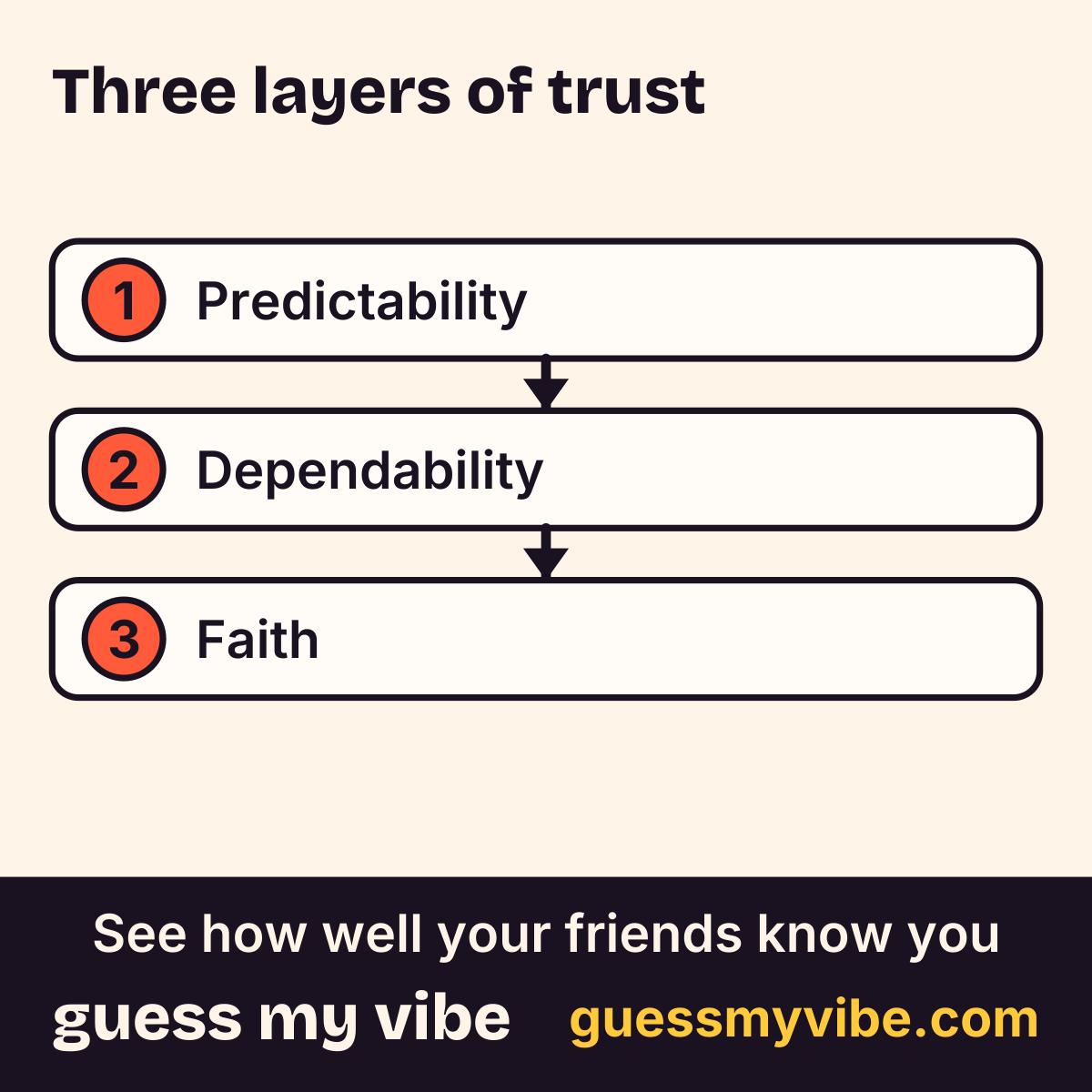
Foundational research on trust in close relationships proposed, and built a validated 17-item scale around, three distinct dimensions that develop in sequence as a relationship matures, with the scale tested in a survey of established couples [1]. The first and most basic is predictability: can you forecast a specific action from a person's past behavior, will they actually show up on time, will they text back within a day. This layer is built almost entirely from direct observation, which is why it's the first one available even in a new friendship. The second, dependability, is a step up in abstraction: it's less about forecasting one specific action and more about trusting a person's broader qualities, their basic honesty, their cooperativeness, their follow-through as a pattern rather than a single instance. The third and deepest layer is faith: a conviction that a friend will be there for you in situations neither of you has faced yet, a kind of trust that, by definition, can't be fully justified by past evidence because the situation hasn't happened. Faith is what lets people feel secure heading into genuine uncertainty with someone, not just confident about situations they've already tested.
The practical implication of this sequence is that trust-building complaints often come from a mismatch in which layer two people think they're operating on. Someone asking a newer friend for faith-level trust (total vulnerability, an assumption of permanent loyalty) before predictability has even been established is skipping two steps the research says actually need to happen first. Trust that feels unusually fast and complete early on is worth noticing for that reason, not because it's necessarily fake, but because the layers underneath it may not have had time to form yet.
Cite this figure
Figure: "Three layers of trust." Guess My Vibe (guessmyvibe.com). https://guessmyvibe.com/learn/how-to-build-trust#figure-three-layers
Trust and trustworthiness are different traits, not one thing
A study combining a large-scale personality survey (over 8,000 people) with a behavioral economics experiment found that trust, your own willingness to depend on other people, and trustworthiness, actually being the kind of person others can depend on, are related but genuinely separate personality constructs, not two words for the same quality [2]. Trust itself correlated with higher extraversion and lower neuroticism, sociable and emotionally steady people extend trust more readily. Trustworthiness correlated instead with agreeableness and conscientiousness, warmth and reliability, not sociability, are what actually make someone dependable. A second study in the same research (90 participants) validated this by having people play an actual trust game (the design Berg and colleagues introduced [3]) with real money on the line, not just a self-report survey, and found the trust scale tracked real behavior in that economic game, not just how people described themselves on paper.
The practical takeaway is specific: if you want to build trust in a friendship, the research suggests focusing less on persuading the other person you're trustworthy in the abstract and more on consistently demonstrating the concrete building blocks of it, agreeableness and conscientiousness in action, being warm and actually following through, which are the two traits that research links to trustworthiness specifically.
Curious how your friends would answer?
Free. Answer 10 quick questions about you, then send your link. Friends play in their browser, no app needed.
Start freeThe experiment that shows trust is more than a feeling
One of the most-cited experiments in all of behavioral economics is built entirely around trust between strangers. In the setup, one person can send some or all of their money to an anonymous partner; whatever is sent gets tripled, and the partner then decides how much, if any, to send back [3]. A purely self-interested partner would keep everything and send nothing back, which means a purely rational sender should never send money in the first place. Real participants didn't behave that way. People reliably sent money anyway, and partners reliably sent some back, evidence that reciprocity, not just self-interest, is a basic and fairly dependable feature of how people actually behave, not just something they say they value. The experiment matters for friendship for a simple reason: trust isn't only the warm feeling of being comfortable with someone, it's also a behavioral bet that the other person will reciprocate, and the research says that bet pays off more often than pure self-interest would suggest.
Why trust tracks so closely with how someone handles conflict
Since trustworthiness ties specifically to Agreeableness, it's worth knowing what else that same trait goes with, because it's one of the more thoroughly studied links in personality research. Studies using both hypothetical conflict scenarios and two weeks of real, diary-tracked daily conflicts found Agreeableness was the Big Five trait most consistently tied to how people actually respond when friction comes up, not just how they say they'd respond [4]. People lower in Agreeableness rated confrontational, power-based tactics more favorably, even though virtually everyone, regardless of trait level, agreed that negotiation and simply letting small things go were the objectively better strategies. That gap between what people know is the better move and what actually feels tempting in the moment is a reasonable way to understand part of why trustworthiness and agreeableness travel together: being dependable under pressure, not just when things are easy, is what the predictability and dependability layers of trust are actually testing for.
What this means for actually building trust with someone
Put together, the research suggests trust isn't built through one conversation or one test passed, it's built through a sequence: first through small, repeated, predictable actions (replying, showing up, following through on the minor stuff), then through a track record solid enough to generalize into a broader sense of someone's character, and only later into the kind of faith that doesn't need constant re-proving. Skipping straight to asking for the third layer before the first two have had time to accumulate is a common way trust-building stalls out. A more honest shortcut is finding out directly whether you and a friend actually read your own trust level the same way, which is a smaller version of what Guess My Vibe does with personality questions more broadly: a friend guessing your honest answer instead of assuming they already know it, which surfaces exactly these kinds of gaps before they turn into a bigger misunderstanding.
Key takeaways
- Trust develops in three layers that build on each other: predictability from consistent past behavior, dependability based on a person's character, and faith, a conviction that holds up even in situations you can't fully foresee [1].
- Trust and trustworthiness are measurably different things: a large study found trust (willingness to depend on others) relates to extraversion and lower neuroticism, while trustworthiness (actually being dependable) relates to agreeableness and conscientiousness [2].
- People will extend real trust to near-strangers with no guarantee of reciprocity, a classic economics experiment found participants sent money to an anonymous partner expecting it would come back fairer than a purely selfish model would suggest [3].
- Agreeableness, the trait the research above links to trustworthiness, is also the Big Five trait most consistently linked to how someone actually handles conflict day to day, not just how they talk about handling it [4].
- This isn't therapy, a diagnosis, or a substitute for professional care.
Questions people ask
What are the stages of building trust in a friendship?
Research on trust in close relationships identifies three layers that build in sequence: predictability (forecasting specific actions from past behavior), dependability (trusting broader character traits like honesty), and faith (a settled confidence that holds up even without proof) [1].
Is being trustworthy a personality trait?
Research distinguishes trust (your willingness to depend on others, linked to extraversion and lower neuroticism) from trustworthiness (actually being dependable, linked to agreeableness and conscientiousness) as two separate, Big Five-linked traits [2].
Do people actually trust strangers, or only people they know well?
A classic economics experiment found people reliably sent money to anonymous partners with no guarantee of return, and partners reliably sent some back, evidence that reciprocity is a basic, measurable feature of real behavior, not just a nice-sounding value [3].
Why do agreeable people seem easier to trust?
Agreeableness is the trait most closely linked to trustworthiness in personality research [2], and it's also the Big Five trait most consistently tied to how someone actually handles real conflict, not just how they describe handling it [4].
How long does it take to build real trust with someone?
There's no fixed timeline in the research, but the layered model suggests it can't be skipped: faith-level trust, the deepest layer, develops only after predictability and dependability have had time to build from repeated, consistent behavior [1].
See how well your friends know you.
Free. Answer 10 quick questions about you, then send your link. Friends play in their browser, no app needed.
Start freeReferences
- [1] Rempel, J. K., Holmes, J. G., & Zanna, M. P. (1985). Trust in close relationships. Journal of Personality and Social Psychology, 49(1), 95–112. doi.org/10.1037/0022-3514.49.1.95 (opens in a new tab)
- [2] Evans, A. M., & Revelle, W. (2008). Survey and behavioral measurements of interpersonal trust. Journal of Research in Personality, 42(6), 1585–1593. doi.org/10.1016/j.jrp.2008.07.011 (opens in a new tab)
- [3] Berg, J., Dickhaut, J., & McCabe, K. (1995). Trust, reciprocity, and social history. Games and Economic Behavior, 10(1), 122–142. doi.org/10.1006/game.1995.1027 (opens in a new tab)
- [4] Jensen-Campbell, L. A., & Graziano, W. G. (2001). Agreeableness as a moderator of interpersonal conflict. Journal of Personality, 69(2), 323–361. PubMed: 11339802 (opens in a new tab)
How we find and check these sources: how we write. Spotted an error? Report a correction.
Related
- Honesty in Friendship: Why It Hurts Less Than You Think
- Conflict Styles: How Personality Shapes How You Fight
- Agreeableness: The Trait Closeness Barely Helps Friends Read
- Sarcasm: Why Some Friends Speak It Fluently
- Holding Grudges: The Personality Behind It
- How to Tell if Someone Is Trustworthy (Faces Won't Help)
- Attachment Styles in Friendship: What Research Shows
Cite this article
- Title
- How to Build Trust in a Friendship, According to Research
- Publisher
- Guess My Vibe
- Updated
- URL
- https://guessmyvibe.com/
learn/ how-to-build-trust
Copy this citation
Guess My Vibe. (2026, October 3). How to Build Trust in a Friendship, According to Research. Guess My Vibe. https://guessmyvibe.com/
To point at one section, add that section's anchor (the # link on its heading) to the URL.