Honesty in friendship holds up better than most people expect: when researchers had people try being completely honest for a few days, it was more enjoyable and more connecting than they expected beforehand, with less relationship damage than they feared. The fear of honesty is mostly a forecasting error, not an accurate read of what will actually happen. Most small daily lies are minor, self-protective ones, and conversations that include a lie tend to feel less close than honest ones, not safer.
Honesty in friendship: the fear vs. what actually happens
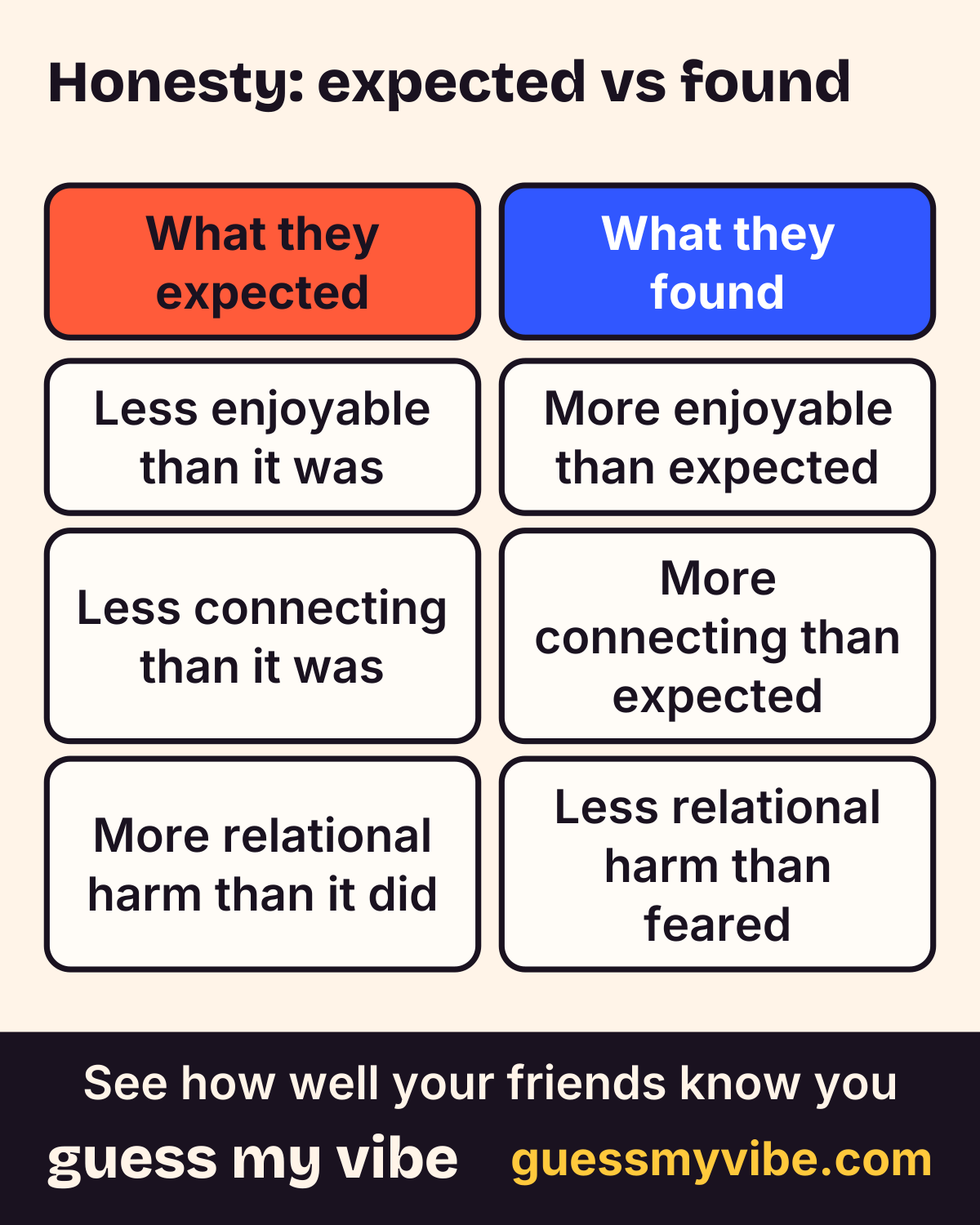
Most people quietly believe honesty in friendship is a risk you manage, something to dose out carefully so it doesn't do damage. The research says that fear is mostly wrong. Across a set of field and lab studies, people instructed to be completely honest in every conversation for a few days, instead of just kind or careful, found it more pleasurable and more socially connecting than they'd expected going in, and it did noticeably less relational harm than they'd feared [1]. The honest version of friendship isn't a trade-off between closeness and truth. In the actual data, more honesty tracked with more closeness, not less.
Cite this figure
Figure: "Honesty: expected vs found." Guess My Vibe (guessmyvibe.com). https://guessmyvibe.com/learn/honesty-in-friendship#figure-feared-vs-found
Why people expect honesty to go worse than it does
The same research program is specific about where the fear comes from, and it's a forecasting error, not a lesson learned from experience. The same studies compared what people expected would happen with what actually happened, across both everyday honesty and two harder, more deliberately controlled situations: disclosing something personal, and sharing honest negative feedback [1]. In both cases, the researchers found that the people being honest overestimated how negatively the other person would react: they consistently guessed it would land worse than it did. The actual listeners, the people on the receiving end of that honest disclosure or feedback, reacted better than the communicators expected. You're not bad at being honest. You're bad at guessing how honesty will be received, and the error runs in exactly one direction: too pessimistic.
What honesty is actually competing with: small, constant white lies
It helps to know what the realistic alternative to honesty actually looks like, since it's rarely a dramatic betrayal. Two diary studies tracking real conversations over time found that college students reported telling about 2 lies a day and community members about 1, and most of them were small, self-centered, not-particularly-planned white lies, the kind nobody worries much about getting caught in [2]. These aren't the headline-grabbing betrayals honesty's reputation is built around. They're closer to "I love it, thanks" about a gift you didn't, or "no, you're not interrupting" when you were in the middle of something. The same studies found something worth sitting with, though: on average, conversations where a lie was told were rated as less pleasant and less close than conversations without one, even when the lie itself was small and unremarkable. Participants said they didn't worry much about being caught, yet the lie-free conversations still came out ahead. That's a correlation, so it can't prove the lie itself flattened the conversation, but the gap was there.
Curious how your friends would answer?
Free. Answer 10 quick questions about you, then send your link. Friends play in their browser, no app needed.
Start freeNot all small lies look the same
The same diary research found a detail worth noticing before you assume all white lies are equally harmless: most of the lies people told were self-centered, protecting how they looked or what they wanted, rather than other-oriented, protecting someone else's feelings, with one notable exception. In conversations between two women, other-oriented lies showed up just as often as self-centered ones, while other pairings stayed more self-centered overall. People also leaned toward telling more self-centered lies to men and more other-oriented lies to women [2]. None of that makes any single white lie a crisis. It does mean the honest question worth asking yourself before smoothing something over isn't just "is this lie small," but "who is this actually protecting, them or me," since the research above found the self-centered kind is the one doing most of the quiet, everyday work.
Honesty and being liked aren't opposites
A natural worry sits underneath all of this: if you're more honest, including about things you'd normally soften, will people like you less? A large meta-analytic review of self-disclosure research points the other way. It found three separate, reinforcing patterns: people who disclose more intimately tend to be liked more than people who disclose less, people disclose more to people they already like, and people grow to like someone more as a result of having opened up to them [3]. Honest self-disclosure, telling someone a real opinion, a real feeling, a real reaction instead of a polished one, isn't competing with being liked. In the research, it's one of the things that actually builds it. That third pattern is worth sitting with, since it runs in the direction most people don't expect: you don't just need to already like someone to feel safe opening up to them. Opening up can be what grows the liking in the first place, which flips the usual order people assume honesty has to follow in a new or still-forming friendship.
The same pessimism shows up in how people read whole conversations
Honesty isn't the only place this pattern of "people expect worse than reality" shows up. After an ordinary conversation, most people also underestimate how much their conversation partner actually liked them and enjoyed talking, a well-documented pattern called the liking gap, which holds up between total strangers and keeps showing up months into an actual friendship [4]. The two findings rhyme: one says people guess a friend will take honesty worse than they actually do, the other says people guess a friend liked a conversation less than they actually did. Both errors point in the same pessimistic direction, and both get corrected the same way: not by guessing more carefully, but by finding out.
Why a guessing game built on honesty works
This is the real case for structuring honesty instead of hoping for it. Guess My Vibe's honest take card asks a friend to rate you directly, in writing, on real personality questions, instead of leaving them to soften an answer in conversation the way the diary-study participants above routinely did. It isn't a substitute for an honest conversation; it's a lower-stakes first step toward one, since seeing an honest answer written down, outside the pressure of a live reaction, is exactly the kind of practice that chips away at the mispredicted fear the honesty research keeps finding. If the research is right that you're overestimating how badly honesty lands, the fastest way to actually find out is to see a real one.
Key takeaways
- People who were told to be completely honest for 3 days found it more pleasurable and more socially connecting than they expected, with less relational harm than they'd feared [1].
- The gap isn't that people avoid honesty for no reason; it's that they specifically overestimate how badly the other person will react to it [1].
- In diary studies, college students admitted to roughly 2 small lies a day and community members to about 1, mostly minor and self-centered, but conversations that included a lie were rated less pleasant and less close than lie-free ones [2].
- Opening up honestly is tied to being liked more, not less: a large meta-analysis found people who disclose more intimately tend to be better liked, and liking someone makes you disclose to them more in turn [3].
- This isn't therapy, a diagnosis, or a substitute for professional care; it's a plain-English summary of what personality and social psychology research says about honesty in friendship.
Questions people ask
Does being honest actually hurt friendships?
Less than people expect. In controlled studies, people instructed to be completely honest for a few days found it more enjoyable and more connecting than they'd expected, with less relational harm than they feared going in [1].
Why do people avoid being honest with friends?
Mostly because they overestimate how badly the other person will react, not because honesty is actually risky. Studies comparing expected and actual reactions to honest disclosure and honest feedback found people consistently guessed worse outcomes than what actually happened [1].
How often do people actually lie to friends?
Diary studies found college students reported about 2 small lies a day and community members about 1, mostly minor, self-centered white lies, not major betrayals [2].
Does being more open make people like you more or less?
More, on average. A large meta-analysis found people who disclose more intimately tend to be liked more, and liking someone also makes you more likely to open up to them in return [3].
What's the honest take card in Guess My Vibe?
It's where a friend rates you directly, in writing, on real personality questions instead of softening an answer out loud in the moment, which gives you an honest answer with less of the social pressure that leads people to round feedback up.
See how well your friends know you.
Free. Answer 10 quick questions about you, then send your link. Friends play in their browser, no app needed.
Start freeReferences
- [1] Levine, E. E., & Cohen, T. R. (2018). You can handle the truth: Mispredicting the consequences of honest communication. Journal of Experimental Psychology: General, 147(9), 1400–1429. PubMed: 30148388 (opens in a new tab)
- [2] DePaulo, B. M., Kashy, D. A., Kirkendol, S. E., Wyer, M. M., & Epstein, J. A. (1996). Lying in everyday life. Journal of Personality and Social Psychology, 70(5), 979–995. PubMed: 8656340 (opens in a new tab)
- [3] Collins, N. L., & Miller, L. C. (1994). Self-disclosure and liking: A meta-analytic review. Psychological Bulletin, 116(3), 457-475. PubMed: 7809308 (opens in a new tab)
- [4] Boothby, E. J., Cooney, G., Sandstrom, G. M., & Clark, M. S. (2018). The Liking Gap in Conversations: Do People Like Us More Than We Think?. Psychological Science, 29(11), 1742–1756. PubMed: 30183512 (opens in a new tab)
How we find and check these sources: how we write. Spotted an error? Report a correction.
Related
- Conflict Styles: How Personality Shapes How You Fight
- Envy vs Jealousy: The Real Difference, With Friend Examples
- How to Get Honest Feedback From Friends
- The Beautiful Mess Effect: Vulnerability Reads as Brave
- Avoiding Conflict: When It Helps and When It Backfires
- Why Do People Gossip? What the Research Actually Found
Cite this article
- Title
- Honesty in Friendship: Why It Hurts Less Than You Think
- Publisher
- Guess My Vibe
- Updated
- URL
- https://guessmyvibe.com/
learn/ honesty-in-friendship
Copy this citation
Guess My Vibe. (2026, October 3). Honesty in Friendship: Why It Hurts Less Than You Think. Guess My Vibe. https://guessmyvibe.com/
To point at one section, add that section's anchor (the # link on its heading) to the URL.