Honest feedback from friends is harder to get than it sounds, because liking you and knowing you aren't the same thing, and the people who like you most tend to describe you more positively, whether or not it's fully accurate. Research also finds people don't always want flattering feedback anyway; when a belief about yourself is negative, you often want someone to confirm the negative, not talk you out of it. The fix isn't asking a stranger. It's asking specific, narrow questions, and comparing what more than one friend actually says instead of trusting any single answer.
Want to take it for real? Make a friendship quiz and get your friends honest read
Why honest feedback from friends is harder to get than it sounds
Asking a friend for honest feedback feels like it should work: they know you, they presumably care about you, and surely that combination gets you a truer answer than a stranger could give. The research says the opposite risk is more common. A friend who likes you is working against their own liking of you the whole time they're trying to answer honestly, and liking tends to win. The honest version of "how do I come across" usually needs more than one friend's answer and a specific enough question that there's less room to round up.
The "letter of recommendation" effect: why liking skews the rating
Most personality research that uses friends as raters recruits those friends through the person being rated, the same way a job candidate picks their own references. A study built specifically to test what that does to the ratings found something worth knowing before you ask anyone close to you for an honest read [1]. People who liked their target more described them more positively across the board, more sociable, more agreeable, more open, more organized, less anxious, not just on one flattering trait but broadly. Liked people were also rated as more similar to each other than they probably really are, which quietly narrows how useful the feedback is, since everyone starts sounding like a slightly better version of the same person. A second study flipped the usual setup to test this directly: 90 people were asked to name someone they did NOT like and rate that person, and those same rated people then separately picked their own informants (typically people who liked them) to rate them too. The raters who disliked their target gave less positive, more varied descriptions than the target's own hand-picked raters did. The uncomfortable, tentative finding: lower liking may be linked to somewhat better accuracy. The friend most motivated to be nice to you is often the friend least likely to tell you something you don't already believe about yourself.
You might not even want the flattering version
It's tempting to assume everyone wants to hear good things about themselves, full stop, and that honest feedback is really just a euphemism for "tell me something nice but true." Three studies on this directly found something more specific [2]. People with both high and low self-esteem preferred positive feedback about the parts of themselves they already saw positively, that part tracks with what you'd expect. But those same people, when asked about the parts of themselves they saw negatively, sought out unfavorable, accurate feedback instead of a flattering spin on it, regardless of their overall self-esteem. In plain terms, whether you want to hear something nice or something true depends on which part of yourself is being asked about, not on how confident you generally are. If you already suspect you come across as scattered in group settings, the useful answer isn't "no, you're great," it's confirmation of the real thing you already half-know, which is a different request than most friends assume you're making when you say you want honest feedback.
Curious how your friends would answer?
Free. Answer 10 quick questions about you, then send your link. Friends play in their browser, no app needed.
Start freeYou don't know your own reputation as well as you think
There's a second layer of difficulty that has nothing to do with whether your friend is being honest: you may already be bad at guessing what they'd say before you even ask. A classic review of this research, covering eight separate studies, found people are fairly good at guessing their overall, general reputation, the broad impression they make on people as a group, but noticeably worse at guessing how one specific person actually sees them [3]. The explanation is the useful part: people build their sense of "this is how they see me" mostly out of their own self-image, not out of real feedback they've actually received. If you've never actually asked, your guess about what a friend would say is closer to a mirror than a window. Asking directly replaces a guess built from your own head with an answer built from theirs.
Which traits a friend can actually judge well
Not every question is equally answerable by a friend, even an honest one. A study comparing how 165 people rated themselves against how friends and strangers rated them found a consistent pattern by trait type [4]. For things that happen mostly inside your head, like how easily your mood gets thrown off by stress, you're still the best judge, since a friend only sees the outward sign, not the internal experience behind it. For outward, sociable behavior, how much you're energized by being around people, you and your friends tend to be about equally accurate, since it's genuinely visible. The practical version: asking a friend "am I actually stressed more than I let on" is asking them to guess at something they can't fully see. Asking "am I actually as outgoing as I think I am" is asking something they're in a real position to answer.
How to actually ask for feedback that holds up
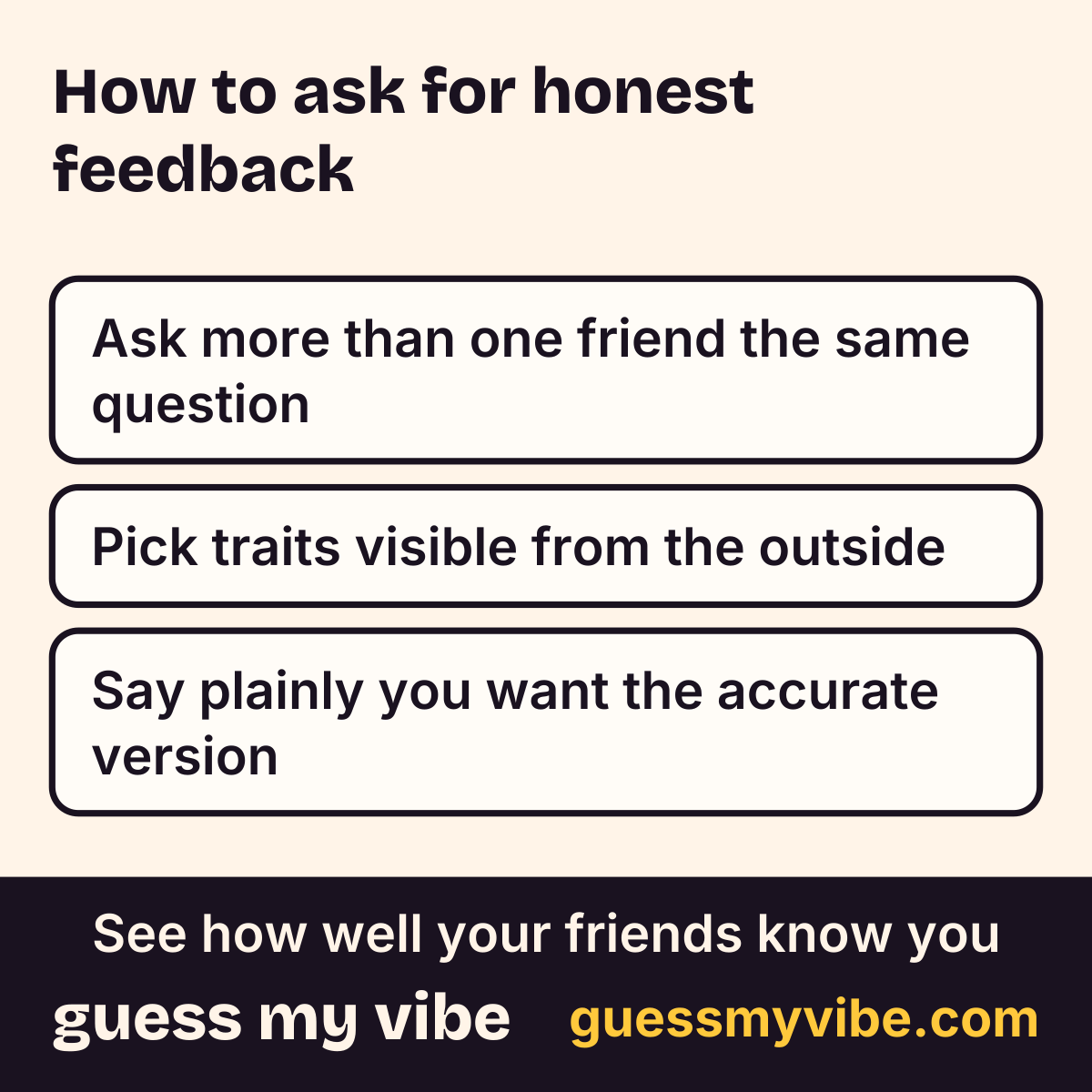
Put together, the research points to a few concrete habits. Ask more than one friend the same specific question rather than one friend to sum up your whole personality, since any single rater's liking for you will color the answer in one direction. Pick questions about traits that are genuinely visible from the outside (how you come across in a group, how outgoing you seem) over questions about things only you can feel (how anxious you actually are). And say plainly that you want the accurate version, even if it's not flattering, since the self-verification research above says people are often willing to give that, once they believe you actually mean it. Guess My Vibe's honest take card is built around exactly this gap: a friend answers real personality questions about you in writing, separately from the conversation where liking you would normally take over, so you get their actual answer instead of the politely rounded-up version most honest-feedback requests get by default.
Cite this figure
Figure: "How to ask for honest feedback." Guess My Vibe (guessmyvibe.com). https://guessmyvibe.com/learn/honest-feedback-from-friends#figure-how-to-ask
Key takeaways
- People who like you describe you more positively across the board, not just on one trait, and the people who like you least may actually be rating you more accurately [1].
- People don't uniformly want flattering feedback. When a self-belief is negative, people seek out unfavorable, accurate feedback on it, not reassurance, regardless of their self-esteem [2].
- Guessing how a specific person sees you is harder than it feels. People are decent at guessing their general reputation but much weaker at guessing one person's actual opinion, partly because they guess from their own self-image instead of real feedback [3].
- Which traits a friend can actually judge well depends on the trait: outward, sociable behavior is easy for friends to read; your own private stress and worry is something you still know better than they do [4].
- This isn't therapy, a diagnosis, or a substitute for professional care; it's a plain-English summary of what personality research says about honest feedback.
Questions people ask
Why don't friends give honest feedback even when you ask?
Partly because liking someone goes along with describing them more positively, even when you're trying to be objective. A study found people who liked their target more rated them more positively across many traits, and liking also made raters sound more similar to each other [1].
Do people actually want honest feedback, or just flattery?
It depends on which part of themselves is being asked about. Research found people want positive feedback about the parts of themselves they already see positively, but accurate, even unflattering, feedback about the parts they see negatively [2].
Is a stranger's feedback more honest than a friend's?
Not automatically more honest, but research found friends chosen specifically because they like the person tend to rate more positively than raters who don't especially like that person, suggesting lower liking is linked to somewhat better accuracy [1].
How many people should I ask for honest feedback?
More than one. A single friend's answer is shaped by how much they like you [1]; in one study, two acquaintances' combined judgments matched a person's actual behavior better than the person's own self-view did, so a few honest answers beat trusting any one alone [5].
What kind of questions get the most honest answers from friends?
Specific questions about outwardly visible behavior (how you come across in a group, how outgoing you seem) tend to get more accurate answers than questions about private feelings a friend can't directly observe, like how anxious you really are [4].
See how well your friends know you.
Free. Answer 10 quick questions about you, then send your link. Friends play in their browser, no app needed.
Start freeReferences
- [1] Leising, D., Erbs, J., & Fritz, U. (2010). The letter of recommendation effect in informant ratings of personality. Journal of Personality and Social Psychology, 98(4), 668–682. PubMed: 20307137 (opens in a new tab)
- [2] Swann, W. B., Jr., Pelham, B. W., & Krull, D. S. (1989). Agreeable fancy or disagreeable truth? Reconciling self-enhancement and self-verification. Journal of Personality and Social Psychology, 57(5), 782–791. PubMed: 2810025 (opens in a new tab)
- [3] Kenny, D. A., & DePaulo, B. M. (1993). Do people know how others view them? An empirical and theoretical account. Psychological Bulletin, 114(1), 145–161. PubMed: 8346325 (opens in a new tab)
- [4] Vazire, S. (2010). Who knows what about a person? The self-other knowledge asymmetry (SOKA) model. Journal of Personality and Social Psychology, 98(2), 281–300. PubMed: 20085401 (opens in a new tab)
- [5] Kolar, D. W., Funder, D. C., & Colvin, C. R. (1996). Comparing the accuracy of personality judgements by the self and knowledgeable others. Journal of Personality, 64(2), 311–337. PubMed: 8656321 (opens in a new tab)
How we find and check these sources: how we write. Spotted an error? Report a correction.
Related
Want to try it with your own friends? Take the best friend test and see how your friends see you
Cite this article
- Title
- How to Get Honest Feedback From Friends
- Publisher
- Guess My Vibe
- Updated
- URL
- https://guessmyvibe.com/
learn/ honest-feedback-from-friends
Copy this citation
Guess My Vibe. (2026, October 3). How to Get Honest Feedback From Friends. Guess My Vibe. https://guessmyvibe.com/
To point at one section, add that section's anchor (the # link on its heading) to the URL.