The better-than-average effect is the well-documented tendency for most people to rate their own abilities, personality, and other desirable traits as better than the average person's, something that can't be true for everyone at once. A massive meta-analysis of over 950,000 people found the effect is large and consistent, especially for personality traits and positive qualities [1]. The effect held up with little evidence of publication bias, and outside raters can sometimes see things about you that you miss.
What the better-than-average effect actually is
The better-than-average effect is the finding that when you ask a group of people to rate their own traits against "the average person," most of them rate themselves above that average, on nearly every desirable quality: how kind they are, how funny, how good a driver, how good a friend. That's a statistical impossibility at the group level. In a typical group, roughly half the people have to fall below the middle. The gap between that math and what people actually report is the effect, and it isn't a small or occasional quirk. It's one of the most consistently replicated findings in the entire self-perception literature.
The evidence: a meta-analysis of nearly a million people
The most thorough look at this effect pulled together 124 published studies, 291 independent samples, and more than 950,000 participants in total [1]. The result was a large, reliable effect (a standardized difference of dz = 0.78, well into what researchers consider a big effect size), meaning this isn't a borderline or fragile finding that shows up in some studies and not others. The effect also wasn't uniform across every kind of self-rating. It was larger for personality traits (how kind, how honest, how good a friend someone is) than for more measurable abilities (how good a driver, how smart), and larger for positive traits than negative ones. So people aren't inflating everything equally. The meta-analysis maps where the effect is bigger; it doesn't say why.
What changes how big the effect is
The meta-analysis also found that how a study asks matters: the effect was larger with the direct method than with the indirect one, and larger when studies covered many dimensions rather than few [1]. It was also larger in European American samples than East Asian ones, especially for individualistic traits. This connects to a broader pattern in self-perception research: a review found that others' advantage over self-views is largest for the most evaluative traits, the ones that are most clearly desirable or undesirable, where self-enhancement pulls hardest [2].
It's tied to self-esteem, but it isn't just confidence
The same meta-analysis found the better-than-average effect was moderately linked to both self-esteem (r = .34) and life satisfaction (r = .33) [1]. That's a real but far from total overlap: plenty of the variation in how strongly someone shows this effect has nothing to do with how confident or satisfied they generally feel. It's worth being precise about what that correlation does and doesn't mean. A moderate link like .34 means self-esteem and self-enhancement travel together to a real, meaningful degree, not that one causes the other, and definitely not that everyone high in self-esteem is equally inflating their self-ratings. The effect shows up broadly across the population, not just among people who happen to feel great about themselves.
Curious how your friends would answer?
Free. Answer 10 quick questions about you, then send your link. Friends play in their browser, no app needed.
Start freeWhy an outside view is a genuine check, not just a different opinion
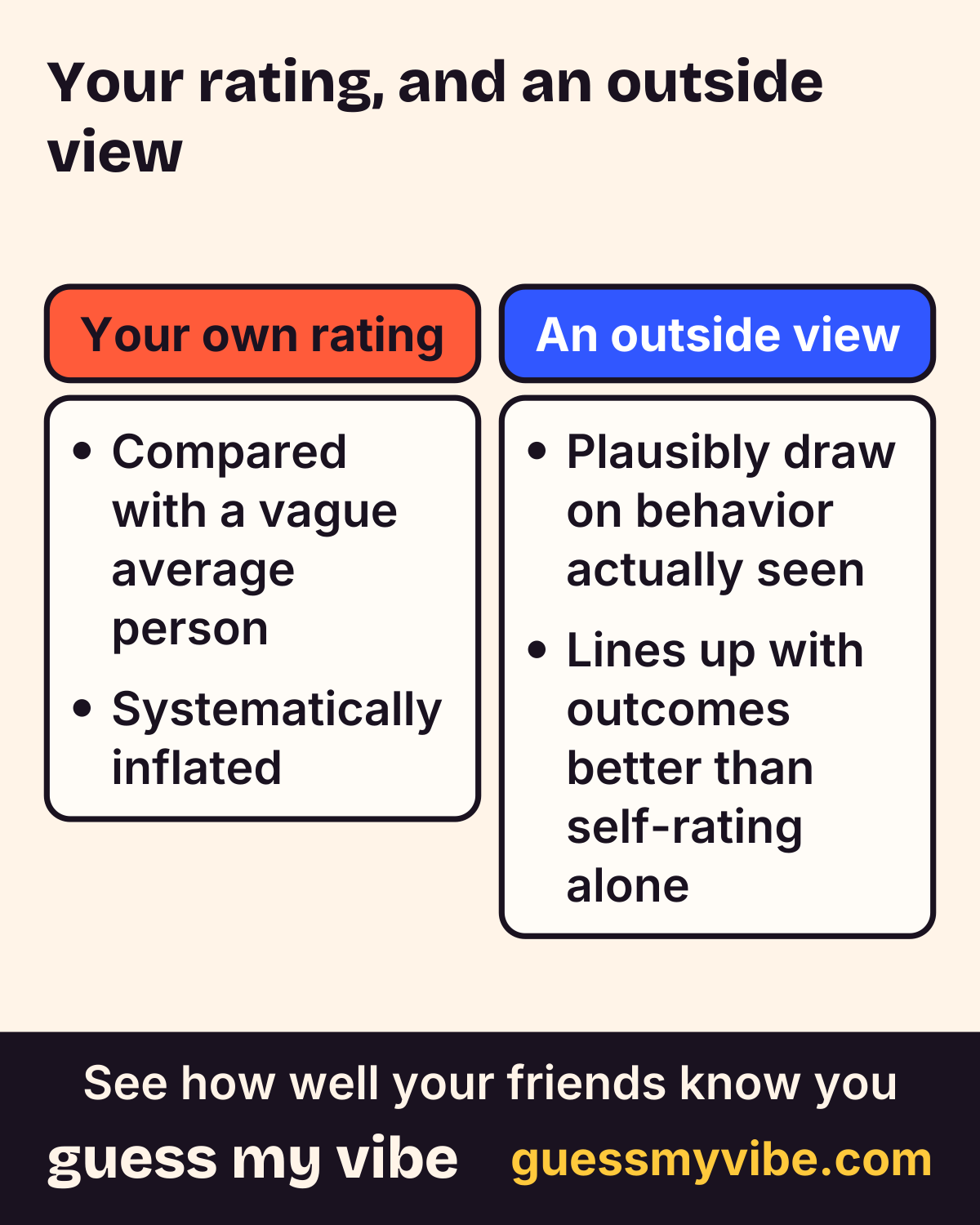
If self-ratings on desirable traits are systematically inflated, the obvious next question is whether anyone's ratings of you are actually more accurate. The research on this is reassuring: other people's ratings aren't just a second, equally biased opinion sitting alongside your own. A large meta-analysis of observer accuracy found that how other people rate you lines up with real-world outcomes, like job performance, better than your own self-rating alone does [3]. People who know you well aren't running the same comparison you are (you against a vague, generous mental image of "the average person"); they plausibly draw on behavior they've actually seen, a different source of information than the quick self-comparison behind the better-than-average effect. The meta-analysis shows the outcome link, not the mechanism.
Cite this figure
Figure: "Your rating, and an outside view." Guess My Vibe (guessmyvibe.com). https://guessmyvibe.com/learn/better-than-average-effect#figure-self-view-vs-outside-view
You're better at spotting this gap than you might think, once you look
One encouraging piece of this picture is that self-enhancement isn't the same thing as being clueless about how you're actually seen. Research on "meta-insight", whether people can accurately tell the difference between their own self-view and how others genuinely see them, found that people generally can make that distinction, across both first-impression settings and real friendships [4]. That's a meaningfully different claim from "people know exactly how others see them." It means the gap between your own generous self-rating and someone else's more grounded view of you isn't invisible to you by default; it's something you have at least some genuine capacity to recognize, if you actually go looking for it instead of assuming your own comparative judgment is automatically correct. That capacity is exactly what makes asking a friend for a specific, concrete read worthwhile instead of pointless: you're not just trading one biased guess for an equally biased one, and you're equipped to actually notice when the two views diverge.
What this means day to day
None of this means your self-view is generally wrong, or that you should distrust every positive thing you believe about yourself. The effect is about comparative judgments ("am I a better friend than average"). The studies above don't say how it plays out for grounded, specific ones ("did I show up for my friend last week"). The practical takeaway is less about doubting yourself and more about knowing which kinds of self-assessment to lean on less. A comparative, fuzzy self-rating is exactly the kind of judgment where asking someone who actually knows you adds real information, not just a second guess.
Getting an honest take instead of guessing alone
Guess My Vibe's honest take card is built around exactly this gap: instead of comparing yourself to a vague "average person" in your head, a friend rates you on specific, concrete questions, the kind of outside view the observer-accuracy research above found useful. It won't settle whether you're "better than average" in general, since that's not really an answerable question. It will show you where a friend's actual read on a specific behavior lines up with your own, and where it doesn't, which is a more useful comparison than the one the better-than-average effect runs on autopilot.
Key takeaways
- Across 124 studies and more than 950,000 people, on average, people rated their own traits as better than the average peer's, a large and robust effect (dz = 0.78) [1].
- The effect is bigger for personality traits than for concrete abilities, and bigger for positive qualities than negative ones, so the inflation isn't uniform across every kind of self-rating [1].
- A review of self-other research found that others' advantage over self-views is largest for the most evaluative traits, the most desirable and undesirable ones, where self-enhancement pulls hardest [2].
- Other people's ratings of you aren't just noise against your own: across many traits, how others see you lines up with real outcomes (like job performance) better than your own self-rating alone does [3].
- This isn't therapy, a diagnosis, or a substitute for professional care; it's a plain-English summary of what personality and social psychology research says about self-enhancement.
Questions people ask
What is the better-than-average effect?
It's the tendency for most people to rate their own abilities, personality, and other desirable traits as better than the average person's, something that can't be mathematically true for a whole group at once [1].
How strong is the better-than-average effect, really?
Very consistent. A meta-analysis of 124 studies and over 950,000 people found a large effect size (dz = 0.78), and it showed up more for personality traits than measurable abilities, and more for positive traits than negative ones [1].
Is the better-than-average effect the same as having high self-esteem?
Related but not the same thing. The effect was only moderately correlated with self-esteem (r = .34) in the same meta-analysis, meaning a lot of who shows this bias strongly has little to do with general confidence [1].
Why do people inflate personality traits more than abilities?
The meta-analysis found the effect larger for personality traits than abilities [1]. It didn't test why. A plausible guess is that traits are harder to check against a scoreboard, but that is an interpretation, and a separate review notes self-enhancement pulls hardest on the most evaluative traits [2].
Can other people's opinions of me actually be more accurate than my own?
On comparative, fuzzy judgments like this one, yes, in a real sense. Research on observer accuracy finds other people's ratings line up with real outcomes better than self-ratings alone do, though the studies show the outcome link, not why [3].
See how well your friends know you.
Free. Answer 10 quick questions about you, then send your link. Friends play in their browser, no app needed.
Start freeReferences
- [1] Zell, E., Strickhouser, J. E., Sedikides, C., & Alicke, M. D. (2020). The better-than-average effect in comparative self-evaluation: A comprehensive review and meta-analysis. Psychological Bulletin, 146(2), 118–149. PubMed: 31789535 (opens in a new tab)
- [2] Vazire, S., & Carlson, E. N. (2011). Others sometimes know us better than we know ourselves. Current Directions in Psychological Science, 20(2), 104–108. doi.org/10.1177/0963721411402478 (opens in a new tab)
- [3] Connelly, B. S., & Ones, D. S. (2010). An other perspective on personality: Meta-analytic integration of observers' accuracy and predictive validity. Psychological Bulletin, 136(6), 1092–1122. PubMed: 21038940 (opens in a new tab)
- [4] Carlson, E. N., Vazire, S., & Furr, R. M. (2011). Meta-insight: Do people really know how others see them?. Journal of Personality and Social Psychology, 101(4), 831-846. PubMed: 21688920 (opens in a new tab)
How we find and check these sources: how we write. Spotted an error? Report a correction.
Related
Want to try it with your own friends? Take the best friend test and see how your friends see you
Cite this article
- Title
- The Better-Than-Average Effect: Why Friends Check You
- Publisher
- Guess My Vibe
- Updated
- URL
- https://guessmyvibe.com/
learn/ better-than-average-effect
Copy this citation
Guess My Vibe. (2026, October 3). The Better-Than-Average Effect: Why Friends Check You. Guess My Vibe. https://guessmyvibe.com/
To point at one section, add that section's anchor (the # link on its heading) to the URL.