The halo effect is a well-documented bias where one positive (or negative) impression of a person bleeds into how you rate everything else about them, even traits you haven't actually seen evidence for. It was first named in 1920, when Thorndike found that army officers' ratings of separate traits like intelligence, leadership and character were far more correlated than the real traits could be, as if one overall impression colored every score [1]. A modern version involves attractiveness: researchers describe an "attractiveness halo" that overshadows valid cues when people judge competence from faces [2].
What the halo effect actually is
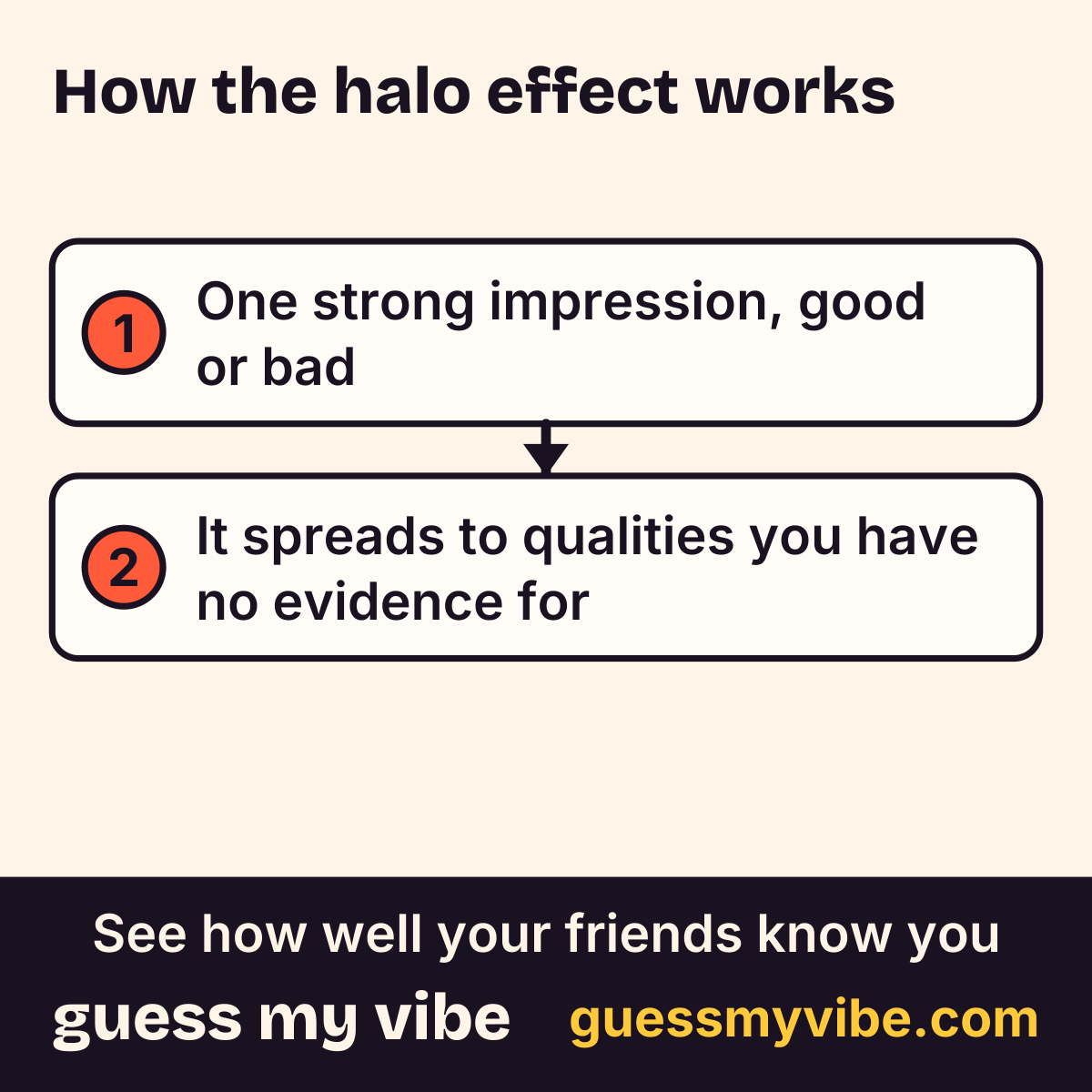
The halo effect is a bias where one strong impression of a person, good or bad, spreads into how you judge everything else about them, including qualities you haven't actually seen any evidence for. Meet someone warm and funny and you'll likely also guess they're smart, competent, and trustworthy, not because you've seen proof of any of that, but because the good feeling from one trait bleeds sideways into all the others. The reverse works too: one bad first impression, an awkward handshake, a rude comment, and a person starts getting rated lower on traits that have nothing to do with what you actually witnessed.
Cite this figure
Figure: "How the halo effect works." Guess My Vibe (guessmyvibe.com). https://guessmyvibe.com/learn/halo-effect#figure-how-the-halo-spreads
Where the name comes from: a 1920 study of military ratings
The term comes from psychologist Edward Thorndike, who in 1920 studied how army officers rated the men under them on separate traits, such as intelligence, physique, leadership and character [1]. Those traits should have produced ratings that moved somewhat independently. A man can be physically strong without being especially bright, or a sharp leader without an imposing build. Instead, the ratings were too highly and too evenly correlated. In one example, a conscientious flight commander's ratings of 137 aviation cadets on intelligence correlated .51, .58 and .64 with his ratings on physique, leadership and character, higher than the real traits could justify. In another, eight raters' scores for two specific abilities averaged a correlation of .67 where Thorndike judged the real figure could hardly top .25. Thorndike called this a "constant error" and described it as a halo of general merit extended to the specific ratings.
The modern version: the attractiveness halo
A century later, one well-studied version of the same bias runs through physical appearance. A 2016 study showed people faces of 100 real university students and asked them to judge academic performance from the face alone [2]. The authors describe an attractiveness halo, in which desirable traits get assigned to attractive people and overshadow cues that carry real information. The researchers also tested whether perceived conscientiousness (how disciplined and organized someone looks) tracked with real academic performance better than perceived intelligence did, and it did. Judgment accuracy also improved once the influence of attractiveness was controlled for, which is the authors' evidence that the attractiveness halo was getting in the way of valid cues. This is the same basic mechanism Thorndike found in 1920, just running through looks instead of a commanding officer's overall opinion.
Curious how your friends would answer?
Free. Answer 10 quick questions about you, then send your link. Friends play in their browser, no app needed.
Start freeWhy it happens: filling gaps with the wrong evidence
The halo effect gets its power from a simple shortcut: judging someone accurately on any given trait requires real evidence about that specific trait, and a lot of traits don't hand over clear evidence quickly. The Realistic Accuracy Model, a framework for studying how accurately people judge each other, lays out what has to happen for any judgment to land close to the truth: a relevant cue has to actually exist, the observer has to notice it, and the observer has to read it correctly [3]. When that chain breaks down, usually because the trait in question is hard to observe directly, like how trustworthy or competent someone really is, people don't just shrug and say "I don't know." They borrow from whatever impression is already sitting there: how much they like the person, how attractive the person looks, how the person's one visible trait made them feel. The halo effect is that borrowing, applied automatically and mostly outside awareness.
Where the halo effect shows up day to day
Beyond the lab, the halo effect explains a lot of ordinary, slightly unfair snap judgments. A charismatic coworker gets assumed competent before anyone checks their actual work. A classmate who dresses well gets assumed organized. A friend's new partner who's warm and easy to talk to at dinner gets assumed trustworthy with money, or reliable in a crisis, long before anyone has real evidence either way. None of this means the halo effect is always wrong; sometimes the traits genuinely do travel together in a given person. The problem is that the halo effect applies the same generous (or harsh) logic whether or not that's actually true for the specific person in front of you, which is exactly why it's worth noticing when a rating is coming from real evidence versus a borrowed good feeling.
The fix researchers point to: specific behaviors, not one overall vibe
A practical counter isn't "try harder to be objective," which doesn't hold up against a bias that operates automatically. It's asking about specific, concrete behaviors instead of one global impression. Instead of "is this person trustworthy," the better question is "has this person followed through on what they said they'd do, specifically, the last few times it mattered." That shift matters because a large meta-analysis found that closeness to the rater mattered most for traits that are hard to see from the outside, which fits the idea that watching someone in specific situations beats a general impression [4]. A friend who has watched you handle a dozen real deadlines has evidence a first impression never gets access to. That's the whole logic behind asking about a specific behavior instead of trusting a general vibe: it closes the gap the halo effect sneaks through.
What this means for how well your friends actually know you
The halo effect is one of the best arguments for why "does my friend know me" is the wrong question to ask in general, and "does my friend know this specific thing about me" is the right one. A friend who likes you a lot can still be running a halo-driven guess on a trait they've never actually watched you demonstrate, the same way Thorndike's raters let a general impression color ratings of specific traits. Guess My Vibe is built around specific behaviors rather than one overall impression for exactly this reason: a friend guesses how you'd actually act in a particular moment, not whether they generally think highly of you, which is the version of the question the halo effect can't quietly answer for them.
Key takeaways
- The halo effect is named for a 1920 paper showing that military officers' ratings of separate traits (intelligence, physique, leadership, character) correlated more than real independent traits should, as if one overall impression leaked into every specific score [1].
- A modern version centers on attractiveness: a study of 100 student faces describes an "attractiveness halo" that overshadows valid cues, and judgments of academic performance became more accurate once attractiveness was controlled for [2].
- Accurate judgment of any trait needs a relevant cue that is available, noticed and used correctly, and a general impression is an easy substitute when that chain breaks [3]. That is a reasonable reading of why halos happen, not something these studies tested directly.
- Judging specific behaviors instead of one overall vibe is a sensible counter, in line with the finding that people who know someone closely read hard-to-see traits more accurately than a stranger forming one fast impression [4].
- This isn't therapy, a diagnosis, or a substitute for professional care; it's a plain-English summary of what personality and social psychology research says about the halo effect.
Questions people ask
What is the halo effect in psychology?
It's the tendency for one overall impression of a person, usually based on liking them or finding them attractive, to spill over into how you rate completely separate traits you haven't actually seen evidence for [1].
Where does the term halo effect come from?
Psychologist Edward Thorndike coined it in 1920 after finding that ratings of separate traits like intelligence, physique, leadership and character were too highly and too evenly correlated to be independent judgments [1].
Does attractiveness really affect how competent people think you are?
Evidence points that way. A 2016 study of 100 student faces describes an attractiveness halo that overshadows valid cues, and judgments of academic performance got more accurate once attractiveness was controlled for [2].
Why does the halo effect happen?
Accurate judgment needs a relevant cue that is available, noticed and read correctly. One plausible reason for halos is that people fall back on an overall impression when that chain breaks [3].
How can you avoid the halo effect when judging someone?
Ask about specific, concrete behaviors instead of a general impression. Closeness to the rater mattered most for hard-to-see traits in a large meta-analysis, which fits the idea that watching specific situations helps [4].
See how well your friends know you.
Free. Answer 10 quick questions about you, then send your link. Friends play in their browser, no app needed.
Start freeReferences
- [1] Thorndike, E. L. (1920). A constant error in psychological ratings. Journal of Applied Psychology, 4(1), 25–29. doi.org/10.1037/h0071663 (opens in a new tab)
- [2] Talamas, S. N., Mavor, K. I., & Perrett, D. I. (2016). Blinded by beauty: Attractiveness bias and accurate perceptions of academic performance. PLoS ONE, 11(2), e0148284. PubMed: 26885976 (opens in a new tab)
- [3] Funder, D. C. (1995). On the accuracy of personality judgment: A realistic approach. Psychological Review, 102(4), 652–670. doi.org/10.1037/0033-295X.102.4.652 (opens in a new tab)
- [4] Connelly, B. S., & Ones, D. S. (2010). An other perspective on personality: Meta-analytic integration of observers' accuracy and predictive validity. Psychological Bulletin, 136(6), 1092–1122. PubMed: 21038940 (opens in a new tab)
How we find and check these sources: how we write. Spotted an error? Report a correction.
Related
- First Impressions: How Fast and How Accurate They Are
- Thin Slicing: What a Few Seconds Reveal About You
- The Better-Than-Average Effect: Why Friends Check You
- Are You a Good Judge of Character? What Research Finds
- Judging Personality: Why People Get It Right (or Wrong)
- Attractiveness Halo Effect: Is What's Beautiful Good?
Cite this article
- Title
- The Halo Effect: Why One Good Trait Colors Everything
- Publisher
- Guess My Vibe
- Updated
- URL
- https://guessmyvibe.com/
learn/ halo-effect
Copy this citation
Guess My Vibe. (2026, October 3). The Halo Effect: Why One Good Trait Colors Everything. Guess My Vibe. https://guessmyvibe.com/
To point at one section, add that section's anchor (the # link on its heading) to the URL.