Judging personality accurately depends on a specific chain, not instinct: a real behavioral cue has to exist, be available for someone to see, actually get noticed, and then get read correctly [1]. Break any link and the judgment fails, which is why the same person can be read well by one friend and badly by another, and well on one trait but badly on a different one.
Want to take it for real? See how well a friend actually judges your personality
Judging personality isn't instinct. It's a chain of four things going right
People talk about "reading someone" like it's a gift some people have and others don't. Research on judging personality tells a more specific, more useful story. The clearest version of it is the Realistic Accuracy Model, which lays out exactly what has to happen for an outside judgment of someone's personality to land: a relevant cue has to actually exist (the person has to really behave in a way connected to the trait), that cue has to be available (someone has to be in a position to see it happen), a judge has to detect it (notice it, rather than miss it in the noise), and then the judge has to use it correctly (not misread a nervous laugh as rudeness) [1]. Four separate steps, each one a place the whole judgment can quietly fail. "She's just not very perceptive" is almost never the real explanation; usually one specific link in that chain broke.
This reframes most of what people assume about judging personality. It isn't a single skill you either have or don't. It's closer to four separate conditions that all have to be met at once, for one specific trait, in one specific relationship, at one specific moment. The same friend who reads your sense of humor instantly might completely miss how anxious you get before a big event, not because they're a worse judge of you overall, but because that particular cue is rarely available to them in the first place.
Cite this figure
Figure: "The four hurdles." Guess My Vibe (guessmyvibe.com). https://guessmyvibe.com/learn/judging-personality#figure-four-hurdles
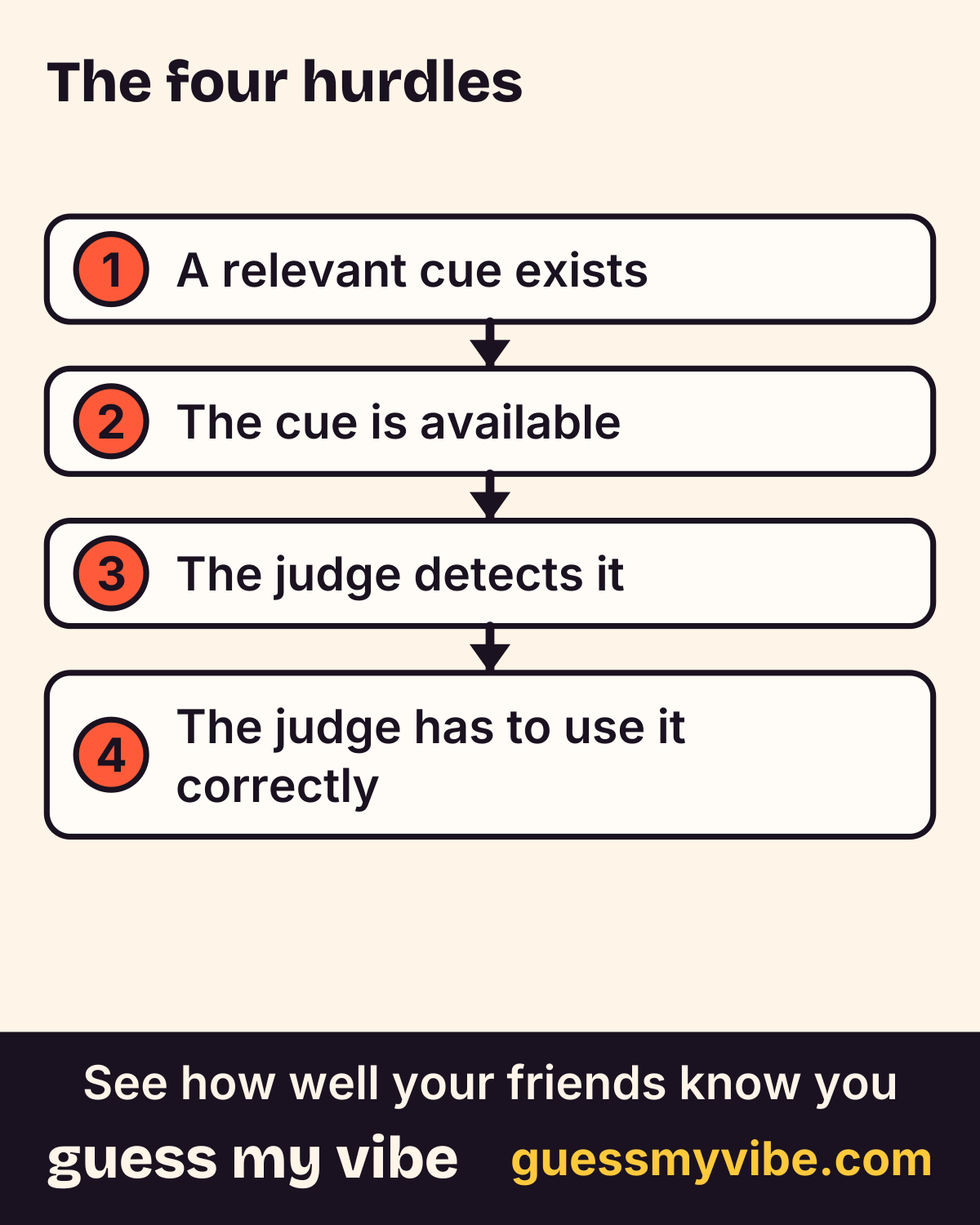
The four hurdles, one at a time
"Relevant" means the behavior actually has something to do with the trait being judged. Showing up late to one brunch doesn't reliably say much about someone's organization, because lots of things cause lateness that have nothing to do with personality. "Available" is about exposure: a trait like how someone handles conflict can't be judged by someone who's never seen that person in a conflict, no matter how close they are otherwise. "Detection" is about attention: the cue might be right there, but busy, distracted or socially anxious observers miss plenty of real signal. "Utilization" is about interpretation: even a clearly noticed cue gets misread all the time, like mistaking someone's quietness in a group for coldness when it's really just low energy that day. A comprehensive review of this research organizes exactly these ideas into one framework, sorting what changes accuracy into judge-side factors, target-side factors, trait-side factors, and how much information is actually on the table [5].
Strangers aren't clueless. Friends aren't perfect
A classic study put close acquaintances and total strangers side by side: close friends rated about 150 people, and separately, strangers rated the same people after watching just one brief videotaped interaction [2]. Close friends agreed with each other and with the person's own self-ratings far more than strangers did, which is the unsurprising part. The more interesting finding was that strangers still agreed with each other on judgments of the exact same person, more than random chance would allow, from a single videotaped interaction. And the traits that were easiest for friends to judge accurately were the same traits that were easiest for strangers to judge too, which fits the four-hurdle idea directly: some traits simply have cues that are relevant, available, and easy to detect almost immediately, while others stay genuinely hidden even after years of friendship.
A related study pushed this one step further and found something worth sitting with: a single close acquaintance's judgment of someone slightly outperformed that person's own self-judgment at matching their actual, recorded behavior, and two acquaintances' combined judgment beat the person's self-judgment by a clear margin [3]. That isn't a knock on self-knowledge. It's the same four-hurdle logic from a different angle: two observers each catch cues the other misses, and averaging across them cancels out some of the noise that any single observer, including you judging yourself, is stuck with.
Curious how your friends would answer?
Free. Answer 10 quick questions about you, then send your link. Friends play in their browser, no app needed.
Start freeSome traits are just easier to judge than others
A meta-analysis spanning 263 samples and more than 44,000 people measured how well other people's ratings of someone's personality line up with that person's own self-rating, trait by trait [4]. Agreement wasn't equal across traits. Closeness to the person mattered most for traits low in visibility, like emotional stability, and only minimally for highly evaluative traits like agreeableness. One plausible reading in four-hurdle terms is that agreeableness's most relevant cues (how someone actually treats people when something goes wrong, when they're annoyed, when there's nothing in it for them) are rarely on display in everyday, low-stakes interactions, and plenty of people manage a pleasant public face regardless of what's underneath it. Closeness helping most on the low-visibility traits is the pattern the whole model lays out: the less automatically a cue leaks out, the more it depends on someone actually having access to it.
Some people are easier to read than others
The four-hurdle model also has a side most people don't think about: the person being judged has some control over how available their own cues are. An experiment randomly assigned people to put their best self forward when meeting someone new, versus giving a flatter, low-effort impression [6]. The people instructed to self-present weren't just liked more, which might sound like simple charm winning out. Their new acquaintance also formed a more accurate read of their actual personality and intelligence, not a rosier but less accurate one. Being more expressive and engaging didn't paper over who they really were; it made more real cues available for a stranger to detect and use. The same four-hurdle logic applies to the target, not just the judge: someone who gives almost nothing away isn't protecting their privacy from a bad read so much as making every hurdle in the chain harder to clear, for better judgments and worse ones alike.
What actually improves your odds of judging someone right
None of this points to a trick for suddenly becoming a better judge of character in general. It points somewhere more specific and more useful: more opportunities to observe the relevant behavior, not just more time spent together in general, is what closes the availability gap. Someone you've known for years but only ever seen at parties may still be a weak judge of how that person handles real stress, because the relevant cue has simply never been available. The acquaintance research above also points at a second lever worth taking seriously: more than one observer. Two honest judges catch more real cues between them than one does, which is the exact same logic behind asking more than one friend what they actually think, rather than treating any single person's read of you as the final word.
Guess My Vibe is built around testing that chain directly rather than just asserting it. A friend guesses your answers to real personality questions, and you find out, trait by trait, where their read of you actually lands, which is a much more specific and honest test than "my friends know me well" as a vague feeling.
Key takeaways
- Judging personality accurately isn't about one person simply being "perceptive." It depends on a four-step chain: a relevant cue has to exist, be available, get detected, and get used correctly [1].
- Close friends judge personality more accurately than strangers do, but strangers still do better than chance, because some cues leak out even from a single short interaction [2].
- Two acquaintances judging the same person together can actually outperform that person's own self-judgment at matching their recorded behavior, once their judgments are combined [3].
- Accuracy isn't flat across traits. A meta-analysis of over 44,000 people found that closeness to someone improved accuracy most for traits low in visibility (like emotional stability) and only minimally for highly evaluative traits like agreeableness [4].
- This isn't therapy, a diagnosis, or a substitute for professional care; it's a plain-English summary of what personality research says about judging people.
Questions people ask
Why are some people better at judging personality than others?
It's rarely one global skill. The Realistic Accuracy Model breaks a correct judgment into four separate requirements: a relevant cue has to exist, be available to the judge, get detected, and get interpreted correctly. A specific judgment usually fails because one of those four links broke, not because the judge is generally unperceptive [1].
Can strangers accurately judge someone's personality?
To a real but limited degree. One study found strangers who'd only watched a brief videotaped interaction still agreed with each other on a person's traits more than chance alone would explain, though far less accurately than that person's close friends did [2].
Which personality traits are hardest to judge accurately?
Agreeableness is a hard one. In a meta-analysis of over 44,000 people, closeness improved accuracy only minimally for highly evaluative traits like agreeableness. One plausible reason through the accuracy model is that agreeableness's clearest cues, like how someone treats people when nothing's in it for them, are far less visible in everyday interactions than extraversion's are [4].
Do two people judge someone's personality better than one?
Often, yes. One study found two acquaintances' combined judgment of a person outperformed that person's own self-judgment at matching recorded behavior, while a single acquaintance's judgment only slightly beat self-judgment — combining observers' judgments gave a more valid picture than any one view alone [3].
What makes a judgment of someone's personality more accurate?
More access to the specific, relevant behavior, not just more time spent together in general. A friend who has never seen you handle real conflict can't accurately judge how you handle it no matter how long you've known each other; the cue simply hasn't been available to them [5].
Is it easier to accurately judge someone who's more outgoing or expressive?
Yes. One experiment found people who put their best, more engaging self forward when meeting someone new weren't just better liked; their new acquaintance also judged their actual personality and intelligence more accurately, with the effect linked to those people coming across as more engaging [6].
See how well your friends know you.
Free. Answer 10 quick questions about you, then send your link. Friends play in their browser, no app needed.
Start freeReferences
- [1] Funder, D. C. (1995). On the accuracy of personality judgment: A realistic approach. Psychological Review, 102(4), 652–670. doi.org/10.1037/0033-295X.102.4.652 (opens in a new tab)
- [2] Funder, D. C., & Colvin, C. R. (1988). Friends and strangers: Acquaintanceship, agreement, and the accuracy of personality judgment. Journal of Personality and Social Psychology, 55(1), 149–158. PubMed: 3418488 (opens in a new tab)
- [3] Kolar, D. W., Funder, D. C., & Colvin, C. R. (1996). Comparing the accuracy of personality judgements by the self and knowledgeable others. Journal of Personality, 64(2), 311–337. PubMed: 8656321 (opens in a new tab)
- [4] Connelly, B. S., & Ones, D. S. (2010). An other perspective on personality: Meta-analytic integration of observers' accuracy and predictive validity. Psychological Bulletin, 136(6), 1092–1122. PubMed: 21038940 (opens in a new tab)
- [5] Back, M. D., & Nestler, S. (2016). Accuracy of judging personality. In J. A. Hall, M. Schmid Mast, & T. V. West (Eds.), The Social Psychology of Perceiving Others Accurately (pp. 98–124). Cambridge University Press. doi.org/10.1017/cbo9781316181959.005 (opens in a new tab)
- [6] Human, L. J., Biesanz, J. C., Parisotto, K. L., & Dunn, E. W. (2012). Your Best Self Helps Reveal Your True Self. Social Psychological and Personality Science, 3(1), 23–30. doi.org/10.1177/1948550611407689 (opens in a new tab)
How we find and check these sources: how we write. Spotted an error? Report a correction.
Related
Cite this article
- Title
- Judging Personality: Why People Get It Right (or Wrong)
- Publisher
- Guess My Vibe
- Updated
- URL
- https://guessmyvibe.com/
learn/ judging-personality
Copy this citation
Guess My Vibe. (2026, October 3). Judging Personality: Why People Get It Right (or Wrong). Guess My Vibe. https://guessmyvibe.com/
To point at one section, add that section's anchor (the # link on its heading) to the URL.