How to read people, backed by research: look at what they actually leave behind, their bedroom, their office, their music, not at crossed arms or shifty eyes. Studies find strangers who only see someone's room or learn their music preferences form impressions that show real accuracy [1] [2], while many of the classic body-language "tells" for lying show no reliable link to deceit under testing [3].
How to read people: what the research actually tested
Most popular advice on how to read people is about watching the person: their face, their posture, their hands. Personality research has tested a different, less glamorous idea: that the most reliable cues aren't in the person at all, they're in the evidence that person leaves scattered around them. A bedroom, an office, a playlist, a social media feed. These are durable traces of hundreds of small decisions made over months or years, not a single fidget that might mean anything or nothing. That distinction (a pile of real evidence vs. a few seconds of body language) turns out to matter enormously for whether reading someone actually works.
A bedroom or office really does say something about you
In one striking study, strangers judged a person's bedroom or office, never the person themselves, and were asked to guess their personality [1]. Their impressions agreed with each other (different strangers converged on similar guesses) and showed some accuracy against the occupant's own self-ratings and ratings from their actual friends, with results varying a little across rooms and traits. The researchers call this "behavioral residue": a messy desk, alphabetized bookshelf, or wall of concert posters isn't random clutter, it's the physical record of hundreds of small, personality-driven choices the occupant made and then left behind. In fact, the consensus and accuracy correlations were generally stronger than those found in earlier zero-acquaintance research (strangers judging someone after only a brief look), which is a counterintuitive finding: a room can carry more usable information than a quick first impression.
What someone listens to carries real information
Music works the same way, and the research on it answers an obvious question first: why do people talk about music so much when they're first getting to know each other? A two-part study found music was the single most common topic among strangers given the task of getting acquainted, and then showed why that might be a reasonable instinct [2]. Observers who only knew someone's music preferences, nothing else, formed impressions of their personality that other observers agreed with and that held up as genuinely accurate. Crucially, the specific details people picked up on (not just vague stereotypes about genre) tended to be the ones that actually did connect to the person's real personality, and music preferences revealed different information than a room or a first conversation did. Someone's workout playlist, road-trip rotation, or long-running favorite artist can tell you things small talk doesn't.
Appearance carries some cues too, within limits
Clothing and physical presentation sit somewhere between a room and a passing gesture: more durable than a single expression, more chosen and curated than a bedroom nobody else was meant to see. A study using full-body photographs found strangers could accurately judge extraversion, self-esteem and religiosity even when the photos were taken with the same neutral pose and expression, meaning the accuracy came from choices like clothing and styling rather than from posture or facial expression in the moment [4]. Once people were allowed to pose and express themselves naturally, accuracy held up across nearly every trait studied, not just those three. Appearance is a real, usable cue, and both the durable parts (like clothing style) and the expressive parts (expression, posture) carried personality information; the durable choices are closer to a room than to a passing gesture.
Curious how your friends would answer?
Free. Answer 10 quick questions about you, then send your link. Friends play in their browser, no app needed.
Start freeWhere this falls apart: body language "tells"
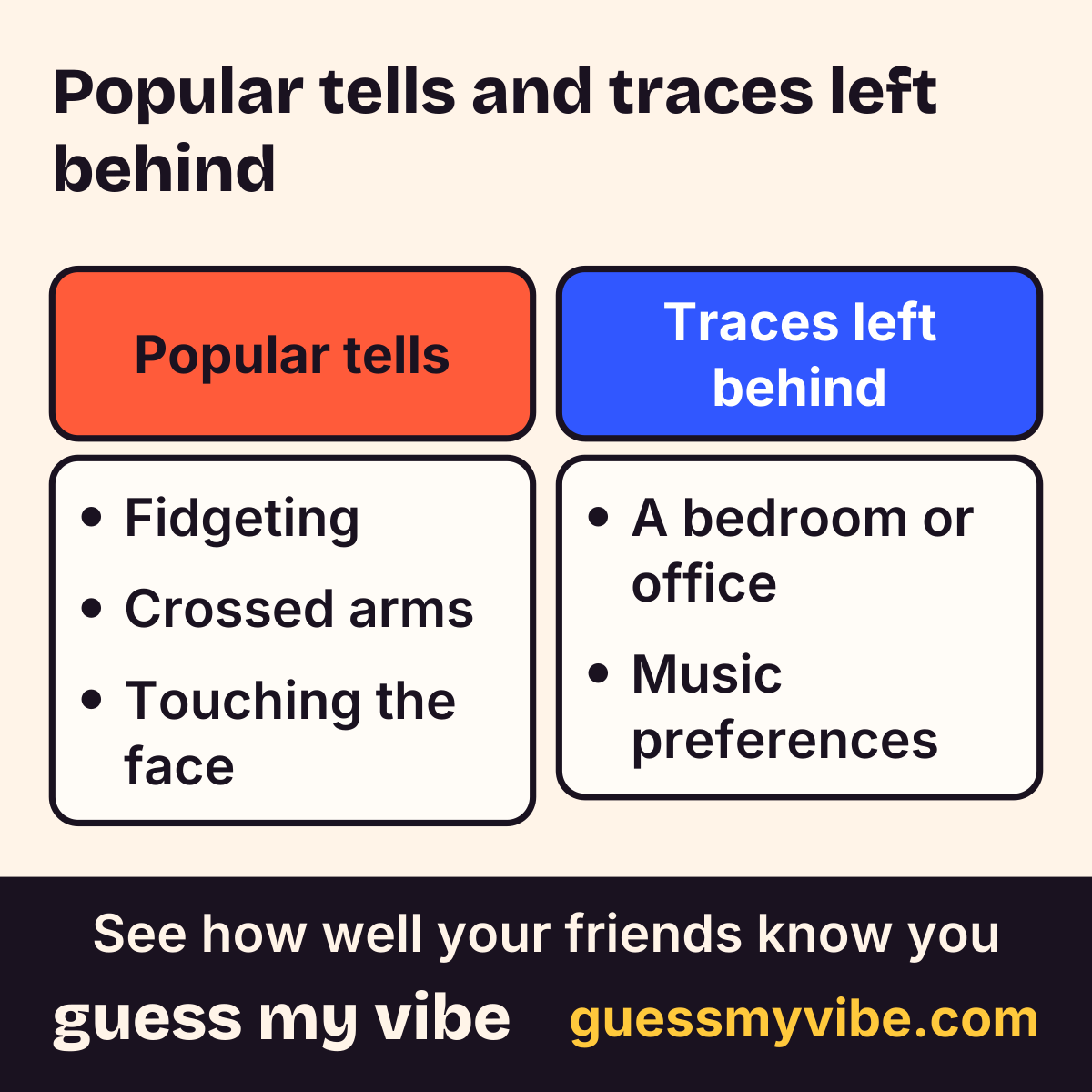
The specific popular claim worth retiring is that you can reliably read someone, especially whether they're lying, from a handful of physical tells: avoiding eye contact, fidgeting, crossed arms, touching the face. A massive meta-analysis pooled 1,338 separate estimates covering 158 different candidate cues to deception, drawn from decades of studies [3]. The honest result: liars did, on average, come across as slightly less forthcoming, less compelling, and a bit more tense than truth-tellers. But many of the individual behaviors people believe are reliable tells showed no discernible link to actual lying, or only a weak one. The cues that did show up got stronger specifically when someone was motivated to succeed (especially when the stakes were about identity rather than money) or when the lie was about a transgression. In plain terms: there's no universal "tell." The confident advice about crossed arms and shifty eyes is a much shakier foundation than a bedroom full of behavioral residue.
Why rooms and playlists work when body language doesn't
The pattern across all three findings traces back to the same basic requirement real accuracy needs: a cue has to be genuinely connected to the trait, not just assumed to be. A room accumulates that connection over months of real decisions nobody was performing for an audience. A playlist accumulates it over years of actual listening choices. A crossed arm in a single tense moment could mean a hundred different things, most of them having nothing to do with personality or honesty at all, which is exactly why it fails to hold up once it's tested against hundreds of real cases instead of one convincing anecdote. Popular body-language advice usually gets its confidence backward: it treats a cue as proven because it feels intuitive in the moment, rather than asking whether it survives being checked against what people actually did across hundreds of real, recorded cases.
Cite this figure
Figure: "Popular tells and traces left behind." Guess My Vibe (guessmyvibe.com). https://guessmyvibe.com/learn/how-to-read-people#figure-where-cues-live
What doesn't leave a readable trace
None of this makes a person an open book. A room, a playlist, and a wardrobe are all external: they're built from choices other people can eventually see. Some of the most important parts of a personality never produce that kind of evidence in the first place. A study comparing self-ratings, friends' ratings and strangers' ratings against real behavior found the self kept a clear edge specifically on traits like how easily someone's mood is thrown off by stress, exactly the traits with the least outward evidence to collect [5]. No amount of studying someone's bedroom or Spotify history is going to reveal what's going on inside their head during a quiet moment of anxiety that they never let show. Reading people well means knowing which parts of someone are actually visible to read, not assuming everything about a person eventually leaks out somewhere.
What this means in practice
If you actually want to read someone accurately, the research points toward paying attention to patterns of real behavior and real choices over time, not to a single gesture in a single conversation: what someone's space looks like when no one's watching, what they keep returning to, what they've built up over years rather than performed for a moment. It also means being honest about the traits that genuinely don't leave much residue anywhere, like how anxious someone gets privately, which no room or playlist is going to reveal no matter how carefully you study it. Guess My Vibe is built on that same idea in miniature: a friend answers real personality questions about you based on what they've actually noticed over time, and you find out exactly where their read lines up with yours and where it doesn't, rather than trusting a first impression alone.
Key takeaways
- A bedroom or office is a real, readable cue. Strangers who judged someone only from their room, never meeting the person, formed impressions that showed some accuracy against the occupant's own and friends' ratings [1].
- Music preferences carry real personality information too, and the specific cues people pick up on from someone's playlist tend to be the accurate ones, not just stereotypes [2].
- Many popular behavioral "tells" for spotting lies showed no discernible link, or only a weak one, to deceit, according to a meta-analysis of 1,338 estimates of 158 cues [3].
- The common thread across what actually works: durable physical evidence of real behavior (a room, a decade of song choices) beats a few seconds of watching someone's posture.
- This isn't therapy, a diagnosis, or a substitute for professional care; it's a plain-English summary of what personality research says about reading people.
Questions people ask
Can you really tell someone's personality from their room?
Yes, to a real and measured degree. Strangers who judged a person only from their bedroom or office, never meeting them, formed impressions that showed some accuracy against the occupant's own and friends' ratings, picking up on "behavioral residue" left behind by real choices [1].
Does someone's music taste actually reveal their personality?
Research suggests it does. Observers who only knew a person's music preferences formed personality impressions that agreed with each other and held up as accurate, and the specific details they picked up on tended to be the ones that were actually valid rather than vague stereotypes [2].
Is body language a reliable way to read people?
Not for many of the specific "tells" people believe in. A meta-analysis of 1,338 estimates of 158 cues found many behaviors showed no discernible link, or only a weak one, to lying [3].
What's the most reliable way to read someone's personality?
Durable evidence of real behavior over time beats a few seconds of watching someone. Rooms, offices, and music preferences all showed some tested accuracy [1], while many single behaviors people treat as lie-detecting tells show no discernible or only weak links to deceit [3].
Why do strangers talk about music so much when getting acquainted?
Research found music was the single most common topic among strangers getting to know each other, and a follow-up study suggested a reason why: observers could form accurate impressions from music preferences, and those preferences revealed information different from what other zero-acquaintance contexts do [2].
What parts of someone's personality can't be read from the outside?
Low-observability traits, like how easily someone's mood is thrown off by stress, don't reliably leave outside evidence the way visible, social traits do. Research comparing self-ratings, friends' and strangers' ratings against real behavior found the person themselves keeps a real edge on exactly these traits [5].
See how well your friends know you.
Free. Answer 10 quick questions about you, then send your link. Friends play in their browser, no app needed.
Start freeReferences
- [1] Gosling, S. D., Ko, S. J., Mannarelli, T., & Morris, M. E. (2002). A Room With a Cue: Personality Judgments Based on Offices and Bedrooms. Journal of Personality and Social Psychology, 82(3), 379–398. PubMed: 11902623 (opens in a new tab)
- [2] Rentfrow, P. J., & Gosling, S. D. (2006). Message in a ballad: The role of music preferences in interpersonal perception. Psychological Science, 17(3), 236–242. PubMed: 16507064 (opens in a new tab)
- [3] DePaulo, B. M., Lindsay, J. J., Malone, B. E., Muhlenbruck, L., Charlton, K., & Cooper, H. (2003). Cues to deception. Psychological Bulletin, 129(1), 74–118. PubMed: 12555795 (opens in a new tab)
- [4] Naumann, L. P., Vazire, S., Rentfrow, P. J., & Gosling, S. D. (2009). Personality judgments based on physical appearance. Personality and Social Psychology Bulletin, 35(12), 1661–1671. PubMed: 19762717 (opens in a new tab)
- [5] Vazire, S. (2010). Who knows what about a person? The self-other knowledge asymmetry (SOKA) model. Journal of Personality and Social Psychology, 98(2), 281–300. PubMed: 20085401 (opens in a new tab)
How we find and check these sources: how we write. Spotted an error? Report a correction.
Related
- Judging Personality: Why People Get It Right (or Wrong)
- First Impressions: How Fast and How Accurate They Are
- Self-Perception vs. How Others See You
- Social Media Personality: Does It Show the Real You?
- Personality From Photos: How Accurate Are First Guesses?
- Reading Body Language: What It Can and Can't Tell You
Cite this article
- Title
- How to Read People: The Cues That Actually Work
- Publisher
- Guess My Vibe
- Updated
- URL
- https://guessmyvibe.com/
learn/ how-to-read-people
Copy this citation
Guess My Vibe. (2026, October 3). How to Read People: The Cues That Actually Work. Guess My Vibe. https://guessmyvibe.com/
To point at one section, add that section's anchor (the # link on its heading) to the URL.