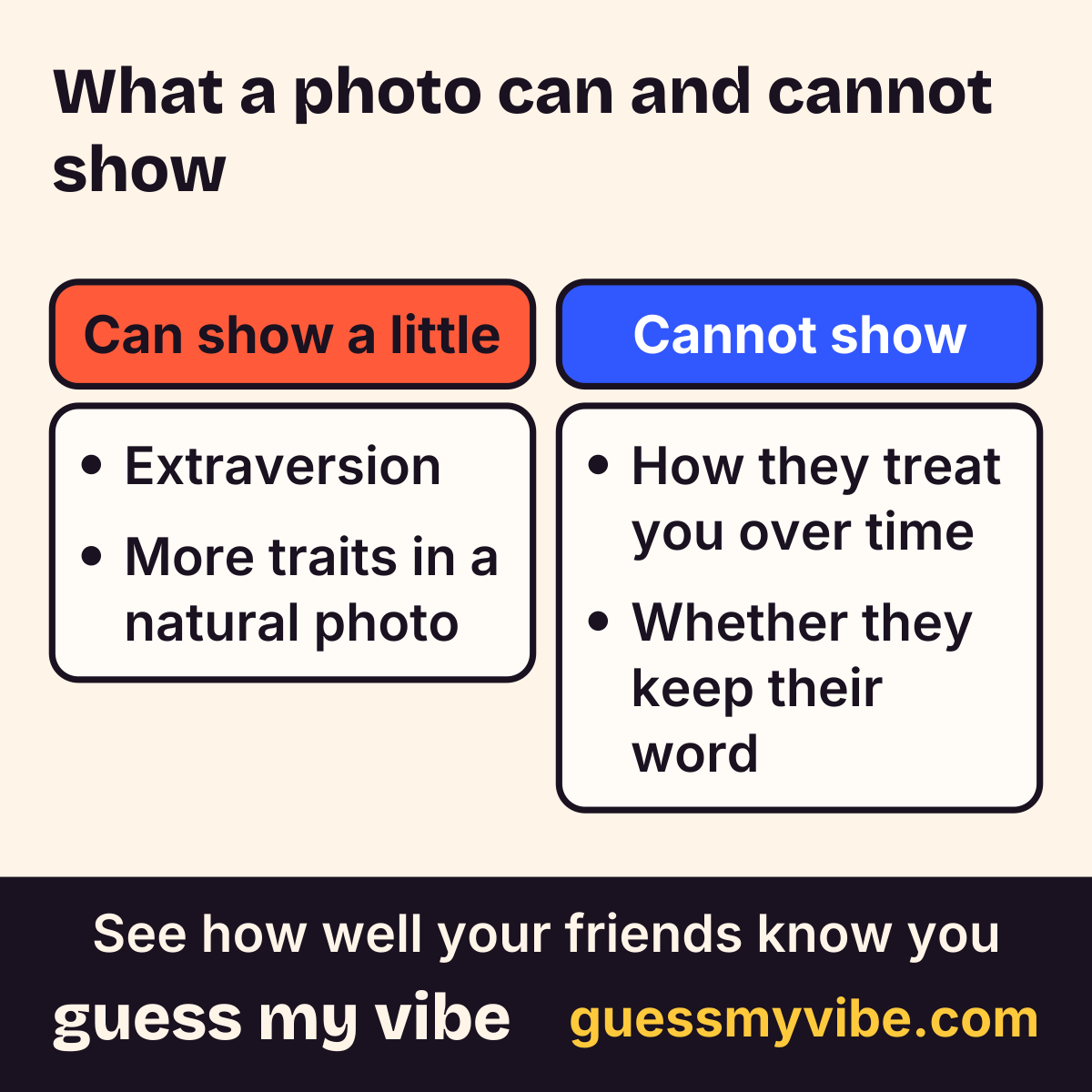
A little, for some traits, and far less than it feels like. Strangers rating full-body photos were accurate for a few traits, including extraversion, and for more traits when the person was photographed in a natural pose and expression [1]. But a major review concludes that the diagnostic validity of what people read from faces has been greatly overstated [2].
Personality from photos: a little signal, a lot of confidence
Can you tell personality from photos? Partly, and less than it feels like. In one study, strangers who looked only at full-body photographs were accurate for some traits, including extraversion, self-esteem and religiosity when poses were constrained [1]. At the same time, a major review of the face research concludes that the diagnostic validity of what people read from faces has been greatly overstated [2]. Both are true. A photo contains some real information, and people routinely read much more into it than it holds.
That mix is why this topic is so easy to oversell. If you have ever looked at a profile picture and felt sure you knew someone's vibe, you were experiencing the second half of that sentence. This article separates what the evidence supports from what it only feels like, and why a photo is a weaker source than it seems.
What full-body photos can show
The most direct study is a 2009 paper that asked how accurate impressions of ten personality traits are when they are based on full-body photographs alone, using the targets' own ratings and their friends' ratings as the benchmark [1]. It ran two versions.
- Standardized photos: the targets' posture and expression were constrained. Observers were accurate for extraversion, self-esteem and religiosity [1].
- Spontaneous photos: the targets took photos with a natural pose and facial expression. Observers were accurate for almost all of the traits examined [1].
This is the closest the research comes to the common claim that candid photos tell you more than posed ones. In this study, the more natural photos gave observers more to work with. The authors also found that two kinds of cues carried real personality information: static ones, like clothing style, and dynamic ones, like facial expression and posture [1].
A caution about the word accurate. In this kind of research it means observers' ratings matched the benchmark better than chance. It doesn't mean they got people mostly right. So the better summary of this study is that appearance carries a modest but real amount of information, and that a natural photo carries more of it than a stiff one.
What the face alone shows
Other studies strip away everything but the face. In one, researchers photographed 146 men and 148 women who also filled out a Big Five questionnaire [3]. Other people rated the faces. The study identified a link for extraversion: how extraverted people looked tracked how extraverted they said they were. For male faces only, there was some accuracy for emotional stability and openness to experience as well [3].
In a second part of the study, the researchers blended the faces of people who scored high or low on each trait into composite images, which independent raters then rated for personality. Controlling for attractiveness, the ratings could discriminate high from low composites for agreeableness and extraversion, and for male faces only, emotional stability [3]. That fits a pattern you can see across the studies: extraversion is the trait that turns up in each analysis, and the rest is patchier and sometimes depends on the sample.
A broader comparison supports the same pattern. In a study where strangers rated traits from one of four sources, a sound film, a silent film, a still photo or an audio recording, the stranger ratings were most valid for extraversion and conscientiousness, and extraversion was the trait that covaried most strongly with physical attributes [5]. The amount of information available changed how valid the ratings were, which is one reason a single photo is a thin source.
Curious how your friends would answer?
Free. Answer 10 quick questions about you, then send your link. Friends play in their browser, no app needed.
Start freeWhy photos feel more accurate than they are
The reason this topic is slippery is speed and agreement. People form an impression of a face almost instantly. In five experiments, judgments of traits like trustworthiness, competence and likeability made after only 100 milliseconds correlated highly with judgments made with no time limit, and extra time did not significantly raise those correlations, while confidence went up [4]. That is roughly a tenth of a second, a blink.
A 2015 review adds the key distinction. People agree with one another about what faces seem to signal, and that consensus appears surprisingly fast [2]. Those impressions are also linked to real-world outcomes, such as investment decisions and leader selection. But the authors argue that the diagnostic validity of these attributions, whether the impressions are actually correct, has been greatly overstated in the literature [2].
In plain words, agreement is not accuracy. If ten people look at a photo and all think the person seems warm, they have found a consistent impression. That doesn't show the person is warm. A shared impression can be a shared guess. It is also why a confident first read can feel like insight. The guess comes instantly, matches what other people think, and gets more confident the longer you look, without necessarily getting any more correct.
What a photo cannot show
Even in the studies where accuracy was above chance, a photo only captured part of the picture. Across the studies above, extraversion turns up most often and other traits are partial or depend on conditions [1] [3]. And the benchmark itself was self-report plus friends' reports, which means the studies measure how well strangers match what you and your friends say, not some hidden truth.
A photo can't show how someone treats you over time, whether they keep their word, how they handle a disagreement, or how they act when they are tired. Those are exactly the things friends learn by being around someone. Photos also invite a second problem we cover in our article on the halo effect, where one standout feature colors judgments of unrelated traits.
So the realistic way to use this research is as a calibration. If you glance at a profile picture and feel a strong read, treat it as a hypothesis with a modest chance of being partly right, perhaps about extraversion, and not a conclusion.
Cite this figure
Figure: "What a photo can and cannot show." Guess My Vibe (guessmyvibe.com). https://guessmyvibe.com/learn/personality-from-photos#figure-photo-can-and-cannot
Behavior tells you more than a picture
If photos are a thin source, the sensible move is to look for thicker ones: what people do, say and choose over time. That is the premise behind Guess My Vibe. It doesn't ask anyone to read a photo. Your friends guess how you would answer questions about yourself, based on how you actually act around them, and you see where those guesses match yours and where they don't. That is a different kind of evidence from a face, and it is the kind the research on other-ratings supports: a large meta-analysis found that how close a rater is to the person matters, with interpersonal intimacy needed for substantial gains in accuracy [6].
There is a practical upside to this. If you are worried about what your own profile picture says about you, the research suggests it says less than you fear, and the people who actually know you hold a much fuller picture than any photo does. Choose a photo because you like it. A single image is a modest cue, not a verdict on your personality.
The game doesn't test photo-reading and makes no claim about it. It is simply built on the idea that people who know you are a better source than a snapshot of how you look.
Key takeaways
- Judging personality from photos is modestly accurate and partial: in one study of full-body photos, strangers were accurate for extraversion, self-esteem and religiosity when pose and expression were fixed, and for almost all ten traits when people posed naturally [1].
- Faces alone carry some signal too: in a study of 294 people, perceived extraversion tracked self-reported extraversion, with other traits showing up less consistently and sometimes only in male faces [3].
- People form an impression of a face in about a tenth of a second, and more viewing time did not significantly improve how well that first impression matched the no-time-limit one, though it boosted confidence [4].
- Feeling sure is not the same as being right: a review argues the accuracy of face-based judgments has been greatly overstated, even though the judgments are highly consistent between people [2].
- In a study of strangers' ratings from still photos, film and audio, extraversion was among the most validly judged traits and the one most tied to physical attributes [5].
- This isn't therapy, a diagnosis, or a substitute for professional care.
Questions people ask
Can you judge personality from a face?
Slightly, for a few traits. In one study with 294 people, perceived extraversion tracked self-reported extraversion, with other traits showing up less consistently [3]. A review concludes that the accuracy of face-based judgments has been greatly overstated [2].
Which personality trait is easiest to guess from a photo?
Extraversion, the trait for how outgoing someone is, is the best-supported answer. It was accurately judged in both standardized and spontaneous full-body photos [1], and it was the trait that varied most with physical attributes in a study of strangers' ratings [5].
Are candid photos more revealing than posed ones?
In one study, yes. When people were photographed with a spontaneous pose and expression, observers were accurate for almost all ten traits, compared with only three traits when posture and expression were constrained [1]. Accurate there means better than chance, not mostly right.
How fast do people form an impression from a face?
Very fast. Judgments made after 100 milliseconds correlated highly with judgments made with no time limit, and extra viewing time did not significantly improve that match, though it added confidence [4].
Does a profile picture say what someone is really like?
Not reliably. A photo can carry a little real information, for example about extraversion [1], but a review argues that the accuracy of what people read from faces has been greatly overstated [2]. Treat a first impression as a guess to test, not a fact.
See how well your friends know you.
Free. Answer 10 quick questions about you, then send your link. Friends play in their browser, no app needed.
Start freeReferences
- [1] Naumann, L. P., Vazire, S., Rentfrow, P. J., & Gosling, S. D. (2009). Personality judgments based on physical appearance. Personality and Social Psychology Bulletin, 35(12), 1661–1671. PubMed: 19762717 (opens in a new tab)
- [2] Todorov, A., Olivola, C. Y., Dotsch, R., & Mende-Siedlecki, P. (2015). Social attributions from faces: determinants, consequences, accuracy, and functional significance. Annual Review of Psychology, 66, 519-545. PubMed: 25196277 (opens in a new tab)
- [3] Penton-Voak, I. S., Pound, N., Little, A. C., & Perrett, D. I. (2006). Personality judgments from natural and composite facial images: More evidence for a “kernel of truth” in social perception. Social Cognition, 24(5), 607–640. doi.org/10.1521/soco.2006.24.5.607 (opens in a new tab)
- [4] Willis, J., & Todorov, A. (2006). First impressions: Making up your mind after a 100-ms exposure to a face. Psychological Science, 17(7), 592–598. PubMed: 16866745 (opens in a new tab)
- [5] Borkenau, P., & Liebler, A. (1992). Trait inferences: Sources of validity at zero acquaintance. Journal of Personality and Social Psychology, 62(4), 645–657. doi.org/10.1037/0022-3514.62.4.645 (opens in a new tab)
- [6] Connelly, B. S., & Ones, D. S. (2010). An other perspective on personality: Meta-analytic integration of observers' accuracy and predictive validity. Psychological Bulletin, 136(6), 1092–1122. PubMed: 21038940 (opens in a new tab)
How we find and check these sources: how we write. Spotted an error? Report a correction.
Related
- First Impressions: How Fast and How Accurate They Are
- Snap Judgments: How Accurate Are They, Really?
- Thin Slicing: What a Few Seconds Reveal About You
- The Halo Effect: Why One Good Trait Colors Everything
- How to Read People: The Cues That Actually Work
- Social Media Personality: Does It Show the Real You?
- Selfies and Personality: What Your Selfie Says About You
- Attractiveness Halo Effect: Is What's Beautiful Good?
Cite this article
- Title
- Personality From Photos: How Accurate Are First Guesses?
- Publisher
- Guess My Vibe
- Updated
- URL
- https://guessmyvibe.com/
learn/ personality-from-photos
Copy this citation
Guess My Vibe. (2026, October 4). Personality From Photos: How Accurate Are First Guesses?. Guess My Vibe. https://guessmyvibe.com/
To point at one section, add that section's anchor (the # link on its heading) to the URL.