Selfies and personality are linked less tightly than the internet likes to claim. One study that coded how selfies looked (head tilt, mood, the side of the face shown) found no significant links between those cues and the takers' personality traits [1]. A questionnaire study found that the reasons people give for taking selfies were related to some traits [2]. And viewers do read selfies, often harshly: in one experiment, the same people looked less trustworthy and more narcissistic in selfies than in photos taken by others [3].
Selfies and personality: the short version
If you have ever wondered what your selfie says about you, the honest research answer is: less than you would guess, and less than a hundred listicles claim. Selfies and personality are linked, but mostly through the reasons people take them, not through how the picture looks. One study that coded the look of students' selfies found no significant relations between those cues and personality traits [1]. A different study found that the motives people give for taking selfies do line up with some traits [2]. And there is a third piece that matters most for your own life: the people who look at your selfies may read them quite differently from how you intended [3].
This is a small, young research area. Most of the studies below used questionnaires, student samples and a single point in time, so they describe patterns, not rules about any one person. We will say what each study did, so you can judge for yourself how far to stretch it.
Does the selfie itself show personality?
The popular idea is that small details give you away: which side of your face you show, how you tilt your head, whether you smile. One research team tested this directly. In the first part of their research they described what selfies tend to look like, including head tilt, the side of the face shown, mood and head position, and how these differ by gender. In the second part they related those picture characteristics to personality measures, including the Big Five traits, narcissism and femininity-masculinity [1].
The result was mostly a null. The authors report no significant relations between selfie cues and personality constructs. Two narrow links did turn up: a face-framing measure called the face-ism index was related to entitlement, and selfie availability was related to neuroticism [1]. A null result in one study does not prove selfies can never carry personality information. It does mean the confident claim that a head tilt reveals a trait is not something this study supports.
There is a reason this is not surprising. A selfie is one frame, chosen from many, usually on purpose. A whole account gives observers much more to work with. In one study of Instagram, 100 unacquainted observers judged 102 users from screenshots of their profiles, including up to the latest 102 posts. Their judgments agreed with each other and significantly converged with the users' actual traits, with accuracy correlations ranging from r = .44 for extraversion to r = .25 for conscientiousness [5]. That is a whole account, not a single selfie. (We cover that study in more depth in our piece on [what your Instagram says about you](/learn/what-your-instagram-says-about-you).)
Why you take selfies says more than how they look
A more promising thread is motivation. One study first asked 117 people why they take selfies and used factor analysis to find three distinct motives: self-approval, belonging and documentation. A second group of 191 different people then answered the same questions plus personality questionnaires [2]. Each motive was related to a different set of traits.
- Self-approval (the authors' label for one motive) was negatively related to conscientiousness, emotional stability, openness and self-esteem, and positively related to frequently checking for likes [2].
- Belonging (another motive) was related to openness [2].
- Documentation (the third motive) was related to agreeableness and extraversion [2].
Two cautions apply. These are correlations from one questionnaire study, so they cannot say that a trait causes a motive, or the reverse. And the authors note that, unlike some earlier studies, none of the three motives was related to narcissism [2]. The popular label that selfie takers are narcissists is a good example of a claim that is more complicated in the actual literature: the researchers explicitly point to selfie taking as a multidimensional behavior, not one trait.
A separate study of 238 people explored the self-presentation side. People who scored high on self-promotion (highlighting their strengths) and self-disclosure (sharing feelings to earn sympathy) felt especially positive while taking selfies, while people who scored high on understatement tended to feel negative [4]. In other words, how comfortable you feel taking a selfie seems to connect to how you like to present yourself in general.
Curious how your friends would answer?
Free. Answer 10 quick questions about you, then send your link. Friends play in their browser, no app needed.
Start freeHow other people read your selfie
This is the part with the clearest result, and it is a little uncomfortable. A research team showed participants Facebook profile mockups that differed in whether the picture was a selfie or a photo taken by someone else, whether the owner was a woman or a man, and whether one person or a group was pictured. In this online experiment with 297 participants, selfies were evaluated more negatively. People in selfies were rated as less trustworthy, less socially attractive, less open to new experiences, more narcissistic and more extroverted than the same people in photos taken by others [3].
The authors also tested why. A mediation analysis of presumed motives for posting selfies found that the negative evaluations were mainly driven by the perceived motivation of impression management [3]. They conclude that selfies are likely to be evaluated less positively than the people posting them might suppose. Two details are worth noting. These were profile mockups shown in an online experiment, not real friends reading real feeds. And the study found male profile owners were rated as more narcissistic and less trustworthy than female owners, though there was no significant interaction between picture type and gender [3].
Note what this does and does not say. It does not say selfie takers are less trustworthy. It says that a viewer who sees a selfie, with nothing else to go on, tends to infer something less flattering than a viewer who sees the same person in a photo someone else took. That is a finding about first impressions, and it fits a wider pattern in first-impression research that quick judgments come from small cues and are not always fair.
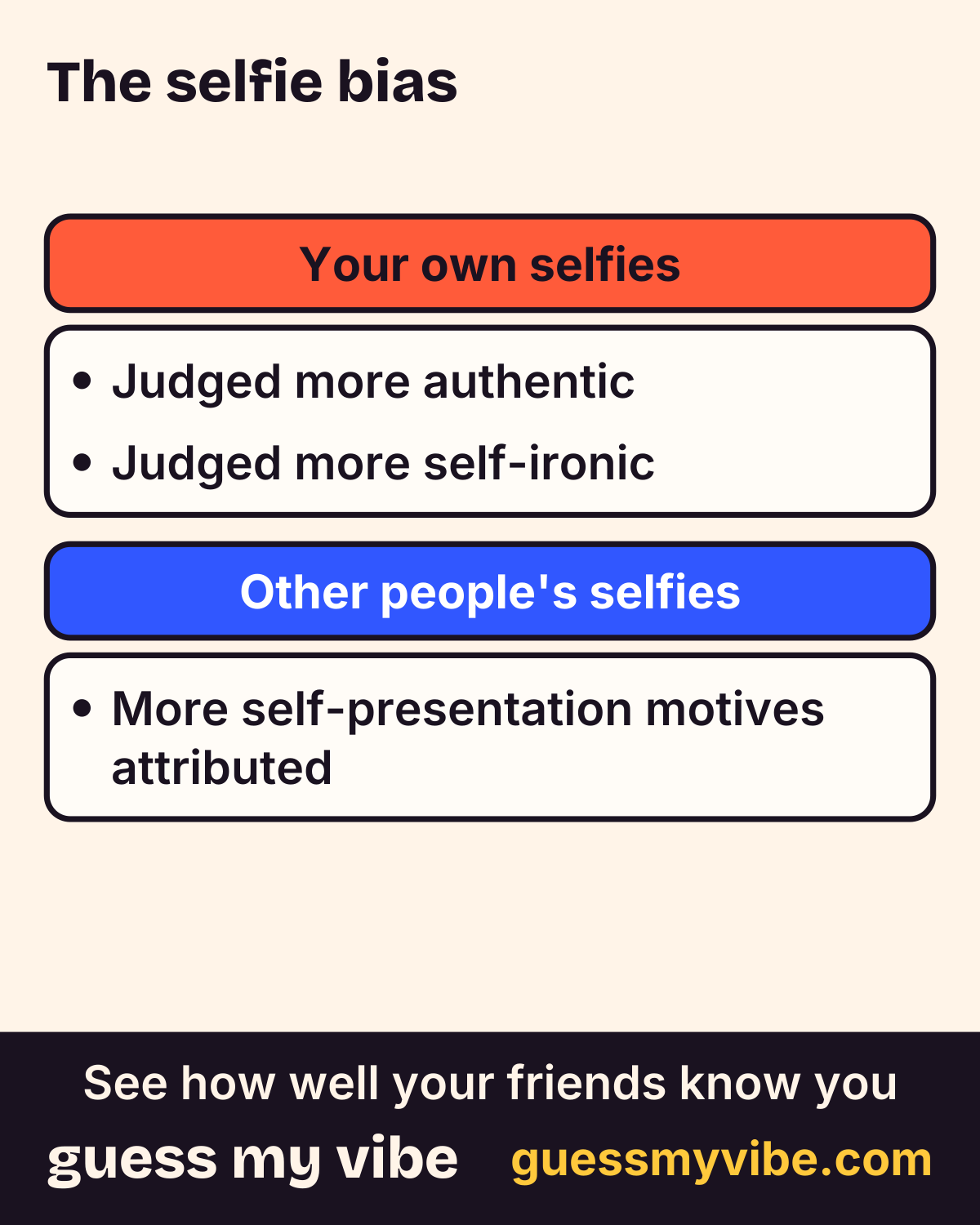
The selfie bias: yours are fine, theirs are performed
The study of 238 people turned up a pattern that most readers will recognize. Participants attributed self-presentational motives more to other people's selfies than to their own, assumed others had more fun and positive feelings taking selfies, and judged their own selfies as more authentic and self-ironic. Overall they expressed a distanced attitude toward selfies: 82% said they would prefer to see more usual pictures on social media instead of selfies [4]. The researchers call this discrepancy between judgments of own and others' selfies the selfie-bias.
The authors offer one interpretation, not a settled answer: perceiving your own selfies as playful and only half-committed may let you meet self-presentation needs without feeling narcissistic [4]. It is a nice example of something we see across the research on how people judge themselves versus others. We are usually better at spotting the performance in other people than in ourselves. If you want to see how that plays out in your own friend group, that is exactly the kind of gap a guess-and-compare game can show.
Cite this figure
Figure: "The selfie bias." Guess My Vibe (guessmyvibe.com). https://guessmyvibe.com/learn/what-your-selfies-say-about-you#figure-selfie-bias
What this means for your own selfies
Taken together, the research suggests a more useful and less judgmental way to think about selfies. A single selfie is a weak personality test. It is a poor place to look for hidden traits, and it is probably an unfair thing to judge a stranger on. But it does reflect some real things: why you wanted to take it, and how you like to present yourself. And it can shape how you come across to people who know nothing else about you.
None of this means you should stop taking selfies, or that you should worry about what yours say. The studies are mostly about averages across groups, usually of students, and they were run in a handful of countries. A friend who knows you will read your selfie in light of everything else they know about you, which is a much richer source than any picture. That is the logic of a friend-based game: someone who has seen you in many situations has far more to go on than someone looking at one frame.
See how well your friends read you, selfie or not
Guess My Vibe skips the selfie guessing. You answer honest questions about yourself, your friends guess how you answered, and you see where their picture of you matches yours and where it does not. It is a lot closer to how people actually know each other than a single photo can be, and it is quick and free.
Key takeaways
- In a study where selfies were coded for cues like head tilt, side of face shown, mood and head position, the authors found no significant relations between those cues and personality constructs, apart from two narrow links (one cue measure with entitlement, selfie availability with neuroticism) [1].
- Motives for selfies were related to traits: in a questionnaire study, the self-approval motive was negatively related to conscientiousness, emotional stability, openness and self-esteem, while the documentation motive was related to agreeableness and extraversion [2].
- Viewers judge selfies harshly. In an online experiment with 297 participants, people shown in selfies were rated as less trustworthy, less socially attractive and more narcissistic than the same people in photos taken by others [3].
- People are kinder to their own selfies than to everyone else's: in a study of 238 people, self-presentation motives were attributed more to others' selfies than to one's own, and own selfies were rated more authentic [4].
- Strangers can pick up something from a whole Instagram account: in one study, observers who saw only screenshots made judgments that significantly converged with users' traits, with accuracy correlations ranging from r = .44 for extraversion to r = .25 for conscientiousness [5].
- This isn't therapy, a diagnosis, or a substitute for professional care. It is a plain-English summary of a small research area.
Questions people ask
Do selfies reveal your personality?
Only weakly, based on the studies we found. One study found no significant relations between selfie cues, like head tilt and mood, and personality traits [1]. Motives for taking selfies were related to some traits in a questionnaire study [2].
Are people who take a lot of selfies narcissistic?
Not as a rule. In one questionnaire study, none of the three selfie motives (self-approval, belonging, documentation) was related to narcissism, unlike in some earlier studies [2]. Viewers, though, tend to perceive selfie posters as more narcissistic than the same people in photos taken by others [3].
Why do selfies make a worse first impression?
In one online experiment, the negative ratings were mainly driven by viewers perceiving a motive of impression management [3]. The study used profile mockups in an online experiment, so it shows a first-impression pattern, not a verdict on any real person.
Why do I like my own selfies but not other people's?
That is a documented pattern. People attribute self-presentation motives more to other people's selfies than to their own, and judge their own as more authentic and self-ironic, a discrepancy researchers call the selfie-bias [4].
Is a whole Instagram feed more revealing than one selfie?
Probably. In one study, observers who saw whole Instagram accounts made judgments that significantly converged with the users' actual traits [5]. That study did not test single selfies, so the comparison is our inference, not a finding.
See how well your friends know you.
Free. Answer 10 quick questions about you, then send your link. Friends play in their browser, no app needed.
Start freeReferences
- [1] Musil, B., Preglej, A., Ropert, T., Klasinc, L., & Babič, N. Č. (2017). What Is Seen Is Who You Are: Are Cues in Selfie Pictures Related to Personality Characteristics?. Frontiers in Psychology, 8, 82. PubMed: 28197113 (opens in a new tab)
- [2] Etgar, S., & Amichai-Hamburger, Y. (2017). Not All Selfies Took Alike: Distinct Selfie Motivations Are Related to Different Personality Characteristics. Frontiers in Psychology, 8, 842. PubMed: 28603508 (opens in a new tab)
- [3] Krämer, N. C., Feurstein, M., Kluck, J. P., Meier, Y., Rother, M., & Winter, S. (2017). Beware of Selfies: The Impact of Photo Type on Impression Formation Based on Social Networking Profiles. Frontiers in Psychology, 8, 188. PubMed: 28261129 (opens in a new tab)
- [4] Diefenbach, S., & Christoforakos, L. (2017). The Selfie Paradox: Nobody Seems to Like Them Yet Everyone Has Reasons to Take Them. An Exploration of Psychological Functions of Selfies in Self-Presentation. Frontiers in Psychology, 8, 7. PubMed: 28144225 (opens in a new tab)
- [5] Osterholz, S., Mosel, E. I., & Egloff, B. (2023). #Insta personality: Personality expression in Instagram accounts, impression formation, and accuracy of personality judgments at zero acquaintance. Journal of Personality, 91(3), 566–582. PubMed: 35837861 (opens in a new tab)
How we find and check these sources: how we write. Spotted an error? Report a correction.
Related
Cite this article
- Title
- Selfies and Personality: What Your Selfie Says About You
- Publisher
- Guess My Vibe
- Updated
- URL
- https://guessmyvibe.com/
learn/ what-your-selfies-say-about-you
Copy this citation
Guess My Vibe. (2026, October 4). Selfies and Personality: What Your Selfie Says About You. Guess My Vibe. https://guessmyvibe.com/
To point at one section, add that section's anchor (the # link on its heading) to the URL.