Impression management is the process by which people control the impressions others form of them. A classic review splits it into two parts: how motivated you are to control the impression, and how you decide what impression to build [1]. It is ordinary, not fake: in one experiment, people told to put their best face forward were liked more and were also seen more accurately [2].
Impression management, defined without the jargon
Impression management is the process by which people control the impressions other people form of them [1]. That sounds calculating, but it covers things almost everyone does without a second thought: choosing an outfit for a first day, sounding a bit more polished in a work email, picking which photos go on a profile. Self-presentation is the closely related term many people search for, and in everyday use the two describe the same basic idea: shaping how others see you.
The useful question isn't whether you do it. A foundational 1990 review describes impression management as playing an important role in interpersonal behavior in general [1], which means it is a normal feature of social life, not a flaw. The better questions are why you do it in a given moment and what you choose to show. The review gives a clear framework for both.
The two parts: wanting to, and deciding how
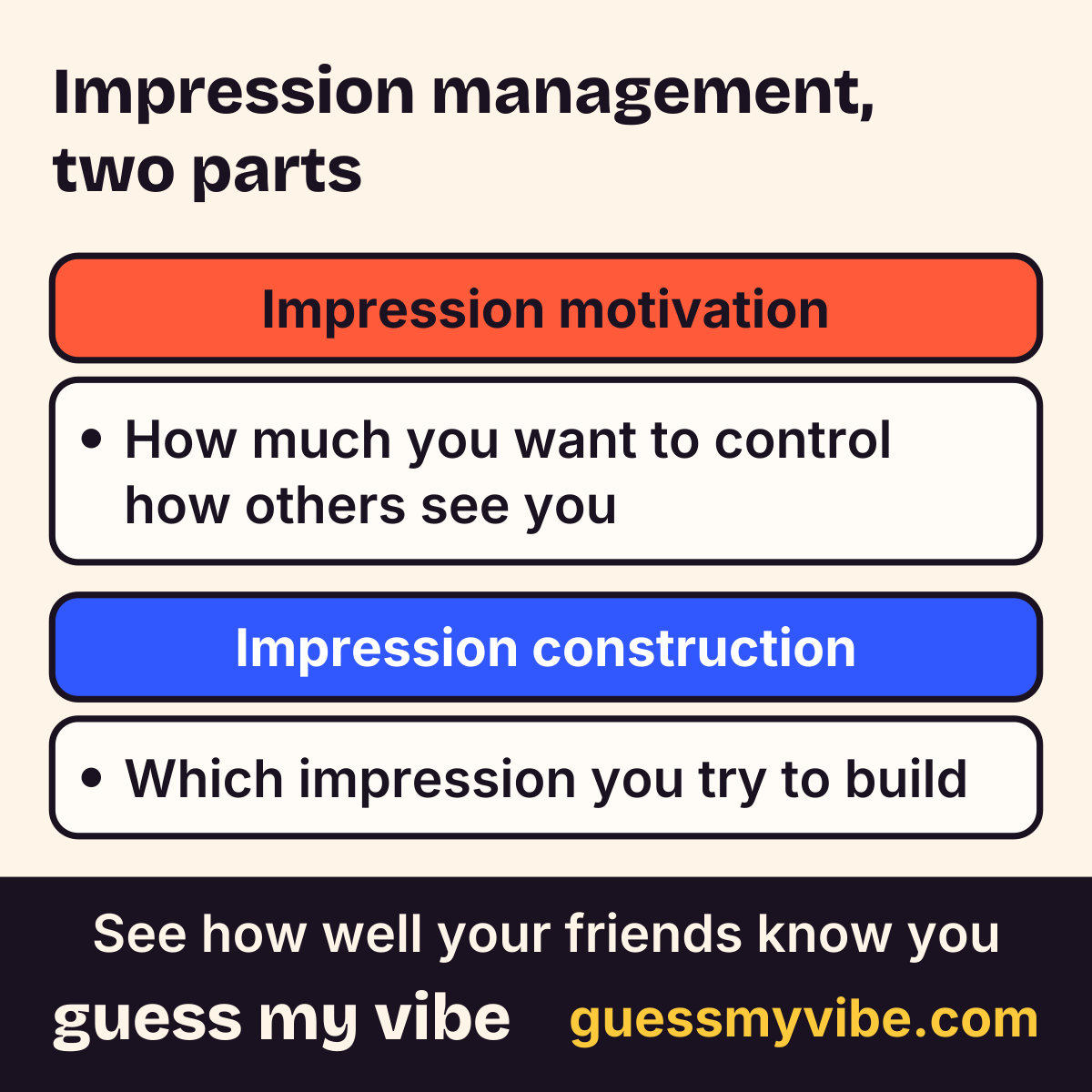
The review, by Mark Leary and Robin Kowalski, proposes that impression management has two separate processes [1]. The first is impression motivation: how motivated you are to control how others see you. The second is impression construction: which impression you try to build. They can come apart. You might care a great deal about being seen well and have no plan, or have a clear plan and not much stake in the outcome.
According to the review, motivation depends on three things [1].
- Goal relevance: how much the impression matters for what you are trying to achieve. A job interview is high; a stranger on a train is low.
- Value of the outcome: how much you want what the good impression could get you, such as the job, the friendship or the invitation.
- The gap between current and desired image: how far the way you are seen now is from the way you would like to be seen.
Construction, the second part, depends on five factors the review identifies: your self-concept, the identity images you want and the ones you want to avoid, the constraints of your role, the values of the person you are trying to impress, and your current social image [1]. In plain terms, you choose which version of yourself to show based on who you think you are, who you want to be, who you don't want to look like, what the situation expects, who is watching and what they value, and what they already think of you.
This is a useful way to read your own behavior. If you spend a long time editing a message to one person but dash off messages to another, you are probably seeing the motivation half in action. If you show a different side of yourself to different groups, you are probably seeing the construction half.
Cite this figure
Figure: "Impression management, two parts." Guess My Vibe (guessmyvibe.com). https://guessmyvibe.com/learn/impression-management#figure-two-parts
Is putting your best self forward fake?
A common worry is that impression management means pretending. One experiment tested a version of that. People were randomly assigned either to put their best face forward when meeting someone or to a control condition with low self-presentation demands [2]. Self-presenters did earn more positive impressions: they were seen as more normative and better liked.
The surprise is what happened to accuracy. The self-presenters were also seen more accurately than the control group, with others' impressions lining up better with their self-reported distinctive personality traits and their IQ test scores [2]. The authors' mediation analyses were consistent with self-presenters being more engaging, which in turn led to more accurate views of them [2]. Their summary is that putting your best self forward helps reveal your true self.
That doesn't mean all self-presentation is honest. The study looked at one kind of effort, being positive when meeting someone, in one experimental setup. But it undercuts the idea that any effort to look good is a mask. Trying to make a good impression can make you more engaging, and an engaging person gives others more real material to work with.
Curious how your friends would answer?
Free. Answer 10 quick questions about you, then send your link. Friends play in their browser, no app needed.
Start freeUsing the two-part model on yourself
The framework is most useful when you point it at a real moment. Take a situation where you felt yourself performing, such as a first date, a new group chat, or an interview, and ask the model's two questions in order [1].
- How much did I want to shape this impression, and why? Check the three drivers: how much it mattered for what you wanted, how much you wanted the outcome, and how far apart your current image and the one you wanted were.
- What did I choose to show? Check the five shapers: who you think you are, who you want to be, who you didn't want to seem like, what your role required, and what the other person seemed to value.
Two things tend to fall out of that exercise. First, a lot of what feels like a personality quirk, such as being much quieter with one group than another, turns out to be a predictable response to who is watching. Second, it separates two things that usually blur together: how much you cared, and what you decided to show. Neither is a flaw. It is just a clearer description of what you were doing.
This is also a different question from self-monitoring, which describes how much a person adjusts their behavior to fit each situation as a stable trait. Impression management is the broader process every person is in at any moment, whatever their trait level.
Online self-presentation: what studies find
Social media makes impression management easy to see, because every post is a visible choice. A survey of 261 emerging adults, with an average age of 22, asked about three ways of presenting on Facebook: the real self, the ideal self and a false self. Respondents said they presented their real self more than either of the other two [3]. People with a more coherent sense of identity reported presenting the real self more, while those with a less coherent identity and lower self-esteem reported more false-self presentation [3]. Those are self-reports, so they show what people say they do, not what an observer would conclude.
An observer-based study gives a different angle. One hundred strangers judged the personality of 102 Instagram users from screenshots of their profiles alone. Their judgments agreed with each other and significantly matched the users' own and informants' ratings of their traits, with averaged-observer accuracy correlations against self-informant composite scores ranging from .44 for extraversion to .25 for conscientiousness [4]. A correlation of .44 is a real, moderate relationship, and .25 is a small one. So a curated feed is not a blank wall. It still leaks real information about the person who made it.
Put together, the two studies point the same way. People report mostly showing their real selves, and strangers looking only at profiles do better than chance. Curation shapes what is visible. It doesn't seem to erase the person behind it.
Why friends see past the curation
The strangers in that Instagram study saw a single, edited slice. Friends see far more: the unedited reactions, the late replies, the stuff that never gets posted. A large meta-analysis of other-ratings across 263 samples found that how close the rater is to the person matters, and that closeness improved accuracy especially for traits that are hard to see from outside [5]. That is a reasonable basis for expecting friends to catch things a feed never shows, though the studies we opened didn't compare friends to feeds directly.
It also explains why impression management is not the end of the story. Whatever image you build, the people closest to you tend to hold a more complete picture. The gap between the image you intend and the picture a friend actually has is information, and often useful.
That gap is the idea behind Guess My Vibe. You answer questions about yourself, your friends guess how you would answer, and you see where their picture and yours differ. It isn't a measure of how well you manage impressions. It is a low-pressure way to see how the version of you that friends know compares to the version you think you show.
Key takeaways
- Impression management has two parts: impression motivation (how much you want to shape the image) and impression construction (what image you build) [1].
- How much you manage your image depends on how relevant the impression is to your goals, how much you value the outcome, and how far your current image is from the one you want [1].
- Presenting your best self isn't automatically deceptive: in an experiment, people asked to put their best face forward were better liked and were seen more accurately than a control group [2].
- In a survey of 261 emerging adults, people said they presented their real self on Facebook more than an ideal or a false self, though this was self-report [3].
- Strangers who only saw Instagram profiles still judged the owners' personality better than chance, so curated profiles leak real information [4].
- This isn't therapy, a diagnosis, or a substitute for professional care.
Questions people ask
What is impression management in psychology?
It is the process by which people control the impressions others form of them. A classic review splits it into impression motivation (wanting to shape the image) and impression construction (deciding which image to build) [1].
Is impression management the same as self-presentation?
In everyday use, yes: both describe how people shape the way others see them. Researchers treat impression management as a normal part of social behavior [1].
Is impression management lying?
Not necessarily. In one experiment, people told to put their best face forward were better liked and seen more accurately than a control group [2]. Deliberately false presentation is a different thing, and some people do report it online [3].
Do people present their real selves online?
In one survey of 261 emerging adults, respondents said they presented their real self on Facebook more than an ideal or a false self [3]. That is self-report, though, and it is one platform and one age group.
Can strangers tell what you are like from your social media?
To a degree. Strangers who saw only Instagram screenshots judged users' personality, with averaged-observer accuracy correlations ranging from .44 for extraversion to .25 for conscientiousness [4]. That is better than chance but far from perfect.
See how well your friends know you.
Free. Answer 10 quick questions about you, then send your link. Friends play in their browser, no app needed.
Start freeReferences
- [1] Leary, M. R., & Kowalski, R. M. (1990). Impression management: A literature review and two-component model. Psychological Bulletin, 107(1), 34–47. doi.org/10.1037/0033-2909.107.1.34 (opens in a new tab)
- [2] Human, L. J., Biesanz, J. C., Parisotto, K. L., & Dunn, E. W. (2012). Your Best Self Helps Reveal Your True Self. Social Psychological and Personality Science, 3(1), 23–30. doi.org/10.1177/1948550611407689 (opens in a new tab)
- [3] Michikyan, M., Dennis, J., & Subrahmanyam, K. (2015). Can you guess who I am? Real, ideal, and false self-presentation on Facebook among emerging adults. Emerging Adulthood, 3(1), 55–64. doi.org/10.1177/2167696814532442 (opens in a new tab)
- [4] Osterholz, S., Mosel, E. I., & Egloff, B. (2023). #Insta personality: Personality expression in Instagram accounts, impression formation, and accuracy of personality judgments at zero acquaintance. Journal of Personality, 91(3), 566–582. PubMed: 35837861 (opens in a new tab)
- [5] Connelly, B. S., & Ones, D. S. (2010). An other perspective on personality: Meta-analytic integration of observers' accuracy and predictive validity. Psychological Bulletin, 136(6), 1092–1122. PubMed: 21038940 (opens in a new tab)
How we find and check these sources: how we write. Spotted an error? Report a correction.
Related
Cite this article
- Title
- Impression Management: What It Is and Why We All Do It
- Publisher
- Guess My Vibe
- Updated
- URL
- https://guessmyvibe.com/
learn/ impression-management
Copy this citation
Guess My Vibe. (2026, October 4). Impression Management: What It Is and Why We All Do It. Guess My Vibe. https://guessmyvibe.com/
To point at one section, add that section's anchor (the # link on its heading) to the URL.