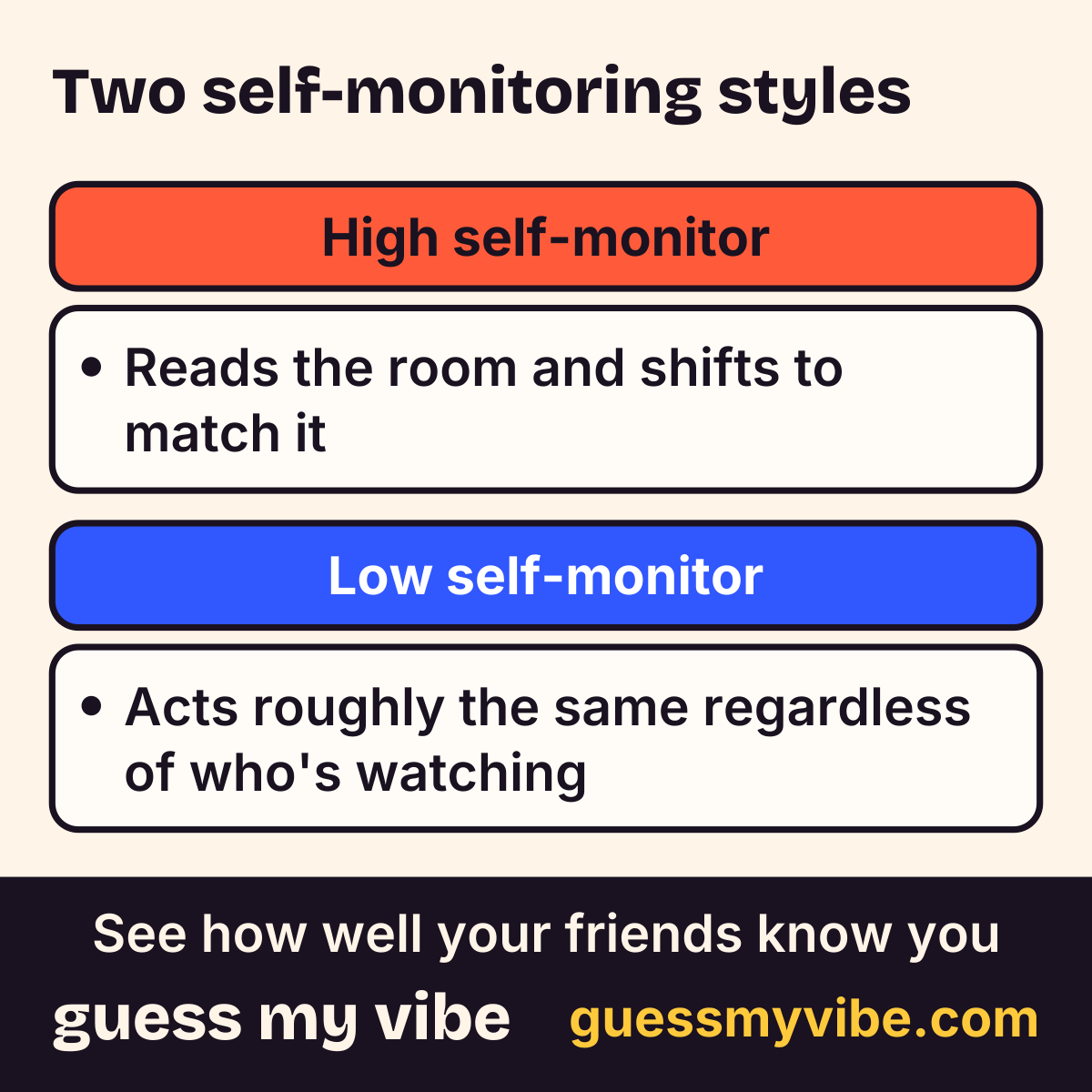
Self-monitoring is a personality trait, introduced by psychologist Mark Snyder in 1974, that describes how much someone adjusts their behavior and self-presentation to fit a social situation. A high self-monitor reads the room and shifts to match it; a low self-monitor acts roughly the same way regardless of who's watching [1]. It isn't about being fake or phony. It's a real, measurable difference in how much a person's own values versus the social situation drives their behavior, and it's a big part of why friends who've only seen you in different settings might describe you in genuinely different ways.
What self-monitoring actually means
Self-monitoring is a personality construct psychologist Mark Snyder introduced in 1974, built to explain a specific pattern: some people consistently read the social situation they're in and adjust how they act to fit it, while other people act in line with their own attitudes and feelings no matter the setting. Snyder called this "self-observation and self-control guided by situational cues to social appropriateness," and built a self-report scale to measure it. In four separate studies with undergraduates, people who scored higher on the scale were independently rated by peers as better actors, were more likely to belong to campus groups built around performing (theater, public speaking), were better at deliberately controlling their facial and vocal expressions on command in a lab task, and paid closer attention to information about how other people were behaving in the same situation [1]. All four pointed at the same underlying thing: a real, measurable skill and habit of reading a room and adjusting to it.
High self-monitors vs. low self-monitors
A high self-monitor tends to come across differently depending on who's around. The version of them at a work happy hour, at a family dinner, and with their closest friend can look like three genuinely different people, not because they're being dishonest, but because they're actually tracking what each situation calls for and shifting to match it. A low self-monitor is closer to "what you see is what you get" in every room: the same opinions, the same energy, the same bluntness or warmth, whether they're talking to a boss or a best friend. Neither pattern is better or worse on its own. A high self-monitor often reads as socially skilled and easy to get along with across many different groups; a low self-monitor often reads as more genuine and predictable to the people who already know them well. Each has an obvious cost too: a high self-monitor can come across as inconsistent or hard to pin down, and a low self-monitor can come across as tone-deaf to a room that clearly wanted something different from them.
Cite this figure
Figure: "Two self-monitoring styles." Guess My Vibe (guessmyvibe.com). https://guessmyvibe.com/learn/self-monitoring#figure-high-vs-low-styles
Is self-monitoring really one trait?
This question turned into a real, extended debate in the research literature. If self-monitoring is supposed to be one coherent trait, it should relate to a wide, logically connected set of outcomes in a consistent way; if it's actually a grab-bag of a few loosely related tendencies, it shouldn't. A detailed, quantitative review of the self-monitoring literature, done 26 years after Snyder's original paper, tackled this directly by checking how the Self-Monitoring Scale related to a wide range of external criteria the theory said it should. The reviewers concluded that, with some real, specific exceptions worth taking seriously, a broad range of these outside criteria did tap one coherent underlying dimension, the one the scale was built to measure [2]. In plain terms: the debate didn't end in "the concept is fake." It ended in "the concept mostly holds up, with some rough edges the simplest version of the theory didn't account for."
Curious how your friends would answer?
Free. Answer 10 quick questions about you, then send your link. Friends play in their browser, no app needed.
Start freeWhy friends from different parts of your life might disagree about you
Here's where self-monitoring connects directly to a question Guess My Vibe asks every day: how well does a friend actually know you? A useful model for why any outside judgment of personality succeeds or fails says accuracy depends on three things happening in order: a real behavioral cue related to the trait has to actually be available, the judge has to notice it, and the judge then has to use it correctly [3]. For a high self-monitor, the first step is the problem. The cues on display at work (measured, professional, a little guarded) can be genuinely different from the cues on display with an old friend (looser, more opinionated, more unfiltered), because the person really is behaving differently in each place, on purpose, in a way that fits each room. A coworker and a childhood best friend aren't failing to read the same person accurately. In a real sense, they're accurately reading two different, real slices of the same person's behavior.
This sits on top of a baseline amount of disagreement that exists for everyone, self-monitoring aside. A large meta-analysis found that how well an outside rating matches a person's own self-view already depends on the trait itself and on how well the rater knows you: closeness boosted accuracy most for hard-to-observe traits, like emotional stability, and only minimally for highly evaluative ones, like Agreeableness [4]. A high self-monitor adds a second layer on top of that baseline: not just "is this trait easy to see," but "which version of this person is this particular observer even seeing in the first place."
What a self-monitoring test actually measures
A self-monitoring test is a self-report questionnaire, the same format as most personality measures: a set of statements about adapting to situations, caring what other people think is appropriate, and changing behavior to fit different groups, which you rate as true or false of yourself. Like any self-report tool, it's measuring your own honest sense of your pattern, not an outside observer's tally of your actual behavior across real situations. That's a real limitation, but not a disqualifying one: Snyder's original validation studies checked the scale against outside, independently observed behavior (peer ratings, lab tasks) specifically because self-report alone isn't enough to trust a new trait measure, and the scale held up across those checks [1]. A test result is a reasonable starting point for the question "do I adapt a lot, or not much," but it's worth reading as a self-description, not an outside verdict; the people who'd actually notice the adapting, the friends who've seen you in more than one room, are a useful second opinion on top of it.
Why this matters for how you show up online
Self-monitoring predates social media by decades, but it's a useful lens for a very modern question: why some people's accounts look nearly identical across platforms while other people run a put-together main account and a messier, more private one for close friends. A high self-monitor adapting their in-person behavior to the room is doing, online, roughly the same thing as someone keeping a polished main feed for distant followers and a rawer account for people who already know them well: reading the audience and adjusting the presentation to match it. A low self-monitor is more likely to post the same way regardless of who's watching, for better (consistent, predictable) or worse (less tailored to what a given audience actually wants to see). None of this makes one approach more honest than the other. It's the same underlying difference Snyder described in 1974, just running on a platform he never could have imagined [1].
Find out which version of you a friend actually sees
If self-monitoring explains why a work friend and a childhood friend might answer differently about you, that's a genuinely interesting thing to actually check instead of just assuming. Guess My Vibe has you answer real questions about yourself, then has a friend guess your answers, scored automatically. Play it with a friend from one part of your life, then a friend from a completely different one, and the gap (or lack of one) between their two scores says something real about how much you shift across rooms.
Key takeaways
- Self-monitoring measures how much someone adapts their behavior to fit a social situation (high self-monitors) versus stays consistent regardless of the audience (low self-monitors) [1].
- A decades-long review of self-monitoring research found the trait mostly holds together as one coherent dimension across a wide range of outcomes, though not without some real, documented exceptions [2].
- A judgment of someone's personality can only be as accurate as the behavioral cues actually available to the judge in that specific situation, which is why a high self-monitor can look like a different person to a coworker than to a close friend [3].
- How well a friend's read on you matches your own self-view already varies a lot by trait, even before self-monitoring is factored in; the closest friends tend to have an edge on the hardest-to-observe traits [4].
- This isn't therapy, a diagnosis, or a substitute for professional care.
Questions people ask
What does self-monitoring mean in psychology?
It's a personality trait describing how much someone adjusts their behavior and self-presentation to fit a social situation. High self-monitors adapt to the room; low self-monitors act consistently regardless of who's around. Psychologist Mark Snyder introduced the concept in 1974 [1].
Is being a high self-monitor a bad thing?
Not inherently. It's a real difference in style, not a flaw. High self-monitors often come across as socially skilled across many different groups; the tradeoff is sometimes seeming inconsistent or hard to pin down to people who see only one or two of those versions.
Is self-monitoring a scientifically valid concept?
Yes, with real nuance. A later, detailed review found that a wide range of outside behavior does relate to the Self-Monitoring Scale in the way the theory says it should, supporting it as one coherent trait, though the review also found specific exceptions worth taking seriously rather than treating the theory as settled in every detail [2].
Why do my friends describe my personality differently?
Partly because some traits are just harder to observe than others, and partly because of self-monitoring: if you genuinely adapt your behavior across different settings, a friend from one part of your life may be accurately seeing a real but different slice of how you act than a friend from another part [3].
How can I take a self-monitoring test?
Self-monitoring tests are self-report questionnaires asking how much you adapt to social situations versus act consistently regardless of them. They're a useful, if imperfect, snapshot of your own sense of your pattern, the same limitation any self-report personality measure has.
See how well your friends know you.
Free. Answer 10 quick questions about you, then send your link. Friends play in their browser, no app needed.
Start freeReferences
- [1] Snyder, M. (1974). Self-monitoring of expressive behavior. Journal of Personality and Social Psychology, 30(4), 526–537. doi.org/10.1037/h0037039 (opens in a new tab)
- [2] Gangestad, S. W., & Snyder, M. (2000). Self-monitoring: Appraisal and reappraisal. Psychological Bulletin, 126(4), 530–555. PubMed: 10900995 (opens in a new tab)
- [3] Funder, D. C. (1995). On the accuracy of personality judgment: A realistic approach. Psychological Review, 102(4), 652–670. doi.org/10.1037/0033-295X.102.4.652 (opens in a new tab)
- [4] Connelly, B. S., & Ones, D. S. (2010). An other perspective on personality: Meta-analytic integration of observers' accuracy and predictive validity. Psychological Bulletin, 136(6), 1092–1122. PubMed: 21038940 (opens in a new tab)
How we find and check these sources: how we write. Spotted an error? Report a correction.
Related
- Social Media Personality: Does It Show the Real You?
- Self-Perception vs. How Others See You
- The Johari Window, and What's Actually Real About It
- Ambivert: What the Science Actually Says
- Impression Management: What It Is and Why We All Do It
- Fitting In vs Belonging: Being Liked for Who You Are
- Authentic Self on Social Media: Linked to Well-Being
Cite this article
- Title
- Self-Monitoring: Are You the Same Person Everywhere?
- Publisher
- Guess My Vibe
- Updated
- URL
- https://guessmyvibe.com/
learn/ self-monitoring
Copy this citation
Guess My Vibe. (2026, October 3). Self-Monitoring: Are You the Same Person Everywhere?. Guess My Vibe. https://guessmyvibe.com/
To point at one section, add that section's anchor (the # link on its heading) to the URL.