Being your authentic self on social media is linked to feeling better. In a study of 10,560 Facebook users, people whose posts and Likes were closer to their self-reported personality also reported greater life satisfaction [1]. A smaller follow-up experiment, in which people posted authentically for a week and in a self-idealized way for a week, found more positive mood during the authentic week, according to the authors [1]. It is promising, not a guarantee: one experiment, mostly students, short term.
Authentic self on social media: what the research finds
Being your authentic self on social media is linked to feeling better, according to a large Facebook study and a small experiment published together in 2020. In 10,560 Facebook users, people whose online footprints were closer to their self-reported personality also reported greater life satisfaction [1]. In a follow-up experiment, the authors report that posting authentically led to more positive affect and mood within the same person [1]. Other, smaller studies point the same way, with caveats we will go through below.
That is a more hopeful story than the usual one about social media. The common worry is that feeds push everyone toward a polished, performed self. The research here asks a narrower question: not how much time you spend online, but how you use it, and specifically whether what you show matches who you are.
How do you measure being authentic?
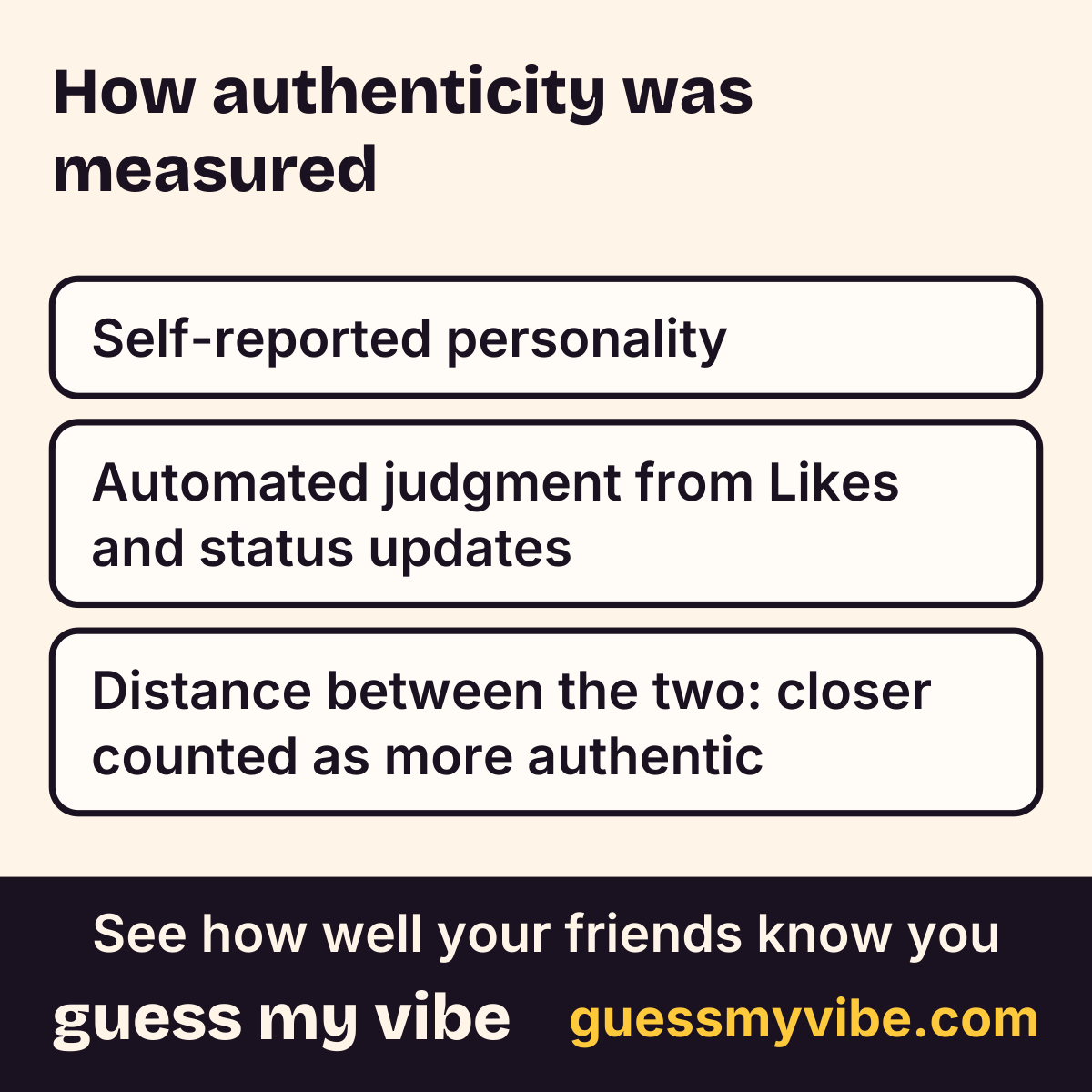
You cannot just ask people, since someone presenting an idealized self may sincerely believe they are being real. So the researchers behind the main study used a clever workaround. They estimated how authentic each person was as the distance between two things: the person's own self-reported personality, and an automated personality judgment made from their Facebook Likes and status updates [1]. The closer the two were, the more authentic the person's self-expression counted as. The more they differed, the more the footprint looked self-idealized.
This is worth understanding, because it limits what the finding can say. The score is a computed gap, not a record of what someone intended or felt. If the algorithm misjudges someone's personality, that shows up as low authenticity, even if the person was being completely sincere. Automated personality judgments from digital footprints are meaningful but imperfect, so treat the measure as a useful proxy. It is not a window into anyone's honesty.
Cite this figure
Figure: "How authenticity was measured." Guess My Vibe (guessmyvibe.com). https://guessmyvibe.com/learn/authentic-self-on-social-media#figure-measuring-authenticity
The large Facebook study: more authentic, more satisfied
Analyzing data from 10,560 Facebook users, the researchers found that people who were more authentic in their self-expression also reported greater life satisfaction [1]. The abstract adds a detail that matters. The effect appeared consistent across different personality profiles, which counters the idea that only people with socially desirable personalities, the sunny, agreeable types, gain from being authentic [1]. In plain terms: the link did not seem to be reserved for people who already come across well.
The caveat here is the usual one for large surveys. This part of the study is correlational. People who are happier with their lives might simply be more comfortable posting as themselves, which would produce the same pattern without authenticity doing anything. That is why the second part of the paper matters.
The two-week experiment: posting real versus posting polished
To test direction, the researchers ran a pre-registered, longitudinal experiment. From the full text of the paper: 90 students and social media users at one university took part in a two-week study. Everyone completed two stages, posting on their social media profiles in a way that was authentic for seven days, and in a self-idealized way for seven days, with the order randomly assigned [1]. The authors report that this demonstrated a causal relationship between authentic posting and positive affect and mood on a within-person level [1].
This design is clever, because each person is their own comparison. But be careful not to overread it. The sample was 90 people, mostly young and mostly women (about 72 percent), recruited at one university, and it was smaller than the 200 the researchers had pre-registered because the campus lab shut down early in the COVID-19 pandemic [1]. The finding is about mood over a short window, not about long-term well-being. A single experiment of this size is a promising result, not the final word.
Curious how your friends would answer?
Free. Answer 10 quick questions about you, then send your link. Friends play in their browser, no app needed.
Start freeOther studies point the same direction, more modestly
A smaller study took a similar approach with a different measure. In it, 164 participants completed a personality assessment twice, once as their true self and once as the self they present on Facebook, and the researchers measured the distance between the two. Better coherence between the true self and the Facebook self was associated with better social connectedness and less stress [2]. The study measured social connectedness, subjective well-being, depression, anxiety and stress, and the authors say their hypotheses received only partial support: the abstract highlights connectedness and stress as the outcomes that went with coherence [2]. It is also correlational, so it cannot say that authenticity caused the better connectedness.
How common is it to be authentic online in the first place? In a survey of 261 emerging adults (average age 22), people reported presenting their real self on Facebook more than their ideal self or a false self [3]. Those who reported a more coherent identity said they presented their real self more, while those with a less coherent sense of self and lower self-esteem said they presented their false self more [3]. This is self-report, so it tells you how people describe their own behavior. But it fits the picture that most people believe they are mostly being themselves, and it suggests that feeling less sure about who you are is linked to a more performed presence (the study cannot say which causes which).
Authentic does not always mean flattering
There is a subtlety in all this. Being authentic is not the same as being positive. A study of 88 people compared their main Instagram accounts (the 'rinsta') with their second, 'fake' accounts (the 'finsta'), and with their offline personality. The finstas were more extraverted, less conscientious and less agreeable than the rinstas, though equally neurotic as offline. Interviews indicated that the differences came from audience perceptions: a large audience promotes a carefully curated self, while a small, trusted audience allows a more authentic but sometimes more negative self-presentation [4].
That matters for how you read the well-being findings. The large Facebook study's measure is about matching, not about how upbeat a post is. A person whose real self is dry, sarcastic or messy can be authentic in that way. (We cover the second-account question in more depth in our piece on [finsta](/learn/finsta).)
Why might authenticity help? Nobody has proved it
It is tempting to explain these findings with a neat story, for example that keeping up a polished act is tiring, or that being seen as you are feels better than being admired for someone you are not. Those are reasonable guesses, and they are only guesses. The studies above measured how closely posts matched personality and then measured well-being, mood, connectedness or stress. None of the abstracts we read reports testing why authenticity would help. The Facebook study's own summary is a careful one: the extent to which social media use is related to well-being depends on how individuals use it [1].
That line is worth sitting with, because it moves the conversation away from the all-or-nothing question of whether social media is good or bad for you. It points instead at a more practical question about what you are doing when you post. Are you sharing something that is true of you, even if it is small, or are you building an image? The research cannot tell you which is better for any one person on any one day. It does suggest that, on average and in the groups studied, the first tends to go with feeling somewhat better.
A few limits are worth stating plainly. The large study used Facebook Likes and status updates, so it says nothing directly about Instagram stories, short videos or private group chats. The experiment lasted two weeks and its participants were mostly young adults at one university. And in most of the studies here, the information about personality came partly from questionnaires people filled out about themselves, which brings its own blind spots. We would call the overall picture encouraging and consistent in direction, but still thin.
What this does and does not mean for you
A fair reading is that the research gives a mild, encouraging nudge, not a rule. Across a large sample, closeness between who people say they are and what their online footprint suggests goes with more life satisfaction. In one small experiment, a week of posting more honestly went with a better mood than a week of posting a polished version. None of this tells you to overshare, to drop privacy boundaries or to feel guilty about a curated photo. Authenticity here means what you share is consistent with who you are. It does not mean sharing everything.
It also helps to remember that your own sense of how real you are online may not match what your friends see. People often have blind spots about how they come across, and a friend can often tell where your public self and private self line up and where they do not. That is the idea behind comparing your answers with your friends' guesses.
See whether your friends know the real you
Guess My Vibe is a low-pressure way to check how your friends' picture of you lines up with the one you would give. You answer honest questions about yourself, a friend guesses how you answered, and the game shows you where they matched and where they missed. The game works best with real answers, since a polished set of answers would tell you nothing.
Key takeaways
- In 10,560 Facebook users, those whose Likes and status updates pointed to a personality close to their own self-reported one also reported greater life satisfaction, and this held across different personality profiles [1].
- The same paper reports a pre-registered two-week experiment (90 people, mostly students) in which authentic posting went with more positive affect and mood within the same person; the authors describe it as a causal link, though it was smaller than planned [1].
- A separate study of 164 people found that a closer match between the self people reported being and the self they presented on Facebook went with better social connectedness and less stress; hypotheses got only partial support [2].
- In a survey of 261 emerging adults, people reported presenting their real self on Facebook more than an ideal or false self, and those with a more coherent sense of identity reported presenting the real self more [3].
- Authentic does not always mean flattering: in one study of 88 people, second 'finsta' accounts showed less agreeable and less conscientious traits than main accounts, which the interviews tied to audience size [4].
- This isn't therapy, a diagnosis, or a substitute for professional care. These studies describe groups of people, and none of them is advice about how you should feel or post.
Questions people ask
Is being authentic on social media good for you?
It is linked to feeling better. In 10,560 Facebook users, people with a more authentic online footprint reported greater life satisfaction, and a small experiment found more positive mood during a week of authentic posting [1]. It is promising evidence, not proof it works for everyone.
How did researchers measure authenticity?
As the distance between a person's self-reported personality and an automated personality judgment based on their Facebook Likes and status updates [1]. It is a computed proxy, not a direct measure of honesty.
Does posting authentically cause better mood?
The authors of one pre-registered experiment report a causal within-person link between authentic posting and positive affect and mood [1]. It had 90 participants, mostly students, over two weeks, so we would call it encouraging, not settled.
Do most people present their real selves online?
In one survey of 261 emerging adults, people said they presented their real self on Facebook more than an ideal or false self [3]. That is self-report and one age group, so it may not match what others see.
Does authentic mean positive?
No. In a study of 88 people, second accounts shown to a small trusted audience were less agreeable and less conscientious than main accounts, which the researchers linked to audience size [4]. Authenticity in these studies is about matching who you are, not about sounding upbeat.
See how well your friends know you.
Free. Answer 10 quick questions about you, then send your link. Friends play in their browser, no app needed.
Start freeReferences
- [1] Bailey, E. R., Matz, S. C., Youyou, W., & Iyengar, S. S. (2020). Authentic self-expression on social media is associated with greater subjective well-being. Nature Communications, 11, 4889. PubMed: 33024115 (opens in a new tab)
- [2] Grieve, R., & Watkinson, J. (2016). The Psychological Benefits of Being Authentic on Facebook. Cyberpsychology, Behavior, and Social Networking, 19(7), 420–425. doi.org/10.1089/cyber.2016.0010 (opens in a new tab)
- [3] Michikyan, M., Dennis, J., & Subrahmanyam, K. (2015). Can you guess who I am? Real, ideal, and false self-presentation on Facebook among emerging adults. Emerging Adulthood, 3(1), 55–64. doi.org/10.1177/2167696814532442 (opens in a new tab)
- [4] Taber, L., & Whittaker, E. (2020). "On Finsta, I can say 'Hail Satan'": Being authentic but disagreeable on Instagram. Proceedings of the 2020 CHI Conference on Human Factors in Computing Systems (CHI '20), 1–14. doi.org/10.1145/3313831.3376182 (opens in a new tab)
How we find and check these sources: how we write. Spotted an error? Report a correction.
Related
- Instagram vs Reality: How Fake Are Curated Profiles?
- Social Media Personality: Does It Show the Real You?
- Finsta vs Rinsta: What Research Says About Two Accounts
- Impression Management: What It Is and Why We All Do It
- Self-Awareness: What the Research Says It Actually Takes
- Why People Post on Social Media: Motives and Personality
Cite this article
- Title
- Authentic Self on Social Media: Linked to Well-Being
- Publisher
- Guess My Vibe
- Updated
- URL
- https://guessmyvibe.com/
learn/ authentic-self-on-social-media
Copy this citation
Guess My Vibe. (2026, October 4). Authentic Self on Social Media: Linked to Well-Being. Guess My Vibe. https://guessmyvibe.com/
To point at one section, add that section's anchor (the # link on its heading) to the URL.