Researchers propose that people use social media for two main reasons: the need to belong and the need for self-presentation [1]. A systematic review of nine papers found extraversion the main personality link to using these sites, with the self-presentation motive tied to narcissism and the need to belong tied to agreeableness and neuroticism [2]. That is a pattern across studies, not a way to tell why one person posts.
Why people post on social media comes down, in the research, to a short list of needs: wanting to belong, wanting to present a self others will like, and wanting to feel good about who you are. The evidence is more tentative than the confident headlines suggest, because much of it is self-reported surveys and some of it is a proposed model rather than a tested one. This article walks through what the main papers say, which personality traits go with which motive, and what you can fairly conclude about your own posting.
Why people post on social media: belonging and self-presentation
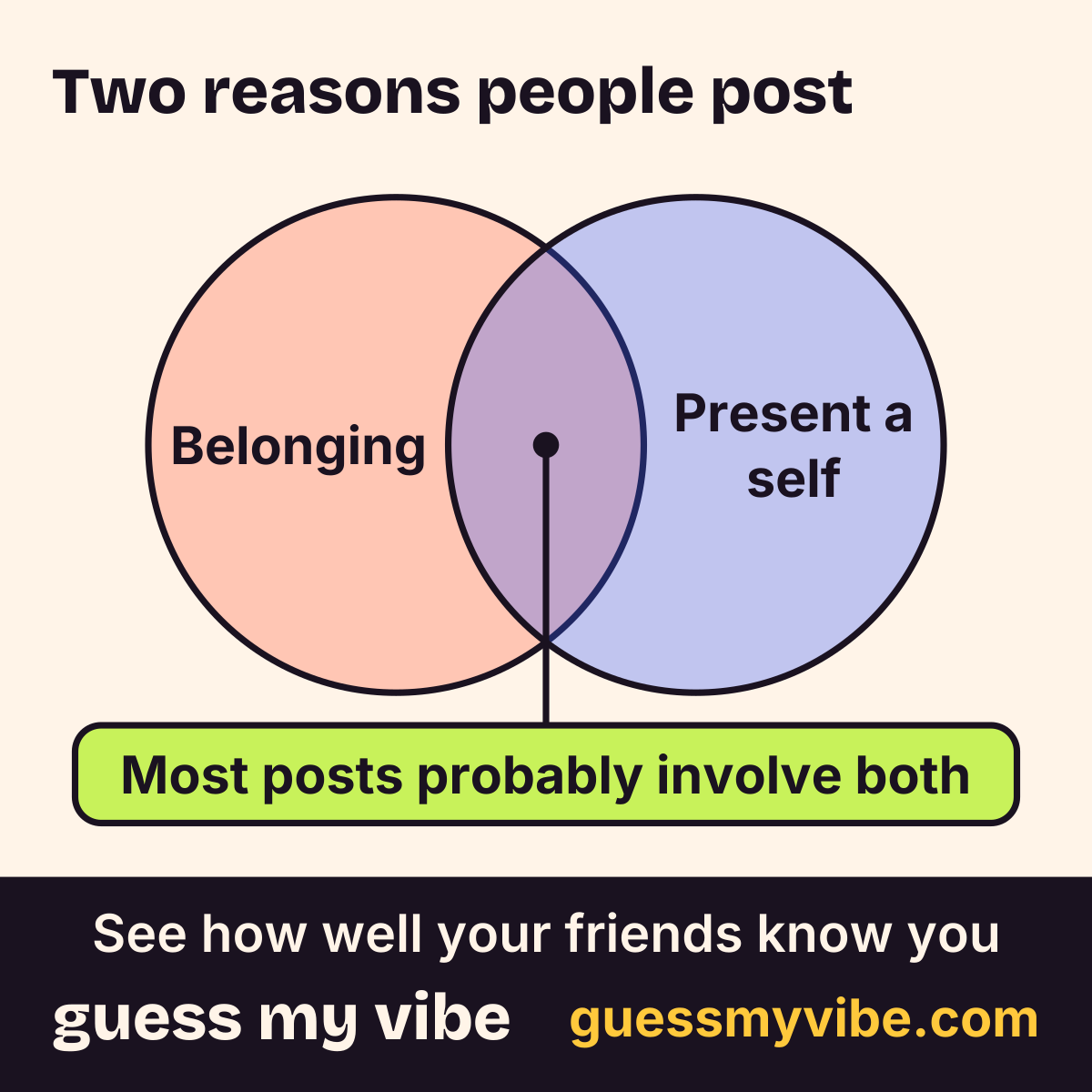
One common framing comes from a review article. After surveying the literature on what drives Facebook use, the authors proposed a model in which use is motivated by two primary needs: the need to belong and the need for self-presentation. They suggest demographic and cultural factors feed the need to belong, while neuroticism, narcissism, shyness, self-esteem and self-worth feed the need for self-presentation [1].
Note what this is. It is a literature review that proposes a model, with areas listed for future research, not a single experiment that proved it [1]. It is also built on Facebook as it was in the early 2010s. But as a way of organizing motives it is a useful starting point, and a later systematic review also treats self-presentation and belonging as motives behind use [2].
In everyday terms: belonging is the part where you post to stay in touch, show up in other people's lives, or feel part of a group. Self-presentation is the part where you choose what to show, whether that is your best angle, your funniest take, or your achievements. Most posts probably involve both, and nothing in the studies suggests that either motive is a flaw.
Cite this figure
Figure: "Two reasons people post." Guess My Vibe (guessmyvibe.com). https://guessmyvibe.com/learn/why-people-post-on-social-media#figure-two-needs
Which personality traits go with which motive
A later systematic review tried to pin this down. It followed standard reporting guidelines, searched literature from 2007 to 2017, and ended up with nine papers on Big Five traits and motivations for using social network sites in adolescents and adults. Three traits stood out: extraversion, neuroticism and openness. Extraversion was a good predictor of motivation and of site use [2].
Beyond extraversion, the self-presentational motive was also related to narcissism, while the need to belong showed an association with agreeableness and neuroticism [2]. The authors suggest neuroticism may reflect an attempt to compensate for difficulties in real-life social situations, and that gender differences in use appear to come from differences in motivation [2]. Those readings are the review's interpretations. With only nine papers, and a search of two databases, they should be held loosely.
A small study of 100 Facebook users at one university shows the narcissism and self-esteem thread. Higher narcissism and lower self-esteem were related to greater online activity and to some self-promotional content, and the type of self-promotional content differed by gender [5]. These are correlations from a small sample at one university, so they don't show that low self-esteem makes anyone post, only that the two went together. "Narcissism" here is a personality score, not a diagnosis, and none of this means that people who post a lot are narcissistic.
Curious how your friends would answer?
Free. Answer 10 quick questions about you, then send your link. Friends play in their browser, no app needed.
Start freePosting as a way to feel better about yourself
A third motive goes beyond belonging and presentation: protecting your sense of self. Using self-affirmation theory, two studies together proposed that these sites' popularity can be understood through the fulfillment of ego needs. In the first study, Facebook profiles turned out to be self-affirming in the sense of satisfying users' need for self-worth and self-integrity. In the second, users gravitated toward their online profiles after receiving a blow to the ego, in what the authors call an unconscious effort to repair their perceptions of self-worth [3].
One reading of this, ours and not the authors' wording, is that it could help explain why someone checks or updates a profile after a bad day. The authors describe it as one of the psychological factors underlying Facebook use [3]. We can't tell from the abstract how large the effects were or exactly who took part, so treat it as one well-framed idea backed by two studies.
Motives differ by type of post
"Why people post" has no single answer partly because different kinds of posts serve different ends. Selfies are a good test case. A two-stage study first asked 117 people for their reasons for taking selfies and found three distinct motivations: self-approval, belonging and documentation. A second group of 191 people then answered the same questions plus personality measures, and the model held up [4].
- Self-approval was negatively related to conscientiousness, emotional stability, openness and self-esteem, and positively related to frequent checking for likes [4].
- Belonging was related to openness [4].
- Documentation was related to agreeableness and extraversion [4].
Unlike earlier studies, none of the three selfie motives was related to narcissism in that work, and the authors argue for treating selfie-taking as a multidimensional phenomenon [4]. The sample sizes were modest and the findings are correlations, but the message is a good counterweight to simple stories: the same behavior can come from very different reasons.
One more caution is that motives are hard to measure. Most of these studies ask people to report why they post, and people are not always good at explaining their own behavior after the fact. A person may say they post to stay in touch while also enjoying the attention, and a questionnaire will usually capture only the answer that comes to mind first. That is another reason to treat the trait links as loose tendencies. They describe groups of people answering surveys, and they don't tell you which reason is behind any single photo or caption.
What this means for your own posting
None of this lets you read another person's motives from their feed, and it doesn't let you diagnose your own either. What it offers is a set of questions you can ask yourself about a post you're about to make, if you are curious.
- Am I posting to connect? If the aim is to stay in touch, a message to a few people may serve it better than a broadcast.
- Am I presenting a version of myself? That's normal and not something to be ashamed of, and the review treats self-presentation as one of two main needs [1].
- Am I posting because I feel low? The profile-gravitation finding suggests people may turn to their profiles after a blow to the ego [3]. Noticing the pull is enough; it doesn't by itself mean something is wrong.
- Am I checking for likes? In the selfie study, self-approval went with frequent like-checking [4]. If checking leaves you feeling worse, that is worth noticing.
If posting or scrolling is weighing on your mood, talking to a professional is a sensible step, and this article is not a substitute for that.
What the research can't tell you
Several limits apply. The review behind the two-needs model is about Facebook [1], and much of the other work is on Facebook, which is only one of the places people post now. Most findings are correlations from self-report, so they can't separate cause from effect. The systematic review covered only nine papers [2]. If you meet a confident claim that a trait "makes" people post for a given reason, this is the thing to remember: the evidence points to tendencies, not rules.
Guess My Vibe gives you a way to compare how you see yourself with how friends read you, which is the same gap that posting can widen or shrink. If a friend can guess your answers, they know the person behind the feed, not just the version in it.
Key takeaways
- A review of the Facebook literature proposes two main motives for use: the need to belong and the need for self-presentation [1].
- In a systematic review of nine papers, extraversion was the main forerunner of social network site use and motivation, and the need to belong was linked with agreeableness and neuroticism [2].
- After a blow to the ego, Facebook users gravitated toward their own profiles, which the authors read as an effort to repair their sense of self-worth [3].
- Selfie-taking has at least three distinct motives, self-approval, belonging and documentation, each linked to different traits [4].
- This isn't therapy, a diagnosis, or a substitute for professional care, and these are averages from mostly self-reported studies, not a reading of any one person's feed.
Questions people ask
Why do people post on social media?
Researchers propose two main reasons: the need to belong and the need for self-presentation [1]. Studies also point to ego needs, such as repairing self-worth after a blow to the ego [3].
Which personality traits are linked to social media use?
In a systematic review of nine papers, extraversion was the main forerunner of use and motivation, the self-presentational motive was related to narcissism, and the need to belong was associated with agreeableness and neuroticism [2].
Do people with low self-esteem post more?
In one study of 100 Facebook users, lower self-esteem and higher narcissism were related to greater online activity [5]. It is a correlation in a small sample from one university, so it doesn't show that low self-esteem causes posting.
Why do people take and post selfies?
One study found three distinct selfie motivations: self-approval, belonging and documentation, each related to different personality traits [4].
Is posting for attention bad?
The research doesn't say so. Self-presentation is described as one of two main needs behind Facebook use [1], and wanting to belong or be seen is common. Studies report patterns across groups, not judgments about any individual.
See how well your friends know you.
Free. Answer 10 quick questions about you, then send your link. Friends play in their browser, no app needed.
Start freeReferences
- [1] Nadkarni, A., & Hofmann, S. G. (2012). Why do people use Facebook?. Personality and Individual Differences, 52(3), 243-249. PubMed: 22544987 (opens in a new tab)
- [2] Mancinelli, E., Bassi, G., & Salcuni, S. (2019). Predisposing and motivational factors related to social network sites use: Systematic review. JMIR Formative Research, 3(2), e12248. PubMed: 31199318 (opens in a new tab)
- [3] Toma, C. L., & Hancock, J. T. (2013). Self-affirmation underlies Facebook use. Personality and Social Psychology Bulletin, 39(3), 321-331. doi.org/10.1177/0146167212474694 (opens in a new tab)
- [4] Etgar, S., & Amichai-Hamburger, Y. (2017). Not All Selfies Took Alike: Distinct Selfie Motivations Are Related to Different Personality Characteristics. Frontiers in Psychology, 8, 842. PubMed: 28603508 (opens in a new tab)
- [5] Mehdizadeh, S. (2010). Self-presentation 2.0: Narcissism and self-esteem on Facebook. Cyberpsychology, Behavior, and Social Networking, 13(4), 357-364. PubMed: 20712493 (opens in a new tab)
How we find and check these sources: how we write. Spotted an error? Report a correction.
Related
Cite this article
- Title
- Why People Post on Social Media: Motives and Personality
- Publisher
- Guess My Vibe
- Updated
- URL
- https://guessmyvibe.com/
learn/ why-people-post-on-social-media
Copy this citation
Guess My Vibe. (2026, October 4). Why People Post on Social Media: Motives and Personality. Guess My Vibe. https://guessmyvibe.com/
To point at one section, add that section's anchor (the # link on its heading) to the URL.