What your posts say about you is real but statistical. In large studies, the words people use online track their Big Five traits. One analysis of Facebook messages from 75,000 volunteers found striking variations in language with personality, gender and age [1], and a model trained on 66,732 users' writing could estimate traits that agreed with both self-reports and what people who knew them said [2]. These are patterns across big groups, not a verdict on any one person's feed.
What your posts say about you: the short version
What your posts say about you is more than you might think, and less than a headline suggests. Across several large studies, the words people use in blogs and Facebook posts go along with their Big Five personality traits. One analysis covering Facebook messages from 75,000 volunteers who also took standard personality tests found striking variations in language with personality, gender and age [1]. A language-based model could then estimate traits that agreed with what people said about themselves and with what people who knew them said [2]. The catch is that these are patterns across thousands of people. They do not mean one caption, or one week of posts, reveals who you really are.
This article is about public posts and the research on language and personality. If you want what a group chat shows about its members, we cover that in [group chat](/learn/group-chat), and for photos, see [what your Instagram says about you](/learn/what-your-instagram-says-about-you).
Word choice and personality: the early evidence
Researchers have studied the link between personality and the words people use for a long time, usually by counting words that fall into broad categories, like words about social life or negative emotion. The catch with broad categories is that they can hide detail. A 2010 study took advantage of the internet to look closer. It analyzed word use in a large sample of blogs, 694 of them, and found pervasive correlations between personality and a broad range of lexical variables, including both aggregate word categories and individual English words [3]. The findings replicated category-level findings from earlier offline studies and identified numerous new associations at the category level and at the single-word level [3].
The practical lesson is that personality does not only show up in what you write about. It also shows up in the small word choices you barely notice. The study is also a good reminder that correlations come in all sizes: pervasive does not mean large. The abstract describes the number and breadth of associations, not that any single word is a strong tell.
Letting the data pick the words: the open-vocabulary approach
A few years later, a much bigger project analyzed 700 million words, phrases and topic instances from the Facebook messages of 75,000 volunteers who also took standard personality tests [1]. Instead of starting with preset word lists, the researchers used what they call an open-vocabulary technique, in which the data itself drives a comprehensive exploration of language that distinguishes people. This finds connections that traditional closed-vocabulary word-category analyses do not capture [1]. By the authors' account, it was the largest study of language and personality by an order of magnitude at the time [1].
The paper's examples show what such a method can surface. Some were face-valid: people living at high elevations talk about the mountains. Some tied in with other research: neurotic people disproportionately used the phrase 'sick of' and the word 'depressed'. And some suggested new hypotheses, such as the idea that an active life implies emotional stability [1]. The authors present these as findings about groups of people who volunteered for the research, so they are best read as tendencies. A person who writes 'sick of' is not therefore neurotic, and the paper does not claim they are.
Can a model read personality from posts?
The next step was to turn those patterns into an estimate. In a 2015 study, researchers compiled the written language of 66,732 Facebook users along with their self-reported Big Five traits, and built a model that estimates personality from language. They then tested it on a separate sample of 4,824 Facebook users [2]. The model's estimates agreed with self-reports of personality and with informant reports, which means ratings from people who know the person. They also added incremental validity over informant reports, adequately discriminated between traits, showed patterns of correlations with outside measures (such as number of friends, political attitudes and impulsiveness) similar to those found with self-reported personality, and were stable over 6-month intervals [2].
In plain words: the model was not just guessing. It converged with two independent sources of information about the same people, and it gave similar answers six months later. The authors conclude language-based assessments can constitute valid personality measures, and suggest the approach can complement traditional methods [2]. That is a more modest claim than 'an algorithm knows you better than you know yourself,' and it is the one the abstract actually supports.
Curious how your friends would answer?
Free. Answer 10 quick questions about you, then send your link. Friends play in their browser, no app needed.
Start freeComputers versus friends: what the comparison really shows
A well-known paper compared computers and people directly. With 86,220 volunteers who completed a 100-item personality questionnaire, the researchers found that computer estimates based on Facebook Likes were more accurate (r = .56) than those made by participants' Facebook friends using a personality questionnaire (r = .49) [4]. The computer models also showed higher agreement between separate judges, and their judgments tracked life outcomes such as substance use, political attitudes and physical health better than friends' ratings, and for some outcomes better than the person's own rating [4].
It is easy to take the wrong lesson from this, so a few details help. This study used Likes, not the words in posts. The computer was compared with friends filling in a personality questionnaire about the person, which is a specific, fairly narrow task. And the gap, .56 against .49, is a difference between two moderate correlations. A reasonable reading is that a big pile of behavioral data can match, and on this measure edge out, what a friend can tell you from a rating form. It does not mean a friend's actual understanding of you is worthless. Friends know things no timeline contains: your reasons, your context, how you act when things go wrong.
What your posts can't tell anyone
Several limits apply across all of this research. First, the samples are volunteers, usually people willing to share their Facebook data or their blog for a study, and they are not a random slice of everyone. Second, language and traits go together as statistical patterns, so a model that is right on average is still wrong about plenty of individuals. Third, all of it measures Facebook posts and blogs from a certain period, not the way people write on whatever app they use now. We do not know how closely the same word patterns hold for short videos, stories or group chats, and the studies here did not test them.
There is also a human version of the limit. What you post is partly a choice. People write for an audience, in a voice they pick, and they leave out most of their day. That is why the same research literature spends so much time on the gap between a person's self-image, their online footprint and how others see them. A feed is one slice of you, picked by you.
Posts versus people who know you
It is worth noticing what the better-validated models in these studies were actually compared against. In the 2015 language study, the comparison points were self-reports and informant reports, meaning ratings from people who know the person well [2]. That is a quiet endorsement of the very thing a friend-based game relies on: people who know you give a useful second opinion on who you are, and the language models earned their credibility by agreeing with them.
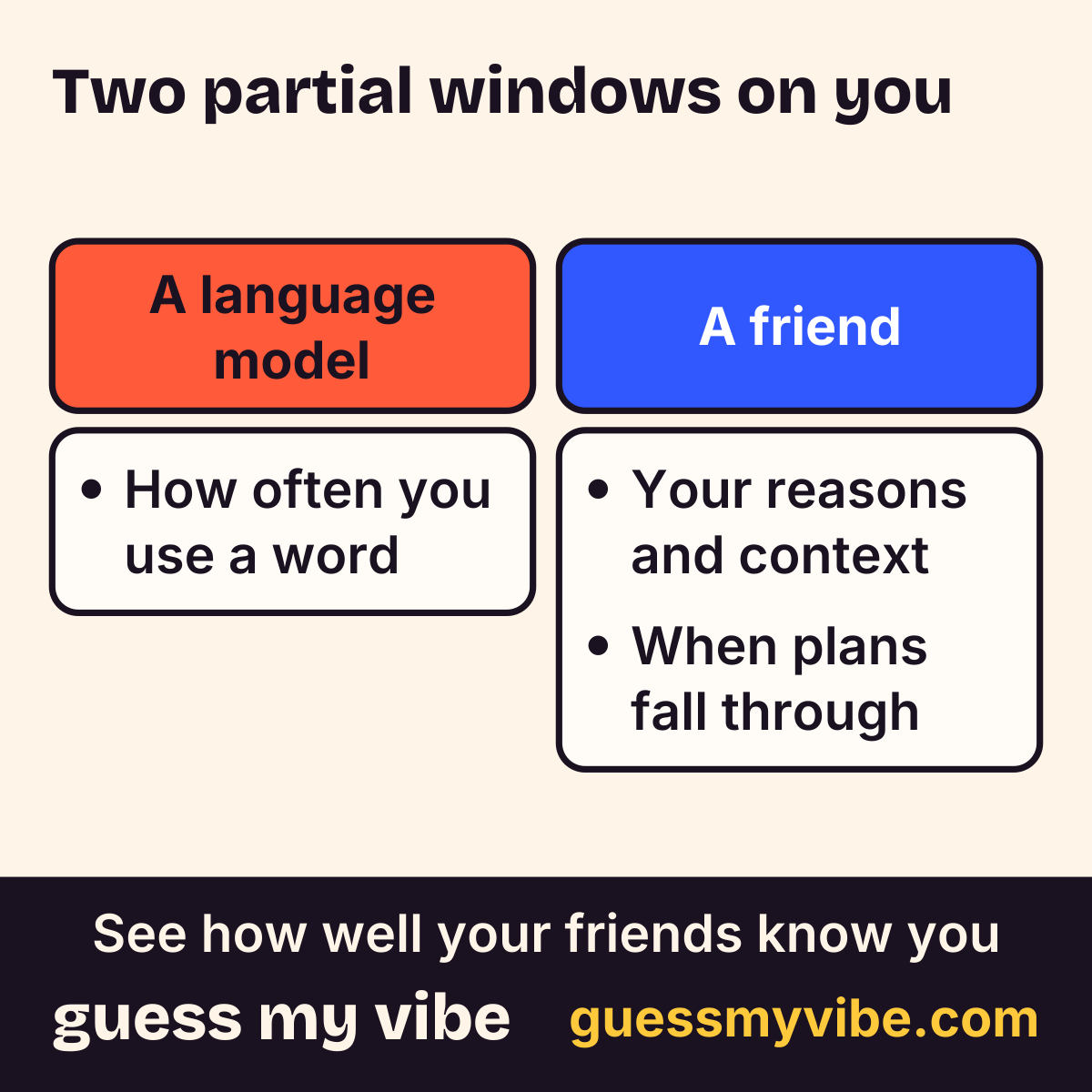
The reverse is also true. A friend can see things your posts leave out, like how you act when plans fall through, and the model can see things a friend would never count, like how often you use a certain word. Each is a different, partial window onto the same person. If you are curious how those windows line up in your own life, the interesting number is not how a model scores you. It is where the people close to you agree or disagree with how you see yourself.
Cite this figure
Figure: "Two partial windows on you." Guess My Vibe (guessmyvibe.com). https://guessmyvibe.com/learn/what-your-posts-say-about-you#figure-two-partial-windows
What this means for you
The useful takeaway is not that you should police your captions. It is that your everyday wording carries information about you that you did not consciously put there, and that the patterns are real enough to be studied at scale. It is also a reason for some privacy awareness: the same techniques that can estimate personality from text can be used by anyone with enough data, which is part of why the authors describe computers outpacing humans in personality judgment as bringing significant opportunities, along with difficulties, in psychological assessment, marketing and privacy [4].
If you are curious how you come across, there is a much friendlier route than running an algorithm on your feed: ask the people who know you. Their read is built from far more than your posts.
Skip the algorithm and ask your friends
Guess My Vibe uses friends' guesses instead of text analysis. You answer honest questions about yourself, a friend guesses how you answered, and the game shows where their picture of you matches yours and where it differs. It is the same basic question as the research on language and personality, how well can someone read you, answered by a person who knows you instead of a model reading your timeline.
Key takeaways
- In an analysis of 700 million words, phrases and topics from 75,000 Facebook users who also took personality tests, the authors found striking variations in language with personality, gender and age [1].
- In 694 bloggers, personality correlated with word use for broad word categories and for individual words, replicating earlier category-level findings and adding many new word-level links [3].
- A language-based model built on 66,732 Facebook users and tested on 4,824 others agreed with self-reports and informant reports, discriminated between traits and was stable over 6-month intervals [2].
- A computer model built from Facebook Likes (not words) made more accurate personality judgments (r = .56) than the person's Facebook friends rating them on a questionnaire (r = .49) [4].
- Treat all of this as group-level patterns: the studies used volunteers and Facebook or blog data, and they show that language and traits go together, not that one post gives you away.
- This isn't therapy, a diagnosis, or a substitute for professional care.
Questions people ask
Can your posts reveal your personality?
On average across large groups, yes: word use tracks Big Five traits in analyses of blogs and Facebook messages [3] [1]. For any one person, a few posts are a weak guide. The studies describe patterns, not individual verdicts.
How accurate is personality estimation from social media language?
In one study, a language-based model's estimates agreed with self-reports and informant reports, discriminated between traits and were stable over 6 months [2]. The authors describe the findings as valid personality measures that can complement traditional methods, not as perfect.
Is a computer better than a friend at judging personality?
On one narrow measure, yes: a model using Facebook Likes reached r = .56 against r = .49 for friends' questionnaire ratings [4]. That was Likes, not posts, and a questionnaire, not a real conversation, so it does not mean friends do not know you.
Which words are linked to which traits?
Large studies found many associations. One example from 75,000 Facebook users is that neurotic people disproportionately used the phrase 'sick of' and the word 'depressed' [1]. These are tendencies across groups, not a reliable sign for one person.
See how well your friends know you.
Free. Answer 10 quick questions about you, then send your link. Friends play in their browser, no app needed.
Start freeReferences
- [1] Schwartz, H. A., Eichstaedt, J. C., Kern, M. L., Dziurzynski, L., Ramones, S. M., Agrawal, M., Shah, A., Kosinski, M., Stillwell, D., Seligman, M. E. P., & Ungar, L. H. (2013). Personality, gender, and age in the language of social media: the open-vocabulary approach. PLoS ONE, 8(9), e73791. PubMed: 24086296 (opens in a new tab)
- [2] Park, G., Schwartz, H. A., Eichstaedt, J. C., Kern, M. L., Kosinski, M., Stillwell, D. J., Ungar, L. H., & Seligman, M. E. P. (2015). Automatic personality assessment through social media language. Journal of Personality and Social Psychology, 108(6), 934–952. PubMed: 25365036 (opens in a new tab)
- [3] Yarkoni, T. (2010). Personality in 100,000 Words: A large-scale analysis of personality and word use among bloggers. Journal of Research in Personality, 44(3), 363–373. PubMed: 20563301 (opens in a new tab)
- [4] Youyou, W., Kosinski, M., & Stillwell, D. (2015). Computer-based personality judgments are more accurate than those made by humans. Proceedings of the National Academy of Sciences, 112(4), 1036–1040. PubMed: 25583507 (opens in a new tab)
How we find and check these sources: how we write. Spotted an error? Report a correction.
Related
Cite this article
- Title
- What Your Posts Say About You: Language and Personality
- Publisher
- Guess My Vibe
- Updated
- URL
- https://guessmyvibe.com/
learn/ what-your-posts-say-about-you
Copy this citation
Guess My Vibe. (2026, October 4). What Your Posts Say About You: Language and Personality. Guess My Vibe. https://guessmyvibe.com/
To point at one section, add that section's anchor (the # link on its heading) to the URL.