Texting personality is a real but small-effect research area: how much someone texts, which words they use, and how often they lean on slang or emoticons all show modest but real links to the Big Five. More extraverted and more neurotic people tend to text more; word choice and emotional tone in texts track personality the same way spoken language and writing style do. The effects are consistently small, not a party trick for reading someone from their texts alone.
What research actually says about texting and personality
Texting personality, the idea that how someone texts reveals something real about who they are, has more research behind it than a quiz-app headline usually lets on, but the honest version of that research is modest. Studies that actually collected real text messages and matched them against personality questionnaires do find consistent patterns. They're small correlations, not a reliable way to read a stranger's whole personality from their texting style, and the studies behind them are modest in size, worth keeping in mind before treating any of this as more certain than it is.
Extraversion and neuroticism track how much people text
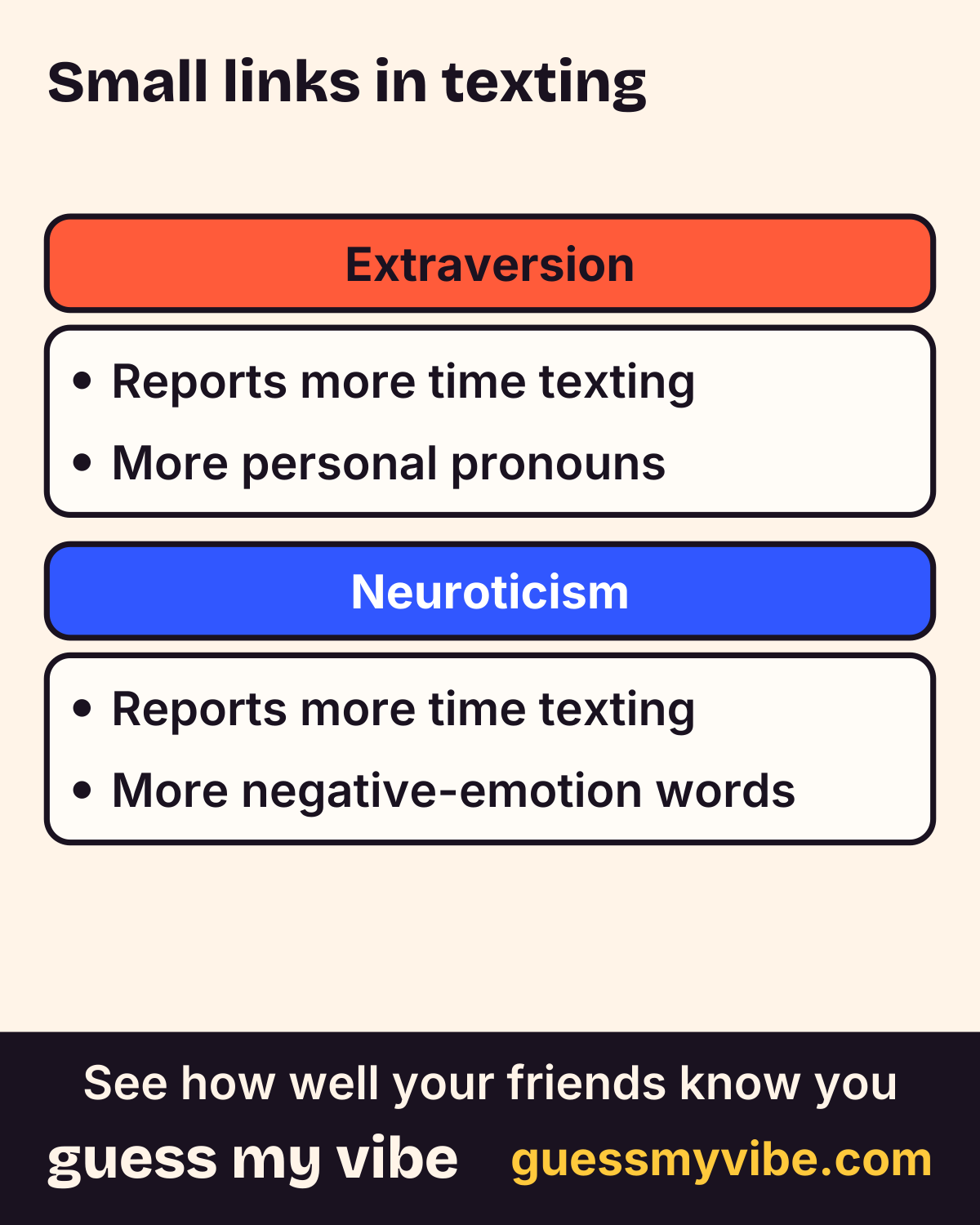
The most direct study on volume comes from a survey of 200 university students, which found that more extraverted and more neurotic individuals both reported spending more time text messaging, while more disagreeable individuals spent more time on phone calls instead, and both disagreeableness and lower self-esteem were separately linked to heavier instant-messaging use [2]. None of these are large effects, and this is a single, modest-sized sample, but the direction for extraversion lines up with a much older, well-replicated finding: more extraverted people seek out more social contact generally, and texting is one more channel for that.
Personality shows up in the actual words, not just how often you text
A more detailed study had 224 college students (ages 18 to 41, almost all 18 to 21) sign up for what was billed as "cell phone research," bring their own phones to the lab, complete a standard Big Five personality measure, then hand over the exact content of their last 20 sent text messages. Each message was then run through a standard language-analysis tool that counts categories like pronouns, emotion words, and social words [1]. Several small but real correlations turned up: extraversion was linked to more personal pronoun use, especially "I," and to fewer impersonal pronouns; neuroticism was linked to more negative-emotion words; and agreeableness was linked to more positive-emotion words. None of these correlations were large (most were in the roughly .13 to .20 range), which in plain terms means personality nudges texting language in a consistent direction without coming close to determining it. Plenty of what any specific text says is about the moment, the topic, or who's being texted, not a stable trait.
The same dataset found a few differences by gender worth knowing too: men used more swear words and more "g-dropped" word endings (texting "doin" instead of "doing"), while women used more emoticons, more expansions (stretching a word out, like "heyyyy"), and slightly more words overall. None of these are personality findings exactly, but they're a reminder that texting style reflects more than one individual-difference variable at once, personality is one real ingredient in a mix that also includes gender, mood and who's on the other end of the conversation.
Cite this figure
Figure: "Small links in texting." Guess My Vibe (guessmyvibe.com). https://guessmyvibe.com/learn/texting-personality#figure-small-links
Curious how your friends would answer?
Free. Answer 10 quick questions about you, then send your link. Friends play in their browser, no app needed.
Start freeSlang and emoticons track closeness, not just personality
The same study found that how much slang, abbreviations and emoticons showed up in a text depended on both the texter's personality and how close they were to the person they were texting. Most of the texts collected were sent to people the texter liked and felt close to: just over half went to friends, about three in ten to a significant other, and the rest to family or roommates. Emoticons in particular were a strong marker of relationship closeness: they showed up more than three times as often in texts to a significant other as in texts to a friend, and rarely at all in texts to family or roommates [1]. That's a useful caveat for anyone tempted to read someone's "texting personality" from a single conversation. The same person will text very differently depending on who's on the other end, which means relationship context, not personality alone, explains a meaningful share of what a text looks like.
Why this fits a much bigger pattern in personality research
Texting personality isn't a standalone curiosity, it's one small corner of a well-established research area on personality and language use generally. Statistical models trained to recognize the Big Five from real speech and writing, using cues like word choice, sentence structure and self-references, consistently do a better job when trained on how someone actually talks than on their own self-report of their personality [3]. A separate line of research built and validated a full inventory of communication styles (how expressive, precise, or emotionally direct someone's everyday communication is), and found personality measured with standard trait inventories showed medium-to-strong associations with those styles [4]. Texting is just one more channel where the same underlying pattern, personality leaking into everyday language in small, consistent ways, shows up.
A caution worth repeating: small samples, small effects
Both of the studies specifically about texting and personality used modest samples, a few hundred college or university students each, at a single point in time. That's enough to establish that a real pattern exists, not enough to promise it generalizes to every age group, culture, or texting platform, or to support a confident claim like "you can tell someone's personality from their texts." The honest summary is closer to: personality shows up faintly and unevenly in texting habits, the same way it shows up faintly and unevenly in how someone talks, dresses, or decorates a room, worth noticing, not worth treating as a verdict.
Both studies were also run before today's texting habits fully took shape, well before autocomplete, voice-to-text, and apps that default to full sentences over clipped abbreviations became the norm. A small, real link between personality and texting style is a reasonable thing to expect to hold up, since the broader language-and-personality pattern it's built on is well replicated, but the exact numbers from any single study, from any single decade of texting conventions, are the part worth holding loosely.
See if your friends know your texting tells
Guess My Vibe turns this into a quick, honest game instead of a guessing exercise done alone: you answer questions about your own everyday habits and personality, a friend guesses your answers, and you compare. It's a fun way to find out whether the people who actually read your texts every day have picked up on the small, real patterns this research describes.
Key takeaways
- In a study of 224 college students, personality tracked specific patterns in actual text messages: extraversion with more personal pronouns, neuroticism with more negative-emotion words, and agreeableness with more positive-emotion words [1].
- In a separate study of 200 university students, more extraverted and more neurotic people both reported spending more time texting, while more disagreeable people spent more time on phone calls instead [2].
- How much slang, abbreviations and emoticons show up in a text depends on both personality and how close the texter is to the recipient, not personality alone [1].
- This fits a much broader pattern: statistical models built on real speech and writing (not just texts) can pick up Big Five traits from language cues, and they do better when trained on how someone actually talks than on their own self-report [3].
- This isn't therapy, a diagnosis, or a substitute for professional care; it's a plain-English summary of research on language and personality, with honest, small effect sizes.
Questions people ask
Can you tell someone's personality from how they text?
Only loosely. Research finds small but real links between personality and texting, like extraversion with more personal pronouns and neuroticism with more negative-emotion words, but the correlations are modest, not strong enough to read someone's personality from their texts alone [1].
Do extraverts text more than introverts?
One study of 200 university students found more extraverted (and more neurotic) people reported spending more time text messaging, while more disagreeable people leaned on phone calls instead [2]. It's a single, modest-sized study, so treat it as a real but small pattern, not a rule.
Why do I text differently with different people?
Research backs this up directly: how much slang, abbreviations and emoticons appear in a text depends on how close the texter is to the recipient, not personality alone, with emoticons especially tied to texting a significant other [1].
Is texting personality research reliable?
The underlying pattern, personality showing up in language use, is well-established and replicated across speech, writing and now text. The texting-specific studies themselves are smaller, single-sample studies, so their exact numbers shouldn't be treated as the final word [1].
Does personality show up in other kinds of language too?
Yes. Statistical models built on real speech and writing can recognize Big Five traits from language cues like word choice and self-references, and they do better using how someone actually talks than their own self-report [3].
See how well your friends know you.
Free. Answer 10 quick questions about you, then send your link. Friends play in their browser, no app needed.
Start freeReferences
- [1] Holtgraves, T. (2011). Text Messaging, Personality, and the Social Context. Journal of Research in Personality, 45(1), 92–99. doi.org/10.1016/j.jrp.2010.11.015 (opens in a new tab)
- [2] Ehrenberg, A., Juckes, S., White, K. M., & Walsh, S. P. (2008). Personality and Self-Esteem as Predictors of Young People's Technology Use. CyberPsychology & Behavior, 11(6), 739–741. PubMed: 18991531 (opens in a new tab)
- [3] Mairesse, F., Walker, M. A., Mehl, M. R., & Moore, R. K. (2007). Using Linguistic Cues for the Automatic Recognition of Personality in Conversation and Text. Journal of Artificial Intelligence Research, 30, 457–500. doi.org/10.1613/jair.2349 (opens in a new tab)
- [4] de Vries, R. E., Bakker-Pieper, A., Konings, F. E., & Schouten, B. (2013). The Communication Styles Inventory (CSI). Communication Research, 40(4), 506–532. doi.org/10.1177/0093650211413571 (opens in a new tab)
How we find and check these sources: how we write. Spotted an error? Report a correction.
Related
Cite this article
- Title
- Texting Personality: What Your Texts Say About You
- Publisher
- Guess My Vibe
- Updated
- URL
- https://guessmyvibe.com/
learn/ texting-personality
Copy this citation
Guess My Vibe. (2026, October 3). Texting Personality: What Your Texts Say About You. Guess My Vibe. https://guessmyvibe.com/
To point at one section, add that section's anchor (the # link on its heading) to the URL.