Communication styles aren't really four fixed types, that's a popular framework, not a research classification. Personality researchers measure communication style as several separate, continuous behaviors (how expressive, precise, or argumentative someone is), and those behaviors overlap substantially with the Big Five personality traits [1]. Because it shows up in how you actually talk, a friend who's heard you talk can usually call it.
The "4 communication styles" quiz isn't a research classification
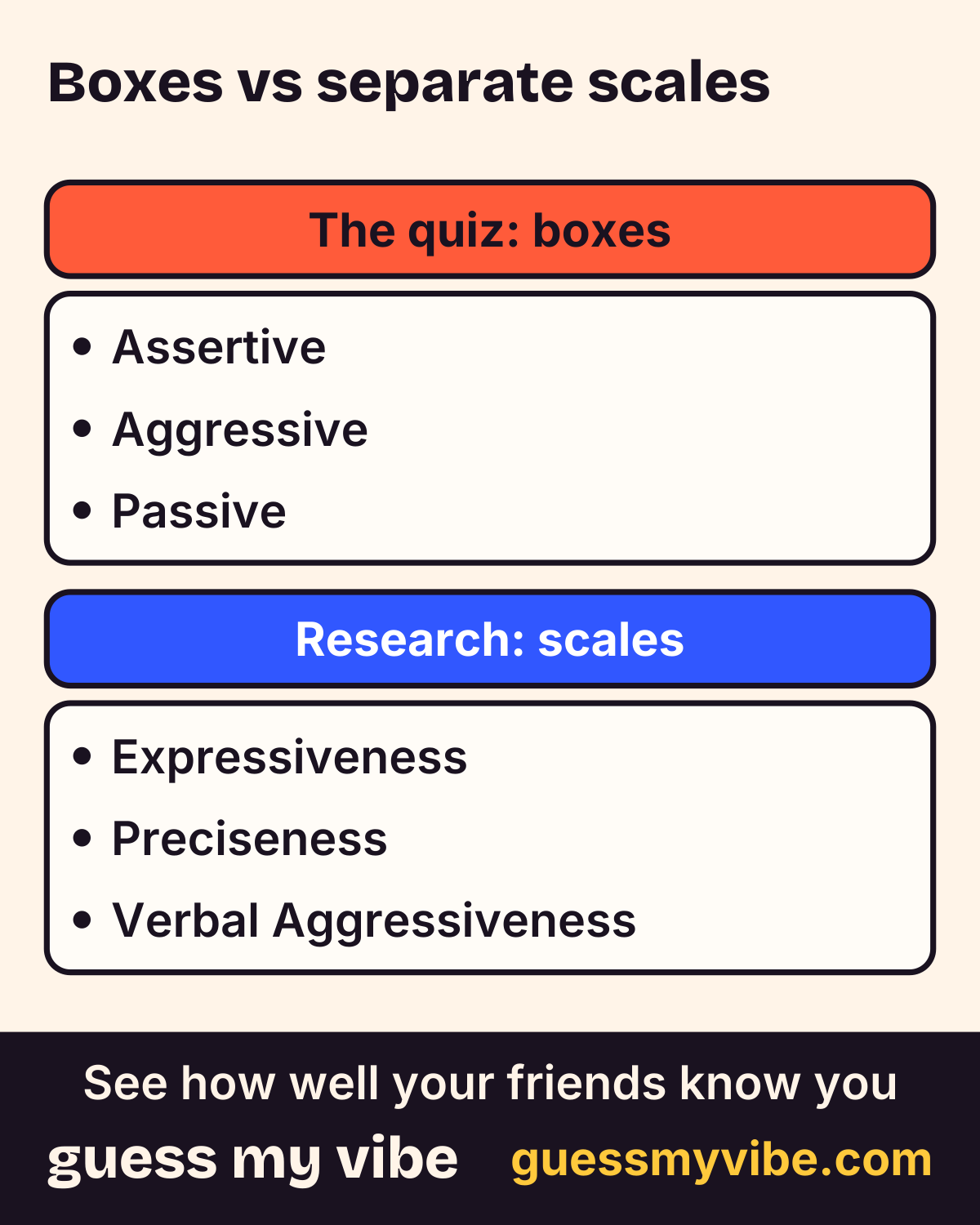
Search "communication styles" and most of what comes back is a quiz that sorts you into one of four boxes: Assertive, Aggressive, Passive, and Passive-Aggressive, or a similar four-way split like Analytical, Intuitive, Functional, and Personal. These lists show up constantly in workplace training and conflict-resolution guides, and they're genuinely useful shorthand for talking about a real difference in how people communicate. What they aren't is a classification personality researchers built and tested the way they built and tested the Big Five. Nobody ran a large, replicated study proving there are exactly four communication styles and everyone fits neatly into one. The honest, research-backed version of this topic treats communication style the same way it treats personality: as several separate behaviors measured on a scale, not a sorting hat with four possible results.
What communication styles research actually measures
The field's foundational model came from communication researcher Robert Norton in 1978, decades before the pop-psychology quizzes existed. Norton broke what he called "communicator style" into nine separate behaviors, each measured on its own scale: how dominant someone comes across, how dramatic, how animated, how open, how contentious (argumentative), how relaxed, how friendly, how attentive, and how much of a lasting impression they leave, plus one combined outcome he called communicator image. He tested the model across two samples, one of 80 people and one of more than a thousand [2]. That structure, several independent dials rather than one on/off switch, set the pattern every later communication-style researcher has followed.
A more recent model, the Communication Styles Inventory (CSI), was built and tested against real behavior rather than people labeling themselves. It groups communication style into six dimensions: Expressiveness (how much you talk and show emotion), Preciseness (how exact and organized your language is), Verbal Aggressiveness, Questioningness (how much you ask versus tell), Emotionality, and Impression Manipulativeness (how much you actively shape how you come across). Each of the six held up well across factor analysis and showed strong reliability [1]. Like Norton's model almost 40 years earlier, it's a profile across several continuous traits, not a single category.
Cite this figure
Figure: "Boxes vs separate scales." Guess My Vibe (guessmyvibe.com). https://guessmyvibe.com/learn/communication-styles#figure-quiz-boxes-vs-research-scales
How communication style connects to personality
The same study that built the CSI also measured personality directly, using two well-established personality inventories, and found medium-to-strong associations between a person's measured personality traits and their communication-style scores [1]. In plain words: how you come across in conversation isn't a separate skill you picked up independently of your personality. A real share of it is personality showing up through the words you choose, how much you talk, and how much emotion you let into the room.
Correlated isn't identical, though. Two people with similar personality traits can still land on noticeably different everyday communication habits, shaped by things personality doesn't cover on its own: what their family's dinner-table conversations were like growing up, what field they work in, or what their first language's conversational norms are. Communication style is personality plus everything else that shapes how a person actually talks.
Curious how your friends would answer?
Free. Answer 10 quick questions about you, then send your link. Friends play in their browser, no app needed.
Start freeYour words give away more personality than you'd think
Researchers have pushed this even further by training statistical models to guess someone's Big Five scores directly from language, in both recorded conversation and written text. The features that mattered most were often small, almost invisible things: roughly how many words someone used, how often they talked about themselves, how certain or hedging their phrasing sounded. Models trained on how a person was actually observed to talk did better than models trained on that same person's own self-reported personality, and the features that helped most were different for each trait [4]. That's a useful reminder for this whole topic: communication style is something other people can observe directly in the moment, not a private fact only you have access to.
Why a friend can usually call your communication style
Because communication style lives in behavior other people can hear and watch, it's exactly the kind of thing research says outside observers tend to read well. A meta-analysis pooling 263 samples and more than 44,000 people found that how accurately an outside observer reads someone's personality depends heavily on how well they know them and how visible the trait is day to day; getting to know someone better helps the most for traits that aren't very visible, and other people's ratings overall turned out to be strong, useful predictors of real behavior, not just noise [3]. A separate study of 165 people found that for sociable, outward behavior specifically, self-ratings, friends' ratings, and even strangers' ratings all landed in about the same place [5]. If a friend has heard you talk through even a handful of ordinary moments, they already have real evidence about your communication style, the same kind of evidence a researcher would use.
When two communication styles clash, it's rarely about caring less
None of the research above ranks one communication style as better than another; Preciseness isn't "more correct" than Expressiveness, and a high-Questioningness friend isn't more thoughtful than a low-Questioningness one. They're just different points on different dimensions, each tracking a real, separate piece of personality. That matters most when two styles land far apart inside the same friendship: a friend high in Verbal Aggressiveness (direct, blunt, comfortable pushing back) talking to one low in it (soft-pedaling, slow to disagree out loud) can genuinely misread each other, the first reading silence as agreement, the second reading directness as an attack, without either one caring less than the other. Knowing that the mismatch is a difference in style, not a difference in how much someone values the friendship, tends to make it a lot less personal.
Guess a friend's communication style, not just your own
Guess My Vibe doesn't score communication style as its own separate category, but plenty of its daily questions land on the same ground this research covers: whether you'd rather talk a problem through out loud or think it over alone, how directly you bring up something that's bothering you, how much you soften bad news before saying it. A friend who's actually watched you handle a hundred small moments like that has a real shot at calling your answers correctly, which is the same bet the self-other-agreement research above is measuring, just turned into a game.
Key takeaways
- The popular "4 communication styles" quiz (assertive, aggressive, passive, passive-aggressive, or similar four-type lists) is a management-training framework, not something personality researchers built or tested the way they tested the Big Five.
- Real communication-styles research measures style as several continuous dimensions, not a box you fall into: Norton's 1978 model used nine, the modern Communication Styles Inventory uses six [2] [1].
- Personality and communication style are linked but not identical: the same study that built the Communication Styles Inventory found medium-to-strong associations with measured personality traits, not a one-to-one match [1].
- Communication style lives in behavior other people can hear and watch, and other-ratings of personality track real behavior well once a rater actually knows the person; even computer models can guess personality from word choice alone [3] [4].
- This isn't therapy, a diagnosis, or a substitute for professional care.
Questions people ask
What are the 4 communication styles?
The most common version (Assertive, Aggressive, Passive, Passive-Aggressive) and similar four-way lists are popular management-training frameworks, not a classification personality researchers built or validated. Real communication-styles research measures style as several continuous traits instead, the way Norton's 1978 model used nine and the modern Communication Styles Inventory uses six.
Is communication style the same thing as personality?
No, but they're closely linked. Research building the Communication Styles Inventory found medium-to-strong associations between measured personality traits and communication-style scores. They overlap a lot without being identical: two people with similar personalities can still end up with different everyday communication habits.
Can you change your communication style?
Communication style is built mostly from habits and behavior, which tend to be easier to adjust on purpose than a personality trait is. That said, no study referenced here directly tested how much an adult can durably change their own communication style over time, so take that as a reasonable inference, not a proven result.
What's the most common communication style?
There's no solid population-level number for this. The research summarized here focuses on how communication-style dimensions relate to personality and to how accurately others read them, not on ranking how common each style is.
Can my friends tell how I communicate better than I can?
Not necessarily better, but about as well. Studies on self-other agreement find that outgoing, expressive behavior, a big part of communication style, is one of the traits where a friend's rating and a person's own self-rating line up most closely.
See how well your friends know you.
Free. Answer 10 quick questions about you, then send your link. Friends play in their browser, no app needed.
Start freeReferences
- [1] de Vries, R. E., Bakker-Pieper, A., Konings, F. E., & Schouten, B. (2013). The Communication Styles Inventory (CSI). Communication Research, 40(4), 506–532. doi.org/10.1177/0093650211413571 (opens in a new tab)
- [2] Norton, R. W. (1978). Foundation of a communicator style construct. Human Communication Research, 4(2), 99–112. doi.org/10.1111/j.1468-2958.1978.tb00600.x (opens in a new tab)
- [3] Connelly, B. S., & Ones, D. S. (2010). An other perspective on personality: Meta-analytic integration of observers' accuracy and predictive validity. Psychological Bulletin, 136(6), 1092–1122. PubMed: 21038940 (opens in a new tab)
- [4] Mairesse, F., Walker, M. A., Mehl, M. R., & Moore, R. K. (2007). Using Linguistic Cues for the Automatic Recognition of Personality in Conversation and Text. Journal of Artificial Intelligence Research, 30, 457–500. doi.org/10.1613/jair.2349 (opens in a new tab)
- [5] Vazire, S. (2010). Who knows what about a person? The self-other knowledge asymmetry (SOKA) model. Journal of Personality and Social Psychology, 98(2), 281–300. PubMed: 20085401 (opens in a new tab)
How we find and check these sources: how we write. Spotted an error? Report a correction.
Related
- Ghosting: Why People Do It, According to Research
- Texting Personality: What Your Texts Say About You
- Overthinking Texts: Why You Reread Every Message
- This or That Questions for Friends, and What They Say
- Social Battery: The Science of Why Socializing Drains You
- How Well Do You Know Me Questions to Ask Friends
- How to Make Small Talk, According to Research
- Why Do People Gossip? What the Research Actually Found
- Active Listening: What Research Says It Actually Does
- Assertive Communication: What the Research Says
More in Communication, texting and conversation
- Friend Who Only Talks About Themselves: What Research Says
- Active Listening: What Research Says It Actually Does
- Building Rapport: The 3 Ingredients Researchers Found
- How to Have Deep Conversations, Backed by Research
- Communication in Relationships: What the Research Shows
- Left on Read: Why We Overthink Reply Times
- Assertive Communication: What the Research Says
- How to Keep a Conversation Going: Ask Follow-Ups
- The Chameleon Effect: Why We Copy People We Like
- Ghosting: Why People Do It, According to Research
- Inside Jokes: Why Shared Laughter Builds Closeness
- Humor Styles: What the Four Types Say About Your Personality
- Texting Personality: What Your Texts Say About You
- Overthinking Texts: Why You Reread Every Message
- Sarcasm: Why Some Friends Speak It Fluently
- How to Make Small Talk, According to Research
Cite this article
- Title
- Communication Styles and Personality: The Real Research
- Publisher
- Guess My Vibe
- Updated
- URL
- https://guessmyvibe.com/
learn/ communication-styles
Copy this citation
Guess My Vibe. (2026, October 3). Communication Styles and Personality: The Real Research. Guess My Vibe. https://guessmyvibe.com/
To point at one section, add that section's anchor (the # link on its heading) to the URL.