An inside joke works because the laughing-together moment, not the joke itself, is doing the real work. Research tracking how much of a conversation two people spend laughing at the same time found that shared laughter specifically, not laughter overall, tracked closeness and relationship quality [1]. Inside jokes also come from a wider pattern: shared, novel experiences build closeness on their own [2], and naturally occurring laughter tends to happen in small, tight clusters rather than evenly across a whole group [3].
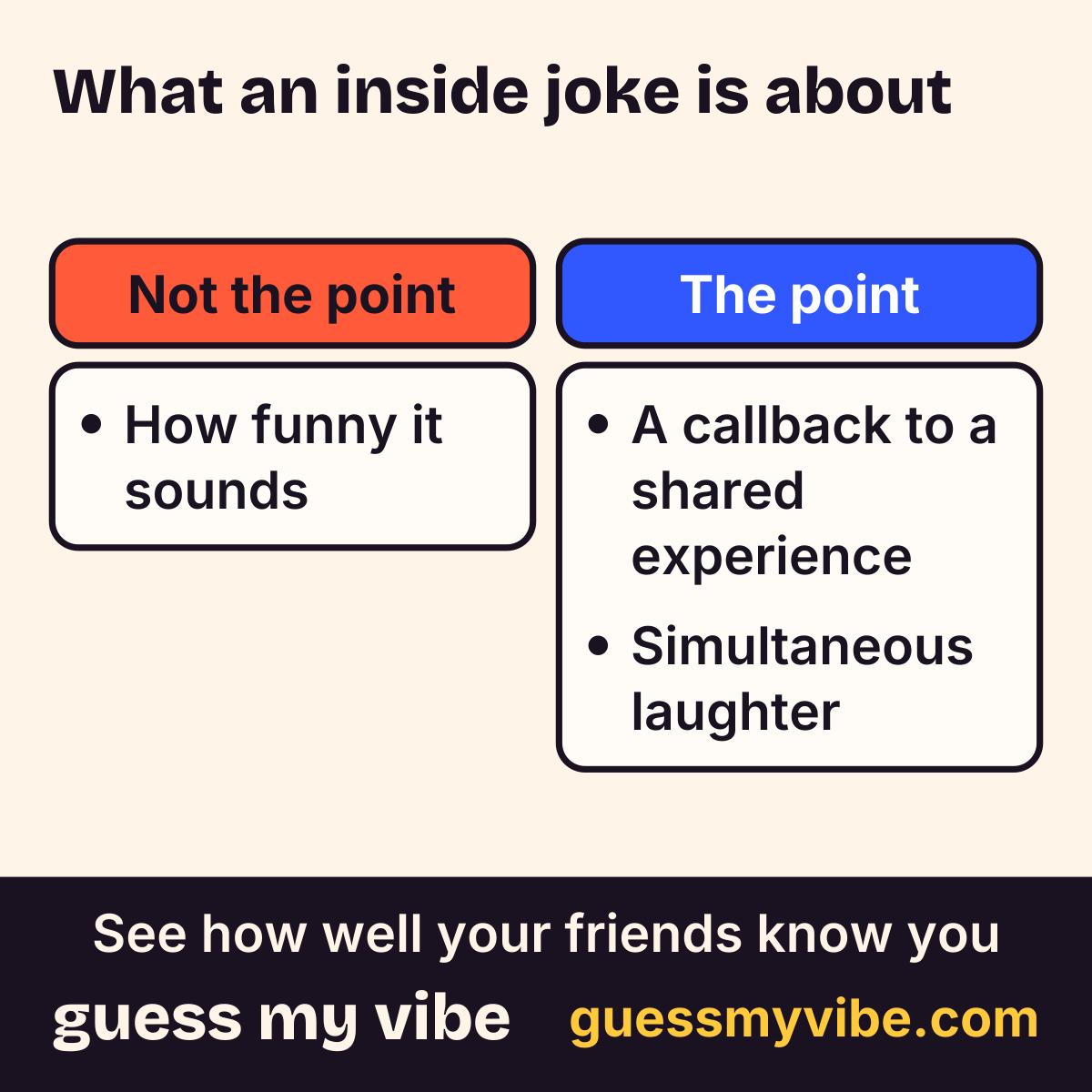
Inside jokes rarely sound funny to anyone outside the two people who have one. Say the line out loud to a third person and it usually falls flat, which is itself the clue to what's actually going on. An inside joke isn't funny because of its content. It's a compressed reference to a moment two people shared, and the laugh when it comes back up is really a small, repeated confirmation that the moment still means something to both of you. Research on shared laughter, shared experience, and how closeness actually forms backs up that reading pretty directly.
It's the laughing together that counts
One study put a number on this. Researchers video-recorded couples describing how they first met, then coded exactly how much of the conversation each person spent laughing, and specifically how much they spent laughing at the same time as the other person [1]. After controlling for each person's laughter on its own, the amount of simultaneous, shared laughter was the piece that independently tracked how the two of them rated their relationship quality, their closeness, and how supported they felt. It's worth being precise about the sample here: this study looked at 71 heterosexual romantic couples, not platonic friends, so it isn't direct evidence about friendship specifically. What it does show, convincingly, is that shared laughter as its own behavior, separate from how funny either person is, tracks closeness in a close relationship. An inside joke is a repeatable, on-demand way to produce exactly that shared-laughter moment on purpose.
Cite this figure
Figure: "What an inside joke is about." Guess My Vibe (guessmyvibe.com). https://guessmyvibe.com/learn/inside-jokes#figure-what-makes-an-inside-joke
Why inside jokes form in the first place
Inside jokes almost always trace back to a specific, shared experience: something slightly unexpected happened to both of you, and the retelling became the bit. That tracks with a broader body of research on how closeness forms. A classic study built a 45-minute structured procedure (escalating personal questions plus a joint task) specifically to generate closeness between strangers in a lab, and found it worked better than a comparable small-talk task at producing genuine post-interaction closeness [2]. The mechanism isn't the specific questions used. It's that doing something unusual together, in real time, builds a kind of shared reference point that ordinary conversation doesn't. An inside joke is a much smaller, funnier, naturally occurring version of the same thing: two people doing or noticing something together, then carrying a private reference to it forward.
Curious how your friends would answer?
Free. Answer 10 quick questions about you, then send your link. Friends play in their browser, no app needed.
Start freeWhy laughter clusters in small groups
A separate line of research looked at where laughter actually happens in public, naturally, not in a lab. Observing real laughter groups found that laughing doesn't spread evenly through a crowd. It clusters in small groups, typically centered around three people at a time [3]. The researchers frame this as a kind of low-cost social bonding, a way of maintaining several close relationships at once more efficiently than one-on-one attention would allow, similar to how grooming works in other primates but faster and reaching more people simultaneously. That pattern lines up with how inside jokes actually spread inside a bigger friend group too: they rarely belong to the whole group equally. They tend to live inside the specific smaller cluster of people who were actually there when the moment happened.
Why some inside jokes fade and others don't
Not every inside joke survives. Some get overused until they stop landing, and others fade quietly once the context that made them funny stops being relevant to either person's life. The shared-laughter research offers a plausible reason why the ones that do survive keep working: it's the live, simultaneous laughing that's doing the bonding work, not the content of the joke sitting in memory [1]. An inside joke that still gets an actual laugh, not just a knowing nod, is still producing that small shared-laughter moment each time it comes back up. One that only gets a polite smile has stopped doing that work, even if everyone involved would still technically call it "their" joke. That's also why reviving an old inside joke with a friend you haven't talked to in a while can feel oddly effective: it's reopening a channel that used to reliably produce real, shared laughter, not just nostalgia for its own sake. That's also a reasonable, low-effort way to check in on a friendship that's gone quiet: bringing back an old joke and seeing whether it still gets a real laugh.
The other half: sharing good news, not just jokes
Inside jokes are one channel for building closeness through small shared moments, but they're not the only one, and it's worth knowing the research doesn't stop at humor. A separate line of studies on "capitalization," telling someone else your good news, found that sharing a positive event boosts daily well-being on its own, and that the boost is bigger when the person you tell responds with real, active enthusiasm rather than a flat or distracted reaction [4]. In close relationships, a partner's habit of responding that way went with higher relationship satisfaction and intimacy over time. An inside joke and an enthusiastically received piece of good news aren't the same thing, but they're close cousins: both are small, repeated, low-stakes moments where someone shows up for you in a way that quietly confirms the relationship matters.
Put together, the research says an inside joke isn't a trivial thing, even though it usually sounds trivial out loud. It's a specific, shared-laughter callback to a shared experience, exactly the combination the research above ties to closeness, repackaged as something you can bring up again any time you want that confirmation back.
Guess My Vibe can't manufacture an inside joke for you, but the daily rounds tend to surface the same kind of small, specific, only-the-two-of-you moments that inside jokes usually grow out of: a guess that's way off in a very "that's so you" way, or a friend nailing something nobody else would've known.
Key takeaways
- It's the laughing together, specifically, that matters. One study found the share of a conversation spent laughing at the same moment as the other person tracked relationship quality and closeness, over and above how much either person laughed on their own [1].
- Shared, novel experiences build closeness between people on their own, which is part of why a joke born out of something that happened only to you two carries more weight than a joke either of you could tell anyone [2].
- Naturally occurring laughter doesn't spread evenly through a crowd. It clusters in small groups, usually around three people, consistent with the idea that laughter helps maintain a handful of close bonds at once rather than a whole room equally [3].
- Telling a friend good news and having them respond with real, active enthusiasm (not just politely) is linked to higher relationship well-being, a separate but related channel through which small shared moments build closeness [4].
- This isn't therapy, a diagnosis, or a substitute for professional care.
Questions people ask
Why do inside jokes feel so much funnier than they actually are?
Because the humor isn't really the point. An inside joke is a callback to a specific shared experience, and research finds it's the shared, simultaneous laughter, not how objectively funny something is, that tracks relationship closeness [1].
Does sharing a laugh actually build closeness, or does closeness just cause the laughing?
The research can't fully separate the two, but one study found shared laughter tracked with closeness even after accounting for each person's own laughter, suggesting it isn't only a byproduct of an already-close relationship [1].
Why do inside jokes usually belong to a small group of friends, not the whole friend group?
Naturally occurring laughter clusters in small groups, typically around three people, rather than spreading evenly through a crowd [3]. Inside jokes tend to follow that same pattern, living inside whichever smaller cluster was actually there for the moment.
Is shared laughter research only about romantic couples?
The specific study on simultaneous laughter and relationship quality used romantic couples [1], so it isn't direct evidence about friendship. The broader findings on shared experience building closeness [2] and small-group laughter clustering [3] aren't limited to romantic couples.
What else builds closeness the same way an inside joke does?
Sharing good news and getting an enthusiastic response works through a related channel: research on "capitalization" found that how someone reacts to your good news tracks with relationship well-being, separate from the event itself [4].
See how well your friends know you.
Free. Answer 10 quick questions about you, then send your link. Friends play in their browser, no app needed.
Start freeReferences
- [1] Kurtz, L. E., & Algoe, S. B. (2015). Putting laughter in context: Shared laughter as behavioral indicator of relationship well-being. Personal Relationships, 22(4), 573–590. doi.org/10.1111/pere.12095 (opens in a new tab)
- [2] Aron, A., Melinat, E., Aron, E. N., Vallone, R. D., & Bator, R. J. (1997). The experimental generation of interpersonal closeness: A procedure and some preliminary findings. Personality and Social Psychology Bulletin, 23(4), 363–377. doi.org/10.1177/0146167297234003 (opens in a new tab)
- [3] Dezecache, G., & Dunbar, R. I. M. (2012). Sharing the joke: the size of natural laughter groups. Evolution and Human Behavior, 33(6), 775–779. doi.org/10.1016/j.evolhumbehav.2012.07.002 (opens in a new tab)
- [4] Gable, S. L., Reis, H. T., Impett, E. A., & Asher, E. R. (2004). What do you do when things go right? The intrapersonal and interpersonal benefits of sharing positive events. Journal of Personality and Social Psychology, 87(2), 228–245. PubMed: 15301629 (opens in a new tab)
How we find and check these sources: how we write. Spotted an error? Report a correction.
Related
Cite this article
- Title
- Inside Jokes: Why Shared Laughter Builds Closeness
- Publisher
- Guess My Vibe
- Updated
- URL
- https://guessmyvibe.com/
learn/ inside-jokes
Copy this citation
Guess My Vibe. (2026, October 3). Inside Jokes: Why Shared Laughter Builds Closeness. Guess My Vibe. https://guessmyvibe.com/
To point at one section, add that section's anchor (the # link on its heading) to the URL.