A friend group isn't one flat list. Research on real social networks finds people's relationships sort into layers by closeness, from a few very close people out to a much wider circle of looser contacts [1]. The popular idea that humans can only keep about 150 stable relationships ("Dunbar's number") comes from one specific set of studies, and a 2021 statistical re-analysis found the number itself doesn't hold up [2]. Personality also shapes who ends up in a friend group and how long they stay, with agreeableness mattering most [3].
A friend group looks, from the outside, like one unit: the people in your group chat, the ones tagged in the same photos. Up close it's never actually flat. Some people in that group you'd call at 2 a.m., others you only see when everyone else is also there, and research on real social networks backs up exactly that shape. People's relationships sort into layers by closeness, and the popular shorthand for "how many friends can a person actually keep track of" (Dunbar's number) turns out to rest on evidence that's shakier than the headline version suggests. This article covers what the data on friend group size and structure actually shows, where it's genuinely solid, where it's disputed, and what personality has to do with who sticks around in a group.
A friend group is layers, not a list
One study ran a fractal analysis on real human grouping data and found something specific: group sizes don't spread out evenly or cluster around one single number. They form a discrete hierarchy, with each layer roughly three times the size of the one inside it, a pattern close to 3 to 5 people, then 9 to 15, then 30 to 45, and on up [1]. That maps onto the everyday shape of a social life pretty well: a tiny inner circle you talk to constantly, a wider group of close friends, a looser circle of people you'd call friends but see less often, and a much bigger outer layer of acquaintances. The researchers describe this as a kind of hierarchical processing of social closeness, groupings your brain organizes by how near someone feels, not a single cutoff.
Where "Dunbar's number" comes from, and why it's disputed
The number everyone's heard, 150, comes from a specific line of research connecting primate neocortex size to typical group size, then applying that relationship to humans. One of the clearest human tests of it used UK Christmas card lists: researchers counted how many people respondents actually sent cards to and found an average maximum network size of 153.5, remarkably close to the 150 figure that primate brain-size comparisons would suggest [4]. That's a real finding, from a real study, and it's the actual evidence behind the famous figure, not just a number someone made up.
What's weaker is treating 150 as a fixed cognitive ceiling on relationships. A 2021 paper went back to the same type of underlying data (the neocortex-size-to-group-size relationship across primates) and tested it with several different, equally valid statistical methods. What came back varied enormously: one method produced an average estimate around 69 to 109 with a confidence interval spanning roughly 4 to 520, another around 16 to 42 with a confidence interval spanning roughly 2 to 336, intervals so wide that the authors concluded no single number can honestly be pulled from this kind of analysis [2]. That doesn't mean group size is unlimited or that Hill and Dunbar's 153.5 figure was wrong as a measurement. It means the step from "we measured roughly 150 contacts in this one dataset" to "150 is a hard-wired brain limit for everyone" isn't as solid as the number's fame suggests. Treat "Dunbar's number" as a useful rough idea (relationships don't scale infinitely, and they do seem to sort into layers) rather than a precise biological rule. It's a good example of a popular science factoid outrunning the data it was built on: the original measurement was real and carefully done, and the leap from that one measurement to a universal brain limit is where the evidence gets thin.
Curious how your friends would answer?
Free. Answer 10 quick questions about you, then send your link. Friends play in their browser, no app needed.
Start freeWhat personality has to do with your friend group
Group size is one question. A separate, more practical one is why some people end up with a wide friend group and others don't, and why some friendships inside a group last while others quietly fade. A review of the research on personality and friendship development found agreeableness has the most consistent effect of any of the Big Five traits on whether friendships form, hold together, or end, ahead of extraversion, conscientiousness, and openness to experience, all of which showed some effect but less reliably across studies, and neuroticism, which also mattered but less than agreeableness [3]. That tracks with lived experience: an extroverted person might meet more people and start more friendships, but warmth and follow-through, the behaviors that make up agreeableness, are what tends to keep a specific friendship from dissolving once the initial spark of a new connection wears off.
This also helps explain why a friend group rarely has one uniform personality. A group usually needs a mix: someone who organizes plans, someone who smooths over conflict, someone who's the one who actually texts first. None of that is captured by headcount alone. Two groups of exactly the same size can function completely differently depending on how the personalities inside them line up and who's doing the quiet maintenance work of keeping the group connected.
Structure matters more than size
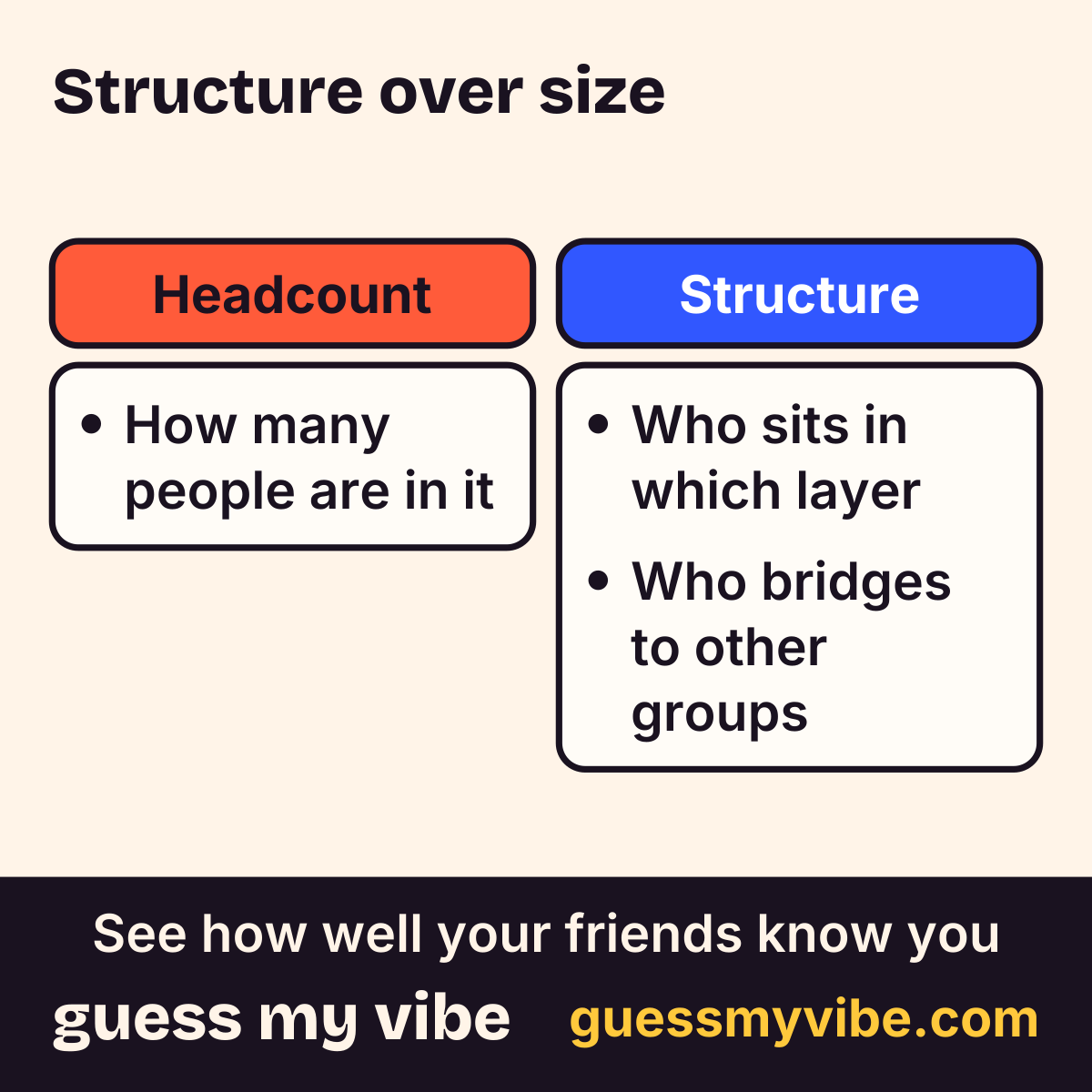
Put the layers finding and the personality finding together and a more useful picture of "friend group" emerges than a simple number. What matters for how a group actually works isn't just how many people are in it. It's who sits in which layer for you, who bridges your group to other groups, and which few people are doing the agreeableness-driven work of keeping everyone connected. A group of 15 with a tight inner three and good bridges to other circles can function better, and last longer, than a group of 40 with no real structure holding it together. Counting heads tells you almost nothing about which of those two groups you're actually looking at.
Guess My Vibe plays with that same layered structure instead of ignoring it: a friend guesses your answers one-on-one, so the game naturally works through whichever layer of your friend group you're closest to first, the people who'd actually know your answers well enough to guess them, rather than treating every name in the group chat as interchangeable.
Cite this figure
Figure: "Structure over size." Guess My Vibe (guessmyvibe.com). https://guessmyvibe.com/learn/friend-group#figure-structure-over-size
Key takeaways
- Friend groups aren't one flat list of equally close people. Studies of real social networks find relationships cluster into layers, with group sizes scaling up by roughly a factor of 3: about 3 to 5 in the innermost circle, 9 to 15 in the next, and so on [1].
- The specific claim that humans can only maintain about 150 relationships, often called "Dunbar's number," traces back to one UK survey that found a mean network size of 153.5 people [4], but a 2021 re-analysis found the statistics behind the original 150 figure produce wildly different numbers depending on the method, undermining the idea of one fixed limit [2].
- Agreeableness has the most consistent link to how friendships form, hold together, and end, more than how outgoing, organized, or curious someone is [3].
- A friend group's real structure (who's close to whom, who bridges to other groups) matters more for how it actually functions than its total headcount does.
- This isn't therapy, a diagnosis, or a substitute for professional care.
Questions people ask
How big is the average friend group?
It depends on which layer you're counting. Research on real social networks finds relationships sort into layers roughly three times the size of the one before, starting around 3 to 5 people in the innermost circle and widening from there [1]. A separate UK study found a mean maximum network size of about 153 people when counting everyone on someone's whole contact list (like a Christmas card list), not just the smaller group of people they're in frequent, active contact with [4].
Is Dunbar's number real?
The underlying measurement (a UK study finding a mean network size close to 150) is real [4]. The idea that 150 is a fixed, universal cognitive limit is disputed: a 2021 statistical re-analysis found the same type of data produces very different estimates depending on the method used, with confidence intervals too wide to pin down one number [2].
Why do some friend groups fall apart while others last for years?
Personality plays a real role. Agreeableness has the most consistent link to whether friendships form, hold together, or end, more than how outgoing or organized someone is [3]. Groups with people doing that quiet maintenance work tend to hold together better than groups without it, regardless of size.
Does a bigger friend group mean a better one?
Not based on the research here. Structure (who's close to whom, who bridges to other groups) explains more about how a friend group actually functions than raw headcount does.
Can you have too many close friends?
The layered-network research suggests closeness itself is naturally limited, with far fewer people in your innermost circle than in your wider circle of friends [1]. That's a description of how relationships tend to sort, not a rule about a maximum number you're allowed to have.
See how well your friends know you.
Free. Answer 10 quick questions about you, then send your link. Friends play in their browser, no app needed.
Start freeReferences
- [1] Zhou, W.-X., Sornette, D., Hill, R. A., & Dunbar, R. I. M. (2005). Discrete hierarchical organization of social group sizes. Proceedings of the Royal Society B: Biological Sciences, 272(1561), 439–444. doi.org/10.1098/rspb.2004.2970 (opens in a new tab)
- [2] Lindenfors, P., Wartel, A., & Lind, J. (2021). 'Dunbar's number' deconstructed. Biology Letters, 17(5), 20210158. doi.org/10.1098/rsbl.2021.0158 (opens in a new tab)
- [3] Harris, K., & Vazire, S. (2016). On friendship development and the Big Five personality traits. Social and Personality Psychology Compass, 10(11), 647–667. doi.org/10.1111/spc3.12287 (opens in a new tab)
- [4] Hill, R. A., & Dunbar, R. I. M. (2003). Social network size in humans. Human Nature, 14(1), 53–72. PubMed: 26189988 (opens in a new tab)
How we find and check these sources: how we write. Spotted an error? Report a correction.
Related
- Mutual Friends: Why So Many Friendships Start Through One
- Emotional Contagion: Do Friends' Moods Rub Off on You?
- Inside Jokes: Why Shared Laughter Builds Closeness
- Humor Styles: What the Four Types Say About Your Personality
- How to Make Friends: What the Research Says
- Popularity: What Research Says About Status vs. Being Liked
- How Many Close Friends Does the Average Person Have?
- Why Do People Gossip? What the Research Actually Found
- Friend Group Roles: Pop Labels vs. What Research Shows
- Conformity Psychology: Why We Go Along With the Group
- Dunbar's Number: Do You Really Have Only 150 Friends?
- The Strength of Weak Ties: Why Acquaintances Matter
More in Friend groups and group dynamics
- Conformity Psychology: Why We Go Along With the Group
- Friend Group Roles: Pop Labels vs. What Research Shows
- Dunbar's Number: Do You Really Have Only 150 Friends?
- The Strength of Weak Ties: Why Acquaintances Matter
- Mutual Friends: Why So Many Friendships Start Through One
- Emotional Contagion: Do Friends' Moods Rub Off on You?
- What Your Group Chat Says About Your Friends
- Popularity: What Research Says About Status vs. Being Liked
- How Many Close Friends Does the Average Person Have?
- Why Do People Gossip? What the Research Actually Found
Want to try it with your own friends? Make a friendship quiz for your friend group
Cite this article
- Title
- Friend Group Psychology: How Groups of Friends Actually Work
- Publisher
- Guess My Vibe
- Updated
- URL
- https://guessmyvibe.com/
learn/ friend-group
Copy this citation
Guess My Vibe. (2026, October 3). Friend Group Psychology: How Groups of Friends Actually Work. Guess My Vibe. https://guessmyvibe.com/
To point at one section, add that section's anchor (the # link on its heading) to the URL.