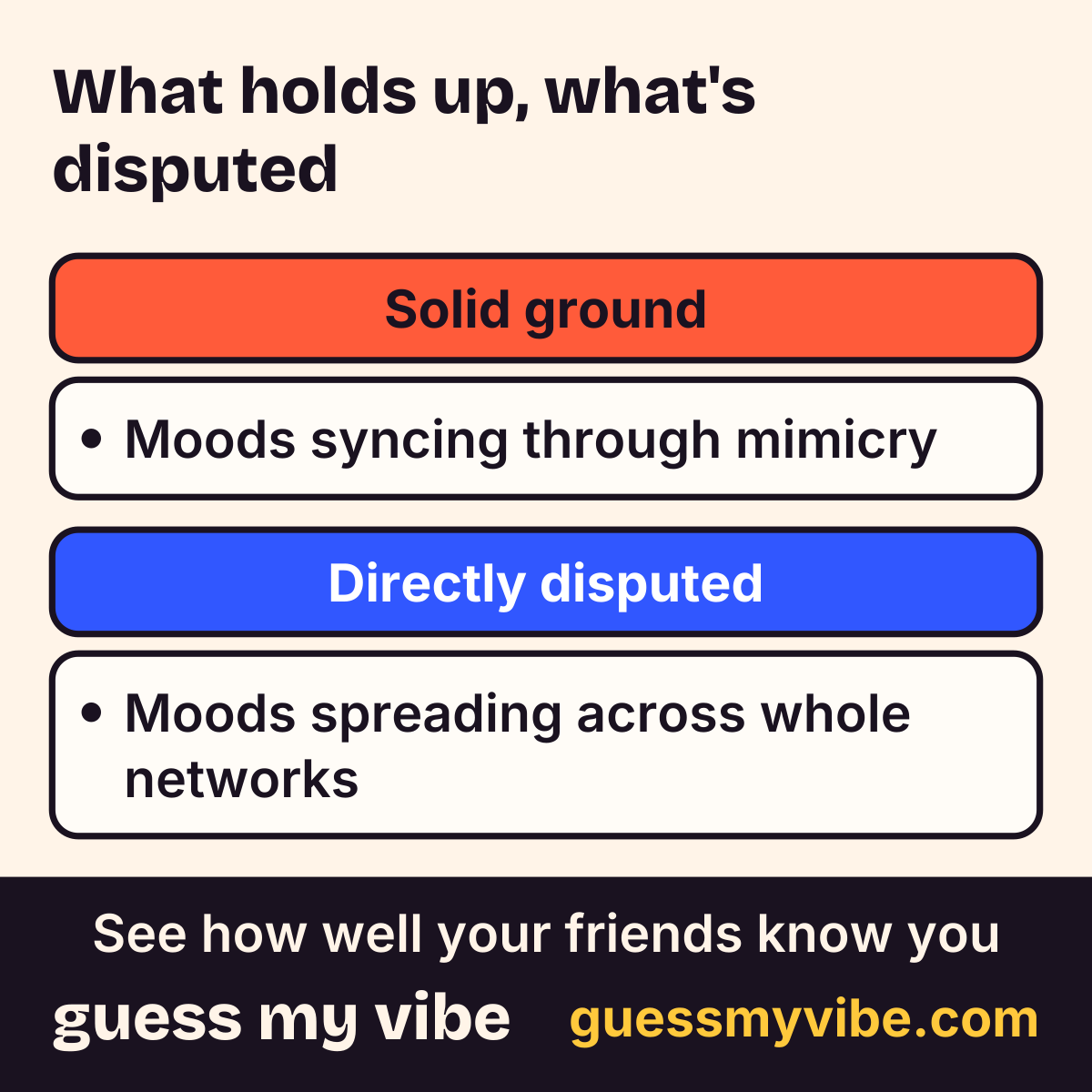
Emotional contagion is a real, well-documented process: people automatically mimic each other's expressions, tone, and posture in conversation, and that mimicry tends to pull their moods into sync [1]. A famous 2008 study went further, claiming happiness spreads through social networks up to three friends away [2], but that specific claim has been seriously disputed by researchers who found the same statistical methods also produce "contagion" effects for things that obviously can't spread between friends, like height [3] [4]. Moods syncing up in a conversation is solid. Moods spreading three degrees through a whole social network is contested.
Emotional contagion is a real phenomenon with real research behind it. Whether it stretches as far as "your friend's friend's friend's happiness affects you" is a much shakier claim than the headlines about it suggested. Both halves of that story are worth knowing, because the honest version is more interesting than either the simple yes or the simple no.
What emotional contagion actually means
The term comes from a short, influential paper by Elaine Hatfield, John Cacioppo, and Richard Rapson, who argued that people continuously and mostly unconsciously mimic the people they're talking to: matching facial expressions, vocal tone, posture, and movement, almost like a reflex [1]. Their argument was that this mimicry isn't just imitation for its own sake. It feeds back into the body and nudges the person doing the mimicking toward the emotional state behind the expression they're copying. Sit with someone who's visibly anxious for twenty minutes and some of that tension tends to show up in you too, not because you consciously decided to feel anxious, but because your face, voice, and posture were quietly tracking theirs the whole time. That part of the theory is widely accepted and well supported: close, face-to-face contact really does pull people's moods toward each other.
The famous happiness network study
The claim that made emotional contagion a headline topic came from a 2008 study that followed 4,739 people in the Framingham Heart Study's social network from 1983 to 2003 [2]. The researchers found visible clusters of happy and unhappy people in the network, and reported that a friend living within a mile who became happy raised a person's own odds of being happy by 25%. Similar, smaller effects showed up for a spouse (8%), a sibling living nearby (14%), and a next-door neighbor (34%). Interestingly, no effect showed up between coworkers. The authors argued these statistical patterns reflect happiness actually spreading between connected people, reaching as far as three degrees of separation, a friend of a friend of a friend, rather than just happy people choosing to associate with other happy people.
That's a striking claim, and it's the specific part of the emotional contagion story that's genuinely contested, not the everyday mimicry Hatfield and colleagues described.
The critique: a strong test case
The cleanest pushback against this kind of claim came the same day, in the same issue of the same journal. Two economists ran the identical type of statistical analysis used in the social-contagion studies, but pointed it at three outcomes that obviously cannot spread from one friend to another: acne, headaches, and height [3]. Using data on thousands of teenagers, they found, before controlling for shared environment, statistically significant "network effects" for all three: a friend's acne went with your acne, a friend's headaches went with your headaches, even a friend's height went with your height. Once the researchers properly accounted for environmental confounders (the fact that friends tend to share neighborhoods, schools, and circumstances), those effects shrank and were no longer statistically significant. Their point wasn't that happiness definitely doesn't spread. It was that this specific statistical approach, on its own, can manufacture the appearance of contagion out of nothing more than people who already share an environment ending up with correlated outcomes.
A separate, more direct statistical critique went after the Christakis and Fowler papers specifically, including the happiness study [4]. The argument there is more technical: that the statistical models used can't actually tell the difference between a trait genuinely spreading between people and a few other, much more mundane explanations, like friends sharing an environment, or people with similar moods simply choosing to spend time together in the first place. The author concluded that, read correctly, some of the same data the original papers relied on provides evidence against the strong spreading claim rather than for it.
Curious how your friends would answer?
Free. Answer 10 quick questions about you, then send your link. Friends play in their browser, no app needed.
Start freeWhy this question is so hard to test cleanly
Part of why this debate has gone back and forth for over a decade is that the underlying question is genuinely difficult to test with the kind of data available. Friends aren't randomly assigned to each other the way participants in a lab experiment are randomly assigned to a condition. People choose friends who are already a bit like them, live in similar places, and go through similar circumstances at similar times, so a real, meaningful correlation between a person's mood and their friend's mood could come from actual mood spreading, from shared environment, or from people quietly sorting themselves into friend groups of similarly moody people in the first place. Teasing those three explanations apart from survey data collected over decades, rather than a controlled experiment, is a genuinely hard statistical problem, which is exactly why the acne-height-headache critique and the follow-up statistical re-analysis both carry real weight: they show the available methods struggle to rule out the boring explanations, not that the interesting one is definitely wrong.
So, does your friend group's mood actually rub off on you?
The honest answer sits between the two extremes. The close-up, moment-to-moment version of emotional contagion, moods syncing through mimicry during real interaction, rests on solid ground [1]. The far bigger, more dramatic claim, that a stranger's happiness ripples out and measurably affects you through two or three other people you've never met, is the part serious critics have directly disputed using the same kind of statistical tools [3] [4]. It's reasonable to notice that spending time with people who are stressed, anxious, or low tends to pull your own mood in that direction, and just as reasonable to be skeptical of a specific number like "three degrees of separation" or "25% more likely," since the statistics behind that particular figure haven't held up well under direct scrutiny.
Guess My Vibe doesn't try to measure anything at the scale of a whole social network. It works one friend at a time, which is exactly the scale where the mood-syncing research actually holds up: a close friend reading your mood day to day, not a stranger three connections away.
Cite this figure
Figure: "What holds up, what's disputed." Guess My Vibe (guessmyvibe.com). https://guessmyvibe.com/learn/emotional-contagion#figure-close-up-vs-network
Key takeaways
- Emotional contagion describes a real, mostly automatic process: people mimic each other's facial expressions, voices, and posture during conversation, and that mimicry tends to sync up their emotional states [1].
- A widely cited 2008 study claimed a friend becoming happy raised your own odds of becoming happy by 25%, with effects reaching up to three degrees of separation in a social network [2].
- A direct test of the statistical methods behind that kind of claim found the same approach detects "contagion" effects in acne, headaches, and height, none of which can actually spread between friends, once shared environment isn't properly controlled for [3].
- A separate statistical critique argues the specific conclusions in the Christakis and Fowler network papers, including the happiness one, don't actually follow from their own data and methods [4].
- This isn't therapy, a diagnosis, or a substitute for professional care.
Questions people ask
Are emotions really contagious?
In close, face-to-face contact, yes. People automatically mimic each other's expressions and tone during conversation, and that mimicry tends to pull their moods toward each other [1]. The much bigger claim that moods spread across whole social networks, several people removed, is far less settled.
Is happiness really contagious through a whole social network?
One well-known 2008 study claimed exactly that, reporting effects reaching three degrees of separation [2]. That specific claim has been directly disputed: the same statistical methods, applied to things that obviously can't spread between friends like height, also produced apparent "contagion" effects until researchers controlled for shared environment [3].
What's wrong with the famous Framingham happiness study?
The critiques target the analysis, not the idea that moods can be shared. The dispute is about whether the statistical methods used can actually distinguish real person-to-person spread from people sharing an environment or choosing similar friends. Two separate critiques argue they can't, using both a direct test case (acne, height, and headaches) and a more technical statistical re-analysis of the original claims [3] [4].
Can a friend's bad mood actually affect mine?
The research on close-contact emotional contagion says yes, moods tend to sync up through mimicry during real interaction [1]. That's a different, better-supported claim than "a stranger's mood three friends away affects you," which is the part that's genuinely disputed.
Is social contagion the same thing as emotional contagion?
They're related but not identical. Emotional contagion usually refers to moods syncing through direct contact [1]. "Social contagion" is the broader, more contested idea that behaviors and traits spread across a whole network, the claim at the center of the happiness-network debate [2] [4].
See how well your friends know you.
Free. Answer 10 quick questions about you, then send your link. Friends play in their browser, no app needed.
Start freeReferences
- [1] Hatfield, E., Cacioppo, J. T., & Rapson, R. L. (1993). Emotional Contagion. Current Directions in Psychological Science, 2(3), 96–100. doi.org/10.1111/1467-8721.ep10770953 (opens in a new tab)
- [2] Fowler, J. H., & Christakis, N. A. (2008). Dynamic spread of happiness in a large social network: longitudinal analysis over 20 years in the Framingham Heart Study. BMJ, 337, a2338. PubMed: 19056788 (opens in a new tab)
- [3] Cohen-Cole, E., & Fletcher, J. M. (2008). Detecting implausible social network effects in acne, height, and headaches: longitudinal analysis. BMJ, 337, a2533. PubMed: 19056789 (opens in a new tab)
- [4] Lyons, R. (2011). The Spread of Evidence-Poor Medicine via Flawed Social-Network Analysis. Statistics, Politics, and Policy, 2(1), Article 2. doi.org/10.2202/2151-7509.1024 (opens in a new tab)
How we find and check these sources: how we write. Spotted an error? Report a correction.
Related
- Friend Group Psychology: How Groups of Friends Actually Work
- Mutual Friends: Why So Many Friendships Start Through One
- Social Battery: The Science of Why Socializing Drains You
- Self-Awareness: What the Research Says It Actually Takes
- Conformity Psychology: Why We Go Along With the Group
- The Chameleon Effect: Why We Copy People We Like
Want to try it with your own friends? Make a friendship quiz for your friend group
Cite this article
- Title
- Emotional Contagion: Do Friends' Moods Rub Off on You?
- Publisher
- Guess My Vibe
- Updated
- URL
- https://guessmyvibe.com/
learn/ emotional-contagion
Copy this citation
Guess My Vibe. (2026, October 3). Emotional Contagion: Do Friends' Moods Rub Off on You?. Guess My Vibe. https://guessmyvibe.com/
To point at one section, add that section's anchor (the # link on its heading) to the URL.