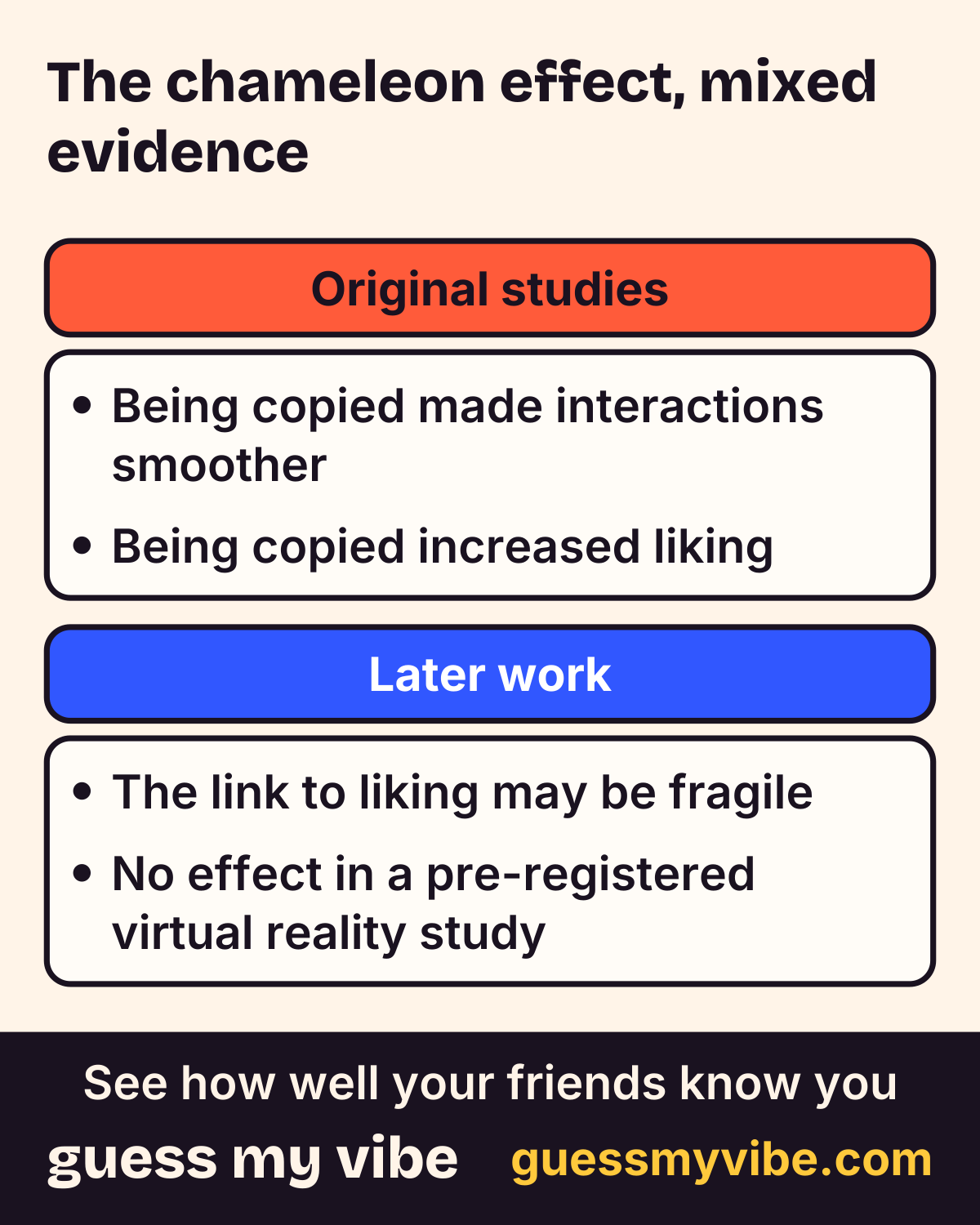
The chameleon effect is the tendency to copy the posture, mannerisms and expressions of the people you are with without meaning to. In the original experiments, being copied made interactions smoother and increased liking [1], but a later review found that link to be fragile [2], and a pre-registered virtual reality study found no effect of mimicry on rapport or trust [3].
The chameleon effect is the habit of quietly copying the people you are with. You cross your legs after your friend does. You pick up her way of laughing. The researchers who named it defined it as nonconscious mimicry of the postures, mannerisms, facial expressions and other behaviors of interaction partners, so that your behavior passively and unintentionally shifts to match theirs [1]. The popular version says this copying builds rapport, and that you can use it on purpose. The research is more interesting, and more mixed, than that.
This article covers what the original studies showed, why people seem to do it, and what later work says about whether being copied reliably makes you liked. We keep the mixed evidence in the open, because it is a good example of a famous finding that turns out to be conditional.
What the chameleon effect is
The authors of the 1999 paper proposed a mechanism called the perception-behavior link. The idea is that simply perceiving another person's behavior automatically makes you more likely to do the same thing yourself. They cited earlier work showing this link, and proposed that it explains the mimicry they saw in social interaction [1]. That makes the chameleon effect different from deliberate imitation. It is not a decision to copy. It is something that happens to your posture while your attention is on the conversation.
Researchers use "behavioral mimicry" for the same family of behavior, meaning the automatic imitation of gestures, postures, mannerisms and other motor movements, and one review describes it as pervasive in human interactions [5]. "Mirroring" is the everyday word for it, and the two are used loosely as synonyms online.
What the original experiments found
The 1999 paper reported three experiments. In the first, the motor behavior of participants unintentionally matched that of strangers they worked with on a task. In the second, confederates (people working with the experimenter) mimicked the posture and movements of participants, and the researchers found that mimicry made the interaction smoother and increased liking between the two people. In the third, people who were dispositionally empathic showed the chameleon effect to a greater extent than other people did [1].
These are lab experiments with strangers, and the abstract does not report effect sizes, so "increased liking" tells you the direction and not the strength. They are also the studies behind the popular advice to mirror someone to build rapport. Notice what they tested. A confederate copied participants in a controlled setting. They did not test whether an ordinary person can raise their own likability by copying a friend on purpose.
Why people seem to do it
A later set of two experiments looked at motive. People who were given a goal to affiliate with an interaction partner showed more nonconscious mimicry, and people who had tried and failed to affiliate in an interaction then mimicked more than people who had not failed. The authors suggested that behavioral mimicry may be part of a person's repertoire, used nonconsciously, when there is a desire to create rapport [4]. In plain words, wanting to connect seems to pull your body toward the other person, even when you are not aware of it.
A broader review, written by the original author and a collaborator, sorted the research into two themes. One is the moderators of mimicry, the motivational, social, emotional and personality factors that lead to more or less of it. The other is the downstream consequences, which include increased prosociality between the people involved and some surprising effects on the individual, such as processing style, attitudes and consumer preferences [5]. The review also places mimicry within the larger family of interpersonal coordination, alongside synchrony and emotional contagion. If you want that neighbor topic, our article on emotional contagion covers it.
Curious how your friends would answer?
Free. Answer 10 quick questions about you, then send your link. Friends play in their browser, no app needed.
Start freeDoes the chameleon effect hold up?
This is the part most explainers skip. A review of the consequences of being mimicked noted that behavioral research has reported many positive effects, including liking and helping. The authors then wrote that an in-depth review suggests the link from mimicry to liking and other positive outcomes may be fragile. They described positive responses breaking down because of individual factors and in social situations where mimicry is unexpected [2].
The same authors also ran a direct test in virtual reality, where avatars either mimicked a participant's head and torso movements or did not. In Study 1, with 50 participants, rapport was higher toward mimicking avatars, and the length of the delay (one second or three) made no difference. In Study 2, a pre-registered attempt to replicate that effect with 40 participants, the researchers found no effects of mimicry on rapport, on trust ratings or on trust behavior in a maze task. Their conclusion was that being mimicked does not always increase rapport or trust [3].
Read that carefully, because it is easy to overstate in either direction. It does not show that the chameleon effect is fake. The VR studies were small, they used avatars and not people, and Study 2 tried to repeat the authors' own first result and not the 1999 experiments. We did not find, in the sources we opened, a large pre-registered direct replication of the original studies. What the evidence does support is a narrower claim. Copying may sometimes raise liking, but the review suggests the link may be fragile, and positive responses can break down when the mimicry is unexpected or when individual factors get in the way [2].
Why does an effect that looks solid in one study turn conditional in the next? We can only offer a general reason, and it is our reasoning, not a finding. People are not avatars. Real conversations are full of other things going on, such as tone, topic and history between the two people, and a small matching movement is easy to drown out. That would make the effect real in some settings and invisible in others, which is roughly what a "fragile" link looks like from the outside.
Cite this figure
Figure: "The chameleon effect, mixed evidence." Guess My Vibe (guessmyvibe.com). https://guessmyvibe.com/learn/chameleon-effect#figure-mimicry-mixed-evidence
Should you mirror someone on purpose?
None of the work above tested whether copying someone deliberately builds rapport in everyday life. The motive study found that people who want rapport mimic more, which describes what people do, and not a recommendation for what to do [4]. Add the review's warning that responses can sour when mimicry is unexpected [2], and you get a cautious answer. If you notice you are already matching a friend's pace or posture, that is normal and nothing to fix. Forcing it is a gamble with no support in the studies we read.
What the evidence does back is the thing the mimicry seems to be standing in for, which is attention. Being responsive and tuned in to the other person fits the findings on liking in conversation better than any move you copy. For the practical side of that, see our articles on building rapport and on how to keep a conversation going.
Who is the chameleon in your friend group?
The 1999 paper found that more empathic people showed the effect more [1], and the review notes that personality factors help decide how much mimicry happens [5]. Neither paper says which Big Five traits drive it, so we will not guess. What you can notice in your own life is a pattern. Some people seem to take on the mood and mannerisms of whoever they are with, and others hold steady.
Your friends probably have a view on which type you are. In Guess My Vibe, you and a friend each guess how the other would answer, and a round is a quick way to compare your picture of yourself with theirs. Ask a friend whether they think you take on other people's energy. The answer may surprise you.
Key takeaways
- The chameleon effect is nonconscious mimicry of the postures, mannerisms and facial expressions of the people around you [1].
- In the original experiments, participants unintentionally matched strangers' movements, and being mimicked by a confederate made interactions smoother and increased liking [1].
- People who wanted to affiliate mimicked more, and so did people who had just failed at it, so copying may be one nonconscious way we reach for rapport [4].
- A review of the downstream effects of being mimicked concluded that the link from mimicry to liking and other positive outcomes may be fragile [2].
- A pre-registered virtual reality study with 40 people found no effect of mimicry on rapport or trust, after a first study of 50 people had found one [3].
- This isn't therapy, a diagnosis, or a substitute for professional care.
Questions people ask
What is the chameleon effect in psychology?
It is the tendency to unintentionally copy the postures, mannerisms and facial expressions of the people you are interacting with. The researchers who named it proposed it works through the perception-behavior link, where perceiving another person's behavior makes you more likely to do the same [1].
Does mirroring someone make them like you?
In the original experiments, being mimicked by a confederate made interactions smoother and increased liking [1]. A later review judged the link from mimicry to liking to be possibly fragile [2], and a pre-registered virtual reality study found no effect of mimicry on rapport or trust [3]. The honest answer is that it sometimes helps and does not reliably help.
Why do I copy other people's body language?
Partly because perceiving behavior makes us more likely to do it [1], and partly, research suggests, because wanting rapport increases mimicry. People with an affiliation goal mimicked more, as did people who had failed to connect [4].
Has the chameleon effect been replicated?
The evidence is mixed. A virtual reality study found the effect in one experiment with 50 people and not in a pre-registered follow-up with 40 [3], and a review described the link to liking as possibly fragile [2]. Those studies are small and use avatars, so they do not settle it.
Is mimicry the same as mirroring?
People use the words interchangeably. Researchers define behavioral mimicry as the automatic imitation of gestures, postures, mannerisms and other motor movements, and treat it as one form of interpersonal coordination [5].
See how well your friends know you.
Free. Answer 10 quick questions about you, then send your link. Friends play in their browser, no app needed.
Start freeReferences
- [1] Chartrand, T. L., & Bargh, J. A. (1999). The chameleon effect: The perception-behavior link and social interaction. Journal of Personality and Social Psychology, 76(6), 893-910. PubMed: 10402679 (opens in a new tab)
- [2] Hale, J., & Hamilton, A. F. de C. (2016). Cognitive mechanisms for responding to mimicry from others. Neuroscience & Biobehavioral Reviews, 63, 106-123. PubMed: 26877104 (opens in a new tab)
- [3] Hale, J., & Hamilton, A. F. de C. (2016). Testing the relationship between mimicry, trust and rapport in virtual reality conversations. Scientific Reports, 6, 35295. PubMed: 27739460 (opens in a new tab)
- [4] Lakin, J. L., & Chartrand, T. L. (2003). Using nonconscious behavioral mimicry to create affiliation and rapport. Psychological Science, 14(4), 334-339. PubMed: 12807406 (opens in a new tab)
- [5] Chartrand, T. L., & Lakin, J. L. (2013). The antecedents and consequences of human behavioral mimicry. Annual Review of Psychology, 64, 285-308. PubMed: 23020640 (opens in a new tab)
How we find and check these sources: how we write. Spotted an error? Report a correction.
Related
- Building Rapport: The 3 Ingredients Researchers Found
- Emotional Contagion: Do Friends' Moods Rub Off on You?
- How to Keep a Conversation Going: Ask Follow-Ups
- Reading Body Language: What It Can and Can't Tell You
- Conformity Psychology: Why We Go Along With the Group
- Self-Monitoring: Are You the Same Person Everywhere?
Cite this article
- Title
- The Chameleon Effect: Why We Copy People We Like
- Publisher
- Guess My Vibe
- Updated
- URL
- https://guessmyvibe.com/
learn/ chameleon-effect
Copy this citation
Guess My Vibe. (2026, October 4). The Chameleon Effect: Why We Copy People We Like. Guess My Vibe. https://guessmyvibe.com/
To point at one section, add that section's anchor (the # link on its heading) to the URL.